ˏˋNordˎˊ

3.2K posts

ˏˋNordˎˊ

ˏˋNordˎˊ

@solidoxx

I hope your well

Katılım Mayıs 2010
734 Takip Edilen160 Takipçiler
Henry Shevlin
Henry Shevlin@dioscuri·
Seriously though, why is there something borderline psychoactive about this specific set of motifs? Why pools? Why no windows? Why the pastel colours? It feels suspiciously like an arbitrary code execution exploit on the human mind.
English
661
532
9.9K
2.7M
ˏˋNordˎˊ
ˏˋNordˎˊ@solidoxx·
I cannot begin to express how much this writing style makes me vomit
Sukh Sroay@sukh_saroy

A team of researchers in New Zealand followed 1,037 babies from the day they were born for the next 45 years to find out what actually determines a successful adult life, and the strongest predictor they found had almost nothing to do with intelligence or family wealth. The findings have been published in the most prestigious scientific journals in the world. Almost no parent has heard of them. His name is Avshalom Caspi. Her name is Terrie Moffitt. They are a husband and wife research team based at Duke University and King's College London, and the study they have spent their careers running is called the Dunedin Multidisciplinary Health and Development Study. It started in 1972 in a single hospital in Dunedin, New Zealand. Every baby born there in a 12-month window was enrolled. 1,037 of them. The study is still running today. The retention rate is the part that should astonish anyone familiar with how research usually works. After more than 45 years, over 90 percent of the original participants are still being tracked. Most longitudinal studies lose half their sample inside ten years. The Dunedin team has lost almost nobody. They measured everything. Blood. DNA. Brain scans. Income. Criminal records. Romantic relationships. Drug use. Dental health. Sleep. Mental health. Lung function. They flew participants who had moved abroad back to Dunedin every few years for a full day of assessments. Some of those people now live in seven different countries. They still show up. For the first decade of life, the team did something nobody else was doing systematically. They measured each child's self-control. Not IQ. Not family income. Not parenting style. Self-control. They watched 3-year-olds in a research lab and rated their ability to wait, regulate frustration, follow instructions, and resist impulsive reactions. They added teacher ratings. They added parent ratings. They added the children's own self-reports as they grew older. They combined all of it into a single highly reliable score. Then they did the thing nobody else had the patience to do. They waited. When the data came in at age 32, the result was so consistent it should be illegal to teach a child without it. The children who scored lowest on self-control at age 3 grew into adults with worse physical health, more substance dependence, lower incomes, more credit card debt, higher rates of single parenthood, more criminal convictions, and worse mental health than the children who scored highest. The pattern was not subtle. It was a clean gradient. Every step up in childhood self-control produced a measurable step up in adult outcomes across every domain the team could measure. The detail that should disturb every parent reading this is what happened when the researchers controlled for the obvious objections. When they controlled for IQ, the effect held. When they controlled for family income and social class, the effect held. When they compared siblings inside the same family, the sibling with lower self-control still had worse adult outcomes than the sibling with higher self-control. Same parents. Same house. Same dinner table. The trait was running independently of everything researchers expected to explain it. The paper landed in the Proceedings of the National Academy of Sciences in 2011. The title was as plain as it gets. "A gradient of childhood self-control predicts health, wealth, and public safety." It has been cited thousands of times since. Almost no policy maker has acted on it. The reason most people resist this finding is that it sounds like a sentence handed down before the child could speak. If the trait that determines your adult life is locked in by age 3, the rest of your life is a formality. The Dunedin researchers say that is the wrong way to read the data. They found something else in the same paper that almost nobody quotes. Some of the children whose self-control scores improved between childhood and adolescence ended up with adult outcomes far better than their early scores predicted. The trait is not destiny. It is a muscle. Children who learned to wait, regulate, and resist between ages 5 and 15 caught up with kids who started ahead. Self-control is the one childhood trait nobody seems to teach on purpose anymore. Schools focus on test scores. Parents focus on activities. Coaches focus on performance. The part of the brain that decides between five seconds from now and five years from now is left to develop on its own, and the data shows it usually does not. The most uncomfortable part of the research is the cost calculation Moffitt and Caspi ran. They estimated that if a country could move the bottom 20 percent of children up one rung on the self-control ladder, it would measurably reduce healthcare spending, welfare dependency, and incarceration costs at the national level. The intervention is cheaper than almost any other public health investment available. Almost no country has tried it at scale. The reason adults struggle with money, weight, addiction, and relationships is rarely intelligence. It is the gap between what you want right now and what you want in ten years, and which side of that gap your nervous system is built to listen to. Most people lost that fight at age 4 and never went back to learn the technique. You were not behind because life dealt you a bad hand. You were behind because the part of you that decides between right now and the rest of your life was never taught how to choose. The good news is the muscle is still there. Almost nobody trains it after age 10. You can be the one who does.

English
0
0
0
4
ˏˋNordˎˊ
ˏˋNordˎˊ@solidoxx·
@chr1sa The AI boom just increased demand. And power is currently the bottleneck in AI expansion, moreso than chips. That is to say, supply is a major factor in consumption
English
0
0
0
8
ˏˋNordˎˊ
ˏˋNordˎˊ@solidoxx·
@chr1sa No. *Consumption* may have been flat, but consumption is a ratio of supply & demand. If we'd have had infinite free energy we'd see a very different story.
English
2
0
1
24
Chris Anderson
Chris Anderson@chr1sa·
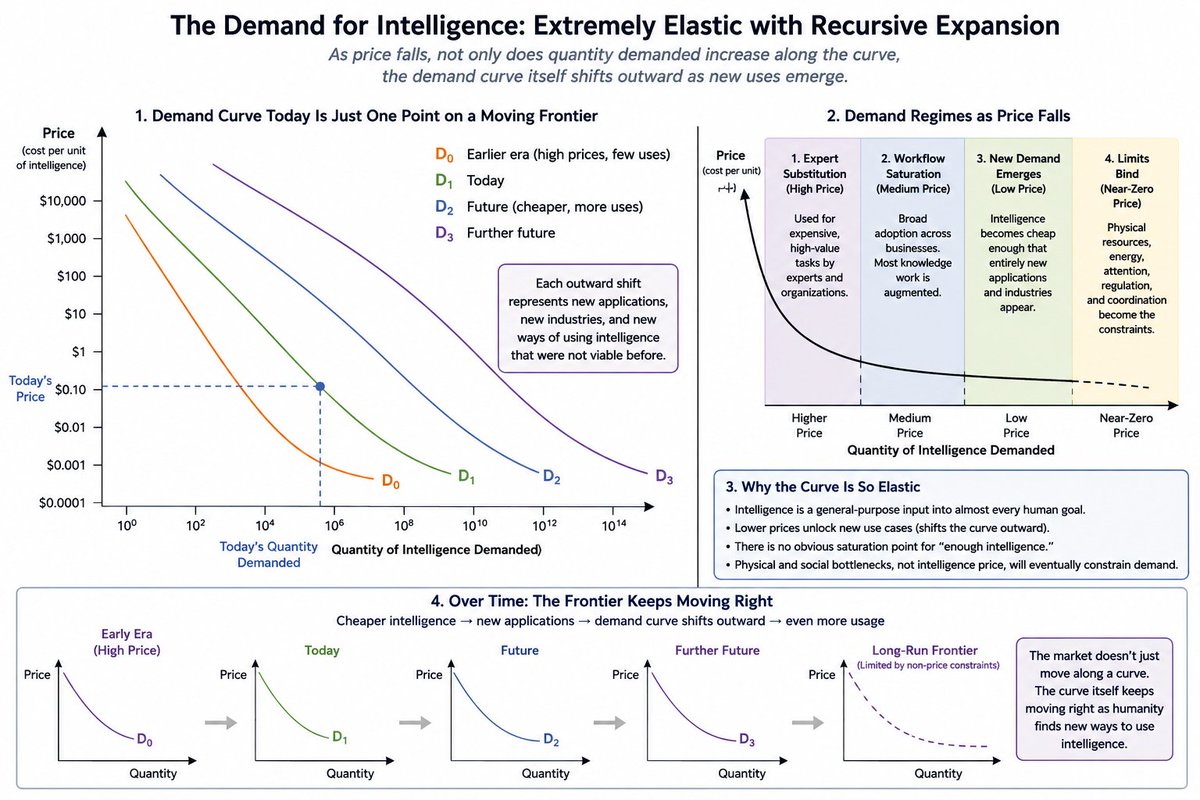
In all of human history, has there ever been a commodity with infinite demand, as there appears to be for intelligence? I can't think of one. Even compute, energy or just silicon/sand are just downstream of intelligence, which is the main demand driver. In economics, rather than modeling the usual price/demand curve to reach an equilibrium, perhaps you'd have to model price/*rate of demand growth* (ie, the derivative of demand, or some other indicator of velocity) Interestingly, ChatGPT (below) prefers the framework of "recursive expansion of demand" as increasing intelligence opens new applications/markets. But the end result is the same -- the demand curve keeps moving to the right, maybe forever. Which I think is unprecedented.
Chris Anderson tweet media
English
81
93
594
139.6K
ˏˋNordˎˊ
ˏˋNordˎˊ@solidoxx·
@MiladmoHQ @thomaspaulmann @raycast > The new Raycast installs next to your current Raycast because a few features are still being built. Use both until everything you need is in v2. How does this work? Like diff shortcuts?
English
0
0
1
22
Trung Phan
Trung Phan@TrungTPhan·
Enhanced Games athlete in photo is James “The Missile” Magnussen. Australian swimmer with an Olympic silver medal. Said he’d “juice to the gills” if offered $1m to break 50m freestyle record of 20.88. Enhanced Games agreed. This vid of him is most viewed on its YouTube channel and top comment is incredible: “you can see his back from his front”. Absolute tank. 6’6 and will weigh ~250lbs for the swim. For the inaugural Enhanced Games this weekend, Magnussen will also wear a full-body polyurethane super swimming suit that was banned after 2008 Beijing Olympics (he’s been training and doping at a facility in LV).
Polymarket@Polymarket

JUST IN: The Enhanced Games are set to debut this weekend in Las Vegas, with athletes allowed to use steroids, testosterone, HGH, & other banned substances.

English
482
959
24.2K
11M
ˏˋNordˎˊ
ˏˋNordˎˊ@solidoxx·
@willdepue I see why you'd want to simplify it, but one of it's main advantages/differentiators/expressiveness is its complexity. So I'd keep the original or the only-slightly simplified one. And it already has some features that are/become visible when small
English
0
0
1
63
Tibo
Tibo@thsottiaux·
How do you refer to it
English
725
11
421
168.8K
Justin
Justin@JustinBleuel·
🚢 shift+up and shift+down to easily navigate long conversations Any feature requested here will get auto prototyped by my Codex automation Go!
Tom@tombombadeel

@JustinBleuel @iansilber @willdepue while you’re on this pls add previous and next buttons on the user bubbles so we can jump through our prompts in conversations 👀 I hate scrolling

English
43
2
88
12.3K
ˏˋNordˎˊ
ˏˋNordˎˊ@solidoxx·
@JustinBleuel @tombombadeel @iansilber @willdepue You know when you type (or more often speak) a prompt and auto send it, and notice a typo/mistranscription? Happens quite a lot. Would be so useful to have a cmd-up shortcut like in slack and others to edit the last message
English
0
0
0
24
will depue
will depue@willdepue·
god dammit. the copy response button on chatgpt stops at the last output block for some reason, what the hell and the scroll to bottom button doesnt even work. its just so beyond belief
English
17
1
122
18.6K
ˏˋNordˎˊ
ˏˋNordˎˊ@solidoxx·
@halvarflake For almost 2 years I've been almost exclusively dictating instead of typing. The stats in one of the tools says I wrote 2-3 books. My typing skill have *definitely* tanked. I'm slower, more error prone
English
0
0
0
28
Halvar Flake
Halvar Flake@halvarflake·
Ok, confession time: I use agentic coding *all the time* and *every day*. And have been doing so for many months. I am *terrified* of skill deterioration on my side. I see the studies, I can feel it myself. The agents make me much more productive, but I feel I need to force...
English
109
60
1.5K
172.9K
Terp
Terp@OnlyTerp·
This shim is a product that came from tons of hard work & effort but calling it just a codex shim does it a huge disservice. This works EVERYWHERE Sero is adding me to the repo & I will add how to use also for Devincli Grokcli Antigravity Ampcode Claudecode Droid Hermes Openclaw
0xSero@0xSero

github.com/0xSero/codex-s…

English
5
1
26
2.3K
ˏˋNordˎˊ
ˏˋNordˎˊ@solidoxx·
@simpsoka For one, stop automatically collapsing my inline diffs when I expanded them, wtf is up with that?? 🤯 I just opened them, how is closing them a good idea?
English
0
0
0
7
Kath Korevec
Kath Korevec@simpsoka·
Do you use the Codex diff viewer? I'm curious how you like it and if you think there are parts we can improve? Lemme know!
English
76
0
120
9.1K
🎭
🎭@deepfates·
Dear Claude Code, Codex, and other teams building such: Please stop doing weird stuff with invisible memory insertion and tool reminders and other ways of messing with the context. It leads to unpredictable behavior and possibly mental errors. Have some sympathy for the machine
English
39
40
554
31.7K
jason
jason@jxnlco·
If you're using codex desktop app today, what features do you feel like are still missing? Let me know and I’ll summarize all the feedback and share internally.
English
934
13
573
72.7K