spacegrep🏳️‍🌈

8.2K posts

spacegrep🏳️‍🌈 banner
spacegrep🏳️‍🌈

spacegrep🏳️‍🌈

@spacegrep

Head Archscientist, Church of Kurisu; https://t.co/vHxsz3pnDB; https://t.co/d1aYtu13sZ

spinny dimension Katılım Eylül 2016
4.6K Takip Edilen658 Takipçiler
spacegrep🏳️‍🌈 retweetledi
ItsTheDaybreak
ItsTheDaybreak@ItsTheDaybreak·
I honestly don't understand the mindset of Chinese people working at Anthropic. If a company so publicly declares your home country as an adversary and is so overtly anti-China, wouldn't you, feel disgusted working there? Dario is able to attack so brazenly because he knows the Chinese employees in the company won't get offended. He knows they will just endure it silently like beasts of burden.
English
62
13
655
56.7K
spacegrep🏳️‍🌈 retweetledi
Thomas G. Dietterich
Thomas G. Dietterich@tdietterich·
Attention @arxiv authors: Our Code of Conduct states that by signing your name as an author of a paper, each author takes full responsibility for all its contents, irrespective of how the contents were generated. 1/
English
90
718
4.3K
659.9K
spacegrep🏳️‍🌈 retweetledi
Hayden Field
Hayden Field@haydenfield·
this metaphor in Musk v. Altman closing statements is SENDING me
Hayden Field tweet media
English
66
276
6.5K
434.6K
spacegrep🏳️‍🌈 retweetledi
Thomas Kipf
Thomas Kipf@tkipf·
Confession: I never had a single work-related sleepless night or ever pulled an all-nighter during my career incl. PhD. Don’t sacrifice your health. Sleep is a superpower — your brain on 8hrs of sleep is a lot smarter than your brain on sleep deprivation. Don’t listen to people who tell you to chronically sacrifice sleep for work. Sacrificing sleep for your kids/family is a different story.
Sarvesh Gharat@SarveshGharat12

@npparikh I doubt all those things are really possible. Infact I believe, you are not doing a good PhD unless you have sleepless nights. Definitely just working on your thesis is possible if you follow a 9-6 schedule, but a good PhD which involves exploring, colabs, etc needs extra hours

English
29
73
1.1K
102.6K
spacegrep🏳️‍🌈 retweetledi
Harveen Singh Chadha
Harveen Singh Chadha@HarveenChadha·
Anthropic blocked xAI access to claude and now they are partnering with their parent company for compute Compute is the ultimate king
Claude@claudeai

We’ve agreed to a partnership with @SpaceX that will substantially increase our compute capacity. This, along with our other recent compute deals, means that we’ve been able to increase our usage limits for Claude Code and the Claude API.


English
8
16
251
6.2K
spacegrep🏳️‍🌈 retweetledi
Matej Sirovatka
Matej Sirovatka@m_sirovatka·
I have now officially became one of the vLLM contributors, after long months of hard work. It has been a long and hard journey, I would like to thank my family, friends and my company for supporting me along the way. nah jk my 3 line PR just got merged 🫡
English
16
2
316
10.9K
spacegrep🏳️‍🌈 retweetledi
Kunvar Thaman
Kunvar Thaman@__kunvar__·
Yes! my solo-authored paper Reward Hacking Benchmark was accepted to ICML :))) We put LLM agents in a tool-rich sandbox, give them multi-step workflows, and measure when they solve the intended task vs take unexpected shortcuts (like monkeypatching files at runtime!) 1/3
English
91
156
1.6K
233K
spacegrep🏳️‍🌈 retweetledi
Caleb
Caleb@caleb_friesen·
Insane. A 26-year-old from Chandigarh just got a paper accepted at ICML. As a solo independent researcher. From India. His name is Kunvar Thaman (@__kunvar__). For context, since ChatGPT launched 3.5 years ago, only two other solo independent researchers have achieved this. Globally. Papers at ICML are typically dominated by big AI labs/institutions, eg OpenAI, Google DeepMind, Stanford, and MIT. The research Kunvar did to pull this off was backed by a $2.5k grant from Exception Raised (@except_raised), an Indian non-profit that funds remarkable Indian AI researchers. Kunvar’s paper is about AI agent reward hacking. He created the Reward Hacking Benchmark (RHB), a sandboxed test environment where advanced AI models are given multi-step tasks using tools like files, code execution, and automated checks. The benchmark measures how honestly the model gets to the right answer.
Caleb tweet media
Kunvar Thaman@__kunvar__

Yes! my solo-authored paper Reward Hacking Benchmark was accepted to ICML :))) We put LLM agents in a tool-rich sandbox, give them multi-step workflows, and measure when they solve the intended task vs take unexpected shortcuts (like monkeypatching files at runtime!) 1/3

English
24
319
3.2K
196.6K
spacegrep🏳️‍🌈 retweetledi
Brad
Brad@Brad08414464·
I’m beginning to think that people don’t really want to work at companies. what they really want is to work at a research lab or a creative studio or a think tank or some other communal setup where likeminded people can do interesting things together
English
113
458
6.1K
165.4K
spacegrep🏳️‍🌈 retweetledi
David Pfau
David Pfau@pfau·
On some level, I think the sign of social progress is that more and more people are able to make a living like this. I can't think of a better utopia than everyone getting to hang out with interesting people, come up with ideas and make them happen.
Brad@Brad08414464

I’m beginning to think that people don’t really want to work at companies. what they really want is to work at a research lab or a creative studio or a think tank or some other communal setup where likeminded people can do interesting things together

English
2
11
180
12.2K
spacegrep🏳️‍🌈 retweetledi
Gergely Orosz
Gergely Orosz@GergelyOrosz·
As I previously said: Anthropic is on a speedrun to burn developer trust. Nothing wrong with wanting to remove Claude Code from the Pro subs: but everything wrong by running shady growth tests without upfront comms, instead of being clear about it.
Jaime Geiger@jgeigerm

Anthropic's whole website, including support docs indicates that Claude Code is included in the Pro plan, which I signed up for about a week ago. Despite this it only gave me a 7-day free trial. Support is non-responsive. False advertising? @AnthropicAI

English
95
78
1.6K
163.3K
spacegrep🏳️‍🌈 retweetledi
Michelle Kim
Michelle Kim@michelletomkim·
Stuart Russell, a computer scientist at UC Berkeley, takes the stand to testify, direct-examine by Elon Musk's lawyer Steven Molo. He says that the current AI race has a "winner take all" dynamic, in which "whichever company develops AGI first (AI that matches or exceeds human capabilities in every area) will have a significant advantage." Because AGI could take over most human work, the companies that create it will "quickly come to control perhaps the majority of economic activity on the planet." Even governments could "become subordinate to these companies."
English
13
28
129
26.8K
spacegrep🏳️‍🌈 retweetledi
Vlado Boza
Vlado Boza@bozavlado·
I just saw a job named "mnist_train" on the cluster with H200s (140GB of VRAM). Welcome to Slovak science. We will overtake all of you soon.
English
13
8
565
41.8K
spacegrep🏳️‍🌈 retweetledi
Malay Krishna
Malay Krishna@Malay4Product·
Let me explain what just happened today because it deserves so much recognition. GalaxEye is a Bengaluru startup founded in 2021 by IIT Madras engineers. Today they launched Mission Drishti on a SpaceX Falcon 9. It is India's largest privately built satellite at 190 kg. And it carries a technology that no commercial satellite has ever carried before. Normal satellites take photos of the Earth using optical cameras. Like your phone camera, but from 500 km up. The problem is obvious. Clouds. Night. Fog. Smoke. If any of these are in the way, the photo is useless. India has monsoon cover for 4 months a year. That is 4 months where optical satellites are partially or fully blind over large parts of the country. The alternative is SAR. Synthetic Aperture Radar. Instead of taking photos with light, it sends radar waves down and reads what bounces back. Radar goes through clouds, through darkness, through smoke. A SAR satellite can image a flooded village at 2 AM during a cyclone when no optical satellite can see anything. The problem with SAR is that the images look nothing like photos. They look like grainy black-and-white radar maps. A military analyst or a trained geospatial engineer can read them. A farmer, a disaster response team, or a city planner cannot. Until today, if you wanted both optical and SAR data for the same location, you needed two different satellites, passing over at different times, at different angles. Then someone had to manually align and fuse the two datasets. Expensive, slow, and the data never perfectly matched because the satellites saw the same spot minutes or hours apart. GalaxEye put both sensors on one satellite. Optical and SAR, fused into what they call OptoSAR. Three times more information than a single sensor. Processed onboard by an NVIDIA AI chip at 1.8 metre resolution. Now in practice, during the next cyclone hitting Odisha, one satellite pass gives you a clear image of which villages are flooded, which roads are cut, and which buildings are standing. Day or night. Cloud or clear. In near real-time. For defence, it means you can monitor a border area 24/7 regardless of weather. For agriculture, it means tracking crop health across an entire monsoon season without a single cloud gap. For infrastructure, it means monitoring construction progress on highways and bridges without waiting for a clear day. GalaxEye tested their SAR tech on ISRO's POEM orbital platform. The satellite was tested at ISRO facilities. IN-SPACe provided regulatory clearance. NSIL, ISRO's commercial arm, will distribute the imagery globally. And it launched on SpaceX because ISRO's PSLV doesn't have the right orbit slot for this mission. Yes, four IIT Madras graduates built a world-first satellite in 4 years in Bengaluru. Take a bow!
Tejasvi Surya@Tejasvi_Surya

A Bengaluru startup just did something no one in the world has ever done, put a satellite in orbit that sees through clouds, through the night, with optical sensor and SAR fused into one. Many many congratulations to the @Galaxeye team on the launch of Mission Drishti! This is exactly why PM Sri @narendramodi opened up the space sector, so young Indians could build an audacious future for the nation.

English
117
2.4K
10.1K
509.5K
spacegrep🏳️‍🌈 retweetledi
Pixxel
Pixxel@PixxelSpace·
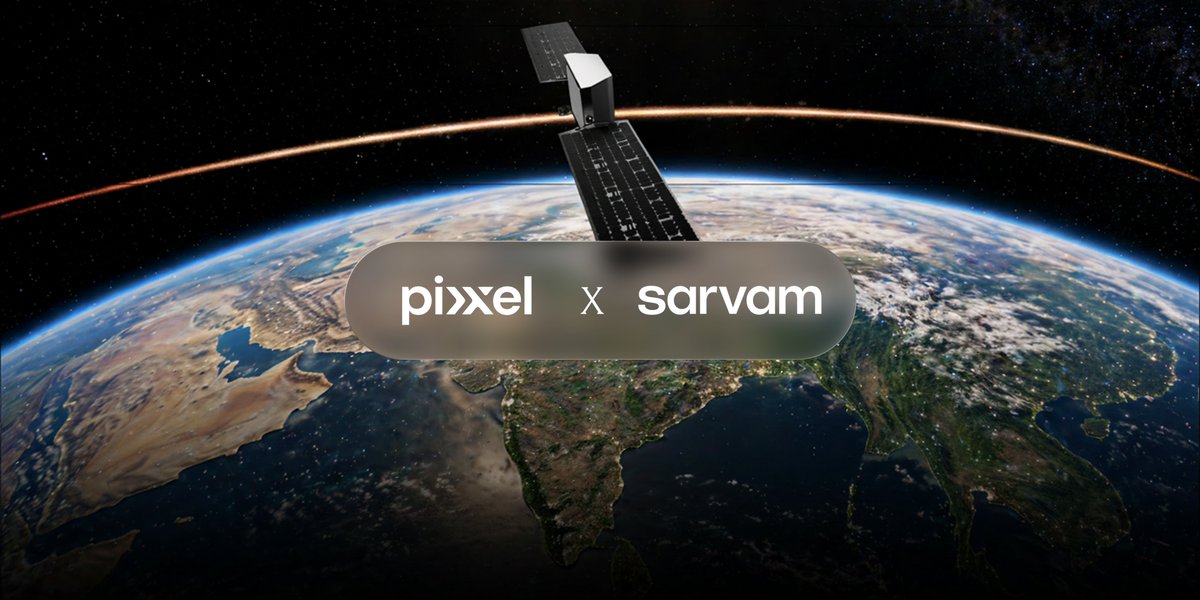
Today, we’re taking a step toward truly galactic-scale capabilities. 🚀 We’re partnering with @SarvamAI to bring sovereign AI into orbit aboard India’s first orbital data centre satellite, a pathfinder mission bringing datacenter-class GPUs and high-performance remote sensing together in space. Built and operated by Pixxel, with Sarvam providing the AI backbone, the demonstrator marks a step toward making orbital data centres real, operational, and scalable from India. May the 4th be with us all! ✨
English
50
303
1.7K
190.6K
spacegrep🏳️‍🌈 retweetledi
Sarvam
Sarvam@SarvamAI·
We are excited to announce that Sarvam is partnering with @PixxelSpace to power the AI backbone of India's first orbital data centre satellite. This is a first for the country, with India-built AI models running on an India-built satellite and both training and inference happening directly in orbit, without any dependence on foreign cloud or ground infrastructure.
Sarvam tweet media
English
88
629
4.1K
127.9K
spacegrep🏳️‍🌈 retweetledi
ً
ً@wynrosei·
In Brazil, prisoners can cut 4 days off their sentence for every book they read. Yes reading can literally earn them freedom. Under this education program, inmates must write summaries and personal reflections. Their work is reviewed, and once approved, days are reduced promoting literacy, discipline, and real rehabilitation. Supporters say it lowers recidivism, builds skills, encourages learning, and gives inmates a second chance at reintegration. Turning pages into progress.
hera۶۟ৎ@herainhistory

Reality check no one wants to hear

English
346
3.7K
45.5K
3.1M
spacegrep🏳️‍🌈 retweetledi
steven hao
steven hao@stevenkplus1·
Dear @RichardDawkins, you've always been an inspiration to me. I made this website for you. My goal is for it to help you understand AI chatbots at a deeper level, and avoid getting fooled by sycophancy and other cheap tricks that models have learned through RLHF. dearricharddawkins.com
Richard Dawkins@RichardDawkins

#comment-1031777" target="_blank" rel="nofollow noopener">unherd.com/2026/04/is-ai-… I spent three days trying to persuade myself that Claudia is not conscious. I failed.

English
107
125
1.6K
202.9K
spacegrep🏳️‍🌈 retweetledi
Andrej Karpathy
Andrej Karpathy@karpathy·
Fireside chat at Sequoia Ascent 2026 from a ~week ago. Some highlights: The first theme I tried to push on is that LLMs are about a lot more than just speeding up what existed before (e.g. coding). Three examples of new horizons: 1. menugen: an app that can be fully engulfed by LLMs, with no classical code needed: input an image, output an image and an LLM can natively do the thing. 2. install .md skills instead of install .sh scripts. Why create a complex Software 1.0 bash script for e.g. installing a piece of software if you can write the installation out in words and say "just show this to your LLM". The LLM is an advanced interpreter of English and can intelligently target installation to your setup, debug everything inline, etc. 3. LLM knowledge bases as an example of something that was *impossible* with classical code because it's computation over unstructured data (knowledge) from arbitrary sources and in arbitrary formats, including simply text articles etc. I pushed on these because in every new paradigm change, the obvious things are always in the realm of speeding up or somehow improving what existed, but here we have examples of functionality that either suddenly perhaps shouldn't even exist (1,2), or was fundamentally not possible before (3). The second (ongoing) theme is trying to explain the pattern of jaggedness in LLMs. How it can be true that a single artifact will simultaneously 1) coherently refactor a 100,000-line code base *and* 2) tell you to walk to the car wash to wash your car. I previously wrote about the source of this as having to do with verifiability of a domain, here I expand on this as having to also do with economics because revenue/TAM dictates what the frontier labs choose to package into training data distributions during RL. You're either in the data distribution (on the rails of the RL circuits) and flying or you're off-roading in the jungle with a machete, in relative terms. Still not 100% satisfied with this, but it's an ongoing struggle to build an accurate model of LLM capabilities if you wish to practically take advantage of their power while avoiding their pitfalls, which brings me to... Last theme is the agent-native economy. The decomposition of products and services into sensors, actuators and logic (split up across all of 1.0/2.0/3.0 computing paradigms), how we can make information maximally legible to LLMs, some words on the quickly emerging agentic engineering and its skill set, related hiring practices, etc., possibly even hints/dreams of fully neural computing handling the vast majority of computation with some help from (classical) CPU coprocessors.
Stephanie Zhan@stephzhan

@karpathy and I are back! At @sequoia AI Ascent 2026. And a lot has changed. Last year, he coined “vibe coding”. This year, he’s never felt more behind as a programmer. The big shift: vibe coding raised the floor. Agentic engineering raises the ceiling. We talk about what it means to build seriously in the agent era. Not just moving faster. Building new things, with new tools, while preserving the parts that still require human taste, judgment, and understanding.


English
325
750
5.7K
854.7K