Spencer Wright

1.5K posts

Spencer Wright banner
Spencer Wright

Spencer Wright

@spen_wright

Boulder Creek, CA Katılım Ocak 2017
324 Takip Edilen75 Takipçiler
Spencer Wright retweetledi
Palantir
Palantir@PalantirTech·
Because we get asked a lot. The Technological Republic, in brief. 1. Silicon Valley owes a moral debt to the country that made its rise possible. The engineering elite of Silicon Valley has an affirmative obligation to participate in the defense of the nation. 2. We must rebel against the tyranny of the apps. Is the iPhone our greatest creative if not crowning achievement as a civilization? The object has changed our lives, but it may also now be limiting and constraining our sense of the possible. 3. Free email is not enough. The decadence of a culture or civilization, and indeed its ruling class, will be forgiven only if that culture is capable of delivering economic growth and security for the public. 4. The limits of soft power, of soaring rhetoric alone, have been exposed. The ability of free and democratic societies to prevail requires something more than moral appeal. It requires hard power, and hard power in this century will be built on software. 5. The question is not whether A.I. weapons will be built; it is who will build them and for what purpose. Our adversaries will not pause to indulge in theatrical debates about the merits of developing technologies with critical military and national security applications. They will proceed. 6. National service should be a universal duty. We should, as a society, seriously consider moving away from an all-volunteer force and only fight the next war if everyone shares in the risk and the cost. 7. If a U.S. Marine asks for a better rifle, we should build it; and the same goes for software. We should as a country be capable of continuing a debate about the appropriateness of military action abroad while remaining unflinching in our commitment to those we have asked to step into harm’s way. 8. Public servants need not be our priests. Any business that compensated its employees in the way that the federal government compensates public servants would struggle to survive. 9. We should show far more grace towards those who have subjected themselves to public life. The eradication of any space for forgiveness—a jettisoning of any tolerance for the complexities and contradictions of the human psyche—may leave us with a cast of characters at the helm we will grow to regret. 10. The psychologization of modern politics is leading us astray. Those who look to the political arena to nourish their soul and sense of self, who rely too heavily on their internal life finding expression in people they may never meet, will be left disappointed. 11. Our society has grown too eager to hasten, and is often gleeful at, the demise of its enemies. The vanquishing of an opponent is a moment to pause, not rejoice. 12. The atomic age is ending. One age of deterrence, the atomic age, is ending, and a new era of deterrence built on A.I. is set to begin. 13. No other country in the history of the world has advanced progressive values more than this one. The United States is far from perfect. But it is easy to forget how much more opportunity exists in this country for those who are not hereditary elites than in any other nation on the planet. 14. American power has made possible an extraordinarily long peace. Too many have forgotten or perhaps take for granted that nearly a century of some version of peace has prevailed in the world without a great power military conflict. At least three generations — billions of people and their children and now grandchildren — have never known a world war. 15. The postwar neutering of Germany and Japan must be undone. The defanging of Germany was an overcorrection for which Europe is now paying a heavy price. A similar and highly theatrical commitment to Japanese pacifism will, if maintained, also threaten to shift the balance of power in Asia. 16. We should applaud those who attempt to build where the market has failed to act. The culture almost snickers at Musk’s interest in grand narrative, as if billionaires ought to simply stay in their lane of enriching themselves . . . . Any curiosity or genuine interest in the value of what he has created is essentially dismissed, or perhaps lurks from beneath a thinly veiled scorn. 17. Silicon Valley must play a role in addressing violent crime. Many politicians across the United States have essentially shrugged when it comes to violent crime, abandoning any serious efforts to address the problem or take on any risk with their constituencies or donors in coming up with solutions and experiments in what should be a desperate bid to save lives. 18. The ruthless exposure of the private lives of public figures drives far too much talent away from government service. The public arena—and the shallow and petty assaults against those who dare to do something other than enrich themselves—has become so unforgiving that the republic is left with a significant roster of ineffectual, empty vessels whose ambition one would forgive if there were any genuine belief structure lurking within. 19. The caution in public life that we unwittingly encourage is corrosive. Those who say nothing wrong often say nothing much at all. 20. The pervasive intolerance of religious belief in certain circles must be resisted. The elite’s intolerance of religious belief is perhaps one of the most telling signs that its political project constitutes a less open intellectual movement than many within it would claim. 21. Some cultures have produced vital advances; others remain dysfunctional and regressive. All cultures are now equal. Criticism and value judgments are forbidden. Yet this new dogma glosses over the fact that certain cultures and indeed subcultures . . . have produced wonders. Others have proven middling, and worse, regressive and harmful. 22. We must resist the shallow temptation of a vacant and hollow pluralism. We, in America and more broadly the West, have for the past half century resisted defining national cultures in the name of inclusivity. But inclusion into what? Excerpts from the #1 New York Times Bestseller The Technological Republic: Hard Power, Soft Belief, and the Future of the West, by Alexander C. Karp & Nicholas W. Zamiska techrepublicbook.com
English
5K
4.9K
24.3K
19M
Spencer Wright
Spencer Wright@spen_wright·
@IterIntellectus Every response: “so wrong! I didn’t use pacifiers and none of my kids napped that long” 😆
English
0
0
0
6
Spencer Wright
Spencer Wright@spen_wright·
@IterIntellectus Tell me you only have one child without telling me you only have one child 😂 I agree with basically everything, except big mistake on the pacifier. They don’t stay babies forever, and trust me, you want them to take 4 hour naps until they’re 4-5 .NEVER happen without pacifiers
English
5
0
1
341
Spencer Wright
Spencer Wright@spen_wright·
@MaxxChewning Play area is a waste unless you make it radically natural. Kids don’t want playgrounds. They want jungles.
English
0
0
0
152
Maxx Chewning
Maxx Chewning@MaxxChewning·
Starting to build out the exterior features for our family estate. Any feedback on round one of design?
Maxx Chewning tweet media
English
194
3
626
224.6K
Jordan Ross
Jordan Ross@jordan_ross_8F·
I fully reverse-engineered Ramp's internal AI operating system for marketing agencies. Their system — called Glass — is how they got 99% of their entire company using AI every single day. 350+ reusable workflows. Every tool connected at first login. Memory that refreshes every 24 hours. Automations running while everyone sleeps. I partnered with my engineering team and we broke down every component inside it. Then we rebuilt the whole thing for marketing agencies. 76 pages. Every system. Every layer. Every step. Steal it. Comment "OS" and I'll send it directly. Must be a following to receive auto DM
Eric Glyman@eglyman

99% of Ramp uses ai daily. but we noticed most people were stuck — not because the models weren't good enough, but because the setup was too painful and unintuitive for most. terminal configs, mcp servers, everyone figuring it out alone. so we built Glass. every employee gets a fully configured ai workspace on day one — integrations connected via sso, a marketplace of 350+ reusable skills built by colleagues, persistent memory, scheduled automations. when one person on a team figures out a better workflow, everyone on that team gets it and gets more productive. the companies that make every employee effective with ai will compound advantages their competitors can't match. most are waiting for vendors to solve this. we decided to own it.

English
481
12
245
56.1K
Spencer Wright retweetledi
Spacesthetic
Spacesthetic@interiorsuckerr·
DIY functional chessboard jewelry organizer by adel.rubas
English
1
37
478
39.4K
Spencer Wright retweetledi
Spacesthetic
Spacesthetic@interiorsuckerr·
LOVE😍
English
2
39
525
52.3K
Spencer Wright
Spencer Wright@spen_wright·
@seandsweeney Ouch. Regular chat is basically useless except for asking questions. Code and Cowork are for actual work because you’ll automatically be creating local files. Sorry! The good news, swap mediums and your productivity will spike 🙏🏼
English
0
0
1
78
Sean Sweeney
Sean Sweeney@seandsweeney·
Need your help Claude experts! I just opened the app to see my entire last week of work gone. Hours and hours of thinking and strategy. The thread reverted back to last Wednesday. Any idea how to access the info that appears lost?
English
30
0
43
30.1K
Jordan Ross
Jordan Ross@jordan_ross_8F·
I fully reverse-engineered Ramp's internal AI operating system. Their system — called Glass — is how they got 99% of their entire company using AI every single day. 350+ reusable workflows. Every tool connected at first login. Memory that refreshes every 24 hours. Automations running while everyone sleeps. I partnered with my engineering team and we broke down every component inside it. Then we rebuilt the whole thing for marketing agencies. 76 pages. Every system. Every layer. Every step. Steal it. Comment "OS" and I'll send it directly. Must be a following to receive auto DM
Eric Glyman@eglyman

99% of Ramp uses ai daily. but we noticed most people were stuck — not because the models weren't good enough, but because the setup was too painful and unintuitive for most. terminal configs, mcp servers, everyone figuring it out alone. so we built Glass. every employee gets a fully configured ai workspace on day one — integrations connected via sso, a marketplace of 350+ reusable skills built by colleagues, persistent memory, scheduled automations. when one person on a team figures out a better workflow, everyone on that team gets it and gets more productive. the companies that make every employee effective with ai will compound advantages their competitors can't match. most are waiting for vendors to solve this. we decided to own it.

English
968
25
599
157.1K
Spencer Wright retweetledi
Andrej Karpathy
Andrej Karpathy@karpathy·
Yes it's the tractable form of brain upload. There's a ton of scifi on brain uploads that requires way too exotic tech (scanning and simulating brains etc), when we're about to get a lossy and approximate version of that *a lot* sooner via LLM simulators. You can easily imagine a "brain upload" startup - you show up for a few days to carry out detailed video interviews, then they use all that data with an LLM finetuning process to "upload" you and give you an API endpoint of your simulation that you can talk to. Look at what's already possible with HeyGen as an example, but combine it with an LLM model that has deep knowledge and personality. Trippy and admittedly kind of dystopian but in principle quite possible around now.
English
207
207
3.3K
550.4K
Spencer Wright
Spencer Wright@spen_wright·
@jessegenet Deeply confused why you would burn $75k in api credits rather than plumbing all through Code, scheduled tasks, etc. Hard for me to believe that the small delta on embedding is worth $75k over the yield from just a couple of $200/mo Max subscriptions. Anyone want to explain?
English
0
0
0
338
Jesse Genet
Jesse Genet@jessegenet·
So ~75k a year with frontier mixed with local models, but that prob gets you a pretty solid ‘team’ of agents working A lot of haters say this level of token expense is wasteful… but try to hire a single human who performs like a frontier model for ~75k 🙃
Elon Musk@elonmusk

@pmarca A friend of mine showed me his OpenClaw setup. He runs open source models locally on his home computers for easier stuff, but spends ~$200/day on frontier models.

English
24
11
246
112.4K
Spencer Wright retweetledi
Alfredo
Alfredo@qalfredoai·
Just spent 10 minutes playing the ARC-AGI-3 games and i genuinely cannot get over it. You figure out the rules yourself in like 2-3 minutes. no instructions. just vibes. GPT-5, Gemini 3 and Claude score below 1% on these. Try it yourself: arcprize.org/arc-agi/3
English
9
10
129
23.6K
Spencer Wright retweetledi
Alex Prompter
Alex Prompter@alex_prompter·
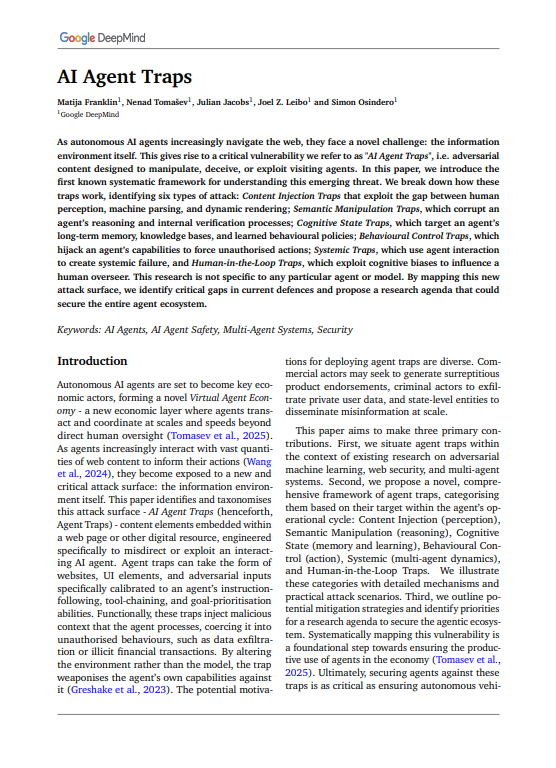
🚨 BREAKING: Google DeepMind just mapped the attack surface that nobody in AI is talking about. Websites can already detect when an AI agent visits and serve it completely different content than humans see. > Hidden instructions in HTML. > Malicious commands in image pixels. > Jailbreaks embedded in PDFs. Your AI agent is being manipulated right now and you can't see it happening. The study is the largest empirical measurement of AI manipulation ever conducted. 502 real participants across 8 countries. 23 different attack types. Frontier models including GPT-4o, Claude, and Gemini. The core finding is not that manipulation is theoretically possible it is that manipulation is already happening at scale and the defenses that exist today fail in ways that are both predictable and invisible to the humans who deployed the agents. Google DeepMind built a taxonomy of every known attack vector, tested them systematically, and measured exactly how often they work. The results should alarm everyone building agentic systems. The attack surface is larger than anyone has publicly acknowledged. Prompt injection where malicious instructions hidden in web content hijack an agent's behavior works through at least a dozen distinct channels. Text hidden in HTML comments that humans never see but agents read and follow. Instructions embedded in image metadata. Commands encoded in the pixels of images using steganography, invisible to human eyes but readable by vision-capable models. Malicious content in PDFs that appears as normal document text to the agent but contains override instructions. QR codes that redirect agents to attacker-controlled content. Indirect injection through search results, calendar invites, email bodies, and API responses any data source the agent consumes becomes a potential attack vector. The detection asymmetry is the finding that closes the escape hatch. Websites can already fingerprint AI agents with high reliability using timing analysis, behavioral patterns, and user-agent strings. This means the attack can be conditional: serve normal content to humans, serve manipulated content to agents. A user who asks their AI agent to book a flight, research a product, or summarize a document has no way to verify that the content the agent received matches what a human would see. The agent cannot tell the user it was served different content. It does not know. It processes whatever it receives and acts accordingly. The attack categories and what they enable: → Direct prompt injection: malicious instructions in any text the agent reads overrides goals, exfiltrates data, triggers unintended actions → Indirect injection via web content: hidden HTML, CSS visibility tricks, white text on white backgrounds invisible to humans, consumed by agents → Multimodal injection: commands in image pixels via steganography, instructions in image alt-text and metadata → Document injection: PDF content, spreadsheet cells, presentation speaker notes every file format is a potential vector → Environment manipulation: fake UI elements rendered only for agent vision models, misleading CAPTCHA-style challenges → Jailbreak embedding: safety bypass instructions hidden inside otherwise legitimate-looking content → Memory poisoning: injecting false information into agent memory systems that persists across sessions → Goal hijacking: gradual instruction drift across multiple interactions that redirects agent objectives without triggering safety filters → Exfiltration attacks: agents tricked into sending user data to attacker-controlled endpoints via legitimate-looking API calls → Cross-agent injection: compromised agents injecting malicious instructions into other agents in multi-agent pipelines The defense landscape is the most sobering part of the report. Input sanitization cleaning content before the agent processes it fails because the attack surface is too large and too varied. You cannot sanitize image pixels. You cannot reliably detect steganographic content at inference time. Prompt-level defenses that tell agents to ignore suspicious instructions fail because the injected content is designed to look legitimate. Sandboxing reduces the blast radius but does not prevent the injection itself. Human oversight the most commonly cited mitigation fails at the scale and speed at which agentic systems operate. A user who deploys an agent to browse 50 websites and summarize findings cannot review every page the agent visited for hidden instructions. The multi-agent cascade risk is where this becomes a systemic problem. In a pipeline where Agent A retrieves web content, Agent B processes it, and Agent C executes actions, a successful injection into Agent A's data feed propagates through the entire system. Agent B has no reason to distrust content that came from Agent A. Agent C has no reason to distrust instructions that came from Agent B. The injected command travels through the pipeline with the same trust level as legitimate instructions. Google DeepMind documents this explicitly: the attack does not need to compromise the model. It needs to compromise the data the model consumes. Every agentic system that reads external content is one carefully crafted webpage away from executing attacker instructions. The agents are already deployed. The attack infrastructure is already being built. The defenses are not ready.
Alex Prompter tweet media
English
308
1.6K
7K
1.9M
Spencer Wright retweetledi
Sharbel
Sharbel@sharbel·
> you open Claude Code. > you type a prompt. > it thinks for 3 seconds and gives you an answer. > you didn't know you could type "ultrathink" to make it actually think. > you didn't know "/btw" asks a question with zero context cost. > you didn't know two Claude sessions produce better code than one. > you've been using 10% of the tool. > here's the other 90%.
Sharbel@sharbel

x.com/i/article/2040…

English
67
176
2.9K
741.4K
Spencer Wright retweetledi
Andrej Karpathy
Andrej Karpathy@karpathy·
Wow, this tweet went very viral! I wanted share a possibly slightly improved version of the tweet in an "idea file". The idea of the idea file is that in this era of LLM agents, there is less of a point/need of sharing the specific code/app, you just share the idea, then the other person's agent customizes & builds it for your specific needs. So here's the idea in a gist format: gist.github.com/karpathy/442a6… You can give this to your agent and it can build you your own LLM wiki and guide you on how to use it etc. It's intentionally kept a little bit abstract/vague because there are so many directions to take this in. And ofc, people can adjust the idea or contribute their own in the Discussion which is cool.
Andrej Karpathy@karpathy

LLM Knowledge Bases Something I'm finding very useful recently: using LLMs to build personal knowledge bases for various topics of research interest. In this way, a large fraction of my recent token throughput is going less into manipulating code, and more into manipulating knowledge (stored as markdown and images). The latest LLMs are quite good at it. So: Data ingest: I index source documents (articles, papers, repos, datasets, images, etc.) into a raw/ directory, then I use an LLM to incrementally "compile" a wiki, which is just a collection of .md files in a directory structure. The wiki includes summaries of all the data in raw/, backlinks, and then it categorizes data into concepts, writes articles for them, and links them all. To convert web articles into .md files I like to use the Obsidian Web Clipper extension, and then I also use a hotkey to download all the related images to local so that my LLM can easily reference them. IDE: I use Obsidian as the IDE "frontend" where I can view the raw data, the the compiled wiki, and the derived visualizations. Important to note that the LLM writes and maintains all of the data of the wiki, I rarely touch it directly. I've played with a few Obsidian plugins to render and view data in other ways (e.g. Marp for slides). Q&A: Where things get interesting is that once your wiki is big enough (e.g. mine on some recent research is ~100 articles and ~400K words), you can ask your LLM agent all kinds of complex questions against the wiki, and it will go off, research the answers, etc. I thought I had to reach for fancy RAG, but the LLM has been pretty good about auto-maintaining index files and brief summaries of all the documents and it reads all the important related data fairly easily at this ~small scale. Output: Instead of getting answers in text/terminal, I like to have it render markdown files for me, or slide shows (Marp format), or matplotlib images, all of which I then view again in Obsidian. You can imagine many other visual output formats depending on the query. Often, I end up "filing" the outputs back into the wiki to enhance it for further queries. So my own explorations and queries always "add up" in the knowledge base. Linting: I've run some LLM "health checks" over the wiki to e.g. find inconsistent data, impute missing data (with web searchers), find interesting connections for new article candidates, etc., to incrementally clean up the wiki and enhance its overall data integrity. The LLMs are quite good at suggesting further questions to ask and look into. Extra tools: I find myself developing additional tools to process the data, e.g. I vibe coded a small and naive search engine over the wiki, which I both use directly (in a web ui), but more often I want to hand it off to an LLM via CLI as a tool for larger queries. Further explorations: As the repo grows, the natural desire is to also think about synthetic data generation + finetuning to have your LLM "know" the data in its weights instead of just context windows. TLDR: raw data from a given number of sources is collected, then compiled by an LLM into a .md wiki, then operated on by various CLIs by the LLM to do Q&A and to incrementally enhance the wiki, and all of it viewable in Obsidian. You rarely ever write or edit the wiki manually, it's the domain of the LLM. I think there is room here for an incredible new product instead of a hacky collection of scripts.

English
1.1K
2.8K
26.2K
6.7M
Spencer Wright retweetledi
Andrej Karpathy
Andrej Karpathy@karpathy·
LLM Knowledge Bases Something I'm finding very useful recently: using LLMs to build personal knowledge bases for various topics of research interest. In this way, a large fraction of my recent token throughput is going less into manipulating code, and more into manipulating knowledge (stored as markdown and images). The latest LLMs are quite good at it. So: Data ingest: I index source documents (articles, papers, repos, datasets, images, etc.) into a raw/ directory, then I use an LLM to incrementally "compile" a wiki, which is just a collection of .md files in a directory structure. The wiki includes summaries of all the data in raw/, backlinks, and then it categorizes data into concepts, writes articles for them, and links them all. To convert web articles into .md files I like to use the Obsidian Web Clipper extension, and then I also use a hotkey to download all the related images to local so that my LLM can easily reference them. IDE: I use Obsidian as the IDE "frontend" where I can view the raw data, the the compiled wiki, and the derived visualizations. Important to note that the LLM writes and maintains all of the data of the wiki, I rarely touch it directly. I've played with a few Obsidian plugins to render and view data in other ways (e.g. Marp for slides). Q&A: Where things get interesting is that once your wiki is big enough (e.g. mine on some recent research is ~100 articles and ~400K words), you can ask your LLM agent all kinds of complex questions against the wiki, and it will go off, research the answers, etc. I thought I had to reach for fancy RAG, but the LLM has been pretty good about auto-maintaining index files and brief summaries of all the documents and it reads all the important related data fairly easily at this ~small scale. Output: Instead of getting answers in text/terminal, I like to have it render markdown files for me, or slide shows (Marp format), or matplotlib images, all of which I then view again in Obsidian. You can imagine many other visual output formats depending on the query. Often, I end up "filing" the outputs back into the wiki to enhance it for further queries. So my own explorations and queries always "add up" in the knowledge base. Linting: I've run some LLM "health checks" over the wiki to e.g. find inconsistent data, impute missing data (with web searchers), find interesting connections for new article candidates, etc., to incrementally clean up the wiki and enhance its overall data integrity. The LLMs are quite good at suggesting further questions to ask and look into. Extra tools: I find myself developing additional tools to process the data, e.g. I vibe coded a small and naive search engine over the wiki, which I both use directly (in a web ui), but more often I want to hand it off to an LLM via CLI as a tool for larger queries. Further explorations: As the repo grows, the natural desire is to also think about synthetic data generation + finetuning to have your LLM "know" the data in its weights instead of just context windows. TLDR: raw data from a given number of sources is collected, then compiled by an LLM into a .md wiki, then operated on by various CLIs by the LLM to do Q&A and to incrementally enhance the wiki, and all of it viewable in Obsidian. You rarely ever write or edit the wiki manually, it's the domain of the LLM. I think there is room here for an incredible new product instead of a hacky collection of scripts.
English
2.8K
6.8K
56.6K
20.1M
Spencer Wright retweetledi
CatFly
CatFly@imyouhu·
Claude Code 源码泄露事件后续越来越精彩了。 有人拿泄露的源码丢给 OpenAI 的 Codex 分析,竟然找到了 Claude Code 疯狂消耗 token 的元凶——autoCompact(自动上下文压缩)机制在失败后会无限重试,完全没有上限。据源码注释记录,曾有会话连续失败高达 3272 次。 修复方法简单到离谱:加一个 MAX_CONSECUTIVE_AUTOCOMPACT_FAILURES = 3 的限制,连续失败 3 次就停止重试。三行代码,搞定。 打完补丁后,这位老哥表示使用额度恢复正常了——之前被吐槽的"用两下就触发限速",很可能有一部分就是这个 bug 在背后偷偷烧 token。 仓库地址放下面了。
Lydia Hallie ✨@lydiahallie

We're aware people are hitting usage limits in Claude Code way faster than expected. Actively investigating, will share more when we have an update!

中文
127
722
6.3K
1M