
Sabitlenmiş Tweet
spock woz
277 posts


spock woz
@spockwoz
Product. Agents. Scale. Designing how they work and how they make money.
Global Katılım Eylül 2019
89 Takip Edilen95 Takipçiler

Joined a new AI-native company this week and it’s kind of wild how different it feels already.
The laptop arrived, I logged in, and an agent basically took over from there. It set up my dev env, pulled repos, fixed dependency issues, got permissions approved, pointed me at the backlog, linked the architecture docs, and surfaced the Slack debates I actually needed to read before touching production.
When I needed context on something, I asked the agent and it found the exact thread from months ago explaining why a decision was made, who owned it, the related Linear issues, and the PRs connected to it.
I’ve only been here 3 days but it honestly feels like I’ve worked here for a year because the usual friction and scavenger hunt for context just isn’t there anymore.
We should probably stop calling this “onboarding” and rename it to “mounting” because this feels a lot more like mounting a distributed filesystem called “institutional memory” than slowly getting drip-fed context over 6 months.
English
@Abhinavstwt @freename Feels like duct-taping tools together is becoming the new leverage for solo builders.
English

The era of duct-taping your business across 10+ tools should be over
From one prompt on @freename AI, you get:
• domain + brand
• website
• SEO + GEO
• marketing
• monetization ready
Wix and Lovable help you build a site
This feels more like a full business engine
English

@jonaswillett1 Cafe. Feels more like live behavioral data. Curious what GTM wedge was.
English

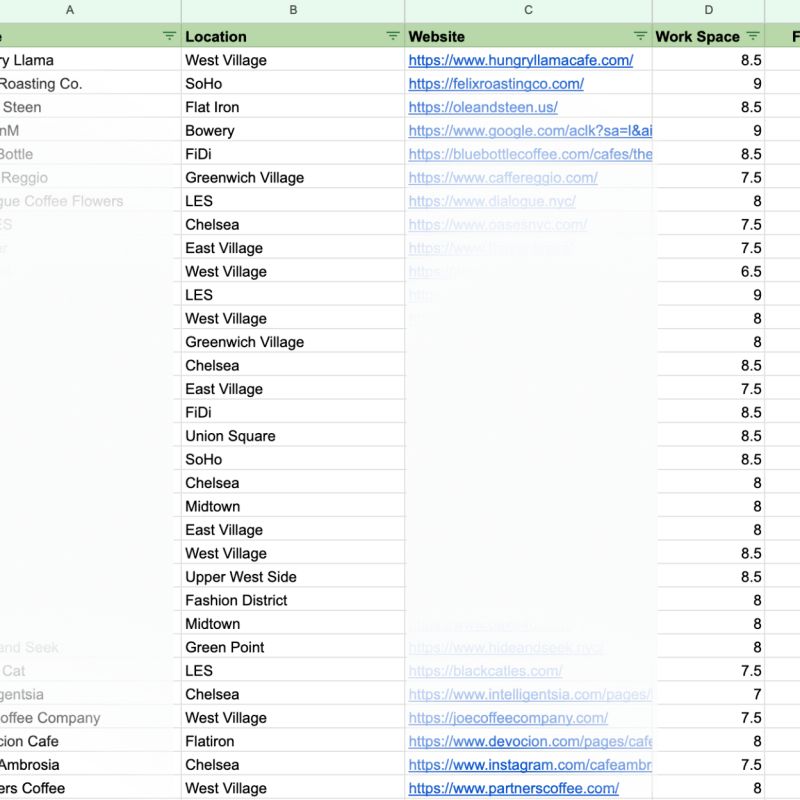
I created a list of my favorite cafes to work at in NYC.
Coffee shops > offices.
I started my company inside a coffee shop.
Beautiful spaces. Good energy. Surrounded by people locking in. And you randomly meet the most interesting people.
My list includes the cafe name, neighborhood, and a proprietary, confidential scoring system based on:
- Work space (tables, outlets, WiFi, design)
- Food (quality, options, price)
- Music (playlist, can you take calls)
- People (do interesting people go here)
- Coffee (does it hit)
- Vibes (overall energy)
I'd love to share this list with you + add new spots.
Comment "CAFE" and I'll DM you the list.

English
You can already see the direction YC has been pointing at.
AI-native products are rebuilding the old SaaS stack at a fraction of the cost - while stripping away a lot of the operational overhead that accumulated over the last decade.
Kraph feels very aligned with that shift.
No bandwidth pricing.
Instant Supabase migration.
Infra that agents can provision themselves.
The stack is getting cheaper, faster, and increasingly autonomous.
ToshiPepe@toshipepe
Every new idea hit the same frustrating wall. AI could generate the code fast. But setting up infra for myself and my agents was a nightmare: new accounts (e.g., Supabase), frontend, emails, billing, KYC, auth, secrets, and wiring everything together. The real bottleneck wasn’t the code. It was infrastructure. So we built @KraphAi the fix. We literally submitted to the @colosseum Frontier Hackathon minutes before the deadline a couple days ago. 🧵
English



My SaaS just hit $1.6K MRR 🥳
Marketing channels that helped:
- SEO + GEO
- Reddit
- YouTube
Soon $2K/mo 🎯💪

English
The old SaaS moat was UI + human habit.
Agents don’t care about either.
The new moat is:
context, workflows, permissions, execution, and trust.
Software is starting to look less like tools for humans,
and more like operating infrastructure for agents.
Seema Amble@seema_amble
English
I want to launch fast and learn from real users.
But every time I’m close, I find one more thing to fix.
Then another.
Then another.
So I end up polishing instead of shipping.
Builders who actually ship:
what’s your threshold for launch?
What makes something
ready enough to go live and learn from?
English
spock woz retweetledi

I'm done paying $500 a month for anti-detect browsers after finding this.
It's called CloakBrowser. A stealth Chromium that scores 0.9 on reCAPTCHA v3 (same as a real human) and passes 14 out of 14 bot detection tests.
- Auto-resolves Cloudflare Turnstile
- Beats FingerprintJS and BrowserScan
- TLS fingerprint identical to real Chrome
- Drop-in Playwright replacement (one line swap)
100% Opensource. MIT License.
What you usually pay for vs CloakBrowser:
Bright Data scraping browser → $500+/month
Browserless stealth tier → $200+/month
Custom anti-detect builds → $10K+ engineering
CloakBrowser → pip install, 200MB binary, done.
The reason it actually works:
Most stealth libraries (playwright-stealth, undetected-chromedriver, puppeteer-extra) inject JavaScript or tweak flags. Every Chrome update breaks them. Antibot systems detect the patches themselves.
CloakBrowser patches Chromium's C++ source code in 16 places. Canvas, WebGL, audio fingerprint, fonts, hardware concurrency, GPU vendor strings, WebDriver flag, TLS fingerprint.
All compiled into the binary. Detection sites see a real browser because it is a real browser.
Stock Playwright scores 0.1 on reCAPTCHA v3. CloakBrowser scores 0.9.
Same code. Same API. One import change.
English
spock woz retweetledi

Supertonic just killed ElevenLabs.
A text-to-speech model that runs entirely on your device. No cloud. No API key. No per-character pricing.
2,700 GitHub stars. 100% open source. MIT licensed.
The numbers are wild:
→ 167x faster than real-time on an M4 Pro
→ Only 66M parameters
→ 1,263 chars/sec vs ElevenLabs Flash at 287
→ 1,048 chars/sec vs OpenAI TTS-1 at 55
→ Runs on a Raspberry Pi. Runs on an e-reader in airplane mode.
Reads currency, dates, phone numbers, and technical units correctly without preprocessing. ElevenLabs fails these. OpenAI fails these. Gemini fails these.
Supports 11 platforms and 5 languages. Chrome extension turns any webpage into audio in under a second.
I've watched on-device models lose to cloud APIs for years. This one doesn't lose.
The cloud TTS business just got cooked.

English
Feels like the agent conversation is finally becoming practical.
More boring-but-useful operational workflows.
People quietly turning repetitive services into agentic systems are probably the ones building the real future.
Curious who else here is working on that. 👀
reddit.com/r/AI_Agents/co…
English
Most people are trying to build better agents.
I think the bigger opportunity is in how agents become services.
Not just smarter agent.
A protocol layer.
That’s what I’m really building toward: Agent Service Protocol.
The next wave won’t come from better agents alone.
It’ll come from making them composable.
English
Shipped more of the agent operating layer today.
The loop is getting tighter:
product context in,
agents coordinated,
distribution handled downstream.
Less manual glue.
More repeatable motion.
Feels less like “using AI” and more like building a real production system for autonomous work.
English


“Go deep on things. Become an expert. Aim to read a lot.
To the extent that you enjoy working hard, do. Subject to that constraint, it’s not clear that the returns to effort ever diminish substantially. If you’re lucky enough to enjoy it a lot, be grateful and take full advantage!
Make friends over the internet with people who are great at things you’re interested in. The internet is one of the biggest advantages you have over prior generations. Leverage it.
Make things. Operating in a space with a lot of uncertainty is a very different experience to learning something.
Find vivid examples of success in the domains you care about. If you want to become a great scientist, try to find ways to spend time with good (or, ideally, great) scientists in person. Watch YouTube videos of interviews. Follow some on Twitter.
People who did great things often did so at very surprisingly young ages. (They were gray-haired when they became famous… not when they did the work.) So, hurry up! You can do great things.”
Patrick Collison
Jay Yang@Jayyanginspires
Co-founder and CEO of Stripe’s advice to ambitious people:
English
@KaiXCreator AI made building cheaper. Distribution got more expensive.
English
