Sreeram Narayan

11.3K posts

Sreeram Narayan banner
Sreeram Narayan

Sreeram Narayan

@sreespace

Tweets/ RT on AI, #ProductManagement, Tech & Startups. CXO. Finance. 💙 Cricket. Not here to give/ take offence. All commentary personal.
Delhi Katılım Haziran 2009
2K Takip Edilen620 Takipçiler
Sreeram Narayan
Sreeram Narayan@sreespace·
@PKpanchal09 He got a slot in the team with his recent form and antics and past performance that is a big call itself, forget VC
English
0
0
0
134
Priyank Panchal
Priyank Panchal@PKpanchal09·
I’m not entirely sure if dropping Rishabh from Test vice captaincy is the right call. Why’d you want to deprive him of confidence from his strongest format? He can’t be the fall guy for the collective underperformance of the side. #IPL2026
Priyank Panchal tweet media
English
30
78
583
20.1K
Sreeram Narayan
Sreeram Narayan@sreespace·
Agentic Anxiety The smarter agents become, the more enterprises slow them down with policy. Every breakthrough in autonomy creates equal demand for: – human oversight – governance – traceability – kill switches “Agentic anxiety” may become the biggest driver of enterprise AI software spend economictimes.indiatimes.com/tech/artificia…
English
0
0
1
12
Sreeram Narayan
Sreeram Narayan@sreespace·
Navigating the Indian economy and markets for the next 6 months What the PM’s speech really signals: India is entering a demand compression cycle not by choice, but by necessity. When a government asks citizens to cut spending, it means the macro cushion has thinned enough that individual behavior now matters at a national level. The next 12 months will likely see: rupee between 92-98, crude between $90-115, potential import curbs, possible fuel price hikes, tighter liquidity, and slower GDP growth (from 6.5% to possibly 5.5-6%). This isn’t a recession. It’s a forced slowdown. Here are 5 essential things to follow 1. Tighten Consumption Cut discretionary, protect essential, defer large purchases. Defer for 6-12 months: New car purchase (auto loans will get expensive if rates rise), home renovation (building material costs are inflated), large electronics (potential import curbs could first spike then crash prices), and foreign vacations (save dollars, explore domestic). Actively reduce: Dining out frequency (restaurant costs will rise with LPG shortage and food inflation), subscription bloat (audit all recurring subscriptions — keep 3-4 essentials, cancel rest), and impulse online shopping 2. The mindset shift Think of the next 12 months as a financial “cutting season” not deprivation, but intentional reduction. Why 12 months ? In a demand compression cycle, job markets tighten with a 6-9 month lag. IT sector layoffs, startup funding freezes, and MSME stress typically follow an oil shock by two-three quarters. Even if YOUR job is secure, the ecosystem around you may not be. Freelancers get paid late. Clients renegotiate contracts. Bonuses get deferred. 3. EMERGENCY FUND. Build the Buffer NOW This is non-negotiable. Before any new investment, ensure you have 6-9 months of expenses in liquid form. If you currently have 3 months, build it to 6. If you have 6, build to 9. Park it in LIQUIDBEES or a bank FD ladder 4: EXISTING INVESTMENTS. Protect, Rotate, Don’t Panic Markets have recovered from every war, every oil shock, every currency crisis within 3-6 months. The 3-year forward returns from these drawdowns have been 42-228%. Your job isn’t to exit. It’s to survive the drawdown with your portfolio intact and capital available to deploy. Geographic diversification is now a hedge against INR depreciation, not just a return play. This is the lesson this crisis is teaching. Your portfolio is ~95% India, ~90% equity. In a world where India’s CAD is widening and the rupee is weakening, concentrated India exposure means your entire net worth depreciates in global purchasing power terms. 5. PREPARE FOR WINTER. What If It Gets Worse? The bottom line: the next 12 months reward discipline, not cleverness. The investors who emerge strongest won’t be the ones who called the oil top or the rupee bottom. They’ll be the ones who maintained their SIPs, kept their emergency fund intact, rotated from weak to strong, and deployed systematically into quality at lower prices
Sreeram Narayan tweet media
English
0
0
0
27
Sreeram Narayan
Sreeram Narayan@sreespace·
PART 2: “Buy Less Gold” Why #1: India imported ~$47B of gold in FY25 — the 2nd largest import item after crude. Every gold chain requires dollars to import. In a dollar-scarce environment, gold imports are a luxury the BoP can’t afford. Why #2: Gold is the only major import that produces zero economic output. Oil powers factories. Semiconductors build phones. Gold sits in a locker. Economists call it the “gold drain” — productive dollars converted into a non-productive asset. Why #3: India tried hard restrictions in 2013 (80:20 rule). Gold smuggling exploded, customs seizures tripled, government revenue fell. Modi knows this history. Voluntary appeal first, formal curbs (duty hike from 15% to 20%+) only if this fails by July. Why #4: Gold is India’s parallel financial system. For 700M Indians without adequate banking/pension access, gold IS the retirement plan and emergency fund. You’re not fighting a market preference — you’re fighting a 3,000-year cultural institution. That’s why the PM can ask but cannot force. Why #5: Three shocks are hitting simultaneously for the first time since 2013: oil above $100, rupee down 10% in 5 months, and gold at all-time highs ($5,000+/oz). The same 800 tonnes of gold India imports annually now costs 2.6x more in dollars than 2 years ago. It’s a price shock × currency shock × oil shock.
English
1
0
1
109
Sreeram Narayan
Sreeram Narayan@sreespace·
🧵 THREAD: Why did PM ask Indians to stop foreign travel & stop buying gold? A “5 Why” deep-dive for details 🇮🇳 Most people heard the appeal. Few understood the engineering behind it. PART 1: “Reduce Foreign Travel” Why #1: Every outbound tourist converts rupees to dollars. India’s outbound tourism spend: ~$28-30B/year. With Hormuz closed and oil at $100+, India’s oil import bill has spiked $15-20B. The country can’t afford discretionary dollar outflows on top of essential ones. Why #2: RBI reserves are bleeding at $5-8B/week — down $38B in 9 weeks to $690.7B. At this pace, that’s only 17-19 weeks of cover. Not a crisis, but the trajectory is what triggers policy escalation. Why #3: India can’t cut oil imports (economy stops), electronics (supply chains break), or fertilizers (food security). But 27M outbound tourists CAN vacation in Goa instead of Dubai. Tourism is the softest dollar-saving lever with the least economic damage. Why #4: The Gulf war has a cruel irony — it’s disrupting remittance flows from the very region that sends India the most dollars. The usual safety valve (Gulf remittances) is partially blocked. Why #5: This is a precursor. If voluntary compliance fails, formal LRS restrictions (capping the $250K/year overseas remittance) are Step 5 in the policy escalation. The PM would rather you change behavior than have the government restrict your freedom to send money abroad.
English
1
0
0
26
Sreeram Narayan
Sreeram Narayan@sreespace·
The PM asked citizens to stop buying gold. Titan fell 6%, jewellers down 10%. But here’s the contrarian view, gold demand is structurally supported by central bank buying globally. Indian consumers will not stop buying gold for weddings and festivals. The organized retailers (Titan, Kalyan) will actually gain share because the unorganized sector gets hit harder by any import curbs.
English
1
0
4
7.3K
Sreeram Narayan
Sreeram Narayan@sreespace·
O think there’s no X/Twitter MCP connector available in Claude’s registry, and X’s API is expensive and restrictive now. So the “fully automated post-from-Claude” dream isn’t plug-and-play today. Anyone cracked this ?
English
0
0
0
47
Sreeram Narayan
Sreeram Narayan@sreespace·
@hnshah Shopify did everything a company is supposed to do in the AI era. And lost $30B+ in market cap in a single day on May 5 2026
English
0
1
3
1.1K
Hiten Shah
Hiten Shah@hnshah·
Shopify has figured out what makes AI work inside of companies. This is exactly what I've been doing at my companies since OpenClaw came out. Get a bot in Slack for team usage in public channels and it'll feel like the future.
tobi lutke@tobi

x.com/i/article/2052…

English
37
74
1.7K
796.3K
Sreeram Narayan
Sreeram Narayan@sreespace·
3 months ago everyone said engineers are obsolete. Vibe coding and production ready were treated as the same thing. Then we went through the cycle. And realised soon that while Prototypes don’t need engineers but going to production and running it at scale absolutely does. Every company shipping AI is hitting the same wall. The demo worked. The prototype impressed. Then production happened. Security holes, data leakage, no graceful degradation, edge cases everywhere. AI doesn’t remove engineering complexity. It multiplies it. You still need microservices, load balancing, throttling, and observability. Now you also need token cost management, guardrails, and agent reliability. We didn’t eliminate engineers. We made their jobs more precise and the stakes higher.
English
0
0
0
10
Sreeram Narayan
Sreeram Narayan@sreespace·
Persistent’s work is deeply embedded in clients’ core product development not peripheral maintenance. Switching costs are high. The company builds and modernises software products, not just processes. In an AI world, the need for software engineering doesn’t diminish; it intensifies. Every enterprise deploying AI agents needs the underlying platforms, data pipelines, and integration layers exactly what Persistent delivers.
English
0
0
0
19
Sreeram Narayan
Sreeram Narayan@sreespace·
Persistent isn’t just offering AI services — it has restructured its entire operating model around AI. The company’s “Re(AI)magining” approach embeds AI across software delivery, data management, and business workflows. Its proprietary SASVA and GenAI Hub platforms help clients integrate AI agents, enabling what the company calls “Engineering Hyper-Productivity.”
English
1
0
0
12
Sreeram Narayan
Sreeram Narayan@sreespace·
Persistent is, arguably, the single best-positioned Indian mid-cap IT company for the AI era. It has delivered 24 consecutive quarters of sequential revenue growth — an extraordinary streak that spans both the post-COVID boom and the subsequent demand slowdown. This consistency is not accidental; it reflects deep alignment with where enterprise tech spending is heading.
English
1
0
0
25
Sreeram Narayan retweetledi
Ayush Pranav
Ayush Pranav@ayushpranav3·
PoliticalTech might be India’s next big SaaS category
Ayush Pranav tweet media
English
31
166
1.4K
221.1K
Sreeram Narayan
Sreeram Narayan@sreespace·
Another killer use case from Anthropic #finance-agents" target="_blank" rel="nofollow noopener">claude.com/solutions/fina…
English
0
0
0
9
Sreeram Narayan
Sreeram Narayan@sreespace·
AI is rewriting commerce. OK What’s unlikely given consumer behaviour 👉 Shopping shifting from user-driven to agent-driven, where AI discovers, decides, and buys. Don’t see that happening. What’s most likely to happen 👉 Stores become intelligent, operations autonomous, and journeys collapse into intent → purchase. Winners will be discoverable to machines, powered by real-time data, and built on trust. Retailers must move from systems of record to systems of intelligence or risk becoming invisible.
Sreeram Narayan tweet media
English
0
0
0
18
Sreeram Narayan
Sreeram Narayan@sreespace·
I’m genuinely curious what you’re seeing in your organisations: Is your AI spend producing measurable revenue output or still sitting in the productivity narrative? Have you started ring-fencing any human-first skill zones? And the hardest one: are you building AI around your existing processes, or actually reimagining them?
Sreeram Narayan@sreespace

Build revenue measurement infrastructure before the board asks. The answer to “how much incremental revenue has AI brought?” lives in three places: conversion lift in AI-assisted workflows, reduced time-to-market on product features, and quality improvement metrics in AI outputs. If you don’t have that measurement infrastructure built, start now, not after the question gets asked in a QBR.

English
0
0
0
14
Sreeram Narayan
Sreeram Narayan@sreespace·
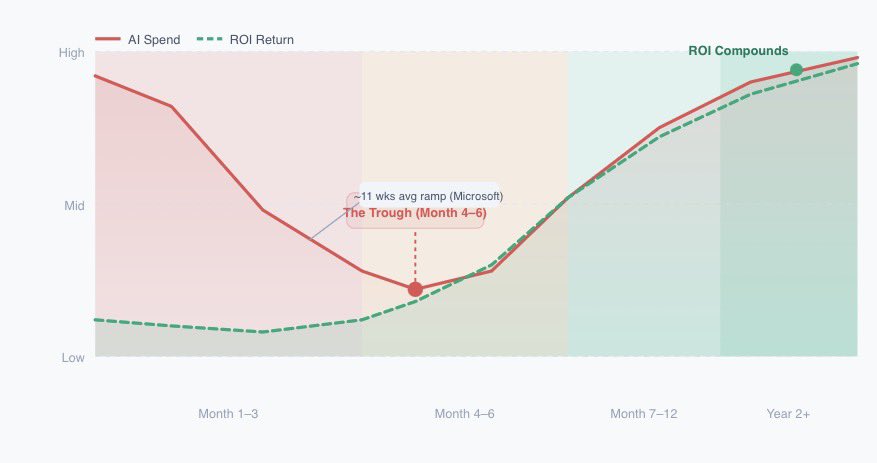
The J-Curve Nobody Warned You About Here’s the scenario I hear from CXO constantly: you freed up budget by deferring headcount. You bought the tooling. Six months later, the AI tab has grown 2–3x as adoption spread, usage scaled, and new use cases kept getting added. The investment curve is not a straight line upward. It’s a J. For two years, “productivity gains” was the default justification for every AI investment. It was the right answer for the pilot phase. The market has now moved on. The enterprise buyer has matured. Boards are now asking the harder question: how much incremental revenue has AI actually brought? Only 20% of organisations are already achieving revenue growth through AI, according to Deloitte’s 2026 State of AI report
Sreeram Narayan tweet media
Sreeram Narayan@sreespace

Something quieter is happening under the productivity headline. A generation of product managers is entering the workforce not knowing how to write the first three lines of a PRD from a blank page. A generation of engineers is being onboarded with AI coding assistants before they’ve ever debugged a complex system by hand. And we’re celebrating both. Meanwhile, enterprise AI budgets are growing faster than the evidence for returns. The tools are proliferating. The token bills are climbing. And the hard questions - What did this actually produce? What did we give up? are getting pushed to the next quarter. 86% of enterprises grew their AI budgets in 2025. Only 5% can demonstrate“substantial ROI” meaning AI investments that demonstrably improve the bottom line beyond the total cost of implementation, including tooling, integration, training, and organisational change.

English
0
0
0
24