Srujan Deolasee

308 posts

Srujan Deolasee banner
Srujan Deolasee

Srujan Deolasee

@sruj_d

building @genrobotics_ai MS @CMU_Robotics ‘25 | CS @bitspilaniindia '23

Katılım Ağustos 2019
1.1K Takip Edilen140 Takipçiler
Srujan Deolasee retweetledi

Jiawei Yang
Jiawei Yang@JiaweiYang118·
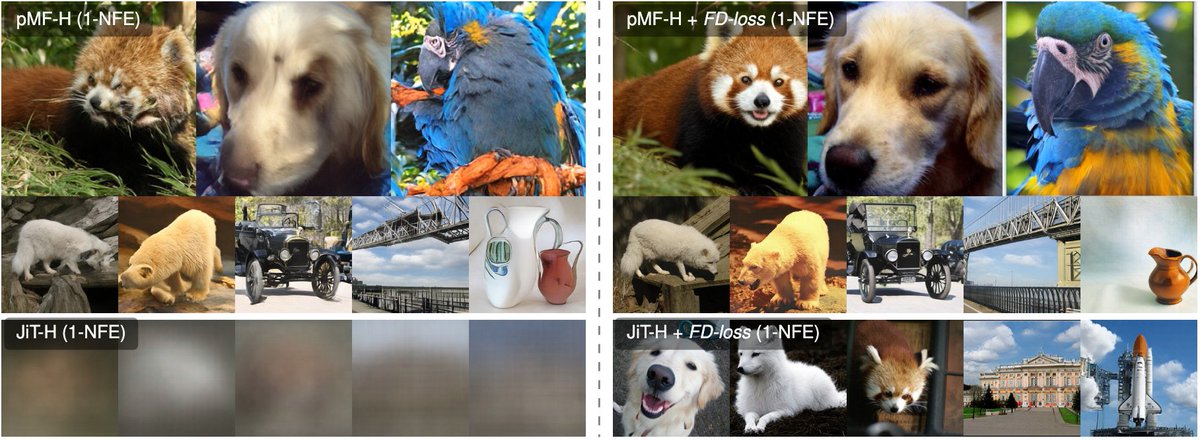
Two months ago, I vaguely posted a number: 0.9 FID, one-step, pixel space. Now it is 0.75, and can be even lower. Many wonder how. I thought it might end as a small FID prank: simple and deliberate. It started with one question: can FID be optimized directly, and what does it reveal? Introducing FD-loss.
Jiawei Yang tweet media
English
53
152
899
200.9K
Srujan Deolasee
Srujan Deolasee@sruj_d·
@Luckyballa I see, that makes a lot of sense. I might have been biased due to working with less noisy sensor data thus not needing much post-processing before building the TSDF. Def agree that it’ll help shape completion/smoothness, and I’ve wanted to tackle that since a while now
English
0
0
0
10
Lucky Iyinbor
Lucky Iyinbor@Luckyballa·
In my experience, to utilize any multiview signal effectively (depth, color, camera params), assuming they are not 100% perfect, you want a differentiable method All observations have to agree on what the scene is, not just by averaging out, but by measuring multiview consistency With a differentiable method, you can spot and even correct outliers without hacks, use priors and regularization for shape completion and smoothness and a couple other things
English
1
0
1
18
Lucky Iyinbor
Lucky Iyinbor@Luckyballa·
I see that a lot of papers and startups still use TSDF fusion to reconstruct surfaces from depth maps Still relying on voxel grids, memory constrained and low quality I think I should solve it next weekend
English
6
2
46
4.1K
Srujan Deolasee
Srujan Deolasee@sruj_d·
@Luckyballa Fair. What applications are you looking at for them to be differentiable though? Uncertainty can be thought of as how may times the voxel has been observed from multiple views, and I think libraries like open3d can give you a mesh easily too
English
1
0
0
19
Lucky Iyinbor
Lucky Iyinbor@Luckyballa·
I agree, sparse variants are not as bad memory wise Classic variants are non differentiable, washing out the details, don’t hold any notion of uncertainty, and if you want a mesh, you have to do marching cubes or similar, further increasing the error and complicating online reconstruction
English
1
0
0
51
Srujan Deolasee retweetledi
CantGuardBook
CantGuardBook@CGBBURNER·
INSANE: An 8 minute compilation of flops, falls, and 50/50 calls, (that all coincidentally went OKC’s way) in round 1 of the NBA playoffs vs the Suns… Enjoy 😂😂 (Via, @Hero_OfThe_Day)
English
365
2.5K
21.4K
1.3M
Srujan Deolasee
Srujan Deolasee@sruj_d·
@taiyasaki Ohh I did not know that either. Coming from robotics, I think I had mostly seen it in context of robot planning
English
0
0
0
10
Andrea Tagliasacchi 🇨🇦
@sruj_d Well, voronoi diagrams pop up in information theory as you discuss optimal quantization. So it's not that surprising that they make their way into representing other forms of signals in discrete form.
English
1
0
0
33
Srujan Deolasee
Srujan Deolasee@sruj_d·
@taiyasaki While I’m no 3dgs expert, I never expected to read voronoi in this context lol
English
1
0
0
24
Andrea Tagliasacchi 🇨🇦
The recipe is Voronoi at every scale: - Bounded *power* diagram → 3D geometry (cells with controllable extent) - 2D Voronoi on each cell → texture / displacement - Spherical Voronoi on each texture site → directional radiance Three Voronoi... one differentiable representation
English
2
3
42
4.4K
Srujan Deolasee retweetledi
Rahul Chhabra
Rahul Chhabra@rahulchhabra07·
you can now control things with your brain. literally. we're building the most wearable BCI on the planet, with @sabicap, backed by @khoslaventures @accel @initialized & @kevinweil. we collected the world’s largest neural dataset and trained the most capable Brain Foundation Model. then we invented a new class of biosensors powered by custom ASICs. type without typing. click without clicking. a cap that lets your brain do the work. we’re sabi.
English
486
708
4.5K
5.9M
Srujan Deolasee retweetledi
#9
#9@gilsrma·
the feeling of a successful hatewatch, but you’re lowkey next
#9 tweet media
English
89
3.6K
39.2K
407.9K
comma
comma@comma_ai·
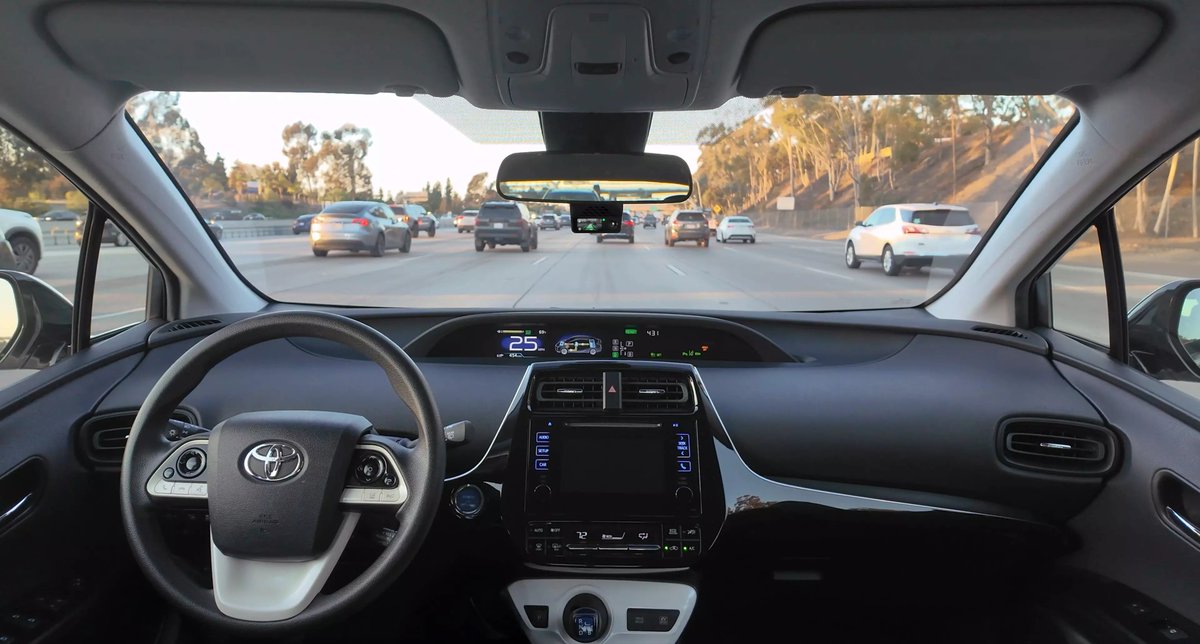
What’s holding you back from buying or recommending comma four?
comma tweet media
English
159
2
163
32.7K
Srujan Deolasee retweetledi
Rafael Spring
Rafael Spring@Rafael_L_Spring·
It's 1:30 am and I've nothing better to do, so here we go: * stereo vs. mono: yes, if you have stereo, use stereo. If you're stuck with mono and have some compute to spare, use an ML depth model to get approximate depth. Accuracy at this stage is overrated. I'll all get bundle-adjusted anyway. * feature tracking: search vs. KLT. Both have upsides and downsides. The best systems use a hybrid. Search is often too expensive and depends on detection, which is often brittle -- but can save your butt in many edge cases. KLT is fast & robust but bare KLT is not very accurate and also drifts over time. I hope to be doing one or more posts on this very topic hopefully soon. * pose estimation: directionally correct but there's a world of best practices to make this fast & robust. People have written entire PhD theses about this. Topic for another post. * KF-based map expansion: yes that's best practice. But KF-selection based on "every few meters" is instant game over. Lots of cases and edge cases that need to go into a suitable heuristic. * CUDA kernels for stereo matching: serious overkill. Matching few hundred features on CPU takes at most a couple milliseconds if implemented right. * Local BA: 12 KFs is kinda arbitrary. Might work well for KITTY but not generalize. * Eval on KITTY: that's easy-tier: camera always upright. No pure rotations. Very controlled motion. Very large field of view. Drone datasets are where the rubber meets the road. * Performance: 9 FPS on RTX 3050. NGL, that is brutally, ludicrously slow. Us old-schoolers did realtime visual SLAM 20 years ago on ~ 1/1000th of the compute budget.
ani@anirudhbv_ce

@nengjiali @Rafael_L_Spring would love to get your feedback on this

English
3
5
82
8.8K
Srujan Deolasee
Srujan Deolasee@sruj_d·
@Parskatt Played around with it quite a bit and I’m very impressed looking at performance gains! Congrats!
English
0
0
1
10
Johan Edstedt
Johan Edstedt @Parskatt·
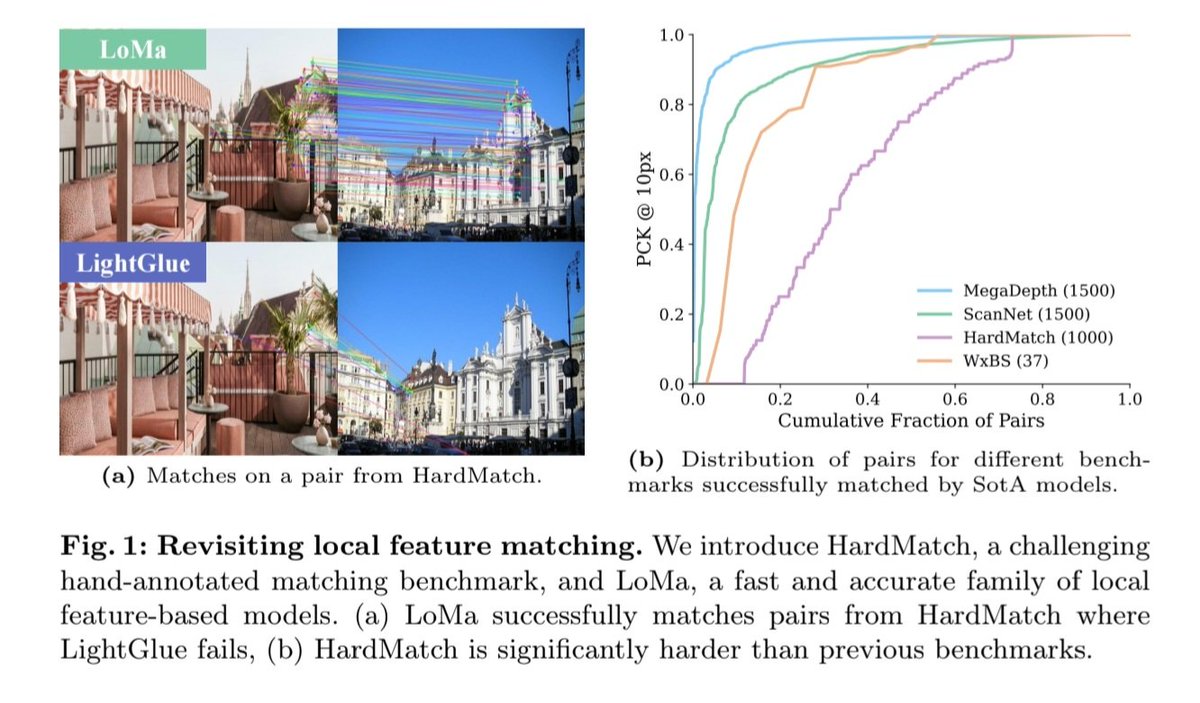
Introducing LoMa, the next generation of feature matcher!
Johan Edstedt  tweet media
English
8
36
293
36.6K
Srujan Deolasee
Srujan Deolasee@sruj_d·
Socha nahi tha samay ka video dekhke rona ayega. Can’t wait for latent to return
हिन्दी
0
0
0
29
Srujan Deolasee
Srujan Deolasee@sruj_d·
how were people using chrome till now? had no idea it didn’t have this already
Google@Google

Too many @GoogleChrome tabs open? Try vertical tabs, rolling out now. Just right-click any Chrome window and select “Show Tabs Vertically” to move your tabs to the side of the browser window, making it easier to read page titles and manage tab groups.

English
0
0
0
23