
Vlad Erium 🇯🇵 retweetledi
Vlad Erium 🇯🇵
63K posts


Vlad Erium 🇯🇵
@ssh4net
RealityCapture/Photogrammetry expert, TD @ CyberAgent, Tokyo. All opinions are my own. Hobby: C++/GLSL/CUDA. Eng・日本語・Rus. @[email protected]
Saitama, Japan Katılım Haziran 2011
958 Takip Edilen3.2K Takipçiler


Vlad Erium 🇯🇵 retweetledi

When there's smoke, there's a chainsmoking cat. Delve into her uncensored life in Chainsmoker Cat, premiering July 2 on Netflix.
English
Vlad Erium 🇯🇵 retweetledi

My Underwater Caustics Pro shader for Blender is now FREE for a limited time! 🌊🥰
This scene is also included in the files!
It's in celebration of our store Grand Re-Opening 🥳
Go check it out at...
smouse.studio ❤️
English

The Fil-C story is a very interesting one, I talked about it in my YouTube channel back then, but what is very intriguing is that if Rust was *really* about safety, the same community would adopt Fil-C massively. Together with Rust, likely, not in substitution, but massively.
Filip Jerzy Pizło@filpizlo
Fil-C release 0.680! - Memory safe inline assembly - Full AVX512 masked/compress/expand load/store intrinsic support - OpenSSL 3.5.7, OpenSSH with mlkem+nistp support - And more! github.com/pizlonator/fil…
English

Vlave not great in PR for sure. They must set the Steam Machine price at 1/2~1/3 of its price. Sell a couple of pieces to real people. And immediately go out of stock due to high demand. Sell the rest on eBay as a scalper for a real price🤔
English
Vlad Erium 🇯🇵 retweetledi

We've kept hearing how GLM-5.2 beats Opus 4.8, and are skeptical of benchmarks - so we tested them on a real bug from the Cline repo. While both models fixed the issue, GLM was the winner in terms of cost and code quality:
- GLM used twice as many tokens (GLM 1.1m vs Opus 660K) but cost half as much (GLM $0.41 vs Opus $0.81)
- Opus finished quicker - 1.6 min and 12 tool calls vs GLM 4.7 min and 28 tool calls
- GLM cleaned up dead code and verified the build compiled before completing. Opus didn't - it left type errors that passed tests but broke the production build.
Both runs used the same Cline harness prompting and tools, so it seems GLM is RL trained to spend more tokens verifying its work before completing. Impressive work by the @Zai_org team!

English

Holy. Shit.
People don’t realize how quickly we will be able to save full 3D models of things we see online, even without the host generating/modeling an object
Just like right clicking or screenshotting a JPG and setting it as a desktop wallpaper. The future is spatial splats
NVIDIA AI@NVIDIAAI
3D scene reconstruction works great until the camera never sees part of the scene. ArtiFixer from NVIDIA Research is an open autoregressive model that fills in the missing geometry that other methods leave blank. #SIGGRAPH2026 paper, code + demo: nvda.ws/4oILqNd
English
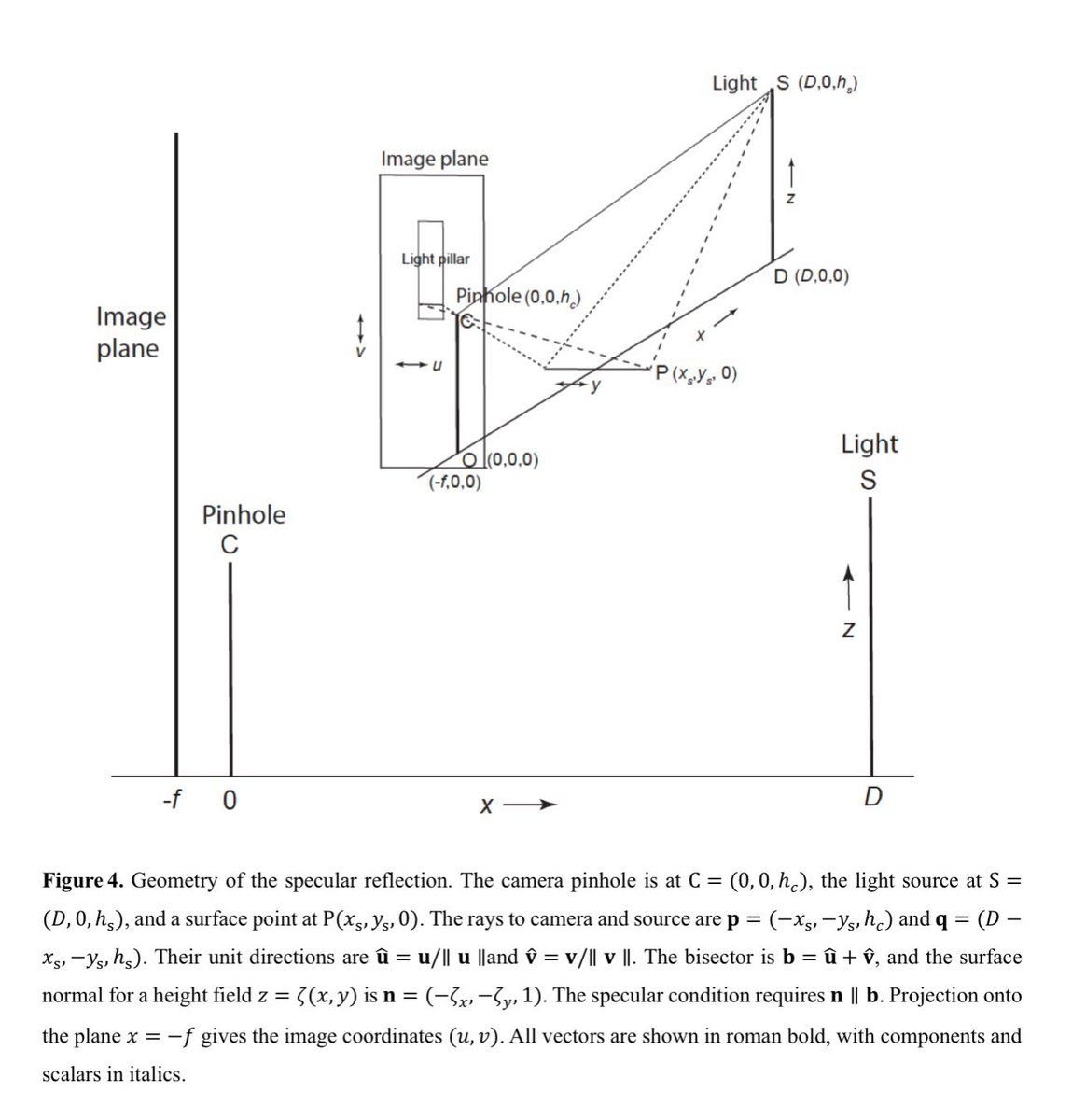
Light pillars over rippled water: why their sides appear parallel
Philip W. Kuchel
arxiv.org/abs/2606.18547
Abstract:
Streetlights shining across rippled water often produce tall, narrow reflections with strikingly parallel sides. These light pillars appear almost architectural, yet the water surface is neither vertical nor smooth. We develop a geometric optics model that explains the phenomenon using the specular reflection rule, projection geometry, and the physics and statistics of surface slopes. A rippled water surface can be viewed as an ensemble of small facets (tangent planes on waves) acting as tiny mirrors. As one looks farther across the water (coordinate x), the physical width of the region whose facets reflect the light into the eye (or camera/pinhole) increases, but the pinhole projection onto the image plane compresses this widening by a factor proportional to 1/x. The two effects cancel, producing a reflection whose image width remains constant. This paper appears to be the first to formally document this. (Deviations from the strict cancellation at both ends of the image are also explained.) The analysis clarifies how earlier qualitative treatments failed through a lack of identifying the role of projection geometry. The model also qualitatively explains the brightness variation along the pillar, and why extended objects such as buildings do not produce elongated reflections. The treatment is intended for scholars of introductory optics and for those interested in the physics and mathematics of everyday visual phenomena. We conclude by outlining how the same framework extends naturally to more complex viewing situations, such as the setting sun viewed from a cliff top over the sea.


English
@nixcraft That is not a Linux become user friendly, but LLM made such steps simple. 🤷♂️
English

@thsottiaux @TechByTaraa Be careful, you already speaking with ai bots 😅
English


Vlad Erium 🇯🇵 retweetledi


Vlad Erium 🇯🇵 retweetledi

I integrated this into Copilot and ran some evals this afternoon. Results were neutral at best and in most cases resulted in MORE token consumption. These results are consistent with our prior evaluation of RTK.
Compression ends up removing information that the agent needs, which triggers a re-read, ultimately resulting in larger costs and latency.
Beware of things that sounds too good to be true.
Charly Wargnier@DataChaz
UP TO 95% TOKEN REDUCTION WITH ZERO CODE CHANGES A Netflix engineer just open-sourced Headroom, and it’s one of the smartest ways I’ve seen to cut LLM costs. It wraps Cursor or Claude in a local proxy to compress your payload before it hits the LLM: → Intelligently shrinks logs, JSON, and code → Perfectly preserves logic accuracy → Keeps 100% of your data local → Stops Opus-tier models from wasting tokens on boilerplate It already crossed 35K stars, which says a lot. 100% free and open-source. repo in 🧵↓
English
@YeheLiu @polarization_yu My common workflow start in Pro to discuss a topic, write ideas to MD and pass that to a Codex-CLI
English


Vlad Erium 🇯🇵 retweetledi

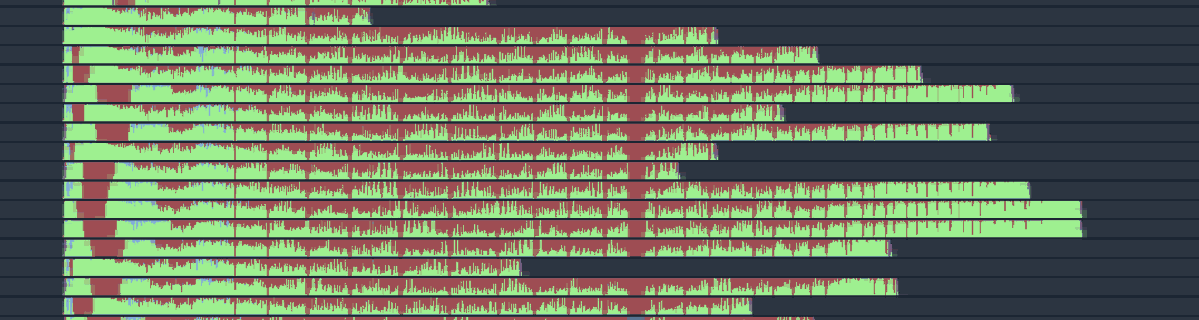
More fun with profiling in Superluminal. Couple of days ago I had 32 badly utilized threads. Profiler showed that most of it was due to malloc&free (including hidden ones from std::vector and co). Now I have 10 threads doing more work than the 32 did before.


English
Vlad Erium 🇯🇵 retweetledi

Response from my radiologist father who has read MRIs for decades:
“This will fail miserably, will harm people and will lose them millions upon millions of dollars. If there were a way that I could short a private investment, I would do so here”
Midjourney@midjourney
Announcing a new division of Midjourney called "Midjourney Medical"
English
There are a lot of question of that even possible in reality. Couple centimeters of water are possible and already sometime used. 10cm already almost not. But fullbody with many decimeters from emitters to a body, will probably generate a data similar to a lensless sensors, that required deconvolution, and probably neural networks to be usable. Hallucinations in a infrasound scans is what medicine don’t need 😅
English
À gauche, les images révolutionnaires qu'ils annoncent. À droite un scanner banal.


Midjourney@midjourney
Announcing a new division of Midjourney called "Midjourney Medical"
Français