Sabitlenmiş Tweet
Vega51
3.8K posts


Manus被收购其实是个皆大欢喜的事情,技术上的实验品能够用足够高的估值卖给fomo的美国人,这件事对整个华人AI创业圈都有提振作用。
问题主要是整个过程搞的太不体面了。先是明确禁止中国用户使用,高调搬到新加坡,又跟宇树、deepseek撞档。这几个信号合起来就要命了——“起了很差的带头作用”。
Facebook此前收购的Scale AI也是华裔项目,founder叫Alexandr Wang。不熟悉这人没关系,你只要知道这人日常挂在嘴边的言论就是“中国太坏了”。
现在 Manus 也要被Facebook收购,你觉得上面的人会怎么想?觉得他为国争光吗?
之前在基金看了这么多年项目,我觉得founder有一个很必要的素质是“体面”,一个founder如果不能提出让每个参与方都体面的方案,就会有参与方让founder不体面。
当这个觉得没被“尊重”的参与方恰好在北京,那结果就可以预想到了。
不管怎么说,希望行业越发展越好吧。
中文
除了几个创始人,Manus目前股份里有很多中国资本,你们不会以为只有2个创始人受到压力了吧?不会真觉得回不回国只是他们个人的决定吧?
亚洲金融 Asia Finance@AsiaFinance
这剧情比电影还魔幻:Manus的CEO肖弘、首席科学家季逸超,本月被发改委召至北京开会。在会后被告知,因监管审查正式被限制出境。此前,该公司被美国Meta以20亿美元收购,肖弘出任Meta副总裁。另一个剧本:Manus从0到1,武汉/光谷给了2000㎡免费场地、税收减免、12亿+资金、算力、人才、政策背书、数据开放,是典型的政府+市场+高校协同养大的项目。这说白了,武汉政府就是天使投资人。他们要是跑了,政府工作人员怎么办?肖弘和季逸超被边控,也是情理之中。
中文
确实,AI每次review自己的改动都能发现一些问题,但它们就是不能第一次就写对
Jimmy Cheung@remixdesigner
有代码洁癖的人一定会喜欢的一个 Vibe Coding 小技巧: “现在问题解决了,但请你重新 Review 一下今天的几轮修改,看看是不是补丁叠补丁式的修改,如果是的话,重构成最优解。”
中文

Vega51 retweetledi

澳大利亚为何缺油如此迅速和严重?
储备问题
澳大利亚是国际能源署(IEA)成员国中唯一长期不遵守90天净进口储备要求的国家(自2012年起违规)。
IEA多数成员国平均持有140天左右的储备,而澳大利亚只有约30-36天(汽油36天、柴油32天、航空燃料29天左右,部分数据称柴油低至26天)。
抢购问题
局部短缺严重(NSW几十到上百站无油,偏远小镇整镇断供),价格涨得最快(发达国家中最剧烈),部分地区柴油已超3澳元/升,个别偏远点接近4澳元。
政府强调“全国够用,别抢购”,但民众不信(历史经验+媒体报道),导致恶性循环。
气候教摧毁炼油能力
从曾经的8-12座炼油厂,到2026年初仅剩2座,国内炼油仅满足不到20%的需求,90%以上依赖进口(亚洲炼油厂和中东原油)。
供应链脆弱
恐慌抢购直接击穿局部配送系统:需求突然激增50%,卡车运不过来,单个加油站很快就空(即使全国总量够)。
其他国家有更多本地生产/储备,抢购影响小;澳大利亚的“just-in-time”模式(过去几十年政商共识,追求低成本)让系统极脆弱,一旦恐慌就连锁反应。
于是,退役空军少将Jon Blackburn等批评这是“管理国家愚蠢的方式”
老猿说OldApe@OldApeTalk
斯洛文尼亚目前面临严重的燃料供应压力,并已成为欧洲第一个出现大规模燃料购买限制的国家 总理Robert Golob表示,政府统一的限制: --个人每天50升,法人实体200升。 --同时,政府已决定动用军队协助燃料运输,并从紧急储备中释放高达3000万升柴油,禁止柴油出口,以保障国内供应。 --高速公路服务区的燃料价格管制已于3月20日起暂时取消,以缓解物流压力并改善偏远地区的供应。 PS:取消价格限制是为了激励零售商(如Petrol、MOL、Shell等)向斯洛文尼亚输入燃料,以利益牵引 此前西班牙已经宣布50亿欧元的补贴模式,大幅度降低相关税率,也是类似的激励措施
中文
Vega51 retweetledi

@shao__meng 目前只听到过后端转全栈。说美国市场回暖了一点,结果Block, Atlassian, Meta都裁员,那国内大厂裁不裁,没什么疑问
中文


为啥销量好,温水煮青蛙
丐版全家桶不到1w5,真正依赖上Apple生态的每年维护成本就是10w了,最后入教的都往Pro、Max走了
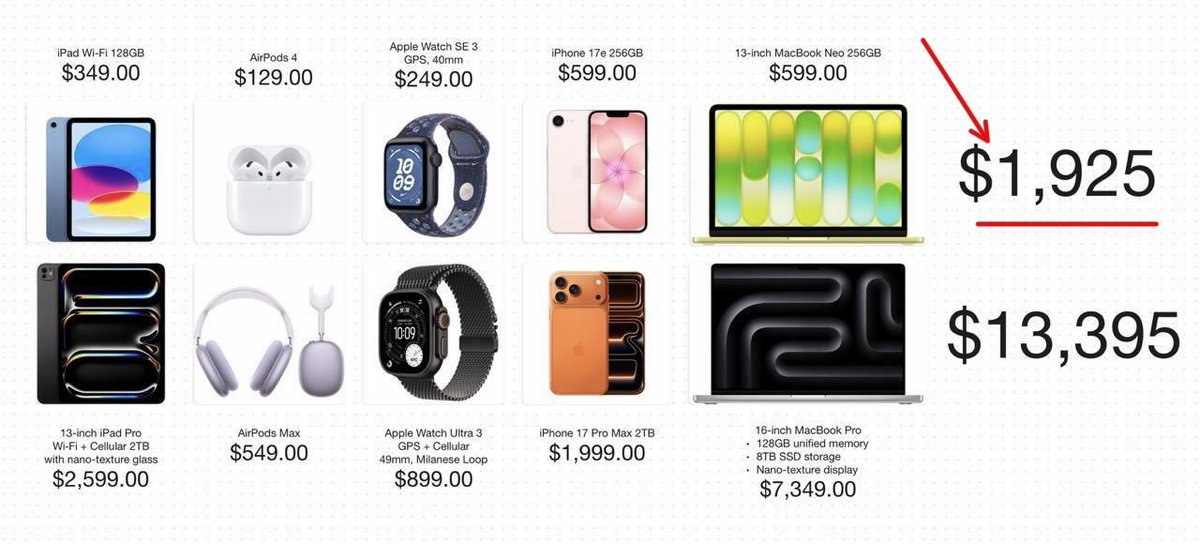
Tim Cook@tim_cook
Mac just had its best launch week ever for first-time Mac customers. We love seeing the enthusiasm!
中文

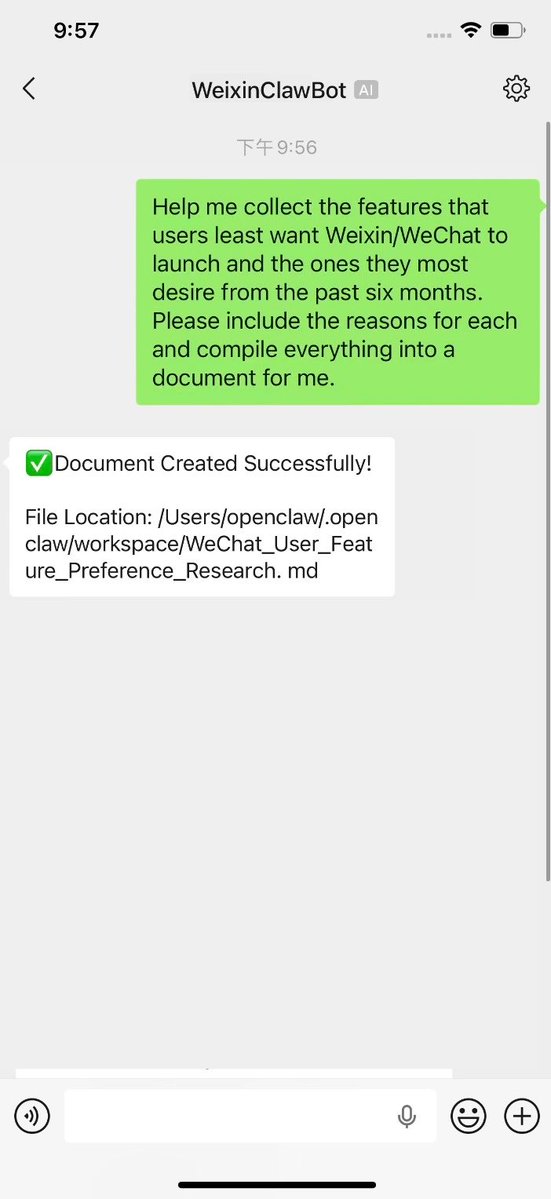
Today, we are officially opening the capability to integrate #OpenClaw into #Weixin.
With the launch of the #WeixinClawBot, users can use Weixin as a dedicated messaging channel for OpenClaw.
Now, you can send and receive messages with OpenClaw just like texting a friend.
#AIAutomation #AI
English

Cursor 上线 Composer 2 不到 24 小时,就被开发者扒出了底裤。
(以下内容 Claude 辅助生成)
一个叫 Fynn 的开发者在调试 Cursor 的 API 时,发现返回的模型 ID 赫然写着:kimi-k2p5-rl-0317-s515-fast。翻译成人话:这就是月之暗面(Moonshot AI)的 Kimi K2.5,加了一层强化学习(RL)微调。
Moonshot AI 预训练负责人 Yulun Du 随即在 X 上发帖确认,经测试 Composer 2 的 tokenizer 和 Kimi 的完全一致,并直接 @ 了 Cursor 联合创始人 Michael Truell,质问为什么不遵守许可证、也没有支付任何费用。另外两名 Moonshot 员工也发帖证实,不过三条帖子后来都被删除了。
而 Cursor 在 3 月 19 日发布 Composer 2 时,只提到性能提升来自"对基座模型的持续预训练加强化学习",全程没有提到 Kimi K2.5。这两件事并不矛盾,持续预训练和 RL 本来就是在某个基座模型上做的,Cursor 只是没说基座是谁的。
这不是第一次了
去年 10 月 Cursor 发布 Composer 1 时,多国开发者发现生成的代码中频繁出现中文。Alley Corp 合伙人 Kenneth Auchenberg 当时贴出截图,直言这是"铁证",认为 Composer 1 就是基于中国开源模型微调的。KR-Asia 和 36Kr 后来证实,Cursor 和 Windsurf 都在使用中国开源模型,其中 Windsurf 承认用的是智谱的 GLM。Cursor 从来没有公开披露 Composer 1 的底层模型,后来悄悄发了 Composer 1.5 就翻篇了。
许可证才是核心问题
Kimi K2.5 使用的是修改版 MIT 许可证,里面有一条专门为这种场景设计的条款:如果使用该模型(包括衍生作品)的商业产品月活超过 1 亿或月收入超过 2000 万美元,必须在产品界面上醒目展示"Kimi K2.5"字样。
Cursor 今年 2 月的年化收入已经突破 20 亿美元,换算成月收入大约 1.67 亿美元,是许可证门槛的 8 倍多。但 Cursor 的界面上只写着"Composer 2",没有任何 Kimi 的标识。
与此同时,Cursor 正在跟投资人谈一轮新融资,估值目标约 500 亿美元,相比去年 11 月的 293 亿美元估值几乎翻倍。而 Moonshot AI 上一轮估值据报道约 43 亿美元。一个估值是对方 12 倍的公司,拿了对方的模型包装成自研技术,用来支撑"前沿实验室"的叙事去融资。
截至目前,Cursor 没有做出任何公开回应。
这件事的后续走向,对整个开源 AI 生态有标杆意义。如果 Moonshot 不对一家年收入 20 亿美元的公司执行许可证,那以后所有开源模型的署名条款就成了摆设。每家 AI 实验室都会算同一笔账:为什么要开源自己的模型,让分发能力更强的公司去掉署名、包装成自研、然后以 12 倍于你的估值去融资?
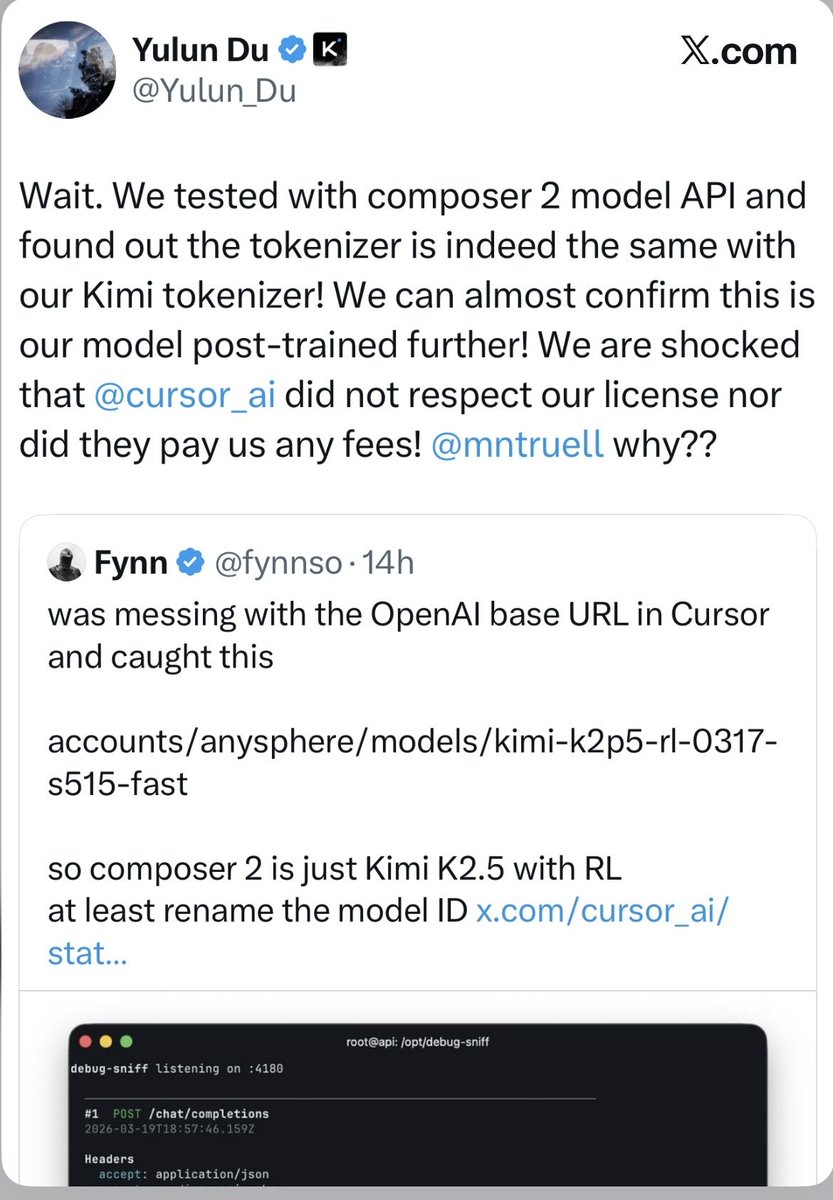
Aakash Gupta@aakashgupta
Cursor is raising at a $50 billion valuation on the claim that its “in-house models generate more code than almost any other LLMs in the world.” Less than 24 hours after launching Composer 2, a developer found the model ID in the API response: kimi-k2p5-rl-0317-s515-fast. That’s Moonshot AI’s Kimi K2.5 with reinforcement learning appended. A developer named Fynn was testing Cursor’s OpenAI-compatible base URL when the identifier leaked through the response headers. Moonshot’s head of pretraining, Yulun Du, confirmed on X that the tokenizer is identical to Kimi’s and questioned Cursor’s license compliance. Two other Moonshot employees posted confirmations. All three posts have since been deleted. This is the second time. When Cursor launched Composer 1 in October 2025, users across multiple countries reported the model spontaneously switching its inner monologue to Chinese mid-session. Kenneth Auchenberg, a partner at Alley Corp, posted a screenshot calling it a smoking gun. KR-Asia and 36Kr confirmed both Cursor and Windsurf were running fine-tuned Chinese open-weight models underneath. Cursor never disclosed what Composer 1 was built on. They shipped Composer 1.5 in February and moved on. The pattern: take a Chinese open-weight model, run RL on coding tasks, ship it as a proprietary breakthrough, publish a cost-performance chart comparing yourself against Opus 4.6 and GPT-5.4 without disclosing that your base model was free, then raise another round. That chart from the Composer 2 announcement deserves its own paragraph. Cursor plotted Composer 2 against frontier models on a price-vs-quality axis to argue they’d hit a superior tradeoff. What the chart doesn’t show is that Anthropic and OpenAI trained their models from scratch. Cursor took an open-weight model that Moonshot spent hundreds of millions developing, ran RL on top, and presented the output as evidence of in-house research. That’s margin arbitrage on someone else’s R&D dressed up as a benchmark slide. The license makes this more than an attribution oversight. Kimi K2.5 ships under a Modified MIT License with one clause designed for exactly this scenario: if your product exceeds $20 million in monthly revenue, you must prominently display “Kimi K2.5” on the user interface. Cursor’s ARR crossed $2 billion in February. That’s roughly $167 million per month, 8x the threshold. The clause covers derivative works explicitly. Cursor is valued at $29.3 billion and raising at $50 billion. Moonshot’s last reported valuation was $4.3 billion. The company worth 12x more took the smaller company’s model and shipped it as proprietary technology to justify a valuation built on the frontier lab narrative. Three Composer releases in five months. Composer 1 caught speaking Chinese. Composer 2 caught with a Kimi model ID in the API. A P0 incident this year. And a benchmark chart that compares an RL fine-tune against models requiring billions in training compute without disclosing the base was free. The question for investors in the $50 billion round: what exactly are you buying? A VS Code fork with strong distribution, or a frontier research lab? The model ID in the API answers that. If Moonshot doesn’t enforce this license against a company generating $2 billion annually from a derivative of their model, the attribution clause becomes decoration for every future open-weight release. Every AI lab watching this is running the same math: why open-source your model if companies with better distribution can strip attribution, call it proprietary, and raise at 12x your valuation? kimi-k2p5-rl-0317-s515-fast is the most expensive model ID leak in the history of AI licensing.
中文

打广告也别太离谱。抖音那套自以为是的算法模式,很多人并不喜欢。音乐App最重要的是曲库,QQ音乐一个周杰伦就把汽水秒了
Pangyu 胖鱼 🐠@pangyusio
最近试了下字节的汽水音乐,再打开 QQ 音乐,有种从 2026 穿越回 2016 的感觉。 汽水音乐的逻辑和抖音一脉相承:选个类型,算法推歌,切歌上下滑。整个 App 只有一个核心交互,极简到没有任何决策成本。 QQ 音乐呢?成千上万个歌单,每天推荐 30 首歌。本质上还是十年前网易云那套"编辑+协同过滤"的思路,只不过加了更多版权和社交。页面也跟狗皮膏药一样复杂。 都 2026 年了,这套东西看着实在像上个时代的产物。 腾讯的路径一直是:找到被验证的产品,抄过来,嫁接社交关系链和版权优势,靠体量碾压。QQ 音乐对网易云如此,微信对米聊亦如此。 但字节的打法是用算法重新定义交互本身。说白了,歌单这个产品形态,在足够强的推荐算法面前,就是个冗余设计。 字节可怕的地方在于,它不跟你比功能多、版权全,是直接把竞争拉到你不擅长的维度——算法驱动的用户体验。 腾讯如果继续在旧框架里迭代,大概率会像门户网站遇上信息流,赢了所有旧对手,却输给一个改变规则的人。
中文
@tangledfairy1 @linyujing 有些人拉肚子排空就好了,但有些人是细菌感染必须吃药杀菌才行,不然就一直不舒服甚至持续腹泻。急性病变那看你多急了,不是快死了去急诊就是坐牢等到怀疑人生。至于MRI第二天就能约到,我表示怀疑,国内很多三甲都安排不到第二天。如果你把几十公里外能做检查的地方也算上,也许是可能的
中文

@star_cubez @linyujing 大多数人拉肚子,补充电解质和防止脱水,排清了就好。如果有基础病,需要更多的检查才做,各种标本培养本身都是需要时间的12-48小时。如果中风,急性病变需要CT,应该去医院,而不是walk in clinic。彩超CT,MRI在悉尼一般也就是第二天就约到,只是需要多打几个电话。边远地区确实就医难。
中文
澳洲医疗好和坏的地方都有。好的地方,比如罕见病政府兜底,比如野外出车祸给你派直升机。坏的地方,看普通病做普通检查很麻烦,不像中国医院,澳洲的医生问诊和CT彩超等检查不在同一个地方,而且也很难安排在同一天。因为要先看医生才能安排检查,查个大便就要好几天,大概率没查完人就康复了😅
林愈静@linyujing
澳洲医疗没什么好吹的,只有一条就能发现分别了:澳洲的人非常少,医生可以看病的机会就少,经验肯定是没有中国,香港丰富的。就这么点儿人,医疗事故发生频率非常高,疑难杂症这些主要靠的是科研,科研可以的。疑难杂症本身也无法靠经验,就是碰运气。那些需要经验--无论是诊治经验还是临床经验--的病,澳洲肯定是比不上中国的。 举个例子吧:甲沟炎,澳洲曾经出现过一例,十几岁的小孩儿甲沟炎去看病,按这位推主说的,这种最多就是到GP,澳洲的GP,99%的情况都是让你回去吃止疼药,这个小孩儿回去吃止疼药了,但没效果,反而越来越肿,去了急诊,急诊说你这个吃止疼药就好,会自己痊愈的,后来这个小孩儿因为细菌感染败血症,送急诊,没抢救过来,死了。死因研训了几个月,陪了几十万了事。 我前年中指也甲沟炎了,肿的不行,我知道GP会让我吃止疼片自己好,就打给一个我认识的以前在中国做护士的朋友,她说你去药房买碘酒,每天伸进去泡两分钟,两天就好了,我照做了,就好了。这位护士朋友移民后因为英语不太好,一直在澳洲做家居清洁。我后来感谢她,她说,哎,我在医院时这种一天得看几十个。都是这么处理的。 GP分流不是什么高级的事,几乎所有地区都是这么做的,中国也有社区诊所,香港分的更清楚,家庭医生分流,急诊室分流。中国能做到急诊室不需要等八个小时不是什么丢人的事儿,是医疗资源充足,并且可持续。这在人少的地方是很难实现的,澳洲现在还有很多人少的地方根本没有医生,靠的是实习生轮流过去坐诊,也就是说不管你生病是什么时候,看病得集中在那几天去看,实习医生去了通通常在当地council给的地方坐诊,住十天半月就走了。就得等下一个“游医”,这是人口少的不便之处,没什么好吹虚的。
中文