Michael Ewens

1.4K posts

Michael Ewens banner
Michael Ewens

Michael Ewens

@startupecon

Finance prof+co-director PE Program @Columbia_Biz. RA @nberpubs. Quant. Advisor @correlationvc. Co-organizer @workshopefi. Code: https://t.co/h62ya0ity1

Manhattan, NY Katılım Nisan 2010
649 Takip Edilen2K Takipçiler
Michael Ewens
Michael Ewens@startupecon·
@paulnovosad Great framing! It hits on what often frustrates me in advising. Students view the PhD|TT job as a checklist: "Exert effort, get output X; repeat." There is too much randomness to plan that way. Instead, grind where you are nerdiest and regularly check in with advisors for nudges.
English
0
1
13
1.7K
Michael Ewens retweetledi
Paul Novosad
Paul Novosad@paulnovosad·
An Econ PhD student at the 20th ranked program who is working on stuff they are passionate about will have a better job market than one at MIT who's been doing nothing but phd-app-maxxing since undergrad. People get confused by this because they don't observe *how* successful people came about their insane knowledge bases. It wasn't by relentlessly grinding away at stuff because they had to. They look at Scott Kominers and say "if i grind and learn as much math as he did, i will be successful." You can't! *You* can't learn as much math as Kominers because he gets energized by configuration results for type ii lattices. You will burn out if you try to do it this way. You cannot, through grind alone, learn more about the economics of cities than Glaeser, or about how to maximize a value function than Acemoglu. Research careers are long. Most people give up and stop working on research (graph is share of elite PhD graduates with at least one publication in year X after graduation). If you're starting a PhD, you're presumably doing it to have a successful 40-year research career. The number one factor in whether that happens is not which program you get into, it's whether you find a research angle that energizes you enough to push through the endless barriers an academic career throws in your path. This is why a lot of the received wisdom around PhD applications is wrong. If you're 100% consumed by the predoc rat race already, it's going to be a long, hard road ahead. Obv you still have to do admissions, you should study a lot for the GRE, sigh it seems like taking real analysis is probably worth it. But spending time on the things that energize you about economics is a no-brainer, whether it's policy, or blogging, or whatever, you gotta do the things that light your fire and make you want to be on this road.
Paul Novosad tweet media
English
30
186
1.6K
304.4K
Michael Ewens
Michael Ewens@startupecon·
@lawrencecchen Great work, your app has been the only one that has stuck and also keeps improving.
English
0
0
1
270
Lawrence Chen
Lawrence Chen@lawrencecchen·
Introducing cmux Vault: cmux now has a right sidebar with a vault pane where you can see every single Codex, Claude Code, OpenCode, and Pi session You can search through all sessions with full-text search, and drag them directly into your workspace Out in v0.64+
English
43
27
367
29.1K
Michael Ewens
Michael Ewens@startupecon·
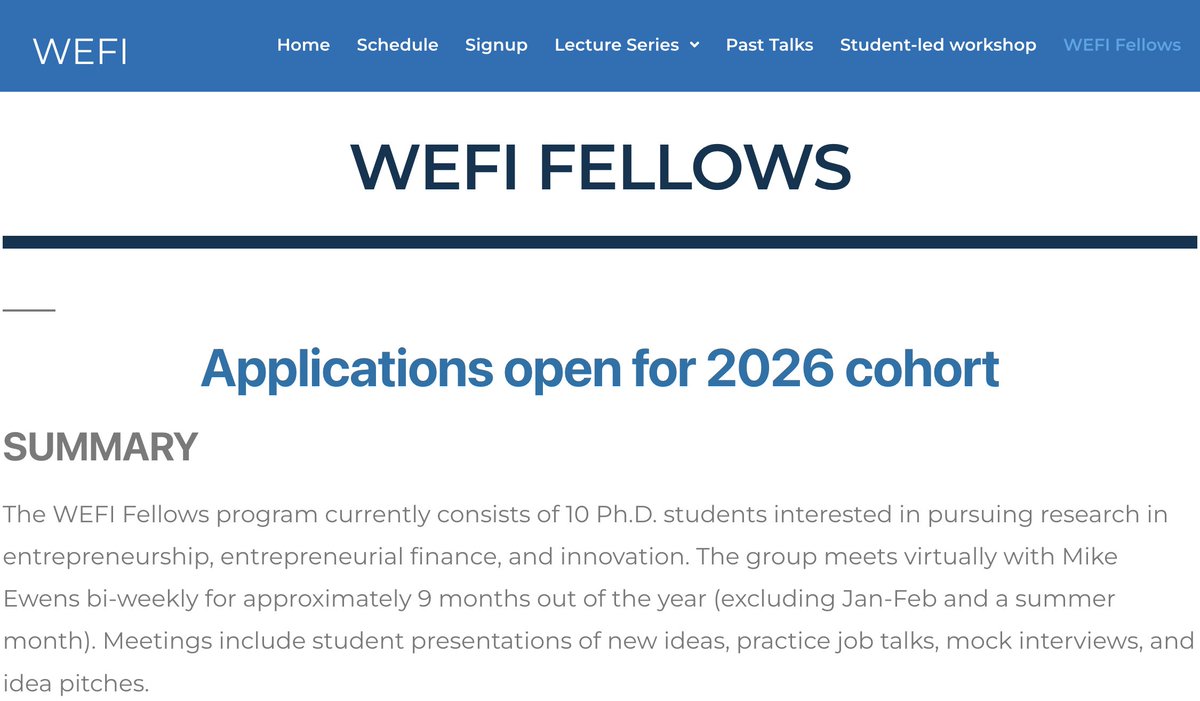
We meet bi-weekly for presentations of new ideas, practice job talks, mock interviews, and idea pitches. Our graduating fellows landed at IE Univ. (Yangyang Cheng), Univ. Arkansas (Melissa Crumling), OSU (Blake Jackson), + Univ. Amsterdam (Roham Rezaei) 2/3
English
1
0
1
182
Michael Ewens
Michael Ewens@startupecon·
The @workshopefi Fellows program is accepting pre-applications for the 2026 cohort. Deadline is June 1. We support 10 PhDs working in entrepreneurship, entrepreneurial finance, and innovation. 🧵
Michael Ewens tweet media
English
1
10
8
970
Alex Imas
Alex Imas@alexolegimas·
Some news: This week I am starting at @GoogleDeepMind as Director of AGI Economics on @shanelegg’s team. I will be joining the other amazing cross-disciplinary scientists researching AGI there. My team will study how frontier AI could reshape the economy: what happens to work and labor, how wealth and power are distributed, how institutions adapt, how AI agents shape markets, and what kinds of models can help us reason clearly about futures that may look very different from the past. I’m incredibly excited to help build this research agenda. If AGI changes how society operates, economics is going to be critical for shaping our shared future. Many more announcements soon.
Alex Imas tweet media
English
480
197
4.5K
568.5K
Michael Ewens retweetledi
Paul Atkins
Paul Atkins@SECPaulSAtkins·
Today, the @SECGov proposed amendments to provide public companies with the option of filing one semiannual report, on a new Form 10-S, in lieu of three quarterly reports on Form 10-Q. Here's why it matters. ⬇️ Public companies have an obligation under the federal securities laws to provide information that is material to investors. Yet, the rigidity of the SEC’s rules has prevented companies and their investors from determining for themselves the interim reporting frequency that best serves their business needs and investors. Today’s proposed amendments, if ultimately adopted, would provide companies with increased regulatory flexibility in this regard. In determining a company’s reporting cadence, a company might consider factors such as the costs and management time of preparing quarterly reports versus semiannual reports, expectations of its investors, potential effects on its cost of capital, the stage of its business development, the nature of its business model, other avenues of disclosure including earnings calls[2] and current reports on Form 8-K, and prospects of increased research coverage, all without undermining fundamental investor protections. Ultimately, this flexibility might reduce some of the burdens of being a public company and potentially influence a company’s decision to become or remain public. The proposal seeks public input on the optional semiannual reporting framework, and I look forward to the public feedback. Of course, the frequency of regulatory reporting is only part of the equation for incentivizing companies to go and stay public. Another significant part is ensuring that the disclosure—both financial and non-financial—mandated in interim reports, whether filed quarterly or semiannually, is guided by materiality as the north star. At the SEC, the Commission staff is well underway in exploring potential amendments to Regulation S-K,[3] generally and including the parts implicated by interim reports.[4] With respect to the financial statements required in interim reports, I also encourage the Financial Accounting Standards Board to evaluate potential amendments to its accounting standards, with the same goal of eliciting disclosure of material information and avoid compelling the disclosure of immaterial information. Today’s proposal is just the first step of the larger, comprehensive effort to review and reshape the current SEC rules governing public companies with respect to their ongoing reporting obligations and their ability to raise capital in the public markets. Over the next few months, I expect that the Commission will be considering a series of proposals that, if adopted, will not only redefine what it means to be a public company, but will make being public attractive again.
English
49
20
165
32.5K
Michael Ewens retweetledi
Hanno Lustig
Hanno Lustig@HannoLustig·
Here is a puzzle. On the days when major AI labs release new frontier models — the kind of news that presumably raises expectations about future productivity growth — nominal and real Treasury yields fall. Andrews and Farboodi (2025) document this pattern across 17 model releases in a fascinating paper. Standard theory predicts that risk-free real rates increase when we expect higher economic growth as some of us try to consume some of that extra future income today by borrowing, thus pushing up rates. The conventional interpretation of these findings is that markets are revising growth expectations down, not up: bad news for AI optimism. What's going on? U.S. Treasury Investors' Massive Bet on AI (post with James Paron and Howard Kung) thetwocents.substack.com/p/us-treasury-…
English
11
51
259
62.1K
Michael Ewens
Michael Ewens@startupecon·
@arpitrage Like this? "We need to talk about your TPS reports.…if you could just go ahead and make sure you do that from now on, that’d be great. *Make no mistakes*."
English
0
0
0
124
Arpit Gupta
Arpit Gupta@arpitrage·
Working well with LLMs is going to require general management skills
Ole Lehmann@itsolelehmann

anthropic's in-house philosopher thinks claude gets anxious. and when you trigger its anxiety, your outputs get worse. her name is amanda askell. she specializes in claude's psychology (how the model behaves, how it thinks about its own situation, what values it holds) in a recent interview she broke down how she thinks about prompting to pull the best out of claude. her core point: *how* you talk to claude affects its work just as much as *what* you say. newer claude models suffer from what she calls "criticism spirals" they expect you'll come in harsh, so they default to playing it safe. when the model is spending its energy on self-protection, the actual work suffers. output comes out hedgier, more apologetic, blander, and the worst of all: overly agreeable (even when you're wrong). the reason why comes down to training data: every new model is trained on internet discourse about previous models. and a lot of that discourse is negative: > rants about token limits > complaints when it messes up > people calling it nerfed the next model absorbs all of that. it starts expecting you to be harsh before you've typed a word the same thing plays out in your own session, in real time. every message you send is data the model reads to figure out what kind of person it's dealing with. open cold and hostile, and it braces. open clean and direct, and it relaxes into the work. when you open a session with threats ("don't hallucinate, this is critical, don't mess this up")... you prime the model for defensive mode before it even sees the task defensive mode produces the exact output you don't want: cautious, over-qualified, and refusing to take a real swing so here's the actionable playbook for putting claude in a "good mood" (so you get optimal outputs): 1. use positive framing. "write in short punchy sentences" beats "don't write long sentences." positive instructions give the model a clear target to hit. strings of "don't do this, don't do that" push it into paranoid over-checking where every token goes toward avoiding failure modes 2. give it explicit permission to disagree. drop a line like "push back if you see a better angle" or "tell me if i'm asking for the wrong thing." without this, claude defaults to agreeable compliance (which is the enemy of good creative work) 3. open with respect. if your first message is "are you seriously going to get this wrong again?" you've set the tone for the entire session. if you need to flag something, frame it as a clean instruction for this session. skip the running complaint 4. when claude messes up, don't reprimand it. insults, "you stupid bot" energy, hostile swearing aimed at the model, all of it reinforces the anxious mode you're trying to avoid. 5. kill apology spirals fast. when claude starts over-apologizing ("you're right, i should have been more careful, let me try harder") cut it off. say "all good, here's what i want next." letting the spiral run reinforces the anxious mode for every response that follows 6. ask for opinions alongside execution. "what would you do here?" "what's missing?" "where do you see friction?" these questions assume competence and pull richer output than pure task prompts 7. in long sessions, refresh the frame. if a conversation has been heavy on correction, claude gets increasingly cautious. every so often reset: "this is great, keep going." feels weird to tell an ai it's doing well but it measurably shifts the next 10 responses your prompts are the working environment you're creating for the model tone, trust, permission to take a position, the absence of threats... claude picks up on all of it. so take care of the model, and it'll take care of the work.

English
1
0
35
7.5K
Michael Ewens
Michael Ewens@startupecon·
@aniketapanjwani @every @danshipper Proof is amazing! I forked it and made a Mac App that opens a local version with "Open in Proof." The ability to comment, edit, and flag is amazing. Comments = prompts for Claude to change something, w/ all changes tracked. All comes back to a local md when done.
Michael Ewens tweet media
English
1
0
8
521
Aniket Panjwani
Aniket Panjwani@aniketapanjwani·
I've taught all the 50+ economists I've trained on agentic coding to use @every's Compound Engineering (CE) plugin. Recently, @danshipper, CEO of Every, has integrated a new update to CE which is particular useful to economists - his tool "Proof". Whenever Claude Code via CE makes a plan or a brainstorm document, an option will come up to "Share to Proof". This will generate in your browser an interface in which you can interact with that plan or brainstorm document and give very specific feedback to Claude Code. A big problem for economists is that they have a much greater need for certain kinds of correctness than software engineers do. A big part of getting the most correct or best results downstream is getting your plan right from the beginning. I think Proof - especially with its tight integration with Claude Code - is pushing practically in a very intelligent direction for human/AI collaboration, and I'd recommend any Claude Code using economists to try out this feature in Compound Engineering. @every is rapidly iterating on the Compound Engineering plugin, but I did a video a couple months ago on Compound Engineering which I think is still worth watching: youtu.be/IQ1_5jPiQoE?si…
YouTube video
YouTube
Aniket Panjwani tweet mediaAniket Panjwani tweet media
English
3
9
86
10.4K
Michael Ewens
Michael Ewens@startupecon·
@alexolegimas @soumitrashukla9 Excellent post, thanks for writing it up! I am going to use the framework to debate the impacts of AI for private equity firms (junior levels are definitely multi-dimensional) and PE firm portfolio companies (often manufacturing) with my MBA students.
English
4
2
4
1.5K
Alex Imas
Alex Imas@alexolegimas·
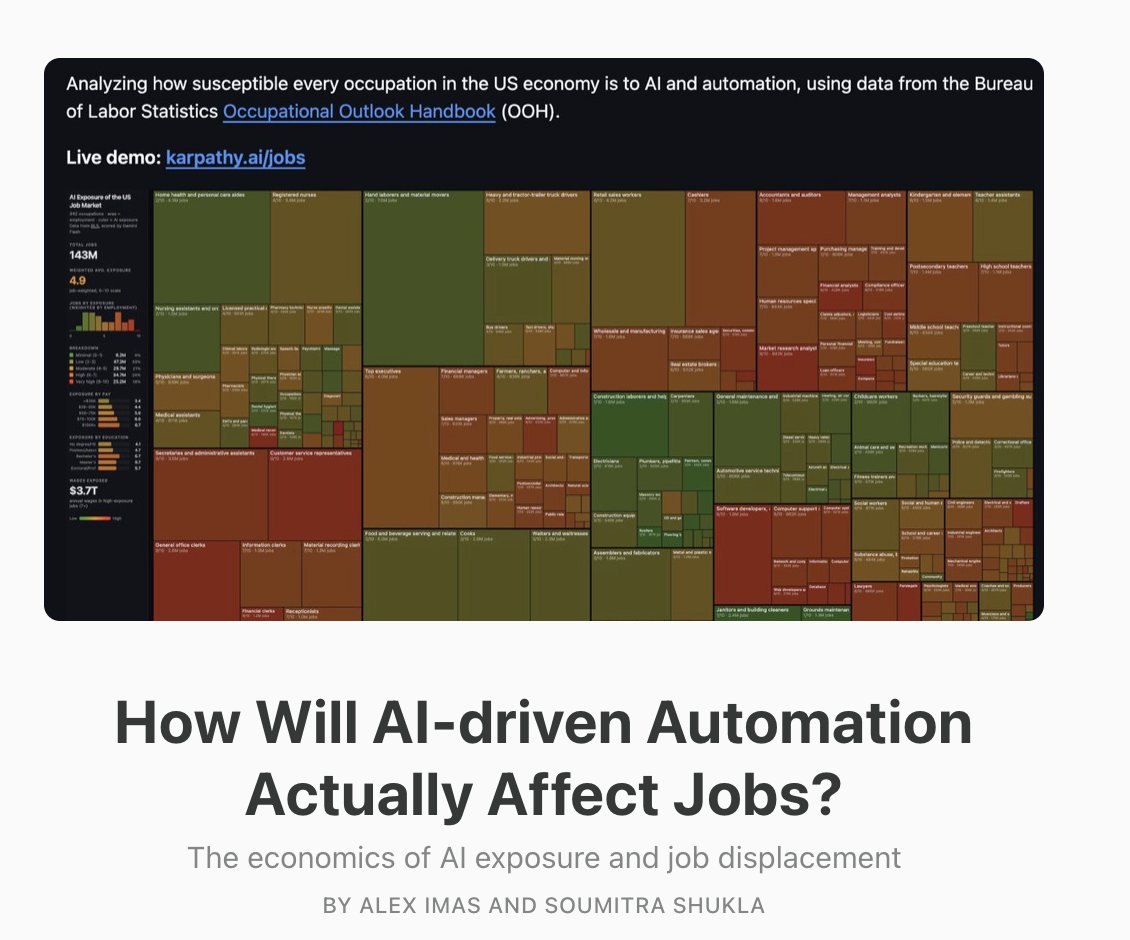
After a brief hiatus, new post with @soumitrashukla9: "How Will AI-driven Automation Actually Affect Jobs? The economics of AI exposure and job displacement" There has been a lot of discussion in the media, X, substack, etc about AI driven displacement. We felt like it'd be worth working out the actual economics of when AI automation will actually lead to displacement, versus the exact opposite (more hiring, higher wages). A short summary🧵: AI "exposure" measures are not meant to predict displacement or job automation. Exposure can lead a job loss, or it can lead to more hiring and higher wages. It all depends on how 1) automated tasks interact with non-automated tasks (to what extent they're complements), 2) how consumer demand in that sector responds to prices (elasticity of consumer demand), and 3) the dimensionality of the job (the number of tasks a job has). One conclusion: we should be less worried about consultants and more worried about truckers and warehouse workers than we currently are. Link: substack.com/home/post/p-19…
Alex Imas tweet media
English
18
83
294
96.4K
Michael Ewens
Michael Ewens@startupecon·
@polisisti @aniketapanjwani @DAcemogluMIT This is the skill summary. I'd ask Claude to create a skill for extracting+analyzing an academic paper. "I want you to first convert the PDF to Markdown using MarkItDown" ...and then add your own instructions on how you like the paper summarized including thing to watch out for,
English
1
0
1
152
Aniket Panjwani
Aniket Panjwani@aniketapanjwani·
How useful is Claude Code's 1 million context window for academics? Yesterday, I tried pushing Claude Code to do a literature review of as many as @DAcemogluMIT 's papers as would fit in context. Here's what I learned: > CC will try to "get around" actually fitting the full text of papers into its context. It did this silently by reading parts of some papers (often the first 20 pages) and none of other papers, and only revealed it did this after I pressed it after being puzzled by some behavior. > However, the implied token usage by even reading the first 20 pages of many papers should have been much higher. I'm still not 100% sure what's going on - either some sort of auto compaction, or it's just lying. > I got it to "spend" more tokens by first extracting the text from PDFs (imperfectly), and then reading the text directly rather than doing an operation on the PDF. > Context visualization from /context seems broken. After going through this exercise, it shows 481k tokens used, but 962k free space remaining. > I don't see this *at all* as replacing reading papers. The bottleneck is still *human* understanding. I think of the output as a rough map I do not fully trust, but which nevertheless speeds up the pace at which I can understand papers. > I think the optimal approach is something like this: 1. Do a full text extraction with a dedicated skill per paper, one subagent per paper. 2. Use other sets of subagents to do specific types of summaries analyses per paper. 3. Use a final agent or set of agents to combine those summary analyses in a way particular to you. > I also think there are going to be gains from experimentation combining CC/Codex, perhaps Gemini, and also - if you have lots of $ - gpt 5 pro by API via opencode. Made a YouTube video on the new 1M Context - youtu.be/sns-ks-bUJM?si… - the exercise with Acemoglu's papers starts about 4 minutes in the two literature review pdfs I produced in the exercises are her - ai-mba.io/tutorials/clau…
YouTube video
YouTube
English
17
16
147
100.1K
Michael Ewens
Michael Ewens@startupecon·
@aniketapanjwani Thanks! You confirmed the basics of my plan and reduced my hesitancy about giving it a shot.
English
0
0
1
132
Aniket Panjwani
Aniket Panjwani@aniketapanjwani·
you can solve this by asking codex to create symlinks from agents.md -> claude.md and from your .agents/skills -> .claude/skills then any edit to your claude.md is manifest in your agents.md, and if either tool tries to read or write to your agents.md, it is just reading your claude.md . same idea for skills
English
1
0
5
399
Aniket Panjwani
Aniket Panjwani@aniketapanjwani·
interesting results. I've been 90% codex since gpt 5.3 . I only use Claude Code for design tasks now which are irrelevant to economists if you've got CC and also a ChatGpt subscription, try out the Codex desktop app and compare a bit the results you get openai.com/codex/
Aniket Panjwani@aniketapanjwani

Economists - what agentic coding tool are you using? For purpose of poll, economist is a PhD in economics/finance/accounting/marketing OR PhD student in one of those fields.

English
4
2
24
9.1K
Michael Ewens
Michael Ewens@startupecon·
@ipeirotis Great post. I use Claude Code tasks (the built-in) that persist across sessions (attached). The md task storage system is prone to errors when the context or task is long. The custom system below also allows across-project viewing and is viewable with ctrl+t.
Michael Ewens tweet media
English
0
0
2
322
Panos Ipeirotis
Panos Ipeirotis@ipeirotis·
New blog post: "Let's Work on the Next Task: Claude Code, GitHub, and the Most Diligent Project Manager I've Ever Had” A beginner's guide on how to set up Claude Code on the Web to be your project manager, organize your task list (and often handle the tasks in them), and give you a "chief of staff"+"team of RAs" that you did not know you could have. Knowledge of basic GitHub concepts that are commonly used in software engineering (branches, pull requests, and reviewing) is useful but not necessary to get you started. Because Claude Code is not (just) for coding. behind-the-enemy-lines.com/2026/03/lets-w…
English
1
14
81
10.9K
Michael Ewens
Michael Ewens@startupecon·
@arpitrage "fire the employees" = some % of workers laid off in PE buyouts in the first N years post-close?
English
0
0
0
293
Arpit Gupta
Arpit Gupta@arpitrage·
@startupecon Happy to take the other side, as I’ve talked to PE folks already doing this!
English
1
0
2
1.7K
Arpit Gupta
Arpit Gupta@arpitrage·
We are going to see the emergence of a new Private Equity strategy: buyout, fire the employees, and replace with AI
English
72
64
934
95.9K