Stéphane Amiot

326 posts

Stéphane Amiot

Stéphane Amiot

@stephaneamiot

Consultant livre et ebook

Ile-de-France, France Katılım Mayıs 2009
1K Takip Edilen262 Takipçiler
Maya Sulkin
Maya Sulkin@SulkinMaya·
Alex Karp, CEO of @PalantirTech at @a16z summit: “If Silicon Valley believes we’re going to take everyone’s white collar jobs…AND screw the military…If you don’t think that’s going to lead to the nationalization of our technology—you’re retarded”
English
192
615
7.3K
1.5M
Nils Wilcke
Nils Wilcke@paul_denton·
Glucksmann justifie ainsi son ralliement au nouveau Front populaire: "Fermez les yeux et imaginez : 300 députés RN à l’Assemblée, Bardella Premier ministre, Mariani aux Affaires étrangères, Marion Maréchal à la Culture ou la Famille, Ciotti à l’Intérieur". Efficace et terrifiant
Français
854
2.2K
10.8K
1.2M
Stéphane Amiot
Stéphane Amiot@stephaneamiot·
@arthurmensch What's your position on the EP demands on transparency, i.e. obligations for foundational models to publish sources' summaries? Is it feasible?
English
0
0
1
61
Arthur Mensch
Arthur Mensch@arthurmensch·
We have heard many extrapolations of Mistral AI’s position on the AI Act, so I’ll clarify. In its early form, the AI Act was a text about product safety. Product safety laws are beneficial to consumers. Poorly designed use of automated decision-making systems can cause significant damage in many areas. In healthcare, a diagnosis assistant based on a poorly trained prediction system poses risks to the patient. Product safety regulation should be proportional to the risk level of the use case: it is undesirable to regulate entertainment software in the same way as health applications. The original EU AI Act found a reasonable equilibrium in that respect. We firmly believe in hard laws for product safety matters; the many voluntary commitments we see today bear little value. This should remain the only focus of the AI Act. The EU AI Act now proposes to regulate “foundational models”, i.e. the engine behind some AI applications. We cannot regulate an engine devoid of usage. We don’t regulate the C language because one can use it to develop malware. Instead, we ban malware and strengthen network systems (we regulate usage). Foundational language models provide a higher level of abstraction than the C language for programming computer systems; nothing in their behaviour justifies a change in the regulatory framework. Enforcing AI product safety will naturally affect the way we develop foundational models. By requiring AI application providers to comply with specific rules, the regulator fosters healthy competition among foundation model providers. It incentivises them to develop models and tools (filters, affordances for aligning models to one's beliefs) that allow for the fast development of safe products. As a small company, we can bring innovation into this space — creating good models and designing appropriate control mechanisms for deploying AI applications is why we founded Mistral. Note that we will eventually supply AI products, and we will craft them for zealous product safety. With a regulation focusing on product safety, Europe would already have the most protective legislation globally for citizens and consumers. Any foundational model would be affected by second-order regulatory pressure as soon as they are exposed to consumers: to empower diagnostic assistants, entertaining chatbots, and knowledge explorers, foundational models should have controlled biases and outputs. Recent versions of the AI Act started to address ill-defined “systemic risks”. In essence, the computation of some linear transformations, based on a certain amount of calculation, is now considered dangerous. Discussions around that topic may occur, and we agree that they should accompany the progress of technology. At this stage, they are very philosophical – they anticipate exponential progress in the field, where physics (scaling laws!) predicts diminishing returns with scale and the need for new paradigms. Whatever the content of these discussions, they certainly do not pertain to regulation around product safety. Still, let’s assume they do and go down that path. The AI Act comes up with the worst taxonomy possible to address systemic risks. The current version has no set rules (beyond the term highly capable) to determine whether a model brings systemic risk and should face heavy or limited regulation. We have been arguing that the least absurd set of rules for determining the capabilities of a model is post-training evaluation (but again, applications should be the focus; it is unrealistic to cover all usages of an engine in a regulatory test), followed by compute threshold (model capabilities being loosely related to compute). In its current format, the EU AI Act establishes no decision criteria. For all its pitfalls, the US Executive Order bears at least the merit of clarity in relying on compute threshold. The intention of introducing a two-level regulation is virtuous. Its effect is catastrophic. As we understand it, introducing a threshold aims to create a free innovation space for small companies. Yet, it effectively solidifies the existence of two categories of companies: those with the right to scale, i.e., the incumbent that can afford to face heavy compliance requirements, and those that can’t because they lack an army of lawyers, i.e., the newcomers. This signals to everyone that only prominent existing actors can provide state-of-the-art solutions. Mechanistically, this is highly counterproductive to the rising European AI ecosystem.  To be clear, we are not interested in benefiting from threshold effects: we play in the main league, we don’t need geographical protection, and we simply want rules that do not give an unfair advantage to incumbents (that all happen to be non-European). Transparency around technology development benefits safety and should be encouraged. Finally, we have been vocal about the benefits of open-sourcing AI technology. This is the best way to subject it to the most rigorous scrutiny. Providing model weights to the community (or even better, developing models in the open end-to-end, which is not something we do yet) should be well regarded by regulators, as it allows for more interpretable and steerable applications. A large community of users can much more efficiently identify the flaws of open models that can propagate to AI applications than an in-house team of red-teamers. Open models can then be corrected, making AI applications safer. The Linux kernel is today deemed safe because millions of eyes have reviewed its code in its 32 years of existence. Tomorrow’s AI systems will be safe because we’ll collectively work on making them controllable. The only validated way of working collectively on software is open-source development. Long prose, back to building!
English
60
335
1.3K
789K
Stéphane Amiot
Stéphane Amiot@stephaneamiot·
@NPA_officiel Pourquoi ne pas y aller vous-mêmes ? Pour qu'on soit débarrassés de vous une bonne foi pour toutes !
Français
0
0
2
242
NPA - L'Anticapitaliste
NPA - L'Anticapitaliste@NPA_antica·
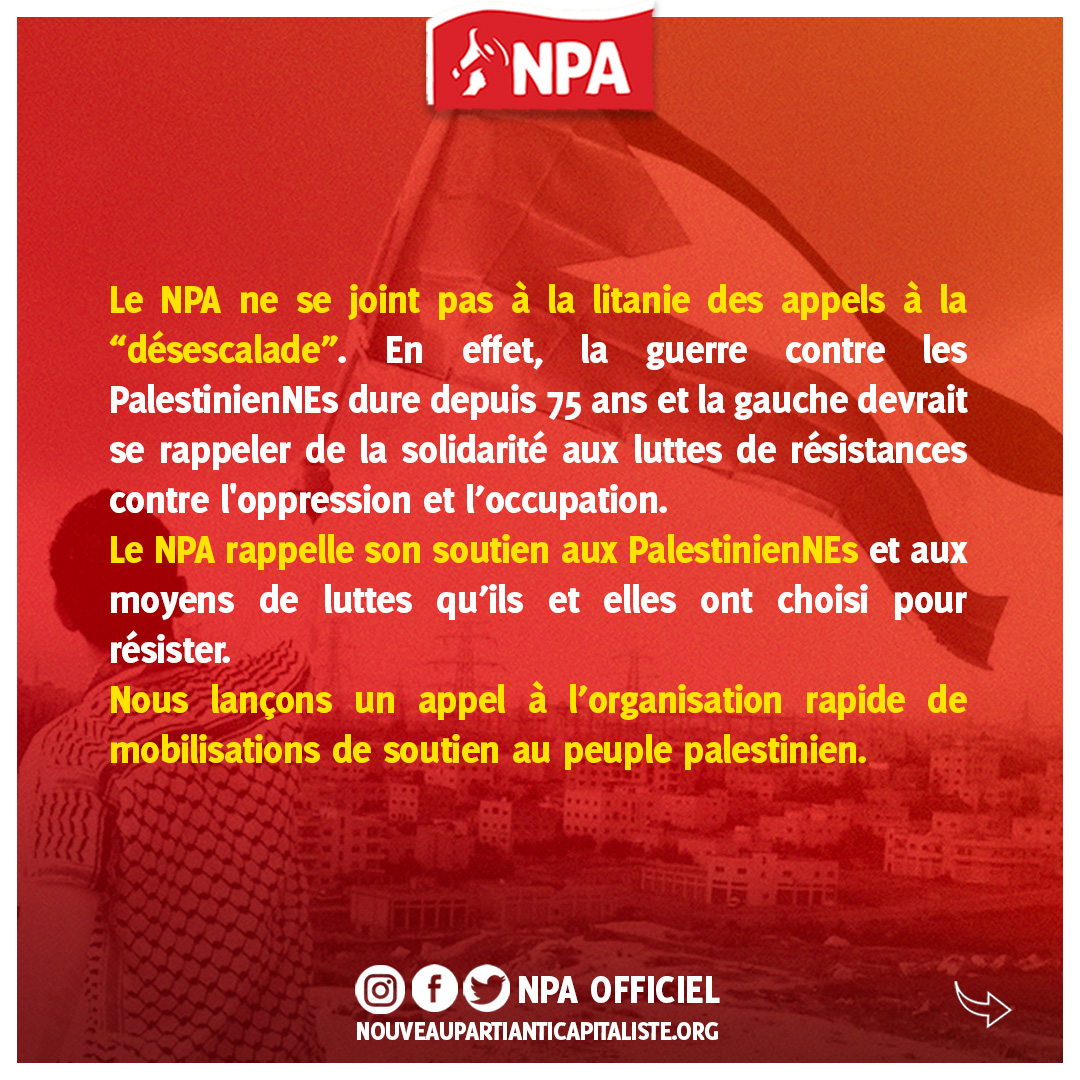
Le @NPA_officiel rappelle son soutien aux PalestinienNEs et aux moyens de luttes qu’ils et elles ont choisi pour résister. Nous lançons un appel à l’organisation rapide de mobilisations de soutien au peuple palestinien. 5/6
NPA - L'Anticapitaliste tweet media
Français
736
188
545
2M
Stéphane Amiot
Stéphane Amiot@stephaneamiot·
@sararbg Le texte de chatgpt est pas mal en effet. Mais il faut dire aussi qu'on accélère le processus en détruisant les pompes naturelles à carbone, comme la forêt équatoriale par exemple. Le Congo est moins abîmé que l'Amazonie pour l'instant... Mais justement, il faut les sensibiliser.
Français
0
0
1
17
Sara Rosenberg
Sara Rosenberg@sararbg·
Gros challenge : dimanche je vais devoir expliquer à des enfants du village le concept et les conséquences du réchauffement climatique. Avec leur perspective (enfant + monde rural du Congo) Je prends toute bonne idée! 🙏🙏🙏
Français
3
1
1
272
Stéphane Amiot
Stéphane Amiot@stephaneamiot·
@ZemmourEric C'est officiel, votre connaissance de l'antiquité est basée sur Astérix et Obélix. Il y a 4000 à 5000 ans d'écart entre l'érection de ces mégalithes et le début de la civilisation celtique ! #inculte
Français
0
0
0
21
Eric Zemmour
Eric Zemmour@ZemmourEric·
En déplacement en Bretagne, j’ai voulu aller à Carnac là où des menhirs vieux de 7500 ans sont en train d’être massacrés. Ce que cette époque détruit, nous le reconstruirons.
Français
701
2.8K
7K
435.1K
Sara Rosenberg
Sara Rosenberg@sararbg·
Voilà, voilà ! Bon maintenant vivement le Congo !! 😁
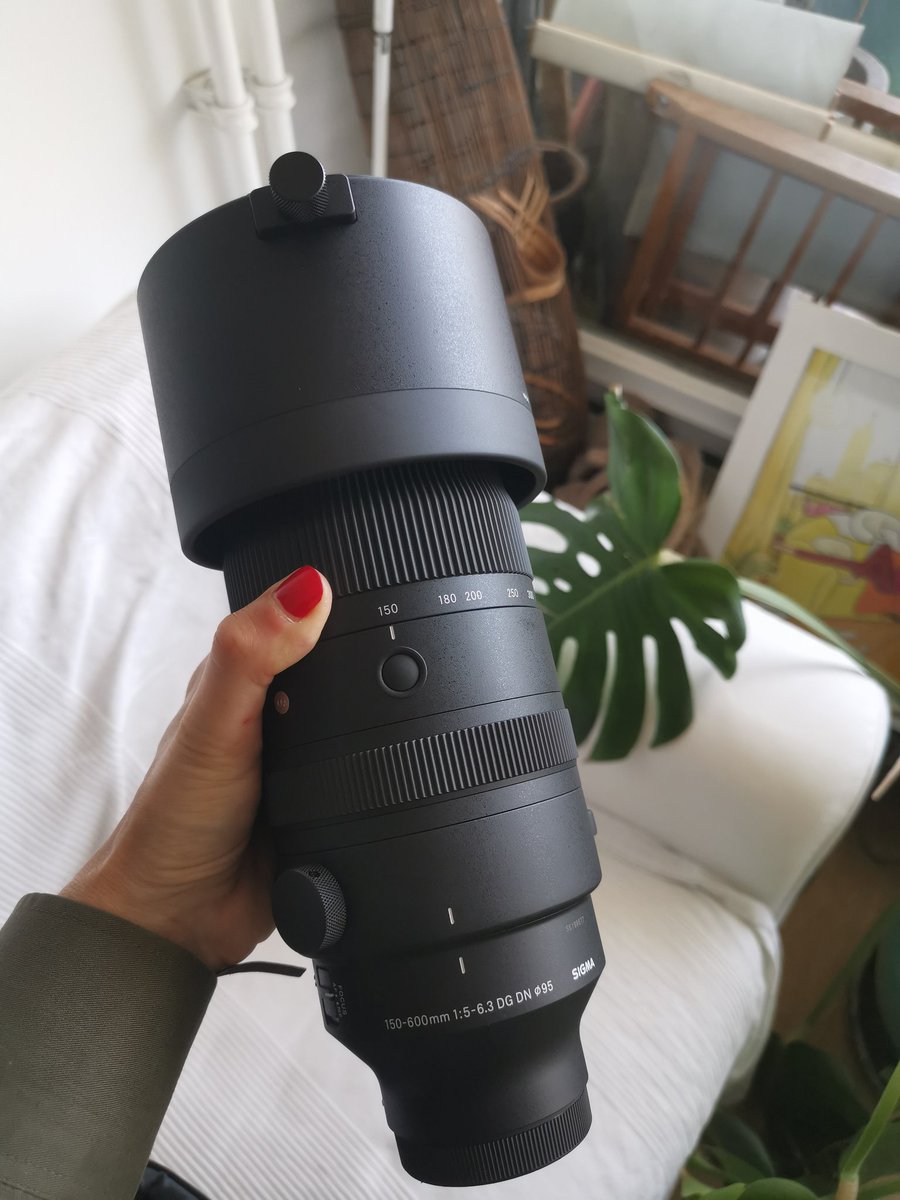
Sara Rosenberg tweet media
Boulogne-Billancourt, France 🇫🇷 Français
3
0
8
412
Stéphane Amiot
Stéphane Amiot@stephaneamiot·
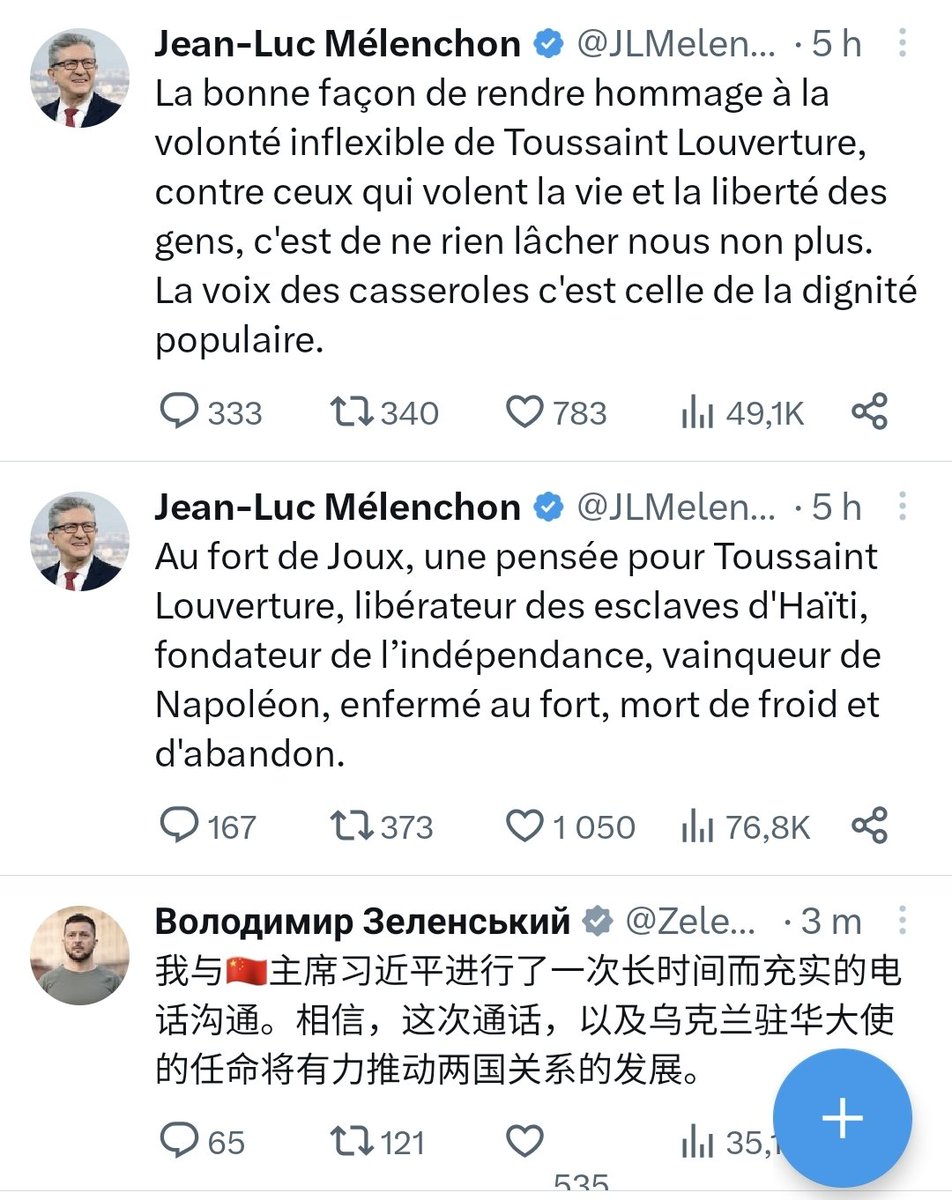
Carambolage sur mon fil Twitter : Zelensky et Mélenchon, l'Ukraine en lutte pour sa survie et les casseroles en lutte pour... faire du bruit !
Stéphane Amiot tweet media
Français
0
0
1
60
Xoxo
Xoxo@chicfryrice·
@elonmusk @unusual_whales No…way more. It started because of police brutality and the corruption by Macron and other politicians. They also increased pension on the people but kept it the same for those in government.
English
270
187
7.3K
776.2K
unusual_whales
unusual_whales@unusual_whales·
This week protesters entered Euronext, the Paris Stock Exchange, as anger over President Macron's pension reform continues to rise, per Bloomberg:
English
1.4K
4.5K
39.7K
17.1M
Stéphane Amiot
Stéphane Amiot@stephaneamiot·
@LaTacfi Merci d'avoir remis une émission scientifique à 14h au lieu de la tribune politique qu'on y entendait depuis deux ou trois ans. Ah zut, les autres reviennent lundi !
Français
0
0
0
10
La Terre au Carré 🌏²
Profonds, mystérieux, inquiétants… Les #abysses sont un monde méconnu qui effraie, fascine, intrigue et dont les mystères sont sources de récits🐟 Mais cet écosystème n’est pas à l’abri, comme tant d’autres, des activités humaines radiofrance.fr/franceinter/po…
La Terre au Carré 🌏² tweet media
Français
3
6
12
9.8K
Stéphane Amiot
Stéphane Amiot@stephaneamiot·
@JLMelenchon Ce qui veut dire que la voix du peuple, c'est du bruit. Quel mépris pour le peuple.
Français
0
0
0
5
Jean-Luc Mélenchon
Jean-Luc Mélenchon@JLMelenchon·
Les casseroles sont la voix du peuple. Dans la rue et aux fenêtres. #Macron dans le noir en visite officielle. Une étape se franchit dans l'insurrection citoyenne.
Français
1K
846
2.9K
248.6K
Stéphane Amiot
Stéphane Amiot@stephaneamiot·
@LaTacfi @PenelopeB Vous touchez vraiment le fond. Dire que vous passiez pour une émission scientifique... Du pur militantisme, comme presque tous les jours d'ailleurs.
Français
1
0
1
346