Here's my crazy thought for the day: I think the Golden Cheeked Warbler should replace the mockingbird as the official Texas state bird. I know, I know ... mockingbirds are awesome, but hear me out:
1) Mockingbirds are the official state bird of not only Texas but also Arkansas, Tennessee, Mississippi, and Florida.
2) The Golden Cheeked Warbler is the only bird species that is endemic to Texas. That means it nests only here ... not in any other state or Mexico. Every other species of birds that nests in Texas also nests someplace else.
3) The mockingbird is a gray, non-descript bird. The golden-cheeked warbler? See photo.
4) Golden-cheeked warblers don't spend half the day sitting on a fencepost yelling at cats, as a mockingbird is doing outside my window at this very moment. 😀
@flatland_sports You can still see where the NTS building has been repaired by the slightly different colored bricks that replaced the ones that were peeled off by the tornado.
*Traces of Texas Tech*
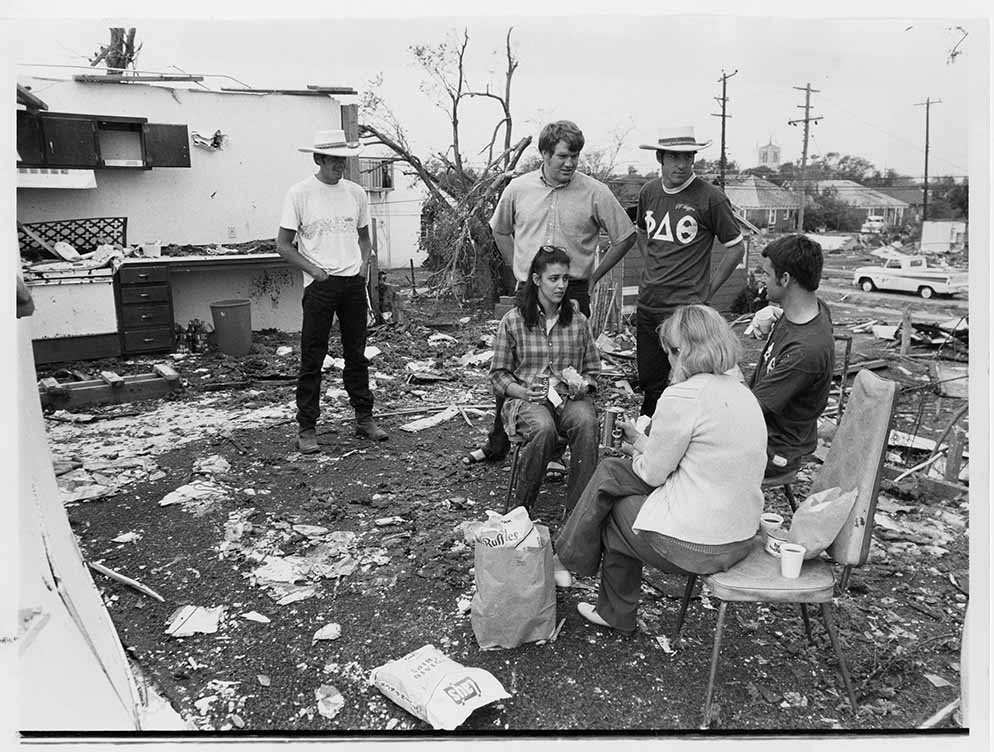
Photograph of storm damage from the on May 11, 1970. The accompanying caption reads:
“Texas Tech students survey the tornado damage to their apartment building. Several apartment complexes near the campus were destroyed or severely damaged.”
The tornado killed 26 people and remains one of the deadliest and most destructive tornadoes in Texas history.
Thankfully, most students had already left for the summer by May 11. Had classes still been in session, the loss of life could have been far worse.
For the students who remained in Lubbock, the tornado came dangerously close to campus and tore through neighborhoods where many students lived off campus.
One former student, Ramsay Banks, shared his recollection of that night with KCBD in 2005:
The evening of May 11th 1970, I had a date with my girlfriend Leslie who lived in the Gates dormitory on 19th street. The weather was clear and warm in the early evening, with distant clouds. We went out to eat, then back to the lobby of her dorm to watch tv. It began to rain, then the storm began to gather more and more force. I remember going out to my car for a minute, and the wind was blowing with tremendous gusts. Inside the big steel-framed girls dormitory, you really couldn't hear or feel the storm. Gates dorm on 19th is only a few hundred yards from where the roofs of houses began to be damaged, east and north 19th and University.
As I sat with my girlfriend, watching tv, the lights in the dorm went out. We smooched a little while the lights out since no one could see us(dorm rules in those days were pretty strict, they even had monitors to make sure nothing unseemly happened). The lights came back within a few minutes when the TTU backup generators powered up. We began to hear on the radio what had happened.
I had to drive back to my parents house in South Lubbock, since I had a curfew and was expected to be home. As I drove out of the dorm parking lot, the storm had stopped, but water was over the curbs. My little white Renault 10 car was great about not drowning out in deep water. I went over to 19th and University. The traffic lights were out, and there was a policeman directing traffic in the flooded intersection.
The next day, I went driving around downtown Lubbock to view the damage. National Guard troops were out, and the area around the Great Plains(now NTS)building was barricaded. It was thought that the 20 story building might fall. A large amount of brick had indeed fallen off the North side of the building, and many windows were broken or blown out. Of course I had to go around the barricades to get a better look, but a Guardsman saw me and told me to get out of the area.
My family had a friend, an attorney who was working in his office on one of the top floors of the Great Plains building when the tornado hit it, and it was really something to hear him tell how the building was swaying so hard, that he had to hold on to the stair hand rails to keep from falling as he ran for his life down more than a dozen flights. Later, engineering analysis showed that the Great Plains building was moving, at the top, by several inches or more. Must have been pretty scary up on the top floors, when it started swaying like that.
The Great Plains building was vacant for years after, because it was believed by many that it might still fall. The Army Corps of Engineers did a study and found it to be structurally sound, so people eventually moved back in.
When spring comes to the South Plains, and the tornado weather arrives, I sometimes remember the night of May 11 1970. I've lived in Lubbock all my life, and I've yet to see a tornado firsthand, although I definitely was close enough to a tornado that night.”
*Traces of Texas Tech*
A colorized photo captures the Rolls-Royce that ended up in the lake during Tornado Jam II. But a closer look at the story behind the infamous “Cadillac in the lake” reveals something most people miss.
It wasn’t a Cadillac—at least not at first.
It was a Rolls-Royce. In fact, it was reportedly the only Rolls-Royce in Lubbock at the time. Borrowed to impress a girl—and it ended about how most of those plans do.
As Joe Ely explained in a 2002 interview with Chris Oglesby for Y’all Magazine:
“The second year, this guy brought his girlfriend to the Tornado Jam. They came out in the afternoon. Her daddy was a lawyer, Harley Huff, and he had
the only Rolls Royce in Lubbock. and this guy had borrowed that car from his girlfriend's daddy to drive it out there, you know, to look cool, so they could kinda' stud around.
And I remember this, Man! We were doing a sound check, late afternoon; I look over and here comes this Rolls. It parks over faced toward the creek, and the two people get out and start walking over to the stage. And I notice that car just roll just a tiny bit. I thought somebody else was in it; I couldn't see. It was pretty far from the stage, so I start kinda' walking over there 'cause I wanted to go over and see that car, anyway. And it started rolling a little faster and pretty soon I yell at those people; I said, "Is that your car?" And they turn around, and by then it had started pickin' up speed.
They'd forgot to set the parking brake and that Rolls rolled into Buddy Holly River, or whatever it's called. I'll never forget this: I ran down to it--they were in a panic, just screaming, running down--I ran down to it, and I remember it went in head first and then it flipped over like a big bubble. It just flipped, and then it turned and just that angel on the hood was the only thing sticking out of the water. It was the most amazing sight.”
That’s the real origin story.
As for the well-known photo of the submerged Cadillac, that came later—and it wasn’t exactly organic.
Joe explains:
“And then the next year, Steve Moss, who was in charge of kinda' promoting & videotaping the thing, he just thought, well, "Let's kinda' set up a tradition," so he went and bought a Cadillac and just rolled it in the lake himself. So it was kind of a fake thing.
the Cadillac was in the paper, the Rolls never was. The next year ol' Steve just bought an old 'Seventies Cadillac and rolled it in there. He thought well, this is a tradition so let's keep it going. I got a picture of the tow-truck pulling the Cadillac out. I've got my hand on the side of it like it was a big fish.”
So the moment everyone remembers—the Cadillac in the lake—was staged. The real story, the one with the Rolls-Royce quietly sinking nose-first into the water, never made the paper.
And you can imagine how the Lubbock City Council felt about the idea of a car ending up in the lake every year during Tornado Jam.
But officially, of course, the event was shut down to protect the beloved buffalo grass.
Nothing else to see there.
@TracesofTexas The premier of 'The Buddy Holly Story' was held at the Lindsey Theater in 1978. Gary Busey - in pink satin jacket and slicked back hair - stayed at the hotel I worked at when I was a student at Tech.
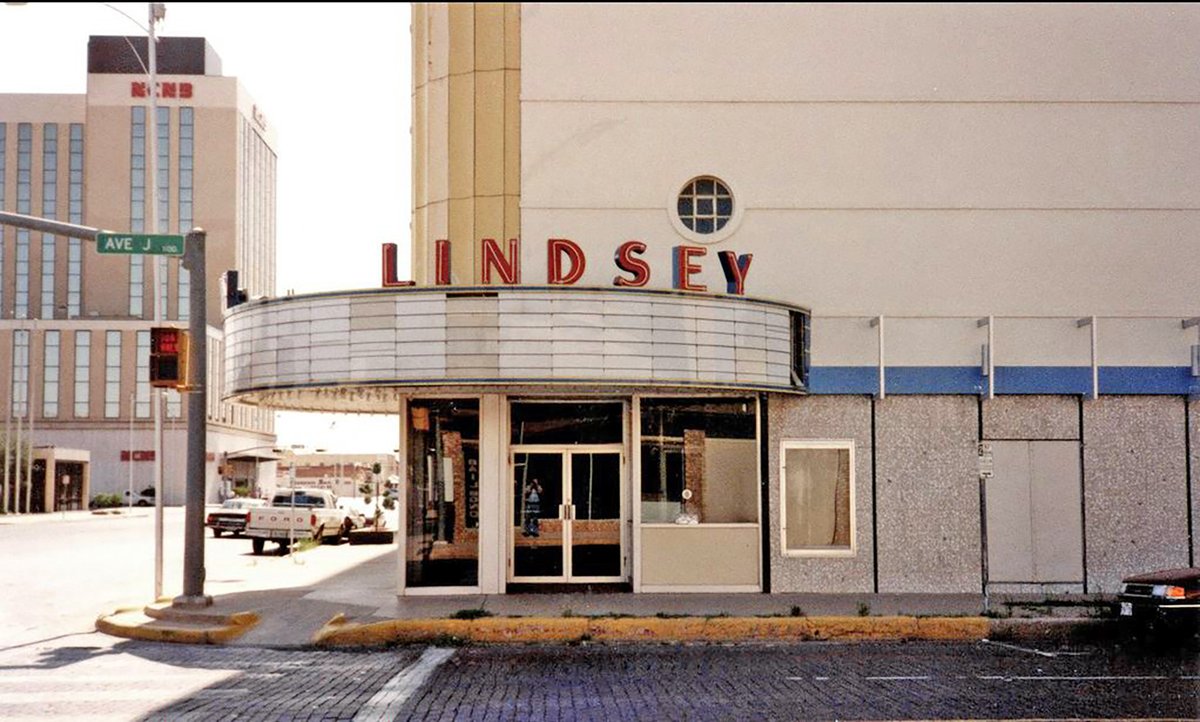
Traces of Texas reader Denise Lorenzo was nice enough to share this circa 1990 photo of the Lindsey Theater in Lubbock. Denise worked at the theater in the 1970s. It had closed down by the time this was taken but, per Denise, at one time it was quite a happening place.
The Lindsey was opened on November 7, 1940 with Tyrone Power in “The Mark of Zorro." It stopped showing movies in early 1980. In July, 1980, it became a short-lived performing arts venue named Lindsey Center for the Performing Arts and was used for concerts and other live performances. By 1990, the theater had closed for good. That's a pity, because at one time it was an elegant theatre featuring this corner entrance, semi-circular marquee with the Lindsey lettering on opposite sides of the marquee and the huge decorative column over the marque seen here. It was levelled sometime after 1990 and a parking lot stands in its place now. Denise remembers it as "a symbol of mid-century Lubbock's cultural scene" and says that many old Lubbock folks remember it with a great deal of wistful nostalgia.
Did any of y'all ever see any movies here or have any memories/stories about it that you'd kindly share?
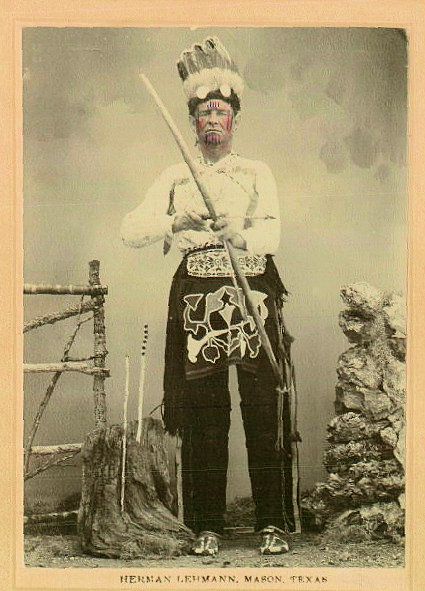
@histories_arch Herman Lehmann participated in the Battle of Yellow House Canyon on March 18, 1877 within the present day city limits of Lubbock. It was the last battle on the Texas High Plains between Indians and whites, in this case buffalo hunters.
He was wounded in the thigh.
Herman Lehmann was born on June 5, 1859, near Mason, Texas, to German immigrant parents.
On May 16, 1870, a raiding party of Apache warriors captured ten-year-old Herman and his eight-year-old brother Willie while the two boys were working in the fields.
A cavalry patrol encountered the raiding party four days later, and Willie managed to escape, but the Apaches fled with Herman still in their possession.
He was taken to a village in eastern New Mexico, adopted by an Apache warrior named Carnoviste and his wife, Laughing Eyes, and given the name "En Da," meaning Pale Boy.
Over six years, Herman became fully assimilated into Apache life, eventually rising to the position of petty chief and fighting alongside warriors against Texas Rangers.
After killing an Apache medicine man to avenge the death of his adoptive father, Herman fled and eventually sought refuge among the Comanche, who gave him the name Montechema.
Comanche chief Quanah Parker eventually persuaded Herman and other holdouts to surrender and relocate to the reservation near Fort Sill in present-day Oklahoma.
In May 1878, soldiers escorted Herman back to his family in Loyal Valley, Texas, nearly nine years after his capture.
His return was emotionally difficult as neither he nor his mother recognized one another, and it was only a childhood scar on his arm that confirmed his identity.
Readjusting to white society was a slow and painful process, as Herman had fully embraced Native life and considered himself an Indian.
He later published his memoir, Nine Years Among the Indians, in 1927, which is considered one of the finest captivity narratives in American literature.
Herman Lehmann died on February 2, 1932, and is buried beside his mother in Loyal Valley, Texas.
Herman Lehmann's story had a lasting impact on how Americans understood the complex relationships between white settlers and Native American tribes on the frontier. His memoir provided a rare firsthand account of life inside Apache and Comanche communities during one of the most turbulent periods of the American West, challenging simplistic narratives of conflict and offering a more nuanced portrait of assimilation, identity, and belonging. His legal recognition as an adopted Comanche, which entitled him to a land allotment from the U.S. government, set a notable precedent in the treatment of white captives who had lived among Indigenous peoples. His life story also inspired later works of fiction, including Fred Gipson's novel Savage Sam, ensuring that the frontier experience he lived continued to shape American cultural memory long after his death.
#archaeohistories
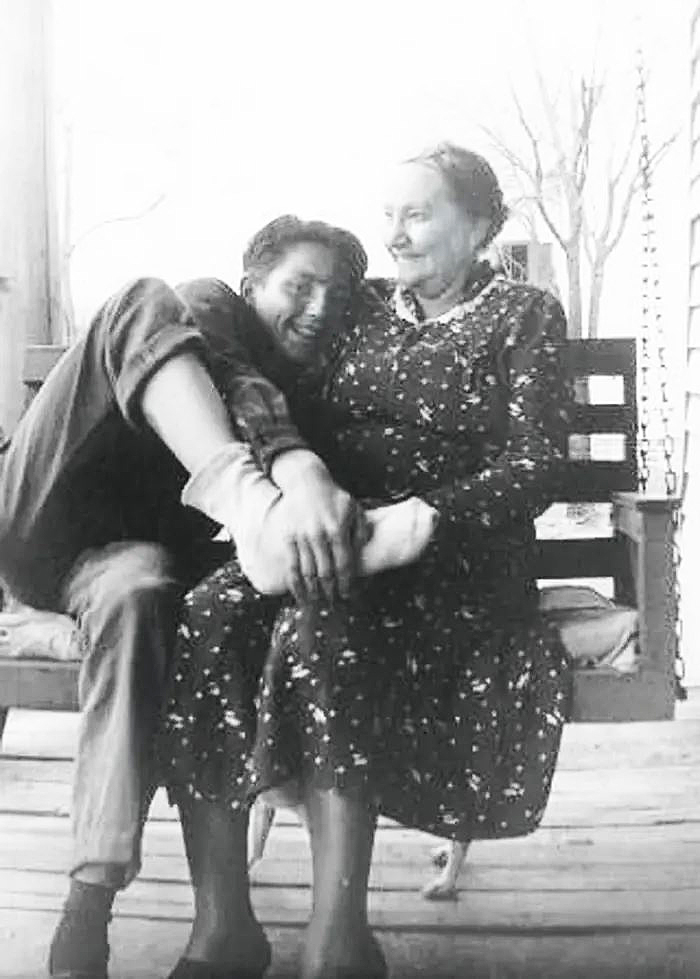
Happy birthday to Willie Nelson, who turned 93 today and is still out on the road, performing two nights ago at the Koka Booth Amphitheater in North Carolina. He is amazing. Here's a circa 1950 photo of Willie with his grandmother, Nancy Nelson, who raised him. Willie's mom left soon after he was born and his father remarried and also moved away, leaving Willie and sister Bobbie to be raised by their grandparents, who had taught singing back in Arkansas and who started their grandchildren in music. Nelson's grandfather, Alfred, bought him a guitar when Willie was six and taught him a few chords before Alfred died in 1940. If only Alfred could have lived long enough to see what those few chords would grow into! Nancy died in 1979 at the age of 96, so she lived long enough to see Willie become a success. Maybe it's just me seeing what I want to see in this photo, but it's pretty clear that Willie and Nancy loved one another dearly.
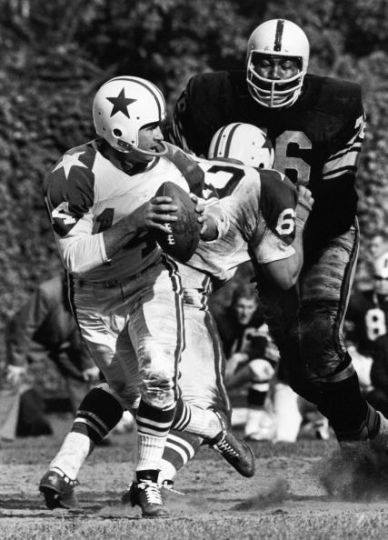
The Dallas Cowboys play the Pittsburgh Steelers, 1962. The Dallas QB is Eddie LeBaron, all 5'7," 168 .lbs of him. Eddie was a highly decorated war veteran, having been wounded twice in the Korean war during the fierce fighting for Hill 673 in the Battle of the Punchbowl. He received the Purple Heart and the Bronze Star Medal with Combat "V" for heroism. After all that, he came back and was NFL Rookie of the Year in 1952. I should probably add that Tom Landry was the coach of the Cowboys.
The monster Pittsburg defensive lineman is Gene "Big Daddy" Lipscomb, the prototype for the modern NFL lineman at 6'6", 300 .lbs. He would die of a heroin overdose within the year. He was most famous for saying, "I just wrap my arms around the whole backfield and peel 'em one by one until I get to the ball carrier. Him I keep." I THINK this photo was taken at Forbes Field in Pittsburgh. If so, the Cowboys won, 42-27.
Zack T. Burkett, foreman of the LS outfit, draws a map of the day's work in the dust for the cowboys while they look on at the LS Ranch near Tascosa, Texas, in 1907. This photo was taken by noted cowboy photographer (and Texan) Erwin E. Smith, who was both a working cowboy and a serious self-taught photographer. The photos that he left behind are a remarkable archive of a way of life that was in the midst of rapid change. Most of his photos can be seen at the Amon Carter Museum of American Art. All of Erwin's stuff is great but this is stupendous --- one of the best collections of hats you'll ever see!
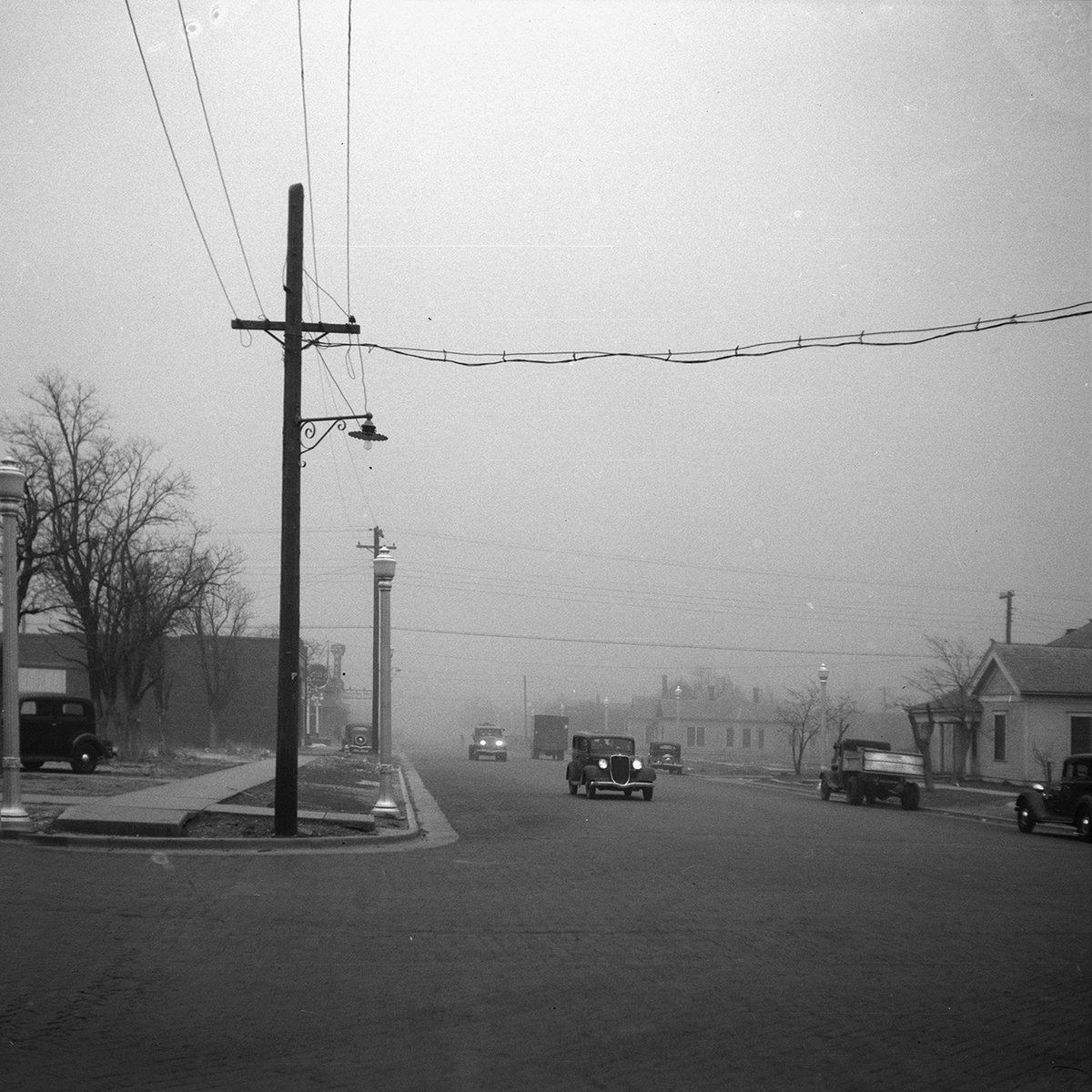
I have posted a couple of different photos of this dust storm in Amarillo, but never this one. Arthur Rothstein, who took it in 1936, commented that it was so fierce that drivers had to turn their headlights on. I was in a dust storm in Amarillo about 30 years ago that, as the storm lifted, I swear the sky turned purple. I've been in a few others but this one was on another level. Do you have any great dust storm stories? I'd love to read them.
Traces of Texas reader Jim Randlett was so kind as to send in this terrific circa 1910 shot of his grandparents and friends near Beaumont. They met in Beaumont where Lilly was teacher in the oil patch. James ( for whom Jim is named ) was a Western Union dispatch rider. James and Lilly Rochelle lived out their lives in Houston where they had one child, Jim's mother. James worked for Gulf oil as a mid-level executive for 40 years. I'm not sure what I like best: the Indian motorcycles, Lily's parasol, or the stunning clarity.
Thank you, Jim. Really a sensational photo, and so well preserved!
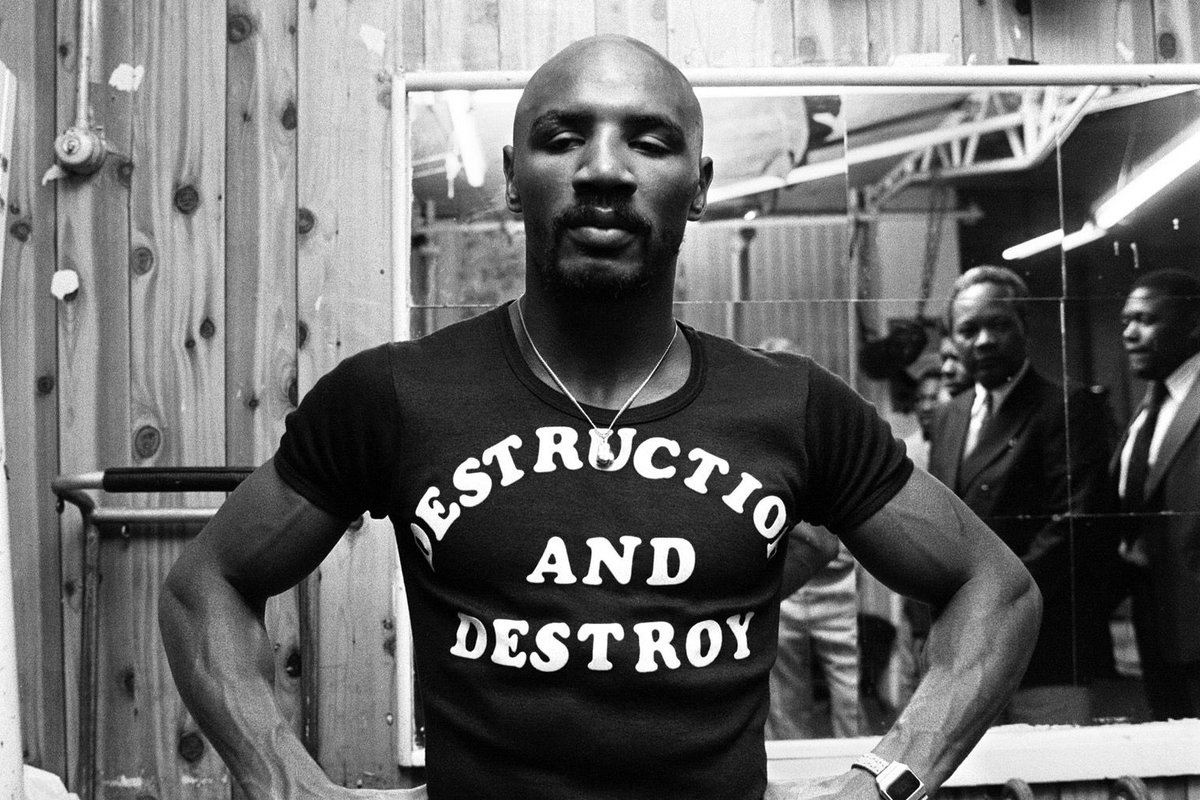
You didn’t have to guess what Marvelous Marvin Hagler was going to do, he always made his intentions crystal clear.
👉 super70ssportsstore.com/products/destr…
@rocknrollofall While at Tech, I lived in an apartment complex adjacent to Fat Dawgs. I went in one night to see what all of the excitement was about. The energy was unparalleled.
They won't tell you how good was Stevie Ray Vaughan but I will.
This is your reminder.
A 1980 clip of SRV, his raw, distorted, and extremely loud stratocaster, at the 1st Tornado Jam in Lubbock.
They don’t want you to understand what just happened…
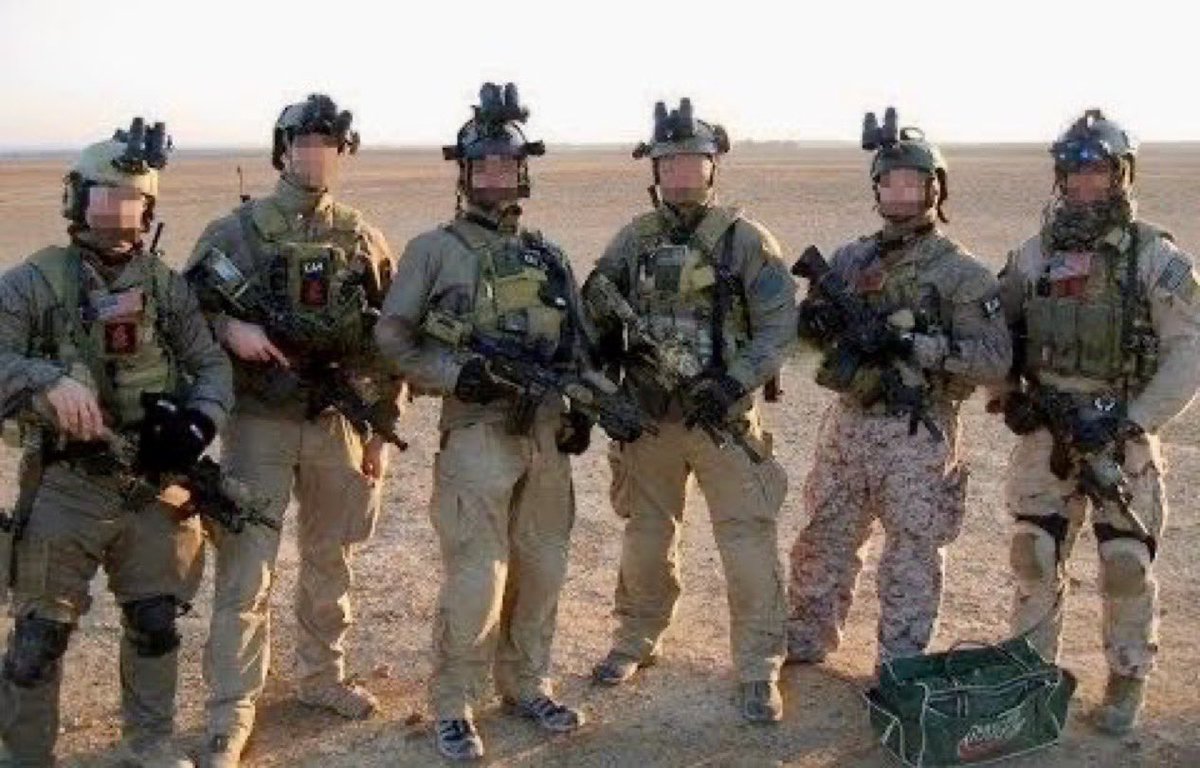
An American F-15E goes down deep inside Iran… hostile territory… mountains… IRGC hunting our guy with a bounty on his head.
Most nations lose that pilot.
America launches a full-spectrum response.
Hundreds of special operators
Dozens of aircraft
Cyber… space… intelligence all synced in real time
SEAL Team 6 goes in.
Not a movie… not a drill… real combat.
The WSO survives over a day on the ground… evading… hiding in rock formations… beacon active… waiting.
Then the hammer drops.
Extraction under fire
Forward base inside enemy territory
Aircraft disabled… and destroyed on-site so Iran gets nothing
Let that sink in…
We flew INTO Iran… fought… recovered our man… and left nothing behind.
Zero Americans killed.
That’s not luck…
That’s capability.
That’s training… doctrine… coordination… and absolute refusal to leave our people behind.
People love to talk about American decline…
Meanwhile… operations like this are happening in real time.
Quietly.
Precisely.
Decisively.
You’re watching the difference between a military…
And a machine built to win.
#SilentMajoritySpeaks#AStoneGroove
🔴 An American airman who went missing after Iran shot down his fighter jet has been rescued after a “heavy firefight”
Follow the latest updates 🔗
telegraph.co.uk/world-news/202…