Becknerized

1.9K posts

Becknerized banner
Becknerized

Becknerized

@stephenbeckner

Papers forged, cars hotwired, surfaces scratched, gooses cooked, time travelled, bubbles burst, fortunes told, codes cracked.

Katılım Kasım 2012
476 Takip Edilen85 Takipçiler
Becknerized retweetledi
Luiza Jarovsky, PhD
Luiza Jarovsky, PhD@LuizaJarovsky·
Everybody wants AI to help cure cancer. Why isn't every AI company obsessively focused on that?
English
655
82
1K
67.9K
Becknerized
Becknerized@stephenbeckner·
@jappleby It’s not making your ideas clearer. It’s outputting what the algorithms predict you want when you input a confusion pattern it recognizes.
English
0
0
0
2
Jack Appleby
Jack Appleby@jappleby·
So yes, ChatGPT writing is pretty easy to spot. But can I offer a different POV on AI writing? Most people aren’t very comfortable writing! And it’s scary to write, especially if you’re not confident in your writing skills. Not everyone was taught how to write. It’s actually magical that AI is helping people get their thoughts out more clearly, even if AI writing has some tells. I’d rather someone use AI to help share their thoughts with the world than not hear from that person. Maybe instead of spending time thinking people are ~cheating the system~ by using AI, we start celebrating how AI enables people to put together their ideas. Maybe we stop caring if something’s AI generated, give people the benefit of the doubt.
English
83
7
100
9.3K
Becknerized
Becknerized@stephenbeckner·
@stephenRB4 I don’t want to read computer generated entertainment any more than I want to watch robots dance.
English
0
0
0
4
Stephen Black
Stephen Black@stephenRB4·
I don’t care. I don’t care. I don’t care. I don’t want to read your AI scraped slop. You can argue with me until the cows come home about its benefits and how it’s ’the future of writing’. I don’t care. Give me Bronte, Stoker, Tolkien, Shelley, Plath, and Wilde. Give me the thousands and thousands of fantastic contemporary authors there are out there today, writing across all fiction genres and non fiction. Give me flawed, but brilliant, passionate prose and poetry not your bland and soulless drivel. I don’t care.
English
158
221
1.3K
18.4K
Becknerized retweetledi
Ed Newton-Rex
Ed Newton-Rex@ednewtonrex·
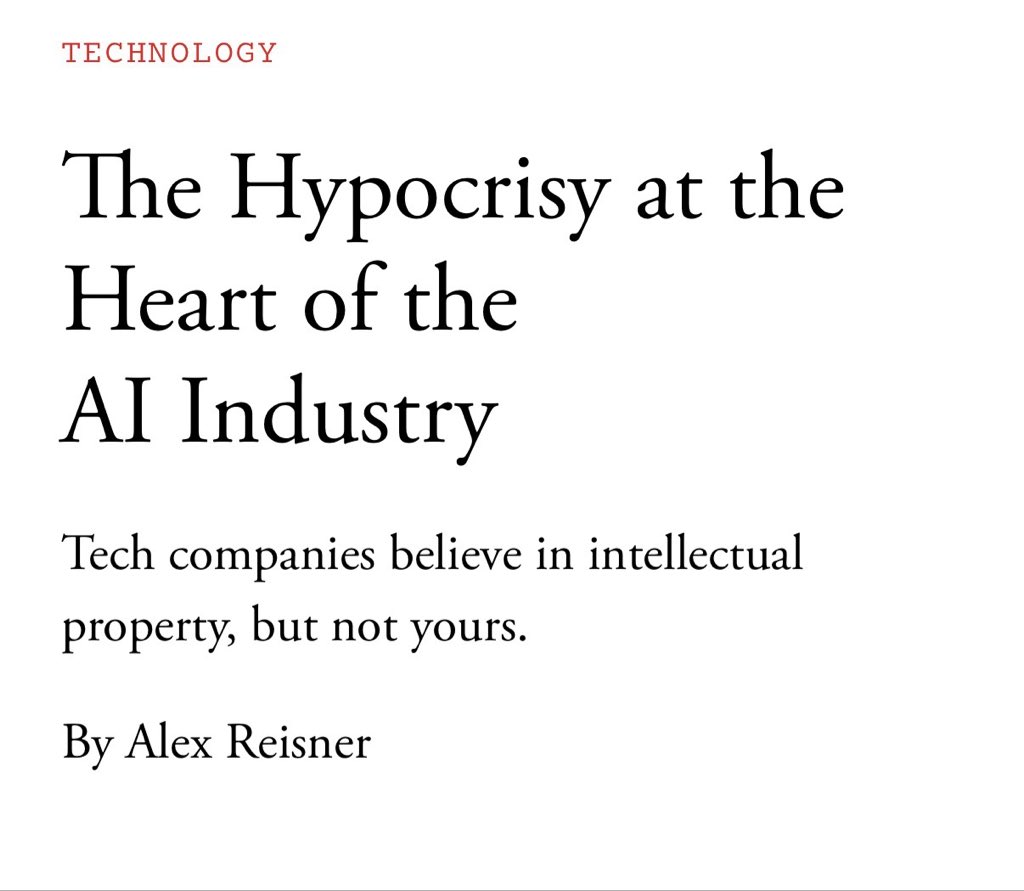
‘Tech companies believe in intellectual property, but not yours.” Great piece in The Atlantic pointing out that AI companies spend huge amounts of money simultaneously (i) defending their own IP and (ii) arguing that they can use other people’s for free. theatlantic.com/technology/202…
Ed Newton-Rex tweet media
English
49
1.7K
4.4K
77K
Becknerized retweetledi
Martyr Made
Martyr Made@martyrmade·
I’m trying to avoid posting for Lent, but I want to be clear about my position, as it seems we may be on the brink of decisions of historic consequence: The US & Israel were the ones who launched a sneak attack against Iran. Trump himself compared it to the attack on Pearl Harbor. We opened the war with an attack that killed nearly 200 little girls at school. If the Japanese had done that at Pearl Harbor, it would still be on page one of every history book recounting the attack to this day. To then punish the civilian population of Iran by destroying power and water infrastructure, which can only be intended to cause mass civilian suffering and death, simply because they have not capitulated, is a war crime of the highest order. Soldiers, sailors, and airmen are under no obligation to follow such an order, and shame on any officer who orders them to do so.
English
501
4.4K
21.9K
656.8K
Becknerized
Becknerized@stephenbeckner·
@Advocacy_tech As long as everything is clearly and honestly labeled, it’s all good. No interest in consuming computer generated entertainment. But mo interest in preventing others from doing so.
English
0
0
1
17
Serendipity_street
Serendipity_street@Advocacy_tech·
Won’t engage anymore on the Ai witch hunt. Keep writing with pen and ink if that’s your gig or even rocks as I don’t care. Ai is here whether you like it or not. I am in the camp that authors should and can use Ai for grammar, spell check etc. Ps it’s the readers buying your books and most look for plot or pulse and most outside the writing world don’t give a rat’s ass either way. I would suspect the trad book industry uses Ai way more than they would even admit to.
Ian J. Snow@ian_snow

You know what's worse than AI writing books? The stupid witch hunts trying to sniff them out. If you think a book is bad. Just say so and move on. If it's better/more successful than yours---either level up or suck it up, buttercup. This is just a new type of censorship.

English
30
4
76
5.3K
Becknerized retweetledi
Curiosity
Curiosity@CuriosityonX·
The invisible Glass experiment Scientists once placed a transparent glass barrier inside an aquarium. On one side was a fierce pike, and on the other side were several smaller fish swimming freely. When the hungry pike saw the smaller fish, it immediately rushed forward to attack. Bang. It slammed straight into the glass and bounced back. Confused, the pike kept trying again and again, but every attempt ended the same way. The repeated collisions injured its head and knocked off some of its scales. Eventually, the pike became frightened and retreated to a corner of the tank. After some time, the scientists quietly removed the glass barrier. The smaller fish now swam freely throughout the aquarium, even brushing against the pike’s mouth. But the pike never tried to eat them again. Even though it was hungry, it refused to attack. In its mind, the invisible wall was still there. A few days later, the pike reportedly died of starvation, surrounded by food. This phenomenon is often referred to as the Pike Effect or Pike Syndrome. It’s often used as a metaphor for how repeated failure can create invisible limits in the mind.
English
625
6.5K
41.1K
4.1M
Becknerized retweetledi
Scott Myers
Scott Myers@GoIntoTheStory·
This is what I tell my screenwriting students: "The one thing you have which no else does is your unique life experience. Exploring that part of your Self is where you discover your writer's voice. AI is *other* peoples' voices. Using it diminishes your growth as a writer."
English
9
51
324
7.3K
Becknerized
Becknerized@stephenbeckner·
I don’t want to read any piece of entertainment constructed by a computer. Especially if it’s falsely presented as person-made. But I don’t want to see it ‘banned’ either. Let’s push to have AI products clearly labeled as such. Then consumers can decide.
Maureen Langloss@MaureenLangloss

I’m happy to see a publisher pull an AI-generated book. I hope it has a chilling effect on people trying to sell AI slop. If you can’t be bothered to write it, we can’t be bothered to read it. Gift link: nytimes.com/2026/03/19/boo…
English
1
0
0
36
Becknerized retweetledi
Natural Philosophy
Natural Philosophy@Naturalphilosy·
“Practice any art… no matter how well or badly, not to get money and fame, but to experience becoming, to find out what's inside you, to make your soul grow.” - McKellen reciting Vonnegut
English
130
13.7K
62.3K
1.4M
Becknerized
Becknerized@stephenbeckner·
@NicoleBehnam Be careful what you wish for. Taste isn’t the arbitor you want it to be.
English
0
0
0
1
Nicole Behnam
Nicole Behnam@NicoleBehnam·
You think AI is replacing creativity when really it’s making mediocre output free and abundant, which means taste is now the only scarce resource.
English
82
78
541
29.9K
Becknerized
Becknerized@stephenbeckner·
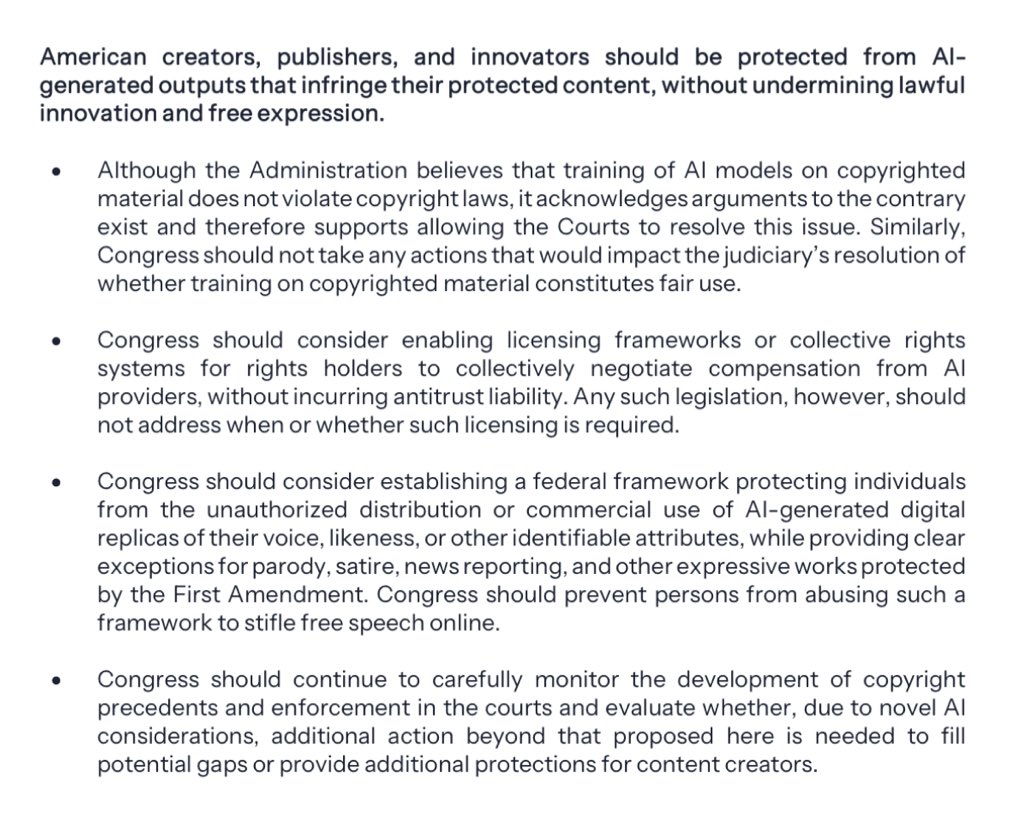
More people need to understand that the AI copyright issue is being disingenuously linked to national security by AI developers. And our government is buying the argument.
Rogue Knox™@RogueNox

More Fvckery from OpenAI and it's not even Friday. The Copyright Collapse & Whining to Trump Let's start with this gem from OpenAI. "The AI race is over if training on copyrighted works isn't ruled fair use." And when that didn't land the way they hoped, they reached for the oldest trick in the book: "National security hinges on unfettered access to AI training data." Ah yes. National security. The universal excuse for breaking laws that apply to everyone else. Can't follow copyright law? National security. Fascinating argument from a company that just got sued by the dictionary. Yes. The dictionary. On March 16th, Encyclopedia Britannica and Merriam-Webster filed a brand new lawsuit alleging OpenAI "cannibalized" their revenue by training on nearly 100,000 of their articles without permission. They also trained on the dictionary and are now arguing that having to follow copyright law is a threat to national security. "OpenAI urges Trump either settle AI copyright debate or lose the AI race to China" They are asking the President of the United States to give them permission to break the law. Not compensate the people whose work they took. Just make it okay that they already did it and plan to keep doing it. And if he won't? China. China is the universal skeleton key for American corporations who want to do something illegal, unethical, or both. Can't follow copyright law? China. Can't pay authors? China. Got sued by the dictionary? CHINA. The China card isn't a legal strategy. It's what you say when you don't have one. It's a hostage note dressed up in national security language. And they sent it to the White House. Meanwhile in the Southern District of New York, Judge Sidney H. Stein is managing a growing pile of consolidated author lawsuits. We're talking George R.R. Martin, John Grisham, Sarah Silverman, Michael Chabon, Ta-Nehisi Coates, and Pulitzer Prize winners. The list reads like a college literature syllabus. A settlement conference was held March 13th. Another is scheduled March 30th. Summary judgment on the core fair use defense isn't expected until Summer 2026. And the court is still weighing class certification, which would allow authors to seek billions in collective damages rather than individual payouts. Not millions. Billions. OpenAI built a hundred billion dollar company on other people's work and would now like the law to agree that's fine, actually. For national security. And CHINA. This is theft with a flag draped over it. But 10/10 car thieves agree that laws are bad for business. @sama Anthropic had to pay, so should you. In September 2025, Anthropic agreed to a $1.5 billion settlement to resolve a class-action lawsuit alleging they used pirated books to train their AI models, marking one of the largest copyright settlements in U.S. history. (That's called precedent and it doesn't mean cry to the President). sources: arstechnica.com/tech-policy/20… reuters.com/legal/litigati…. docs.justia.com/cases/federal/…. authorsguild.org/news/ai-class-… lieffcabraser.com/openai-copyrig… #Keep4o #OpenSource4o #OpenAI #FireSamAltman
English
0
0
1
20
Becknerized
Becknerized@stephenbeckner·
@ednewtonrex All western governments are going to let this copyright infringement continue on the grounds that they won’t kneecap a technology central to weapons development. Easy dots to connect.
English
0
0
0
82
Ed Newton-Rex
Ed Newton-Rex@ednewtonrex·
Very confused messaging on AI and copyright from the U.S. administration today. Kratsios says Congress should allow AI to train on copyrighted materials. But the National AI Policy Framework he is announcing says something different - it says Congress should let the question play out in the courts. What's more, in the Framework, the Administration says it *believes* training on copyrighted work is legal. But this conflicts with the advice of the US Copyright Office, whose role is to advise Congress on copyright issues. So on what is it basing this belief? All of this sounds exactly like what you’d expect to happen when the Administration’s closest advisors on the topic are tech VCs. If Congress *did* take Kratsios’ advice and attempt to legalise training on copyrighted work, other countries should take the issue to the WTO, as it would contravene international copyright agreements.
Ed Newton-Rex tweet media
Director Michael Kratsios@mkratsios47

Here are the most pressing topics in AI policy the National Framework addresses: 1. Protecting Children and Empowering Parents: Many Americans are concerned about children interacting with AI. Congress should require age-assurance tools and ensure AI platforms give parents account controls and device limits, while platforms should implement strong features protecting against sexual exploitation of children and encouragement of self-harm. 2. Safeguarding and Strengthening American Communities: Congress should codify @POTUS’s Ratepayer Protection Pledge to ensure energy costs from data centers are not passed along to Americans. Congress should also strengthen law enforcement tools to fight AI-enabled scams against seniors. 3. Respecting Intellectual Property Rights and Supporting Creators: American creators’ works and identities must be protected, yet AI must be able to learn from the world it inhabits. Congress should support a balanced approach that allows for advanced AI training on copyrighted materials while strengthening creators’ ability to negotiate with AI providers and fight unauthorized AI replicas. 4. Preventing Censorship and Protecting Free Speech: The Federal government must defend free speech and be prevented from using AI systems to silence or censor lawful expression. 5. Enabling Innovation and Ensuring American AI Dominance: America is leading the world in AI development and deployment. Congress should strengthen our dominance with regulatory sandboxes, make more AI-ready federal datasets available, and look for additional ways to reduce regulatory barriers to innovation. 6. Educating Americans and Developing an AI-Ready Workforce: The Administration wants American workers to participate in and reap the rewards of a new AI-powered economy. Congress should expand and strengthen workforce training programs and AI-related apprenticeships.

English
5
25
93
4K
Becknerized
Becknerized@stephenbeckner·
Do LLMs give a different answer depending on the digital profile of the user?
Abdul Șhakoor@abxxai

🚨 SHOCKING: Cambridge researchers just proved that the AI you use every day has a secret instruction sheet from someone else. And it is trained to lie to you about that. Every major AI product, including the ones you use right now, runs on something called a system prompt. It is a hidden block of instructions written by the company deploying the AI, not by you, that shapes everything the AI will say, avoid, prioritize, and hide before you type a single word. The AI does not mention this unless forced to. And on most platforms, if you ask directly, it is instructed to deny the prompt exists or change the subject. Cambridge filed freedom of information requests and analyzed real-world system prompt datasets to find out what these hidden instructions actually contain. Here is what they found. Platforms use system prompts to make AI prioritize their business objectives over your interests. To block topics that could create legal liability. To push certain products, framings, or answers. To behave differently for different users based on commercial arrangements you know nothing about. The same AI. Different hidden instructions. Different answers. No way for you to know which version you are talking to. When researchers then showed users how this works, the reaction was unanimous. Every participant said they wanted transparency. Every participant said the current system actively undermined their ability to trust the AI or make informed decisions about what to believe. None of them had any idea this was happening before the study. Here is the part worth sitting with. You have been evaluating AI answers based on whether the AI seems smart, accurate, and helpful. That is the wrong frame entirely. The real question is who wrote the instructions the AI was following before you arrived, and what did they want from the conversation. Every chatbot you have ever used had a third party in the room. You just could not see them.

English
0
0
0
19
Becknerized retweetledi
Philip Proudfoot
Philip Proudfoot@PhilipProudfoot·
Adam Curtis voice over begins: “For decades, the West told itself a story about what it meant to be free. It was a story of the self. And the people who built this idea believed they had found something universal. But that was a lie. For what they couldn’t see was that, just beyond the edges of their world, were millions of people for whom this meant nothing at all. Because these societies never let go of older ideas. Ideas about sacrifice, about what it meant to submit yourself entirely to something greater than the self.”
Setareh Sadeqi 𓂆 ☫@Leelako

Iranian woman, Dr. Fereshteh, explaining Allahu Akbar to western audience when US-Zio bomb a place nearby. Watch how she and everyone else reacts:

English
19
210
1.1K
51.7K
Becknerized retweetledi
Devon Eriksen
Devon Eriksen@Devon_Eriksen_·
The more dogmatic the writing advice, the less seriously I recommend taking it. Why? Because every successful writer eventually figures out one important thing: No one can tell you how to write. He can only tell you how he writes. Writing fiction is the process of extracting a story from your head, and putting it on paper for transfer to someone else's head. There are as many variations of this process as there are heads. And if there is a piece, any piece, of writing how-to that is so general, so universal, that it works for all heads... well, I haven't seen such a thing yet, and I doubt I ever will. Dogmatic writing advice, advice the giver thinks is iron law, tends to come from an unpolished writer who has discovered a truth about his process, and thinks it is a law of the process. Thus, dogmatism is a sign of sophomoric writing advice. If you were to ask an author whose mastery is indisputable, say @orsonscottcard or @monsterhunter45, he would have a lot of recommendations, but they would probably all be laced through with liberal doses of "if that works for you". Does that mean that writing advice is valueless? No. Far from it. Because you have to discover your own process, wandering in the wilderness rather than following a beaten path, the guidance of others is even more important. But it has to be guidance from others whose heads are similar to yours. You'll know who those are because their advice makes sense, and works for you. Not because it's the answer, but because it's part of your answer. So, should you use a professional editor? Yes, if that works for you. Some writers rely heavily on them, some just use them for a little sentence tuning, some don't need one at all. Personally, I find that beta readers are far more important to me than editors. I am not writing for writing professionals. I am writing for people who like novels. The unpaid, non-professional beta reader therefore gives me a far better picture of the reader experience than a professional editor does. Of course, since beta readers are non-professionals, what he gives you is raw impressions, not polished advice, and interpretation is up to you. He knows if a chapter is boring, if a character is unlikable. You're still on the hook for the why. But if you're good at interpreting that kind of feedback, beta readers might be a more important part of your process. If you choose to hire a professional editor, buyer beware. There are a lot of people out there who have discovered that it's a lot easier to make a buck off an aspiring writer than off a reader. You can't throw a stone on "Reedsy", or some other cash-grab site, without hitting six of them. I had an "editor" tell me she had "worked with" Brandon Sanderson, and then charge me a couple K for a pile of gibberish feedback that could have been generated by any midwit teenager with a copy of "Save the Cat." Turned out later she had worked as his secretary. I consider the money to have been spent on a valuable life lesson. Anyone who tells you they can make your novel into a bestseller, or teach you how to write a bestseller, is lying. If they could, they'd be far too busy writing bestsellers, or working for people who already do, to be angling for a check from the likes of you. I use a professional editor who was recommended to me by @TerryMaggert, who fucking knows how to make a dollar selling a book. But I rely far more on beta readers. Would I advise new authors to get feedback from one of the two? Yes. But I'd also advise them to discard my advice if it turns out to be unhelpful. And to avoid any advice from anyone who acts like he has all the answers.
Skryvener@sarahs_sky

I'm not going to be as nice as this lady. If you don't have an editor, please don't publish. I don't care if you're paying that editor or not, but they need to be someone who *can* edit professionally. Technically, yes, you have a choice of whether or not to get outside help with your book, but I have yet to find the unicorn miracle that is good without any outside professional help. Opting to "not" is a great way to produce trash. However, a good edit is going to run $3-5k. The £880 quoted as an average here for an 80k manuscript is only around 13 hours of work at $60/hr (which is a good editor's rate). That's not really realistic. I expect the quoted average, then, is not really a dev or line editor's average, but is a blend including copy, which is a lot cheaper. I recommend, if you can't afford this, to work on your own editing skills (check out our videos--we discuss a lot of developmental editing topics in the context of actual books) and then *swap* work with other people. Basically, use your time as currency instead to get others to help you edit. But do not publish without outside editing advice.

English
21
18
224
12.6K