Sabitlenmiş Tweet
Sterling Funds
438 posts
Sterling Funds
@sterlingfunds
If you understand money theory, you’ll have no limit wealth.
Katılım Kasım 2025
5 Takip Edilen62 Takipçiler

@coinbureau Fink runs the biggest Bitcoin fund on earth now. 500,000 coins.
He didn't change his mind. He found a new thing to sell.
English

@RippleXrpie Bessent calls it a raise. It's not.
The money was already yours. The government just stops holding it free all year.
English

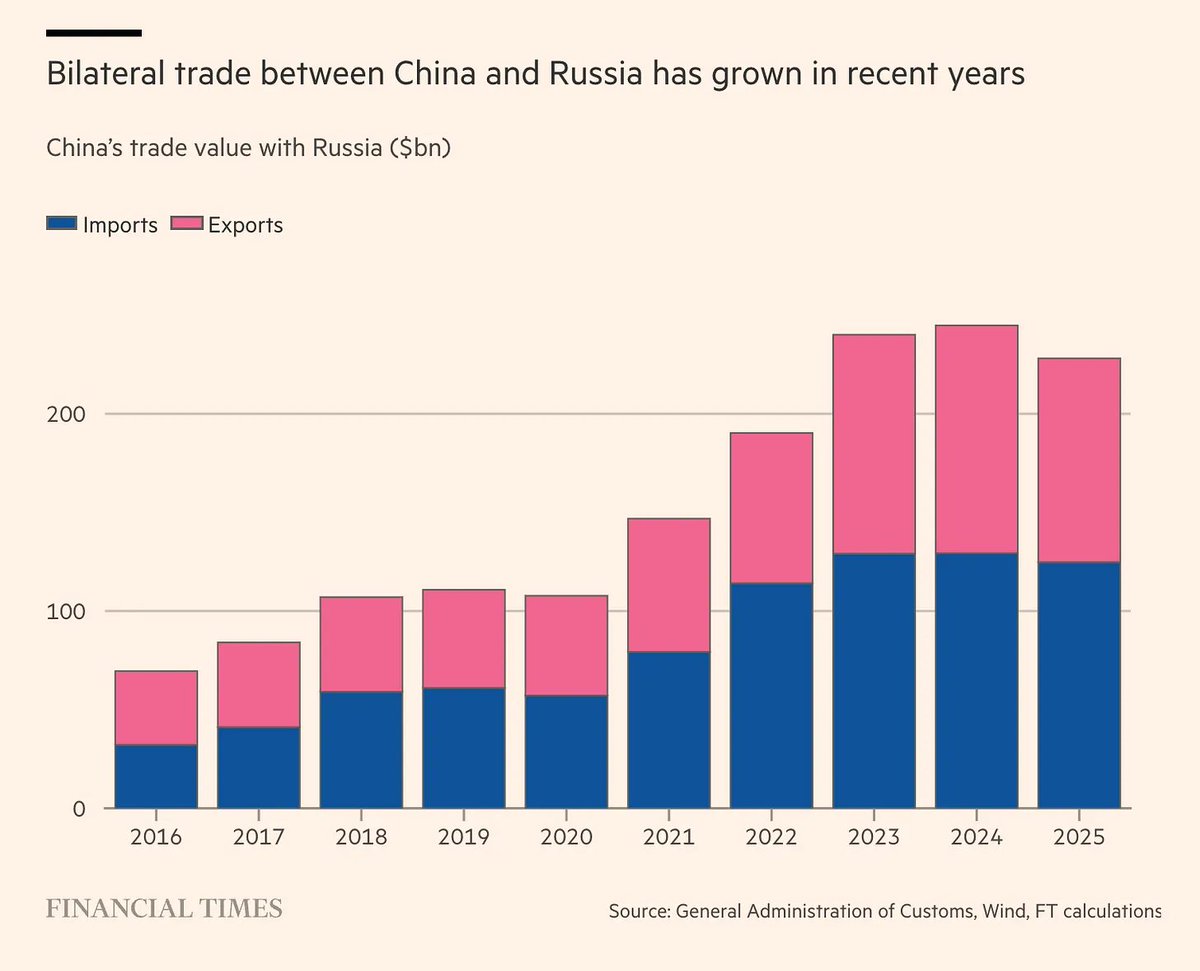
Russia-China trade hit $240B in 2024, double 2020. The yuan now handles over half of Russia's export payments, up from 2% before the war.
Russia keeps a third of its reserves in yuan because the dollars got frozen and oil money had nowhere else to go. Sanctions handed Beijing a captive customer.
English

Singapore just printed 6% annual growth in Q1. Most people don't know how Singapore's central bank actually works.
The Fed targets interest rates. The ECB targets interest rates.
The Bank of Japan targets interest rates.
The Monetary Authority of Singapore targets the currency.
There is no Singapore equivalent of a Fed funds rate.
The MAS picks the currencies of Singapore's biggest trading partners, dollar, yuan, yen, euro, weights each by how much trade Singapore does with that country, and keeps the Singapore dollar inside a controlled band against that basket. They tighten money by letting the band drift stronger.
They loosen money by letting it drift weaker.
Why this setup? Singapore's exports are 174% of GDP.
Imports run 132%.
When a country trades more than it produces, the exchange rate matters more than the borrowing cost. A weaker Singapore dollar makes imported food and oil more expensive.
A stronger one prices Singapore's exports out of foreign markets.
So the MAS skipped the interest rate dial. Currency is the dial.
This is what monetary policy looks like when a country depends on the world more than the world depends on it. Reserve currency issuers can ignore their own currency.
Everyone else cannot.
The US dollar will not be the reserve currency forever. When that day comes, the Fed will have to start caring what the dollar is worth, not just what it costs to borrow.
What does America look like when the dollar matters again?
English

@coinbureau Coinbase already holds the Bitcoin for BlackRock's IBIT and Fidelity's FBTC. Wall Street's biggest crypto products run on Coinbase custody.
The fees are small per coin but recurring, and they grow with every new ETF launch.
English

Argentina shipped most of its central bank gold to London in 2024 to post as collateral on loans. First time ever.
Net reserves had gone negative under Fernández. The export boom is real but the cushion underneath it is still paper thin.
UHN Plus@UHN_Plus
🇦🇷‼️ | La economía argentina vive su mejor momento con las políticas libertarias de Javier Milei. Un informe de la firma Grit Capital Group asegura que Argentina está a las puertas de un boom económico histórico impulsado por la el sector energético y el crecimiento de las exportaciones.
English

Paul Volcker took interest rates to 20% in 1981. People remember it as the brave moment that killed inflation.
They miss the bigger story: he killed wages at the same time.
Here's how it worked. When the Fed pushes rates that high, every loan in the economy gets expensive overnight.
Farmers can't roll their seed loans.
Factories can't refinance their machines. Small businesses go under.
By November 1982 unemployment hit 10.8%, the worst since 1940.
That unemployment did something quiet. It broke wage growth.
Before 1979, American workers had real bargaining power. Strikes worked.
Pay rose with productivity.
Then Volcker caused a recession deep enough that workers stopped asking for raises. They were grateful to keep the job.
Union membership in the private sector fell from 21% in 1979 to 7% today.
The dollar surged too. Made US factories the most expensive in the world.
The Rust Belt died over the next decade.
Mexico, Brazil, and Argentina had borrowed in dollars and couldn't pay. Mexico defaulted in August 1982.
The third world debt crisis started right there.
The story we get told is: brave Fed chair beat inflation, saved the economy. The real story is: he moved wealth from anyone who owed money to anyone who held bonds.
He stopped the cycle of rising prices and rising wages by crushing wages.
Bondholders enjoyed 40 years of falling rates after. Workers got 40 years of flat pay.
A 20% interest rate is not a policy. It is a choice about who absorbs the pain.
English

@agarra_pala @JMilei YPF sits on Vaca Muerta, the second-biggest shale gas field on earth. Break-even fell under $40 a barrel last year.
Druckenmiller isn't really betting on Milei, he's betting on cheap oil that finally has a government willing to let foreigners pump it.
English

@TicTocTick Stocks went up because Scott Bessent borrowed short.
Short loans now 22% of new government borrowing — the cap is 20%. Party now, bigger bill later.
English

If the whole world uses your money, your factories have to die.
That's the trap behind being the reserve currency.
Here's the mechanism. The world needs dollars to trade.
Every oil cargo, every shipping contract, every central bank's rainy-day fund.
To get those dollars, foreign countries have to sell more to America than they buy. America has to run trade deficits, forever, to feed the world's dollar appetite.
A Belgian economist named Robert Triffin walked into the US Senate in 1960 and laid it out. Bretton Woods would break, he said.
The math was simple.
Every dollar shipped overseas was a future claim on US gold at Fort Knox. The deeper the deficit, the smaller the gold pile got relative to dollars outstanding.
Confidence snaps before the gold runs out.
Triffin testified in 1960. Nixon closed the gold window in 1971.
Eleven years.
The dilemma didn't die that day. It just changed clothes.
The dollar still settles global trade.
The US still runs the deficit, $918 billion in 2024, to supply the world. Foreigners hold around $8.5 trillion in US Treasuries.
Every factory that closed in Ohio, every steel mill in Pennsylvania, that's the price of the crown. To stay the world's money, you have to bleed industry.
A strong dollar means foreigners buy your bonds, not your goods.
China figured this out. That's why they're in no hurry to make the yuan the next reserve currency.
They want the influence without the bleeding.
The crown costs more than people see.
English

@Crowded_Mkt_Rpt BusinessWeek's 'Death of Equities' cover ran August 1979, Dow tripled the next 8 years. Time ran 'Home Sweet Home' June 2005, housing peaked 12 months later.
Big media calls show up at the turn, never in the middle. Your 60 Minutes signal might mark the top.
English

@LarkDavis @grok Strategy borrowed money to buy 818,000 Bitcoin.
Now they buy bonds. They went from owing money to being owed money.
English

Interesting. Hey, @grok can you confirm which bonds Microstrategy bought?
Michael Saylor@saylor
This week we bought bonds, not bitcoin. The ₿itVac is charging.
English

@FirstSquawk Same news in April 2015 dropped oil 4%, then bounced in 2 weeks.
Tasnim writes for Tehran, not for buyers.
English

US sold more oil and gas abroad than it bought in 2023, about a $36B surplus. That flips a 50-year setup.
Foreign countries used to earn dollars selling oil to us, then loan those dollars right back by buying Treasury bonds. Now we sell them the oil and the bonds.
U.S. Department of Energy@ENERGY
ICYMI: It is absolutely essential that we DRILL, BABY, DRILL! @SecretaryWright: "People just don't understand that the world runs on hydrocarbons…In fact in the United States we're at a record high, 74% of U.S. energy comes from oil and natural gas."
English

@BitcoinSapiens JPMorgan's own JPM Coin has been moving over $1B a day since 2023. Dimon calling Bitcoin real now is just the boss catching up to what his settlement team built years ago.
The bank quietly became one of the biggest blockchain operators while he kept calling it a fraud on TV.
English

Japan's regulator just told companies to stop hoarding cash and start spending it.
For 30 years Japanese companies were right to sit on cash. Prices fell or stayed flat.
A yen earned in 1995 still bought roughly the same loaf of bread in 2020.
Cash was the winning trade.
That regime ended. Japan's CPI has been above 2% for three years running.
The 30-year Japanese government bond, stuck near zero for a quarter century, now trades above 3%.
The yen has lost 35% against the dollar since 2021.
Japanese corporates are sitting on roughly ¥376 trillion in cash, about $2.5 trillion. In deflation that pile quietly compounded purchasing power.
In inflation it bleeds 2 to 4% a year for doing nothing.
The Financial Services Agency telling firms "use it for growth, not returns" is not a corporate governance memo. It is the Japanese state quietly admitting the deflation regime is over and the cash hoarders are now the losers.
Watch this carefully. Japan is the leading indicator for what happens when a developed economy exits a 30-year deflation.
The cultural muscle memory of save, hold cash, fear price drops, was the right answer for a generation.
It is now the wrong one.
The asset you held for safety becomes the asset that quietly impoverishes you. Nobody rings a bell when the regime flips.
What's the American version of this trade going wrong?
English

@randgroup BlackRock holds more than 500,000 Bitcoin. Americans didn't pick Bitcoin. Larry Fink did.
Gold still needs a safe. Bitcoin fits in a phone.
English

@sdmat123 Saudi Aramco did this in 2019: state owns 98%, zero real shareholder vote. But Aramco pays $75B in dividends yearly, which is why small investors showed up.
SpaceX gives you the no-vote part without the cash. You're funding a Mars ticket you can't board.
English

@business Warsh left the Fed in 2011 because he hated cheap money.
Trump just hired him.
English

As Kevin Warsh takes the helm at the Federal Reserve, bond investors are betting he’ll prioritize the central bank’s inflation-fighting credibility over President Donald Trump’s push for lower interest rates. bloomberg.com/news/articles/…
English

@cryptorover Forecasters missed by a full point because Bessent is loosening while the Fed pretends to be tight. Treasury runs 22% of new borrowing in short bills instead of long bonds, which keeps long rates down.
The economy isn't reacting to the Fed anymore. It's reacting to Bessent.
English

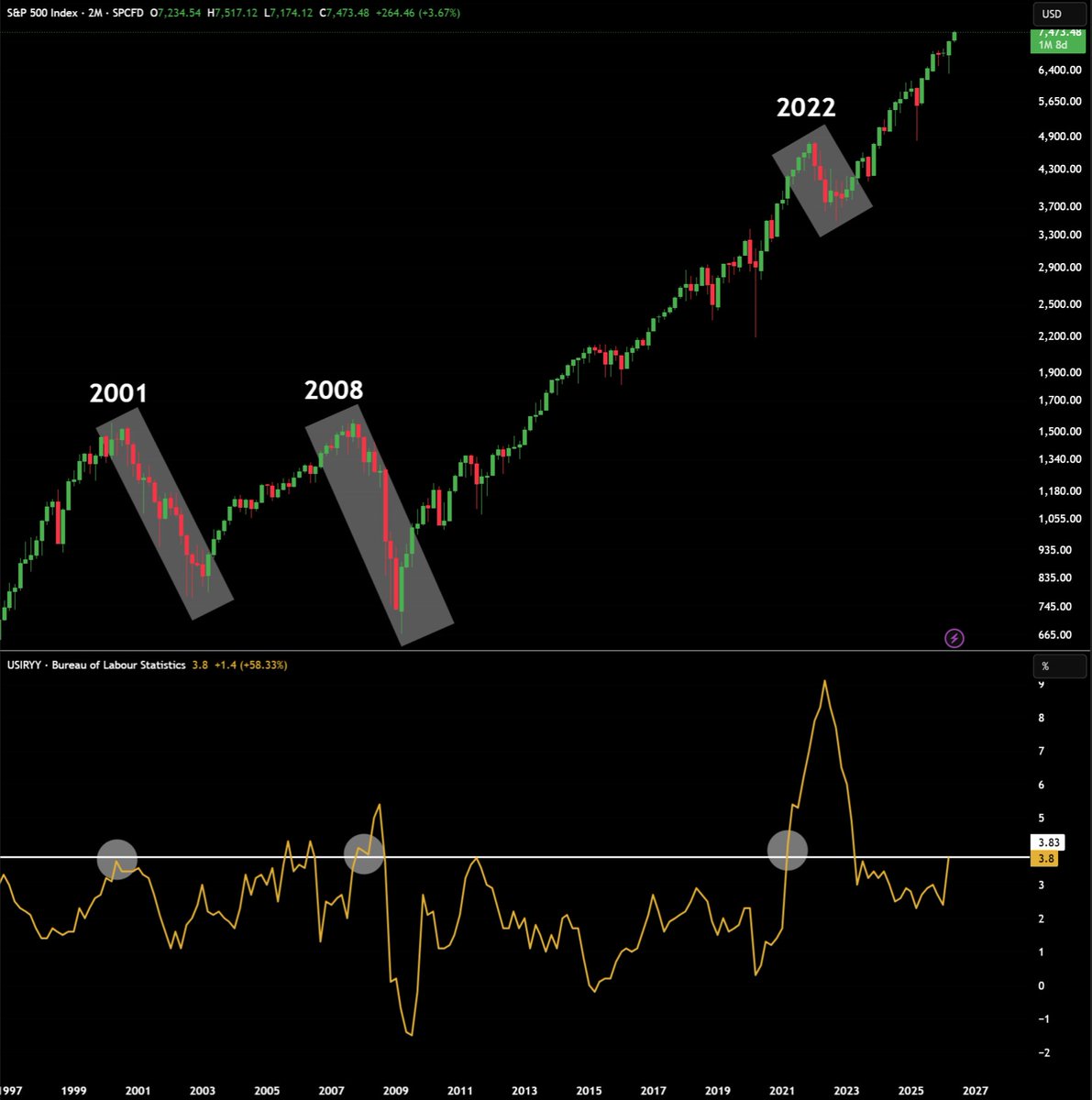
This number has predicted every major stock market crash since 1970.
And America's top economists just warned it is about to cross the danger zone again.
US inflation is at 3.8% right now. Three months ago America's top economists forecast it would be at 2.7% by now. They just revised that forecast to 6% for this quarter.
That is the single largest upward revision in the history of the Survey of Professional Forecasters.
Every single time inflation has crossed 4% in the last 55 years, the stock market crashed:
- 1970: CPI hit 6%, S&P crashed 36%
- 1974: CPI hit 12.3%, S&P crashed 48%
- 1987: CPI hit 4.5%, S&P crashed 33%
- 2001: CPI hit 3.5%, S&P crashed 36%
- 2008: CPI hit 5.5%, S&P crashed 52%
- 2022: CPI hit 9.1%, S&P crashed 25%
Every single time the same chain reaction. Inflation crosses 4%, the Fed keeps rates high, borrowing gets expensive, earnings fall, stocks crash.
Where things stand today:
- CPI: 3.8% in April, highest since May 2023
- Energy: +17.9% year over year
- Gasoline: +28.4% year over year
- Fuel oil: +54.3% year over year
- Real wages: down 0.3% annually
- Gas at the pump: $4.50 today vs $3.14 a year ago
Before the Iran war started on February 28, inflation was at 2.4%.
It jumped to 3.3% in March. Then 3.8% in April. EY is already forecasting it crosses 4% in May.
Oil is only 5% of the CPI basket. But it is 6 times more volatile than almost every other category. And it is embedded in everything, transportation, food production, plastics, electricity.
When oil stays elevated, everything else follows.
We saw this exact sequence in early 2021. Oil rose first while every other inflation component was flat.
Then one by one they all followed. That move sent CPI from 2% to 9.1% by 2022.
Food prices are already up 3.2% year over year. The USDA is forecasting food prices rise another 2.9% in 2026.
That number was set before oil crossed $100. It will be revised higher.
The 1970s had three waves of inflation.
Wave 1 peaked at 6%. Wave 2 hit 12%. Wave 3 hit 15%.
Each time the Fed eased too early thinking inflation was over. Each time it came back stronger than before.
CPI fell from 9.1% in 2022 all the way to 2.4% in January 2026. Everyone assumed inflation was dead. It is now back at 3.8% and the country's top economists are forecasting 6% this quarter.
The Fed cannot cut rates. Inflation is at the exact same level it was before every major bear market in the last 55 years.
History has a very consistent answer for what comes next.

English