

sumkincpp
126 posts

sumkincpp
@sumkincpp
Software engineer in networking area. Automation- and TDD-first approaches. Exploring deep Space!
Katılım Şubat 2023
148 Takip Edilen4 Takipçiler

@jeremychone Yeah, glm or deepseek is more useful now. At least they are churning out tokens at a visible pace.
English

Kimi K3 is unusably slow
I'm not sure how people build anything useful with it.
English
@copyconstruct and increases cognitive load for change where most of this stuff is not needed
more tools is not always better
English

Having dedicated agents review code *pre-commit*, each with a rigorous focus on:
- code clarity
- abstraction quality
- dependency structuring
- API breakage
- regression analysis
- test coherence
- perf
- security
- edge case handling etc
gives drastically better results, IME
English
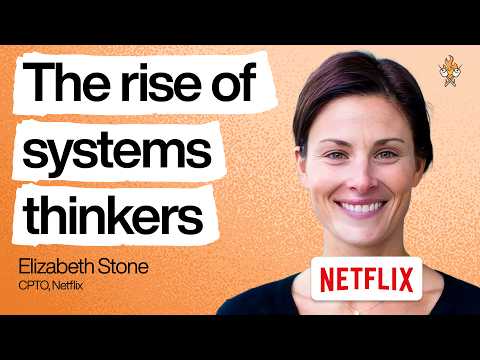
"hiring great people who can be trusted having good judgement"
youtube.com/watch?v=t0GiTy…
YouTube
English
sumkincpp retweetledi

My biggest takeaways from @Netflix's Chief Product and Technology Officer Elizabeth Stone:
1. Elizabeth believes that “systems thinking” is becoming the most important skill in the AI era. In engineering and product, this means people who can see across business domains and build the common capabilities that let many teams move quickly. In design, it means experience designers who create templates and design systems so that non-designers can ship work that stays coherent and on-brand. The underlying driver is velocity: when more people are doing more types of work at higher speed, you need to be good at building common scaffolding.
2. Systems thinking is learnable: zoom out one level from your specific problem. Given a task, step back one click—what bigger problem does this serve the business, will it scale across the product surface areas, should it become a platform capability? The companion habit: do your job in a way that helps your manager do theirs. This will force you to think about how all the pieces fit together.
3. Expect a storming phase before a forming phase. The role confusion people feel right now (“What is my job anymore?”) is the predictable middle of any transformative technology. Elizabeth’s advice: focus on high-quality source-of-truth data, guardrails on what ships, and constant internal reinforcement that humans own what they create.
4. The top AI labs converged on Netflix’s culture. High agency, high talent density, top-of-market pay, bottom-up thinking, fast experiments—the traits Lenny hears constantly from AI labs were in Netflix’s early culture deck. Elizabeth’s explanation: excellence comes from hiring exceptional people, trusting them to do great work, and holding them accountable.
5. Netflix’s culture is centered around building “excellence as an operating system.” High talent density, radical transparency, context not control, and the keeper’s test. These work together to create an environment of trust and accountability, without bureaucracy. But it’s also uncomfortable. It requires tolerating people making decisions you’d make differently, resisting the reflex to add process when things go wrong, and letting people carry the weight of their own choices. Elizabeth describes the hardest part as “being comfortable in that discomfort.”
6. The keeper’s test is as much about recognizing great people as it is about removing the wrong ones. The test—“If this person told me they were leaving, would I fight to keep them?”—is often cited in its difficult form: the moment you realize someone isn’t the right fit. But Elizabeth uses it predominantly as an entry point for honest performance conversations that are deeply positive. Most of the time the answer is “I would fight so hard to keep you,” which creates the opening to articulate strengths, discuss impact, and name what’s working. Good feedback hygiene needs a forcing function; the keeper’s test provides one.
7. Specialization is trending down—adaptable generalists are trending up. We’re shifting away from narrow stack-layer specialists (pure frontend, pure backend) toward people who can navigate fluidly across layers. The same logic applies to business domain knowledge: the mindset of “I’m a payments expert, full stop” is less valuable than “I know payments well enough and I’m willing to imagine what the future version of this looks like.” The meta-skill is learning to learn, not locking into a single lane.
8. Netflix’s approach to AI fluency is a universal principle, not a level-specific expectation. Rather than rewriting career ladders to specify what AI competence looks like at each level, Netflix added a single aspiration across all roles and levels: AI fluency. What fluency means varies by function and seniority, but the non-negotiable minimum is the same everywhere—an open-minded, experimental mindset, genuine curiosity, and comfort with ambiguity.
English


Are we still talking loops or did we shift to graphs yet?
English
Markdown content-types or schema like annotated content is a next big thing
cloud.google.com/blog/products/…
English

sumkincpp retweetledi

I wonder if oh my openagent so good, does anyone use it?
github.com/code-yeongyu/o…
English
Code with Claude 2026 | London 2026
Lots of videos to seee
youtube.com/playlist?list=…
English
sumkincpp retweetledi

OpenCode operates in an AI-native space but, as co-founder Dax Raad(@thdxr) tells us, no one is using AI so well that they’re crushing the competition:
“In the past six months, we operated very differently than we ever have. A lot of stuff went wrong because of that. So now we're pulling back and figuring out, okay, what from the old world still makes sense?
We're figuring out what we should be doing and I definitely don't feel like, oh yeah, we're killing all our competitors, we're using AI so much better than everyone else.
And by the way, none of our competitors are crushing us either. No one out there is using AI so well that we can't even compete.
And we're in the coding agent space. All our competitors are super into AI. So you would think in our space there would be a huge gap, but there just isn't.”
English
@mattpocockuk indeeed!!
first you question this hard work, then you look back on this great hard work done
English

Writing ADR's for agents has been such a good decision
Capturing all the non-obvious decisions in a codebase makes every agent in your stack that touches the stack smarter
It's the thinnest layer of docs that captures the stuff code can't
English

[O]rganizations which design systems (in the broad sense used here) are constrained to produce designs which are copies of the communication structures of these organizations.
en.wikipedia.org/wiki/Conway%27…
English