sb

271 posts

sb banner
sb

sb

@sunboud0

Yield enjoyer and part time trader – Building @21Advisory1

Katılım Eylül 2024
546 Takip Edilen440 Takipçiler
sb
sb@sunboud0·
That's the first thing I agree with you about: they are totally shit, but they are the only logic ones I have. That's why I am surprised there are still that many people. I think the volatility explains why: when a liquidation event happens, they get big returns. Last time they got ≈10%. I think Aave is far from HLP in the risk curve, and the user profile is different.
English
0
0
1
21
creus
creus@creusseverus·
@sunboud0 your reasons are shit, that's what i'am writing about, go and be concerned about the aave rate too, just retards holding money and giving fuel
English
1
0
0
33
sb
sb@sunboud0·
HLP’s annualized yield has dropped from 7.92% last summer to 2.00% over the past 30 days. So why are people still parked in it? The vault has lost 36.4% of its TVL over the last 90 days. Fees collapsed alongside it. A few reasons I can think of: 1. It’s a volatility bet. 2. It’s a Hyperliquid ecosystem bet. 3. It can be leveraged through HyperEVM And it goes beyond HLP. SOFR pays 3.63% right now. Plenty of DeFi capital sits below that. What am I missing?
English
1
0
1
194
sb
sb@sunboud0·
@creusseverus Did I say somewhere that they are good ideas? I specifically wrote that I don’t understand why the money is still in this vault. Do you have any other ideas why people are staying in this vault? Please read before commenting TWICE.
English
1
0
0
30
creus
creus@creusseverus·
@sunboud0 1. lmao, gl with the airdrop for holding some money in hlp, u'll get a 1% apr from the AiRdRoP 2. you wrote LEVERAGE of hlp not using it as collateral 73% of hlp holders are net positive is a very funny take bro. if you want to leverage hlp to be long volatility that is v fun
English
1
0
0
54
sb
sb@sunboud0·
1. season 2 airdrop 2. hlp as collateral to loop hlp or another asset, plus hlp yield is not constant. Leverage could be negative for some time and positive in the long run. 73% of hlp holders are net positive. Also, I am stating in the tweet that I don’t understand why there is still that much money. These are the reasons that come to my mind. Plus, don’t try to act smart and say something that stupid.
English
1
0
0
45
creus
creus@creusseverus·
@sunboud0 Wtf, what’s the ecosystem bet on holding hlp? And how do you want to leverage a 2% yielding asset? What the fuck did i just read
English
1
0
0
69
sb
sb@sunboud0·
One thing DeFi is way better at is user account creation. It is so simple with a wallet connect that every time I have to create an account somewhere else, I am annoyed after 2 minutes of endless forms. Latest: @IBKR
English
0
0
1
173
sb
sb@sunboud0·
@_0xpeter_ Stupid. You are stupid.
English
0
0
0
31
sb
sb@sunboud0·
I can't tag because the account is banned, but a YAM member just signaled a potential exploit regarding @Ostium vault. If you have any money inside, withdraw. Better safe than sorry.
sb tweet media
English
1
0
9
1.7K
sb
sb@sunboud0·
100%+ ROI YT play on @re via @pendle_fi Two ways in, both maturing dec 10 2026: 1/ YT-reUSDe: - 14.44x leverage $1K to $14,440 notional - Yield at maturity: $767 - Net cost of points: $233 - Points earned: approx 85M 2/ YT-reUSD: - 23.14x leverage $1K to $23,138 notional - Yield at maturity: $598 - Net cost of points: $402 - Points earned: approx 102M Season 2 allocation: 35M $RE out of a 1B total supply. At today's price ($0.50–0.55/ $RE, basically my base case): (i) reUSDe: $3,245.61 gain (324.56% ROI) (ii) reUSD: $3,778.21 gain (377.82% ROI) Worth knowing before you ape in: $RE launched june 18 and only 16% of the supply is circulating today. The rest unlocks over the next 3 years, including the biggest season 1 farmers, who are still vesting their tokens on a schedule tied to keeping their money locked in the protocol. Tight supply now ≠ tight supply forever. Risks: RE price drops, protocol/TVL risk. You don't get your notional back at maturity, only the yield. @reintern where am I wrong?
sb tweet media
English
1
2
9
1.8K
sb
sb@sunboud0·
Crypto hasn’t achieved mass adoption or “trust” because it doesn’t really improve over time. Technical innovation in crypto/blockchain is pretty slow compared to AI or semiconductors. The improvements are more on how we design financial flows around blockchain technology. AI + robotics have very good and simple everyday-life use cases, and their results will be exponentially better over time, which is not true with blockchain. Example: My robot is doing my laundry. Today it can’t do the ironing; tomorrow it will. The next day it will detect stains, then learn how to remove them, then learn how to fold, etc. AI will boost robotics. AI is a virtuous cycle, and robotics will just benefit from it.
English
1
0
1
22
daz
daz@MetamateDaz·
a lot of tech progress will be made in those 30 years but i think for ai and robotics to be at a stage where everyone is comfortable allowing such tech to be a big part of their life takes a long time crypto has been around for nearly 20 yers and still most people do not trust it people's reluctance to adopt is the bottleneck imo
English
1
0
0
41
daz
daz@MetamateDaz·
I think it's both impressive and very telling of the times we're in that he keeps giving these predictions despite being wrong about literally every single prediction he has ever made but people still hang on his every word just because he's rich even though he made almost all of his money from government handouts and convincing morons to buy his companies at 1,000x earnings.
unusual_whales@unusual_whales

Elon Musk: AI+Robots will be able to do everything, resulting in universal high income. Work will be optional.

English
4
2
15
962
sb
sb@sunboud0·
@MetamateDaz Way sooner than 30 years, Moore’s law is applicable to AI at an even greater scale. I agree that it will concentrate power and wealth among fewer people.
English
1
0
1
25
daz
daz@MetamateDaz·
@sunboud0 in 30-50 years maybe and it will not be a utopia as he claims, power corrupts and this tech will concentrate power to even fewer people
English
1
0
1
40
sb
sb@sunboud0·
To keep you updated on this position: I sold my YT position at an average cost per JANE of $0.0062. In the meantime, I have decided to short the yield around 12% as I think it is overpriced. Good calculations can be found on @jacq_capital on how to take advantage of such a setup.
sb@sunboud0

100%++ APY YT play on USD3 from @3janexyz There's an asymmetric bet on YT-USD3-17DEC2026. Current leverage is 18.50×, you earn 18.5× the yield AND points on your notional. What makes it unique: 3Jane pays YT holders 2 different $JANE streams simultaneously: 1. YT bonus JANE (on your notional) 2. Native USD3 JANE (also on your notional, not your capital, it's confirmed by the team) Some calculations for $1K invested: > $1K buys you around $18,500 notional. > Native USD3 yield at maturity: $786. Net cost of points: only $214. > JANE earned over 24.86 weeks: 52,116 tokens. How to think about $JANE BE: $214 / 52,116 JANE = $0.0041 per JANE BE FDV: $4.6M at 1.111B TTS $13.7M at 3.333B TTS $27.4M at 6.667B TTS My base case ($0.03/JANE, FDV $100M, TTS 3.333B): $1,563 in $JANE + $786 yield = $2,349 on $1K invested (283% APY) Even the bear case ($0.0075/JANE) leaves you profitable. The break-even is a $13.7M FDV. Almost nothing. Disclosure: bet on $JANE having value at TGE. Risks: TVL dilution, protocol risk, $JANE = $0. Maturity Dec 17 , you don't get notional back, only the yield. @PendleIntern where am I wrong?

English
0
0
8
2.9K
sb
sb@sunboud0·
@dcfgod Dcf didn’t seed Ethereum?
English
0
0
1
50
DCF GOD
DCF GOD@dcfgod·
“Quantum safety has shifted up a LOT in priority. This adds a lot of work (eg. finalizing a quantum-safe blobs design has become urgent; this work has already been ongoing for months)” The best bitcoin is ethereum
vitalik.eth@VitalikButerin

Two weeks ago, Ethereum researchers met in Berlin to continue charting the protocol's long-term trajectory, following along discussions with client teams in Svalbard in April. The updated strawmap is at strawmap.org, and I attached a picture of it to this post. My own high-level takeaways: * "Lean Ethereum" is not a single one-shot upgrade, it is a collection of improvements that will come online to the Ethereum network over the course of three or four years. But make no mistake, this IS the third major iteration of Ethereum in the same way that the Merge was the second. Almost every major piece of the protocol will be replaced: - Verification through recursive STARKs, rather than direct re-execution. Recursive STARKs become an enshrined first-class core component of the protocol - Replacing everything quantum-vulnerable with quantum-safe alternatives - Consensus: decoupled available chain and finality, one or two-round finality. Theoretically optimal security properties, simpler than today, and faster than today - Multidimensional gas - State: not just tree structure, but what *types* of state are available - Changes to client architecture ... At the same time, simplification, cleanup and future-proofing. And this will all be done in a way that minimizes disruption to existing application. We've done this before (the Merge), we can do it again. * H-star (aka Hegota) is probably Ethereum's last thematically "pre-Lean" fork. Starting from I-star, most of everything we do will have a very strong "Lean" feel to it in one way or another. * Privacy is no longer an afterthought, it is a first class goal. When designing Frames, the mempool, additions to the state tree, we explicitly ask the question "okay, how do quantum-safe, intermediary-free privacy protocol transactions go through this, and what is the overhead?" * Formal verification of everything for security. * FV also makes us much more comfortable with canonicalization (having pieces of the protocol that are directly defined as a piece of bytecode expressed in some language). evm-asm is being written in part to become a canonical proof system for the EVM. * Quantum safety has shifted up a LOT in priority. This adds a lot of work (eg. finalizing a quantum-safe blobs design has become urgent; this work has already been ongoing for months) * Probably the single most disruptive part of the plan is the changes to state. There is growing consensus around leaving present-day-style "dynamic state" mostly unchanged, but scaling it only a medium amount, and adding new types of state that are more scalability-friendly (eg. no need for builders to sync/store all of it) but more restrictive, and that will scale a large amount. eg. possible Ethereum in 2030: 2 TB of present-day-style (dynamic) state, and 100 TB of new-style (scalable but restrictive) state This "new-style" state would work very well for ERC20s, NFTs, many defi use cases, but not eg. highly "central" objects like Uniswap contracts, or onchain order books, or other complex things (which are crucial for Ethereum but which only take up a small percentage of state) Hence, it will not be *necessary* to rewrite any apps, but it will be *very cost-effective* to eg. rewrite an ERC20 token into a newer design that uses a new type of UTXO storage that is currently being explored, so that it will have >10x lower txfees. Design of these new state types (current ideas: keyed nonces, ring buffers, UTXOs, statically accessible state, temp state) is an area where we will need a lot of feedback from application developers (incl. privacy-friendly application developers) and probably several rounds of rethinking and iteration. * In the context of a much larger total state size, we need to figure out the incentive issues around who stores this state and what motivates them to. Even saying "each node stores 1%" is not good enough - why do they store that 1% and why are they willing to serve it? This is being elevated as a first-class research area. * Ethereum will need to have a "VM" other than EVM in one form or another - at the very least, we need something like leanISA for recursive STARKs - and the gains are large in exposing it to users so that we support programmable privacy and better scalability. Right now, the most likely contenders are leanISA and RISC-V. My own ideal is that in this world, we adjust the protocol so that the EVM becomes a high-level-language compiler-level feature, and the protocol only "sees" RISC-V / leanISA directly. But this is still far away. * Gas limit increases, blob increases and slot time decreases will happen many times over the next ~5 years. We expect a large gas limit increase with Glasterdam. Each step of increased scale or decreased slot time is a matter of getting to the point where it is safe to do it, which comes from a combination of client optimization and protocol changes. Ethereum is CROPS. Ethereum is scaling. Ethereum is reinventing itself. Onward.

English
11
4
109
12.6K
sb
sb@sunboud0·
This is your average protocol communication while their « stablecoin » is under peg for almost 2 weeks. $apxUSD is trading 20% under peg.
English
0
0
1
267
sb
sb@sunboud0·
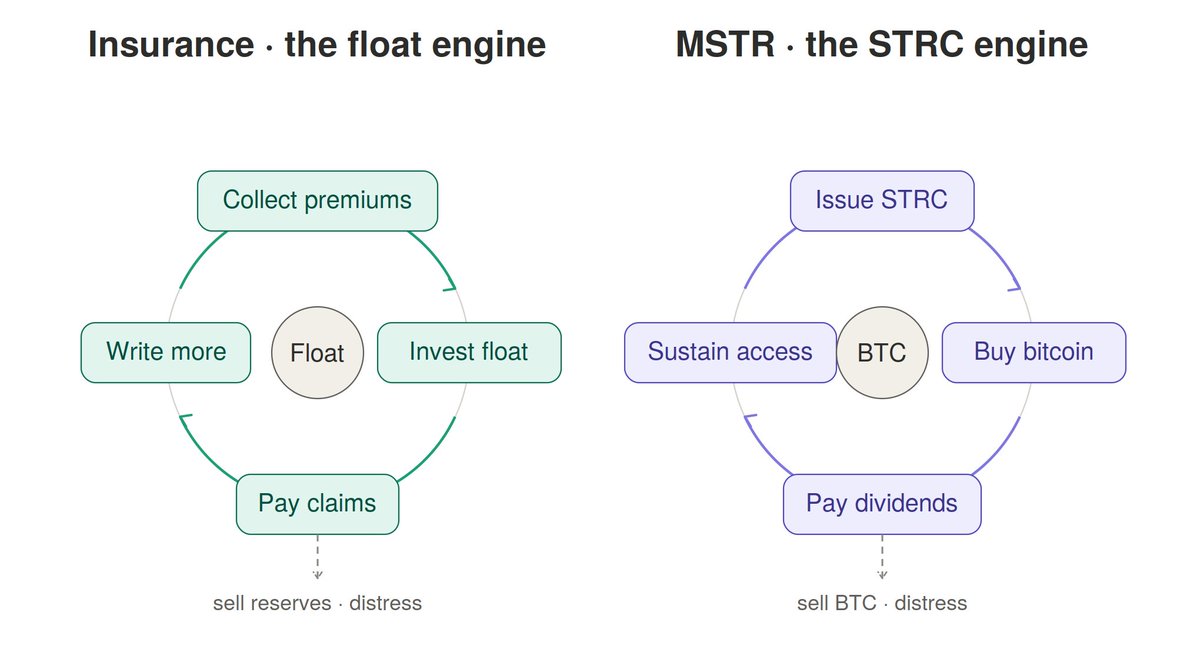
Demand for insurance contracts will last forever, and some insurance companies can go bankrupt (many with bad coverage are going to zero). $BTC demand is not fixed forever, and the model that $STRC is building upon is nothing like insurance or what you described. You are not a serious person.
English
0
0
0
65
sb
sb@sunboud0·
@thedefivillain @FarsideUK I think they are making a good point in the article that I haven’t seen on CT yet: STRC is basically a loan for Strategy to buy bitcoin at 11.5% per year. Question: Is 11.5% too high for buying bitcoin?
English
0
0
3
52
VIKTOR
VIKTOR@thedefivillain·
"The company has not responded by increasing the coupon, perhaps because they are worried about the downward death spiral or because they already think 11.5% is high enough." The company has not responded because they can only change the coupon once a month at the beginning of the month, so it's normal that they haven't reacted yet. Good article overall that addresses the fundamental flaw about the lack of an equilibrium state in the product, but it doesn't make much sense to spend so much time trying to fairly price STRC without taking into account some expectations about BTC future price trajectory...
English
2
0
18
2.3K
sb
sb@sunboud0·
Pete, how have you not assumed by now that creating a stablecoin backed by STRC was a terrible idea? The underlying thesis of APYX is good, but my god, apxUSD is a terrible design. You made a mistake, find solutions, take responsibility, and move on. Even if STRC repegs, it won’t change the fact that the design is stupid.
English
0
0
0
101
sb
sb@sunboud0·
Emitting a stablecoin relying on a volatile asset is reason enough not to trust you. This aged well, garbage protocol.
English
2
0
3
306
sb
sb@sunboud0·
@bas3dp0tat6 Selling $BTC is the ultimate solution for Saylor. There is no other way out for him. The only way out for him is to wait for $BTC to bounce and get his mNAV above 1.2 to restart the $MSTR ATM selling going. Other than these 2 options, it goes lower.
English
1
0
0
313
basedpotato
basedpotato@bas3dp0tat6·
as someone who has been buying distressed shitcoins/ponzitokens for the best part of 4 years here’s what i think: STRC is worth zero until: - Saylor actually raises a fat chunk of cash by selling BTC - Changes his stance on STRC (he said himself it was a box where money goes in and doesn’t come out) - Preferably turns it into a secured creditor claim but this won’t happen without lawsuits Remember Coinbase 3.25% coupon secured debt maturing 2028 traded down to 16% Yield-To-Maturity in December 2022 when they fired half their staff. STRC can go way lower. There is no magical IRR number that makes STRC suddenly biddable, it needs a fundamental shift in BTC macrostructure or actual documentation changes to what STRC is.
basedpotato tweet media
Thomas Braziel@Bkclaims

I like Nic and generally agree with a lot of his work, but I think he's using the wrong framework here. This isn't a CCC bond. It's a distressed special situations security. I've spent the better part of two decades in distressed credit and roughly the last 12 years buying distressed crypto. I've competed with or worked alongside many of the largest distressed investors. When I ask myself who the marginal buyer of STRC is today, it isn't a traditional high-yield fund. It's an opportunistic credit fund. Those funds don't wake up looking for 15% returns. They generally need 30%+ IRRs before they commit capital to something this uncertain. Today you can buy: • Government refund claims targeting 10-15% IRRs. • Distressed crypto claims with recoveries denominated in dollars and often substantial collateral protection for 20-25%+ IRRs. STRC is riskier than both. You're subordinated. There are essentially no meaningful lender protections. The dividend is non-cumulative. The collateral is one volatile asset. There is negative convexity. And unlike a traditional distressed loan, you don't control the collateral or have meaningful enforcement rights. This isn't lending against Bitcoin. It's taking directional Bitcoin exposure through a structurally weak preferred security. There's an important distinction people miss. Common shareholders have a fiduciary relationship with management. Creditors don't. Management's job is to obtain the cheapest possible financing for shareholders - not to create an attractive security for creditors. To Strategy's credit, they did exactly that. They issued extraordinarily issuer-friendly paper because the market let them. Good for them! But once that paper leaves the hands of income-oriented crypto investors, who is the next buyer? That's the question. I think it's an opportunistic distressed investor. And that buyer isn't showing up for a 15-20% required return. They're looking for something closer to a 30%+ IRR. At an 11.5% coupon, that implies a price of roughly $38.33 (11.5 ÷ 30%), versus about $76.67 for a 15% yield and $57.50 for a 20% yield. Maybe 30% isn't exactly the right number. Maybe it's 35%. Maybe it's 40%. But I think anchoring this off CCC spreads misses who the actual marginal buyer is.

English
6
0
31
8.3K
sb
sb@sunboud0·
@YuzuMoneyX's accountable dashboard should be the standard. You can actually delve into where the money is deployed, not just vague labels. Good work by @0xRamenUmai and the team. Dashboard: yuzu.accountable.capital
English
0
1
0
187