

Karen De Sutter
3.5K posts

Karen De Sutter
@supernova_kds
A lover of nature, animals & mountains... A loyalist to crazyness & authenticity... My views are my own.
These boots are made 4 walking Katılım Mayıs 2010
516 Takip Edilen122 Takipçiler

I hope you've found this thread helpful.
Follow me @heynavtoor for more.
Like/Repost the quote below if you can:
Nav Toor@heynavtoor
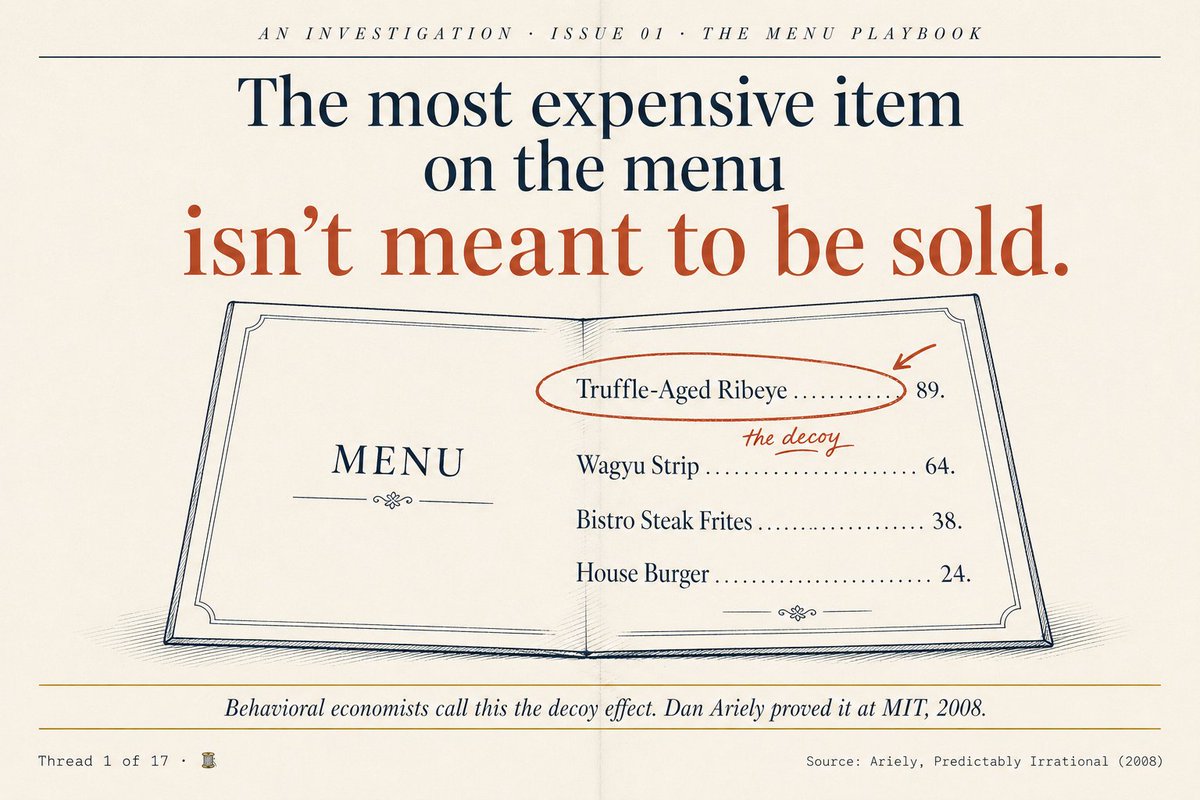
The most expensive item on a restaurant menu isn't meant to be sold. It exists to make the second-most-expensive item look reasonable. Behavioral economists call this the decoy effect. Dan Ariely proved it at MIT in 2008. Every menu you've eaten from this year uses it. Plus 10 more tricks. I pulled the playbook. Here's how each one hijacks your brain. 🧵
English
The most expensive item on a restaurant menu isn't meant to be sold.
It exists to make the second-most-expensive item look reasonable.
Behavioral economists call this the decoy effect. Dan Ariely proved it at MIT in 2008.
Every menu you've eaten from this year uses it. Plus 10 more tricks.
I pulled the playbook. Here's how each one hijacks your brain. 🧵
English
@domdyer70 It honestly is like losing a piece of oneself...
English

Took Lassie to the vets today for routine injection. A man came to reception to say he had his dog in the back of the car his legs had gone & he would need a vet nurse & stretcher to carry him in to be put to sleep. He just stood there in tears as he waited for vet nurse. As I left the vets I could see his children & partner in tears waiting with dog in back of the car. I left in tears myself, walking Lassie back to my car. Having a dog is such a privilege but saying goodbye is so devastating

English

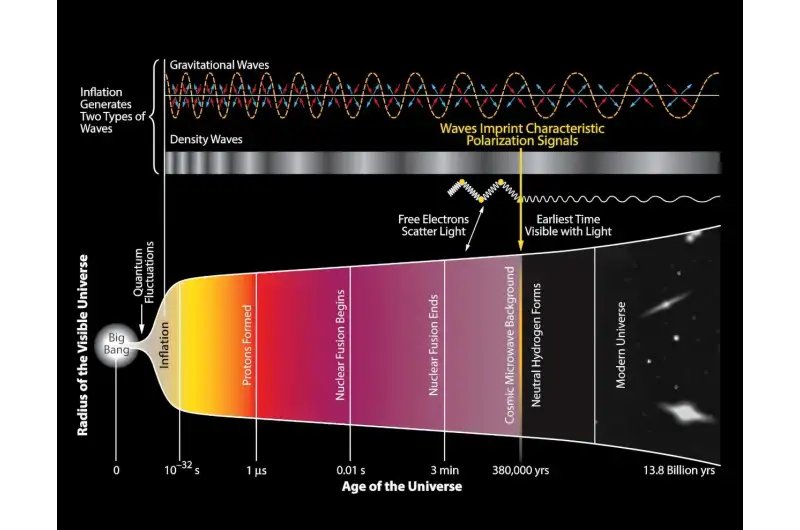
A new study revisits one of the most persistent open questions in cosmology, the nature of dark matter, which makes up most of the matter in the universe yet has never been directly detected as a fundamental particle.
Instead of introducing new particles, the researchers explore a different possibility: that dark matter could consist of black holes, not formed from dying stars but originating much earlier in cosmic history.
The idea is tied to a non-standard cosmological model in which the universe did not begin from an absolute singularity, but instead underwent a “bounce,” transitioning from a prior phase of contraction into the expansion we observe today. In this scenario, black holes formed during that earlier phase would not simply disappear but could survive the transition and persist into the present universe as relic objects.
These relic black holes would be effectively invisible, massive, and only detectable through their gravitational influence, which aligns well with what we expect from dark matter.
This framework also offers a potential way to address another tension in modern observations: the existence of very massive black holes at extremely early times, which are difficult to explain if they had to grow from small seeds after the Big Bang. If black holes already existed before or immediately after the bounce, they could act as pre-formed seeds, making it easier to understand how such large structures appeared so quickly, something that recent observations, including those from the JWST, are beginning to suggest.
At the same time, this proposal does not discard the standard cosmological model, which still successfully explains key observations such as the cosmic microwave background and the large-scale structure of the universe.
Rather, it highlights a limitation of the model, namely the presence of an initial singularity where general relativity breaks down, and explores an alternative that avoids that issue while naturally introducing new physical possibilities.
At present, the idea remains speculative and lacks direct observational confirmation. Dark matter could still turn out to be a new type of particle, and there is no definitive evidence yet for a population of relic black holes from a pre-bounce universe. What makes the proposal interesting is that it connects several unresolved problems, the origin of dark matter, the rapid appearance of massive black holes, and the question of whether the Big Bang was truly the beginning, within a single conceptual framework that could, in principle, be tested with future observations.
👉 share.google/VVtKbeuB2lcldK…
English

Went down the rabbit hole on this. You traveled about 17 million kilometers in your sleep last night, roughly 45 trips to the Moon in a single nap.
The 600 km/s in this post is a real number. Satellites measured it by comparing our motion against the faint glow left over from the birth of the universe. But the speed alone is only half the picture. Where we're headed is the part that got me.
Your body is riding four things at four different speeds, all at once. Earth spins at 1,670 km/h. Earth whips around the Sun at 107,000 km/h. The Sun circles the center of our galaxy at 828,000 km/h. And the Milky Way is tearing through space at 2.1 million km/h. You don't feel any of it.
All the galaxies near us, about 100,000 of them, are being dragged toward one spot. Astronomers call it the Great Attractor. It sits about 250 million light-years away and has the combined gravitational pull of thousands of galaxies. We can't see it, because our own galaxy's dust and stars block the view completely. That whole section of sky is so obscured that astronomers named it "the Zone of Avoidance." We only know something is there because every galaxy near us curves toward the same blind spot. Infrared and X-ray telescopes eventually confirmed a massive pile-up of galaxies hiding behind the curtain.
I kept digging. The Great Attractor is itself being yanked toward something even larger called the Shapley Supercluster, about 650 million light-years out. The thing pulling us is also being pulled.
In 2014, an astronomer at the University of Hawaii named Brent Tully mapped all these galaxy flows and realized we're part of one enormous structure. He named it Laniakea (Hawaiian for "immense heaven"). 500 million light-years wide, about 100,000 galaxies, all draining toward the same gravitational low point like water running downhill. But Laniakea won't hold together. The expansion of the universe is speeding up, slowly ripping the whole structure apart. Our cosmic address has an expiration date.
While all this plays out, the Milky Way is also drifting toward the Andromeda galaxy at about 400,000 km/h. Those two will merge in roughly 4 billion years. But that crash is happening at a fifth of the speed we're falling toward the Great Attractor. Even the collision is a subplot.
You went to bed, stayed completely still for 8 hours, and woke up 17 million km from where you fell asleep. Tonight you'll do it again.
Curiosity@CuriosityonX
While you slept last night, completely motionless in your bed, our galaxy shifted millions of kilometers through the cosmos. You woke up in the same room, on the same planet, but unimaginably far from where you were the night before. The Milky Way does not glide silently through the universe. It is racing through space at about 600 kilometers per second, carrying with it billions of stars, planets, and everything they contain on the journey. It is a good reminder that, even when life seems motionless, you are always in motion.
English

@TodayiLearrned I love the wholesomeness of artisanal craftsmanship...truly special when one realizes the sweat, tears and pride that have gone into a labour of love
English

Expert cobbler at work! This is impressive👏🏼 👞
English

La joie des commentateurs de la RTBF est magnifique
Français

❤🇧🇪
Bence Czigelmajer@cycloben2
Oh, sweet Lord. Anyone who isn't crying right now doesn't love cycling. Wout van Aert did it. Wout van Aert fulfilled his destiny which we've talked about for almost a decade now. For years he chased that cobbled monument. For years he pursued something that many, in fact, most would have already given up on. Today he was the strongest. Today he was the luckiest. Today he was the one who delivered the most competent team performance. And somehow... there is justice in this entire world. There is justice in cycling. The most beautiful moment of the entire season has already happened, 110000% sure about this. #ParisRoubaix
ART

That tiny red nub sitting between the G, H, and B keys on keyboards has been quietly dividing the tech world for over 30 years. Half the people who encounter it have no idea what it does. The other half refuse to use anything else.
It’s called the TrackPoint. And it was born out of a single frustrating observation.
In 1984, a researcher named Ted Selker conducted a study showing that it takes a typist 0.75 seconds to shift their hand from the keyboard to the mouse and a comparable amount of time to shift back. That 1.5 seconds of lost time, multiplied across an entire workday, felt like a solvable problem. So he built something that would eliminate it entirely; a pressure-sensitive nub planted right in the middle of the keyboard, so your hands never had to leave the keys at all. IBM introduced it commercially in 1992 on the ThinkPad 700 series.
The way it works is not what most people expect. It doesn’t move like a joystick. It responds to pressure. Beneath the rubber cap sit strain gauges that measure the force applied in different directions and translate it into cursor movement. The harder you press, the faster the cursor moves. There is no repositioning, no lifting your finger, no running out of space. Infinite cursor movement from a single fingertip that never moves more than a millimeter.
The red color almost didn’t happen. IBM’s product safety division had reserved red exclusively for emergency power-off switches on mainframe computers.
ThinkPad designer Richard Sapper got around this by calling the color IBM Magenta and when the first batch shipped, the engineers made it decidedly more crimson. A loophole dressed in plain sight.
Power users programmers, analysts, executives who live on their keyboards swear by it. The reason, according to Lenovo’s chief design officer, is that your hands never leave the home row. You type and navigate simultaneously, without the constant interruption of reaching for a trackpad. Once mastered, people say it feels less like using a tool and more like an extension of thought.
Most laptops abandoned it. Lenovo never did. And the people who know, know.
halo 𐙚@pIain_tofu
one of the dumbest things they ever added to computers
English