

Tactical Fiend
451 posts

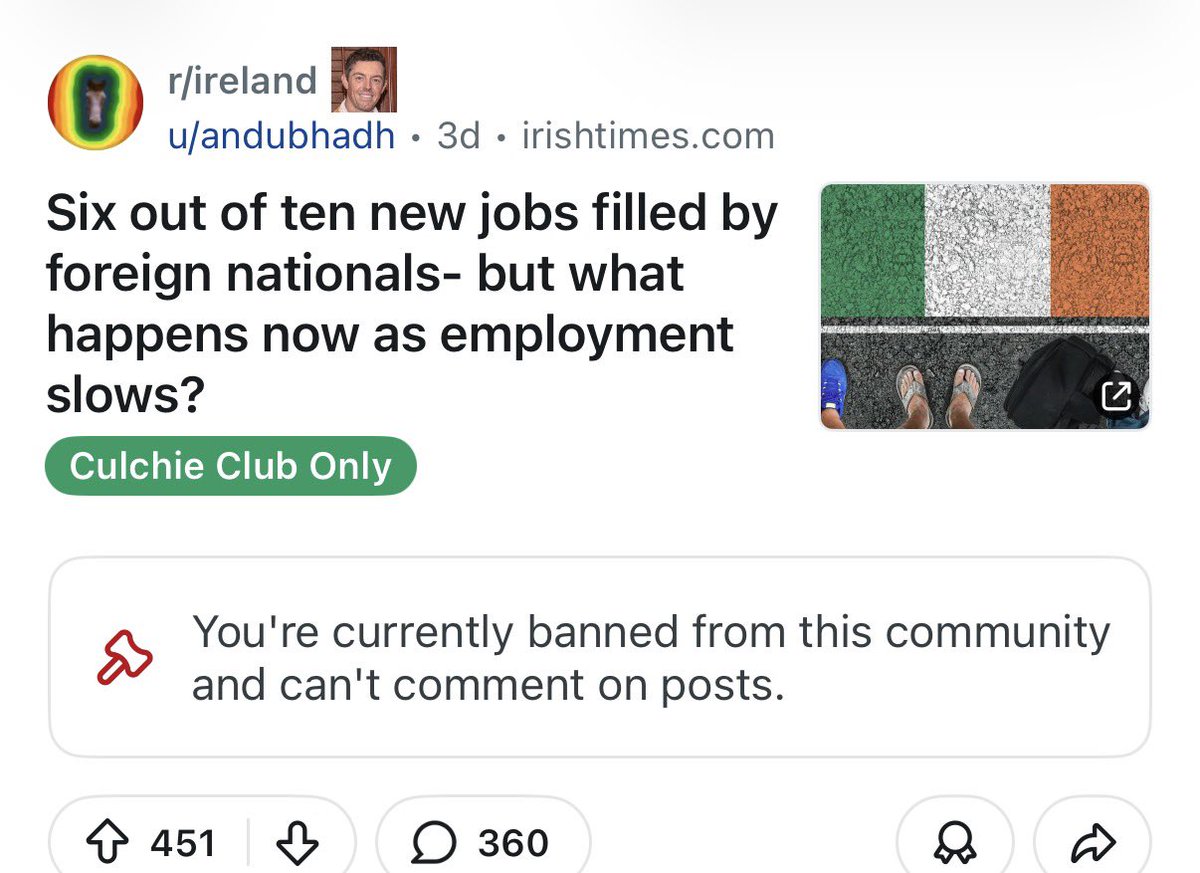
Very interesting thread on the notoriously left wing r/Ireland subreddit here. Almost everyone in agreement that mass legal immigration is fucking over young Irish people.
English

Alasdair MacIntyre was right all along, by Ben Cobley (@bencobley)
‘The project of providing a rational vindication of morality had decisively failed,’ wrote Alasdair MacIntyre in After Virtue (1981). Enlightenment philosophers like Immanuel Kant had attempted to justify rationally what was effectively Christian morality. But, despite titanic efforts, they hadn’t succeeded.
Alistair MacIntyre tried to change that. He did in a way that has particular resonance today, even a year after his death. His endeavour, in After Virtue, is to push humanity in a different direction — sometimes referred to as a ‘post-liberal’ one — and, in a sense, to go backwards, to recover something lost.
Read more below ⬇️
t.co/dkQvDGW9xP

English
@Mullins77David @AhernHerbe8277 @CNolanOffaly What happened to the "Amanda" account it seems the video/account are no longer accessible
English

RTE just played a clip from a @CNolanOffaly speech on immigration and housing that three quarters of the country will agree with. A spectacular piece of unintended campaigning assistance from them.
English
@BrankoMilan I tend to only read abstracts or conclusions for this reason, unless I want the underlying data.
English
The current common approach to paper-writing in economics is wasteful & annoying. Typically, authors describe their contributions & findings in the abstract; then they detail them in the introduction (incl. describing all the main results), and finally their repeat it for the third time in conclusions. You kind of wonder: are readers supposed to be idiots, so they need to be told the same thing, and often verbatim (using copy-and-paste) multiple times?
English
@AhernHerbe8277 Fully agreed
I don't think even Pearse if in charge could stomach allying with II/Aontú though
Sinn Féin seem to be destined for irrelevance with current arithmetic and ideology
English



I'm not on this website for less than a week and this shit happens
New York Post@nypost
San Diego mosque shooter was obsessed with 'based racist' Dutch cartoon character trib.al/qfP6pNl
English

Why AI-fuelled job cuts at multinationals risk blowing a hole in Ireland’s public finances.
jrnl.ie/7049439
English
@arcticinstincts Back to RSS feeds we go. I've honestly never used the for you page though so I never miss pages I follow.
English

New X algo basically ruined the site and makes followers pointless, every posts reach is at mercy of a predictive algo rather than follower count. Perhaps moving to substack or email list is a better way to directly communicate with followers?
Arnaud Bertrand@RnaudBertrand
So I spent some time studying the new Twitter/X algorithm today since the latest version was published about a week ago on Github (#updates--may-15th-2026" target="_blank" rel="nofollow noopener">github.com/xai-org/x-algo…
). My goal was to answer why so many people have seemingly seen such a dramatic drop in their posts' reach. The first answer, which is actually somewhat unrelated to the ranking algorithm on Github, is the auto-translate feature, rolled out worldwide on April 7, 2026 (x.com/nikitabier/sta…). Before that date, if you wrote in English about, say, the Trump-Xi Beijing summit, you were competing for attention with maybe 5,000 other English-language accounts writing on geopolitics. After that date, your post is competing for attention with other posts on the same topic IN EVERY LANGUAGE ON EARTH. For some topics that do command global attention like geopolitics, that's a very brutal multiplier: you used to be one of 5,000, you're suddenly one of 50,000 (something of that order): MUCH more difficult to stand out. Secondly, the number of followers you have matters far less than it used to: each post now has to earn its audience reader by reader, on the predicted engagement of the post, and how its topic matches what each reader has recently been engaging with. Here is how the algorithm works, in simple terms: when you, as a reader, open your feed, the algorithm doesn't load "posts from accounts you follow." Instead it runs a 2-stage prediction of what posts you're likely to engage with in that very moment. The first stage is the retrieval stage. The system narrows billions of posts on X/Twitter that day down to roughly 1,500 candidates by matching the semantic content of each post - what it's about - against what you as a reader have recently engaged with. Some candidate posts come from accounts you follow; others are pulled from across the platform by pure topic similarity to your recent interests. You can test this retrieval stage easily: start disproportionally engaging with - say - Brad Pitt videos and you'll bit by bit see your timeline flooded with Brad Pitt content, most of it from accounts you've never followed and never heard of. Then there's the ranking stage. Each of these candidate posts for your feed is fed through a Grok-based model that tries to understand if you'll engage with the post. It looks at 15 engagement metrics: 1) P(favorite) — the reader likes the post 2) P(reply) — the reader replies to it 3) P(repost) — the reader reposts it 4) P(quote) — the reader quote-tweets it 5) P(click) — the reader clicks a link in it 6) P(profile_click) — the reader taps through to your profile 7) P(video_view) — the reader watches the video 8) P(photo_expand) — the reader expands an image 9) P(share) — the reader shares it (DM, off-platform, etc.) 10) P(dwell) — the reader stops scrolling and lingers on the post 11) P(follow_author) — the reader follows you after seeing it 12) P(not_interested) — the reader marks "not interested" 13) P(block_author) — the reader blocks you 14) P(mute_author) — the reader mutes you 15) P(report) — the reader reports the post Fifteen predicted actions, each multiplied by a weight, summed: that sum is the score that determines in which priority a post will be seen among other candidates. Please note that posting something with a video or an image can give your post an advantage as 2 actions are specifically for these: video_view and photo_expand. No video or photo and you don't get a score for these. Also, naturally, having a video maximizes the chance that a user will "dwell" on your post to watch it. Also note that 4 of these actions carry negative weights (not_interested, block_author, mute_author and report): meaning that if the model expects a post to generate a lot of negativity, it'll get de-boosted quite dramatically. But note, first and foremost, what's NOT in there: none of the things that, naively, one might think a serious information platform would weigh. There is no P(this post is true and well-sourced). No P(the author actually knows what they're talking about). No P(this person has spent a decade building a body of work that has held up). No P(this account has earned the right to be taken seriously on this topic). No P(the author has a large following from credible people). The model does not seem to care - at all - about any of that. Every post starts from zero. You could have ten years of rigorous, well-sourced analysis behind you - or you could be just an uneducated rando who registered yesterday. To this algorithm, you're both just a bag of engagement probabilities. Now, sure, to be fair, there is a "brand" effect that's not covered by the algorithm: someone who has in fact built a brand will naturally have better engagement metrics because people recognize their account. But that's an indirect, second-order effect. And crucially, it's legacy: those "brands" were built under earlier versions of the algorithm that gave followers and reputation more weight. Lastly, several other features of the new algorithm compound the dilution, none of them visible from outside but all consequential. The May 15 update added an "impression bloom filter," tightening the rule that once a reader has been served a post, the system won't serve it to them again. Before, a strong post could marinate in someone's feed across multiple refreshes and accumulate engagement on the second or third pass. Now it basically gets one shot. Also, your own posts compete with each other. An "Author Diversity Scorer" inside the ranking stage attenuates the score of every subsequent post of yours that ends up in a reader's candidate pool. In plain terms: if multiple of your posts land in a reader's candidate pool, the system shows one at full strength and dampens the others. So don't post several times consecutively on the same topic. And, last but not least, another huge impact on reach is that, in the old algorithm, when someone reposted or quote-tweeted you, your post was broadcast to their followers' timelines - a repost from an account with 100,000 followers was a huge boost. In the new algorithm, that mechanism is vastly demoted: reposts - like every post - need to go through the retrieval and ranking stage mentioned above, so a repost from a big account is a long way from the boost it used to be. This is especially brutal for low-effort quote tweets, which used to function as cheap amplification: now they often can't even clear the retrieval stage - they simply don't contain enough novel semantic content for the system to match them to anyone's interests. So, putting it all together, the reach collapse comes from many forces stacking at once: - Auto-translate makes your posts compete for attention against an order of magnitude more content - The retrieval stage matches posts by topic, not by who follows you - The ranking stage scores purely on predicted engagement with no weight for credibility, expertise, or track record - The bloom filter narrows every post's window to one strong shot - The diversity scorer penalizes prolific posting - Reposts no longer carry much distribution power Each of these alone would dent your reach. Combined, they amount to a complete reset: your audience that you built painstakingly over years basically doesn't matter much anymore, and it's much - much - harder to stand out even if you're a big account. People structurally rewarded by this algorithm are folks who: - Post visually (videos/images) - Post on globally popular topics because they clear the retrieval stage easily - Provoke strong emotional reactions - likes, replies, reposts - Don't care about accuracy or seriousness because the algorithm doesn't measure it - Don't care about their existing audience because every post is judged in isolation anyway In short this new algorithm, like so many on social media, is all about maximizing whether people will engage with something - not about whether they should. English

“There is no question on the leadership” - Mary Lou McDonald speaking in Salthill on a bad day for Sinn Fein #galwaywest
English

votetd.ie is now officially live
Direct democracy as it should be.
How would you vote if these bills were presented to you?
Compare your votes with TDs in you constituency.
Discover the TDs that proposed and sponsored each Bill.
Check out the voting record of each TD and whether their vote was carried or lost.
This is the transparency we need.
A summary of each Bill is provided, along with a link to its Oireacthas page.

English
@arisroussinos Now this is autism I can get behind. That's lovely they've managed to encourage so much tree growth. My cousin in Galway is a forester and from what I can see it will take aeons to get to the level of the Greeks.
English

Also the comparative photos show the extent of Greece’s 20th c - 21st c reforestation as the countryside empties. It’s probably more thickly forested now than in classical times, and is one of Europe’s most thickly-wooded countries (perhaps counterintuitively to Aegeanboos)


Aris Roussinos@arisroussinos
Video from Greek state TV of today’s unveiling of the renovated palace of the last emperors of the Byzantine Paleologos dynasty, in the last mainland Greek holdout (Trebizond held out one year longer) of the Roman imperium. All very nicely done tbqh
English
@arisroussinos @donnchup Britain prevails I suppose. Or perhaps decays.
Farage seems like he'd be infinitely more preferable to an Irish nationalist.
English
Should he win, he would presumably be the most powerful N-A enjoyer yet
Aris Roussinos@arisroussinos
Buried within Andy Burnham’s Northern manifesto, Head North, is a one-sentence summation of the Nairn-Anderson thesis, put forward as his personal opinion, and utilised for differing ends (preserving the Union through devolution towards cities rather than nations).
English
@arisroussinos Reading in this this N-A hypothesis has me dreaming of Italian style city states
English
@arisroussinos What do you reckon Burnham's effect/policy on NI would be different to Starmer?
English

QME

Why is Government information still so fragmented across reports, PDFs, portals and departments and almost inaccessible to taxpayers..?
We should build an open-source Irish public-sector LLM so taxpayers can query / access government information in one place
Presumably something that could be advanced by the OGCIO - Office of the Government Chief Information Officer - given its role within the Department of Public Expenditure
Albert Dolan TD@albertdolan_
I’ve been analysing purchase order and payment flows linked to MetroLink. Published data shows the “client partner” consortium for the MetroLink project involves a substantial workforce. I asked how many people are involved in that contract and how the scale of that activity is being managed. The response indicated that, at peak, up to 1,000 people may be engaged across planning, design and tender preparation. Major infrastructure projects require specialist expertise. But at this level of activity, clear oversight, resource management and coordination are essential. This line of questioning was only possible because TII is now publishing detailed purchase order data which strengthens scrutiny of large-scale public projects. The Q3 and Q4 data for 2025 is out and can be found on the tracker. New Data: Q3 2025: 17.51 million Q4 2025: 38.77 million This now bring the total to 86.6 million for 2025 and now totaling over 111.6 million for the whole period.
English
@chris_byrne @albertdolan_ @jon_bayle I yearn for the day all public spending is publicly available. Thanks Chris.
English

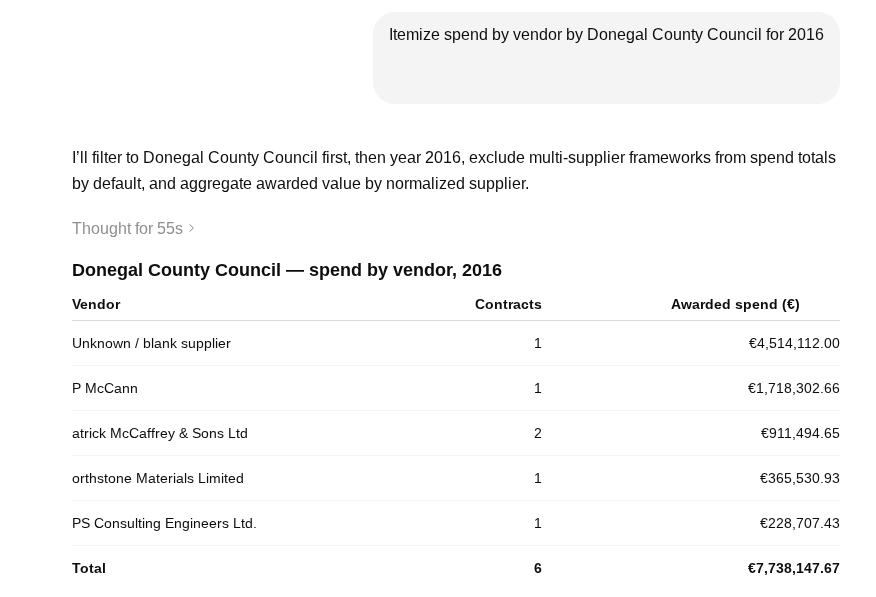
@tactical_fiend @albertdolan_ @jon_bayle Start with smth small and specific, for example:
chatgpt.com/share/6a1074bb…
The dataset does not have spend, just the procurement data so overruns would not be there.
English
English

@DrDStarkeyCBE You can’t ’oblige people to assimilate’. You can have a strong central culture which sets the tone and doesn’t constantly pander to minorities but the evidence shows that people don’t voluntarily shed their culture on settling a new land ⬇️
@GarettJones ‘The Culture Transplant’
English

Could the level of immigration Britain has endured have been handled differently?
If we had brought in the same number of people, could we have obliged them to respect British culture, to not expect handouts, to put their native traditions aside in pursuit of integration?
Some say the numbers involved were simply too big to allow this. But is that right?
English


English
English