tam
144 posts


my one Slack feature request- don't preview HTML as a scary text blob, I find myself wanting to sending coworkers HTML files that Claude generates pretty often, but the click through rate is horrendous



Are you in the $ZK or the $CC camp?




TẠI SAO COINBASE MUỐN "LY HÔN" VỚI OPTIMISM? Nhà phân tích @intangiblecoins vừa chia sẻ một góc nhìn rất thú vị về tương lai của Base – blockchain do Coinbase xây dựng! 🧵 Thứ nhất, Coinbase đang phải trả phí bản quyền cho Optimism để dùng OP Stack, thậm chí còn tốn hơn cả phí giao dịch trên Ethereum L1. Rõ ràng họ muốn giữ lại khoản tiền đó cho mình hơn. Thứ hai, @base hiện vẫn đang dùng sequencer tập trung, tức là chỉ một bên kiểm soát thứ tự giao dịch. Điều này khiến Base có thể bị xếp vào diện "giao thức tài chính KHÔNG phi tập trung" theo Đạo luật CLARITY, và phải chịu sự giám sát từ các cơ quan quản lý thị trường – đặc biệt nguy hiểm khi Coinbase muốn hỗ trợ cổ phiếu token hóa. Chính CBO của Coinbase từng thừa nhận Base "có lộ trình phi tập trung hóa", và có vẻ đây là lúc họ bắt đầu đi theo lộ trình đó.
Week 1 of the ZKnomics Staking Pilot Program is in the books. +160M $ZK is already delegated and staked. Quick breakdown: where we are, why it matters for governance and what we’re tracking next 👇


The reality today is what your own Prividium FAQ calls out: "Trust is built into the math". ZK proofs are positioned as the primary line of defense and security despite everyone in the know fully aware of their state of maturity. a16z put it aptly saying "we are still years away from meeting even the most basic goals for a secure and performant zkVM". You do seem to understand this for why else would Prividiums employ a fully centralized operational model where the central operator sees everything and can validate the whole ledger as a second line of defense. The price you pay for that is fractured single-operator chains where the operator decides who sees what. There's no innovation there, the industry has been trying to get traction with that model since 2014. The mathematical verifiability does not solve the fundamental problems with that model even if it worked flawlessly. The stance you take in your post that ZKP could offer a second line of defense to regular transaction verification is uncontentious. Canton has always taken the stance that if this technology were to mature to the point where it's robust and performant, it could be added to an interoperable system with privacy like @CantonNetwork . But even then, the value proposition that a member of the general public that has no stake in a transaction should have the right to question and mathematically verify the transactions of a highly regulated entity in the RWA space is divorced from reality. Real time synchronization, consistency, and interoperability between counterparties is the problem that finance at scale needs solving. Canton's ceiling is $400tn+ high quality real world assets being mobilized 24x7 with seamless interoperability. Today, ZKP's ceiling is a small subsection of the $2.5tn crypto market.


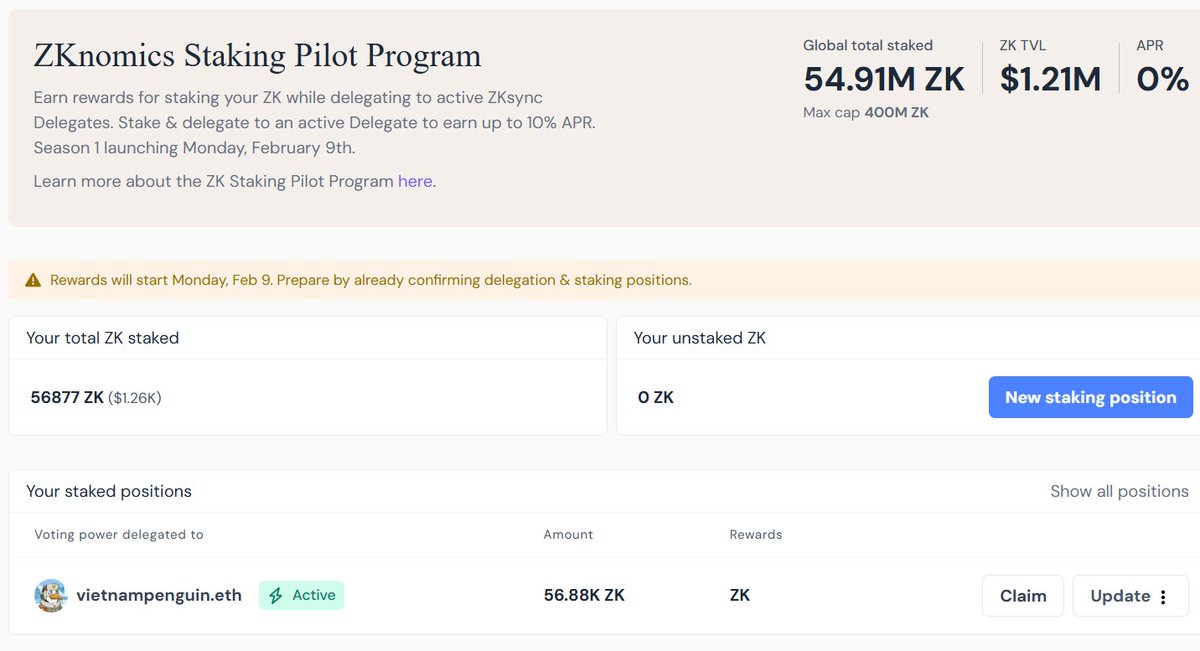
🗳️ Staking Pilot Portal Is Live Now is the time to pick an active Delegate and stake your $ZK! Rewards start as soon as Season 1 begins on February 9th. Delegate-to-Stake here 👇 tally.xyz/gov/zksync/sta…


Khi Ethereum tự scale, L2 còn là “mảnh ghép bắt buộc” không? 🤔 Vitalik mới đây đã chia sẻ khá thẳng thắn rằng tầm nhìn ban đầu về Layer 2 không còn phù hợp như trước, khi đối mặt với hai thực tế lớn. Thứ nhất, phần lớn L2 vẫn loay hoay ở Stage 1, trong khi mục tiêu Stage 2 - mức phi tập trung cao nhất - vừa chậm, vừa khó. Thậm chí có L2 không mặn mà đi tiếp, không hẳn vì kỹ thuật, mà vì yêu cầu tuân thủ pháp lý từ phía khách hàng buộc họ phải giữ quyền kiểm soát. Thứ hai, Ethereum L1 giờ đã tự scale được. Phí giao dịch thấp, network ổn định và gas limit được kỳ vọng sẽ tăng mạnh trong các năm tới. Điều này khiến vai trò “mở rộng #Ethereum” của L2 không còn mang tính sống còn như trước. Thông điệp Vitalik đưa ra: L2 không nên chỉ tồn tại để scale L1 nữa. Thay vào đó, mỗi L2 cần tìm giá trị cốt lõi riêng, có thể là tối ưu cho một loại ứng dụng cụ thể, như social, identity, AI, hay những ứng dụng mà L1 không (và không nên) gánh. Ethereum sẽ tập trung làm một việc: trở thành nền tảng an toàn và trung lập nhất có thể. Còn L2, muốn đi tiếp hay rẽ hướng, là bài toán sống còn của từng dự án. L2 không chết. Nhưng vai trò của L2 đang thay đổi. Và có lẽ, thay vì cố gắng “kéo dài” một tầm nhìn cũ, đã đến lúc cả Ethereum lẫn L2 chọn một con đường thực tế hơn. Anh em nghiêng về kịch bản nào hơn: L2 bám sát Ethereum hay tự mở lối riêng? 👇
Satoshi has not sold any Bitcoin, ever. The last transfer out of his wallets was 16 years ago. He is the best performing individual in crypto with a profit of $86 BILLION USD. He is the 22nd richest person in the world, and has never sold a single coin. If in doubt - check Arkham.

There have recently been some discussions on the ongoing role of L2s in the Ethereum ecosystem, especially in the face of two facts: * L2s' progress to stage 2 (and, secondarily, on interop) has been far slower and more difficult than originally expected * L1 itself is scaling, fees are very low, and gaslimits are projected to increase greatly in 2026 Both of these facts, for their own separate reasons, mean that the original vision of L2s and their role in Ethereum no longer makes sense, and we need a new path. First, let us recap the original vision. Ethereum needs to scale. The definition of "Ethereum scaling" is the existence of large quantities of block space that is backed by the full faith and credit of Ethereum - that is, block space where, if you do things (including with ETH) inside that block space, your activities are guaranteed to be valid, uncensored, unreverted, untouched, as long as Ethereum itself functions. If you create a 10000 TPS EVM where its connection to L1 is mediated by a multisig bridge, then you are not scaling Ethereum. This vision no longer makes sense. L1 does not need L2s to be "branded shards", because L1 is itself scaling. And L2s are not able or willing to satisfy the properties that a true "branded shard" would require. I've even seen at least one explicitly saying that they may never want to go beyond stage 1, not just for technical reasons around ZK-EVM safety, but also because their customers' regulatory needs require them to have ultimate control. This may be doing the right thing for your customers. But it should be obvious that if you are doing this, then you are not "scaling Ethereum" in the sense meant by the rollup-centric roadmap. But that's fine! it's fine because Ethereum itself is now scaling directly on L1, with large planned increases to its gas limit this year and the years ahead. We should stop thinking about L2s as literally being "branded shards" of Ethereum, with the social status and responsibilities that this entails. Instead, we can think of L2s as being a full spectrum, which includes both chains backed by the full faith and credit of Ethereum with various unique properties (eg. not just EVM), as well as a whole array of options at different levels of connection to Ethereum, that each person (or bot) is free to care about or not care about depending on their needs. What would I do today if I were an L2? * Identify a value add other than "scaling". Examples: (i) non-EVM specialized features/VMs around privacy, (ii) efficiency specialized around a particular application, (iii) truly extreme levels of scaling that even a greatly expanded L1 will not do, (iv) a totally different design for non-financial applications, eg. social, identity, AI, (v) ultra-low-latency and other sequencing properties, (vi) maybe built-in oracles or decentralized dispute resolution or other "non-computationally-verifiable" features * Be stage 1 at the minimum (otherwise you really are just a separate L1 with a bridge, and you should just call yourself that) if you're doing things with ETH or other ethereum-issued assets * Support maximum interoperability with Ethereum, though this will differ for each one (eg. what if you're not EVM, or even not financial?) From Ethereum's side, over the past few months I've become more convinced of the value of the native rollup precompile, particuarly once we have enshrined ZK-EVM proofs that we need anyway to scale L1. This is a precompile that verifies a ZK-EVM proof, and it's "part of Ethereum", so (i) it auto-upgrades along with Ethereum, and (ii) if the precompile has a bug, Ethereum will hard-fork to fix the bug. The native rollup precompile would make full, security-council-free, EVM verification accessible. We should spend much more time working out how to design it in such a way that if your L2 is "EVM plus other stuff", then the native rollup precompile would verify the EVM, and you only have to bring your own prover for the "other stuff" (eg. Stylus). This might involve a canonical way of exposing a lookup table between contract call inputs and outputs, and letting you provide your own values to the lookup table (that you would prove separately). This would make it easy to have safe, strong, trustless interoperability with Ethereum. It also enables synchronous composability (see: ethresear.ch/t/combining-pr… and ethresear.ch/t/synchronous-… ). And from there, it's each L2's choice exactly what they want to build. Don't just "extend L1", figure out something new to add. This of course means that some will add things that are trust-dependent, or backdoored, or otherwise insecure; this is unavoidable in a permissionless ecosystem where developers have freedom. Our job should make to make it clear to users what guarantees they have, and to build up the strongest Ethereum that we can.
Introducing the ZKnomics Staking Pilot Program Soon $ZK holders will be able to stake their tokens in the @tallyxyz Staking Pilot interface and receive rewards while strengthening active governance participation. Season 1 launches on Monday, February 9th