Taylor Haddad, MD

747 posts

Taylor Haddad, MD banner
Taylor Haddad, MD

Taylor Haddad, MD

@tbhaddad

PGY-2 @TJUHNeurology. Alum of @JeffersonUniv & @Penn_State. Budding socially responsible vascular neurologist 🧠🪢

Philadelphia, PA Katılım Mart 2020
893 Takip Edilen479 Takipçiler
Sabitlenmiş Tweet
Taylor Haddad, MD
Taylor Haddad, MD@tbhaddad·
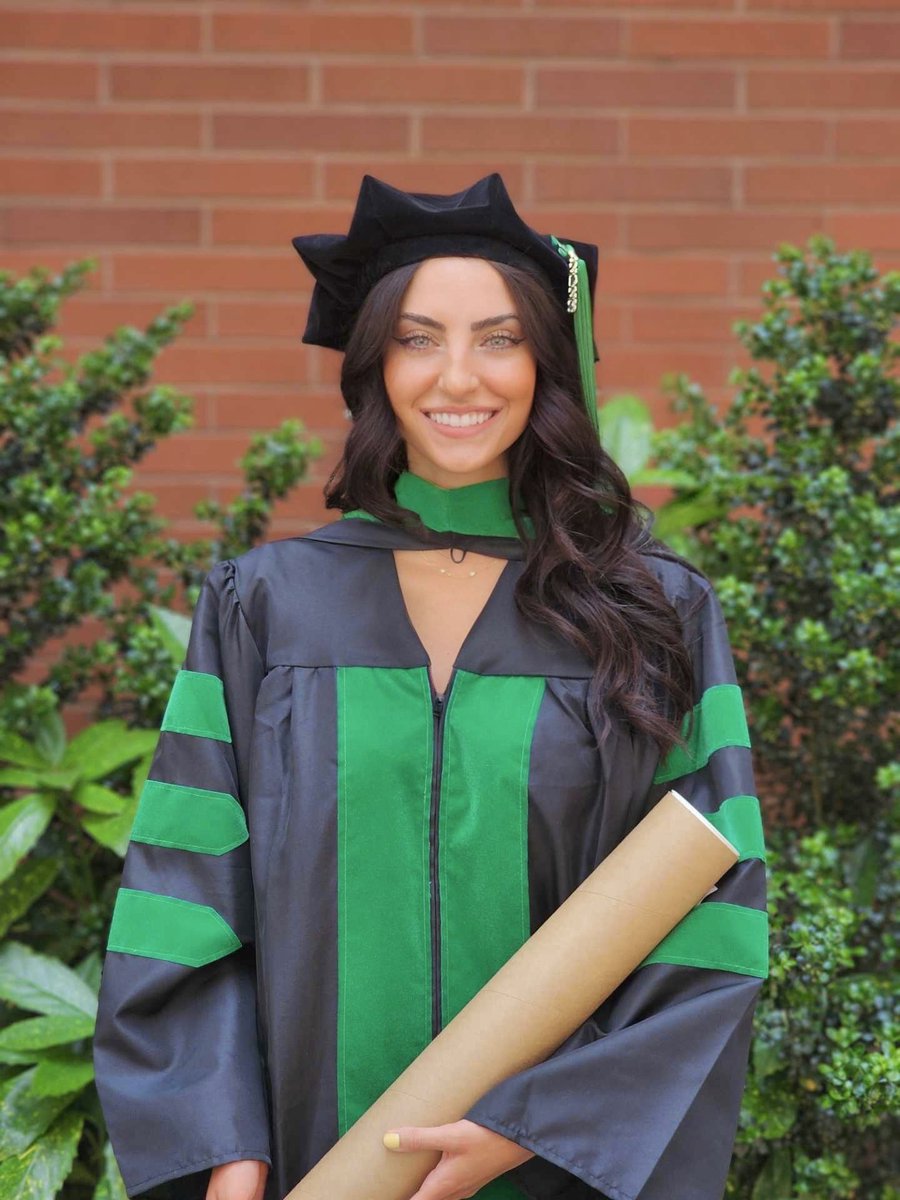
Andddd that’s a wrap on med school!! One neurologist coming right up 🧠 #MedTwitter
Taylor Haddad, MD tweet media
Philadelphia, PA 🇺🇸 English
265
112
2K
48.4K
Taylor Haddad, MD retweetledi
The Culturist
The Culturist@the_culturist_·
10 Van Gogh masterpieces that inspired iconic movies scenes (thread): 1. “Wheatfield with Crows” // “Dreams”, directed by Akira Kurosawa
The Culturist tweet media
English
138
2.5K
20.4K
2.6M
Taylor Haddad, MD retweetledi
Keith Siau
Keith Siau@drkeithsiau·
Patient with blue blood. What’s the likely diagnosis?
Keith Siau tweet media
English
329
566
3.9K
955.8K
Taylor Haddad, MD retweetledi
Zach London
Zach London@zach_london·
If you're studying #neurology, you have to learn about different gates. I'm here for you all day. A normal casual gate. 1/
Zach London tweet media
English
44
237
1.2K
314.5K
Taylor Haddad, MD retweetledi
The Cultural Tutor
The Cultural Tutor@culturaltutor·
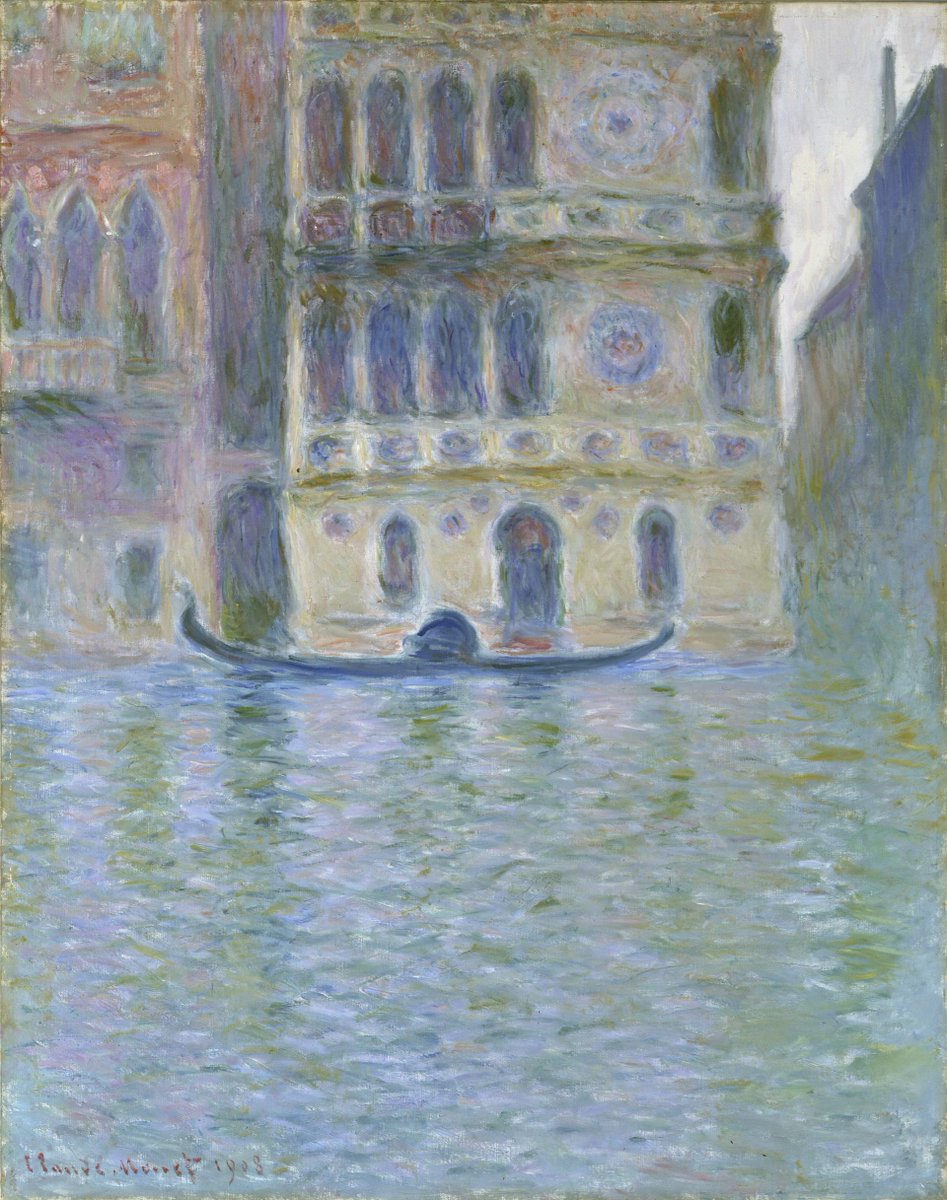
Why is Claude Monet one of the world's most popular and beloved artists? Forget about Impressionism for a moment, and think about him as an individual. As Monet said himself: "I still regret having caused the naming of a group whose majority had nothing impressionist about it." Because, ultimately, Monet was an artistic movement of one, a man who cared little for what others were doing or what they thought, or whether he was an artistic rebel. What Monet cared about, what he truly loved, was the uncomplicated beauty of the ever-changing natural world and its boundless varieties of colour. He even said so: "my only merit lies in having painted directly in front of nature." And so, even beyond his revolutionary techniques which kickstarted the Impressionist movement, this might explain why he is one of the world's most popular artists — and not just popular, but genuinely beloved. Because there has probably never been another artist in history who loved nature as much as Claude Monet, and who observed it so closely and with such delight. As he said toward the end of his life, "nothing in the whole world is of interest to me but my painting and my flowers." And, equally important, there has perhaps never been an artist so sensitive to colour and so technically masterful at portraying it on a canvas: "colour is my day-long obsession, joy and torment." It wasn't just nature Monet loved, but light — light itself! — and the changing effects of this light on flowers, bridges, cathedrals, water, houses, or train stations. And, crucially, he had the talent to show this light in all its subtle, myriad variations of colour. In other words, Monet possessed the perfect union of skill and passion. He has had many imitators, some of them brilliant, but none with the same unique mixture of supreme talent, adherence to truth, love of light, and unceasing reverence for natural beauty. His water lilies and haystacks and sunsets do not ask anything of us, nor challenge our perceptions, nor attempt to inspire us or make us uncomfortable, nor even necessarily to stir our emotions, nor to remind us of our obligations, or of suffering or glory or history or power or strangeness. Rather, in a world of anger, politics, misery, and disappointment, and a world of artists trying to impress or surprise or change us, Monet's paintings stand apart as works of pure and sincere delight, of simple and truthful loveliness. And so, well over a century later, the art of Claude Monet — his enduring gift to us — continues to bring uncomplicated joy, deeply needed peace, and honest beauty to millions upon millions of people around the world.
The Cultural Tutor tweet media
English
86
638
5.7K
1.2M
Taylor Haddad, MD retweetledi
Dr hare krishna pradhan
Dr hare krishna pradhan@harekrishna_h·
Xanthochromia Yellow discoloration of CSF indicating the presence of bilirubin in CSF which appears as oxyhaemoglobin released from the breakdown of red blood cells following haemorrhage into the CSF is converted in vivo into bilirubin in a time‐dependent manner. A subarachnoid haemorrhage (SAH) is a spontaneous arterial bleeding into the subarachnoid space, usually from a cerebral aneurysm, and characterised by a severe sudden‐onset headache.
English
2
30
214
36K
Taylor Haddad, MD retweetledi
Clement Lee, MD, MSc
Clement Lee, MD, MSc@ClementLeeMD·
internal medicine rounds
Clement Lee, MD, MSc tweet media
English
63
1.4K
8.2K
667K
Taylor Haddad, MD retweetledi
The Cultural Tutor
The Cultural Tutor@culturaltutor·
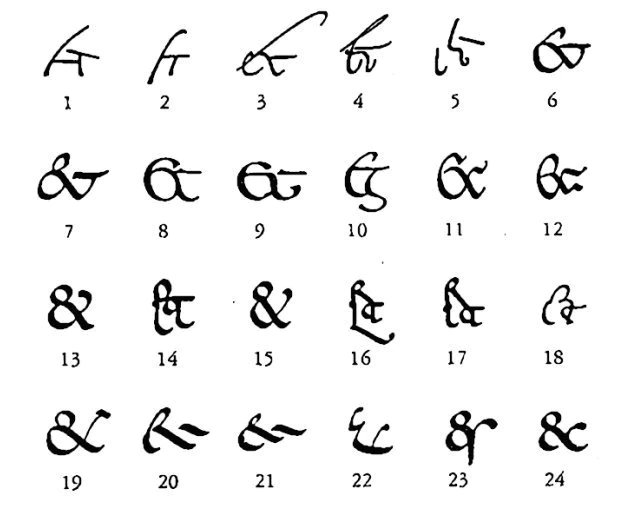
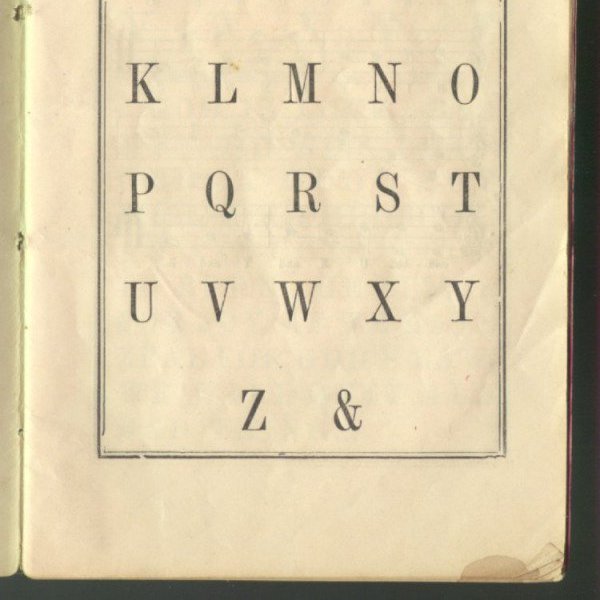
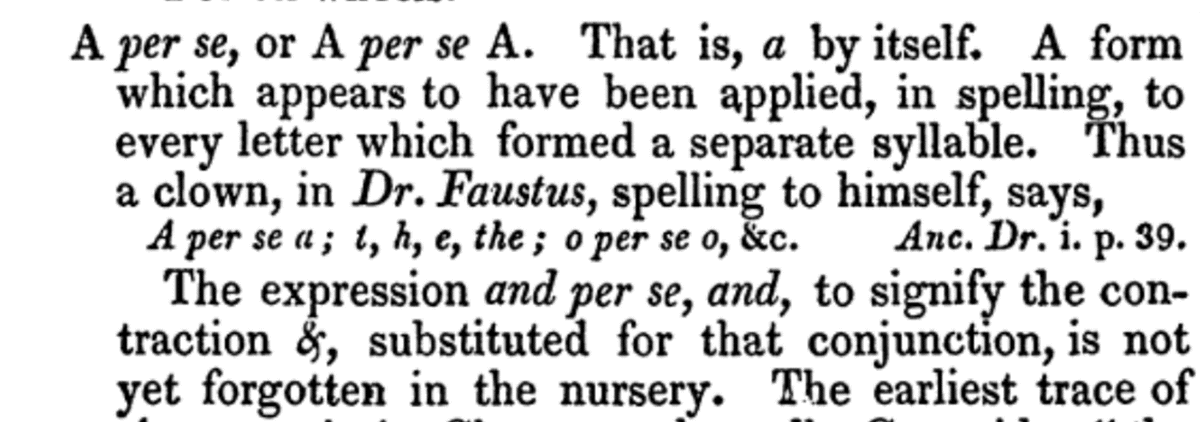
What the hell is an ampersand and why does it look like that?! The first thing you need to know is that "&" used to be the 27th letter of the alphabet... But there are three parts to this story. And the first begins over two thousand years ago in Ancient Rome with a single word: et. It's the Latin for "and". At some point Roman scribes started combining the two letters of et into a single symbol, which was the ancestor of our modern &. The earliest example of the "et" symbol is actually from graffiti in Pompeii. In any case, it did not disappear with the fall of the Roman Empire. Latin survived as the language of the Catholic Church and of scholarship in Medieval Europe. Scribes during the Dark Ages continued to use the & symbol. It evolved down the centuries, in places losing any semblance of the letters e and t whatsoever. The second part of the story is that during the 18th and 19th centuries, as education and the teaching of literacy spread, & was added to the end of the alphabet as a sort of 27th letter. On a related note, although "et cetera" is now usually just abbreviated as etc., for a long time it was instead abbreviated as "&c". The & was for et and the c for cetera. The third and final part of the story is about how the alphabet was taught to children — and how it was read out loud. As this 1822 Glossary of Words and Phrases explains, it had been normal during the Renaissance, when speaking the alphabet, to add "per se" before any letter which could also be a word on its own — "per se" means "by itself" in Latin. Take the letter A, which can also be a word of its own. When reading out the alphabet people would say "A, per se A, B, C, D, E, F, G, H, I, per se I..." and so on. O was also considered a word of its own. Which means, when people got to the end of the alphabet, with & being the 27th letter, they would say: "S, T, U, V, W, X, Y, Z, and per se &." When this old way of reading the alphabet was taught to children in the 18th century and they were reciting it aloud, they would garble "and per se " into what eventually became... ampersand. A Dic­tion­ary of Slang and Col­lo­quial Eng­lish from 1905 relates some of the many other pronunciations school children apparently came up with: "Am­persand. The sign &; am­persand. Vari­ants: Ann Passy Ann; an­pasty; an­dpassy; an­parse; aper­sie; per-se; am­passy; am-passy-ana; am­pene-and; am­pus-and; ampsyand; am­pazad; am­siam; am­pus-end; ap­perse-and; em­per­siand; am­perzed; and zumzy-zan." Well, of all the many pronunciations that might have stuck, it was "ampersand" which came to be accepted and is now the official name for &... rather than zumzy-zan. So, from hurried Roman scribes to unruly school children, that's where "&" came from.
The Cultural Tutor tweet mediaThe Cultural Tutor tweet mediaThe Cultural Tutor tweet mediaThe Cultural Tutor tweet media
English
404
4.7K
27.5K
5.6M
Taylor Haddad, MD retweetledi
Today Years Old
Today Years Old@todayyearsold·
Imagine telling this story without proof: “I didn't go to work because a cat fell on my head and then a dog with shoes tried to do me justice.”
Pepe Meme@pepe_fgm

So many questions..

English
229
20.4K
98.5K
9.7M
Taylor Haddad, MD retweetledi
Oren Gottfried, MD
Oren Gottfried, MD@OGdukeneurosurg·
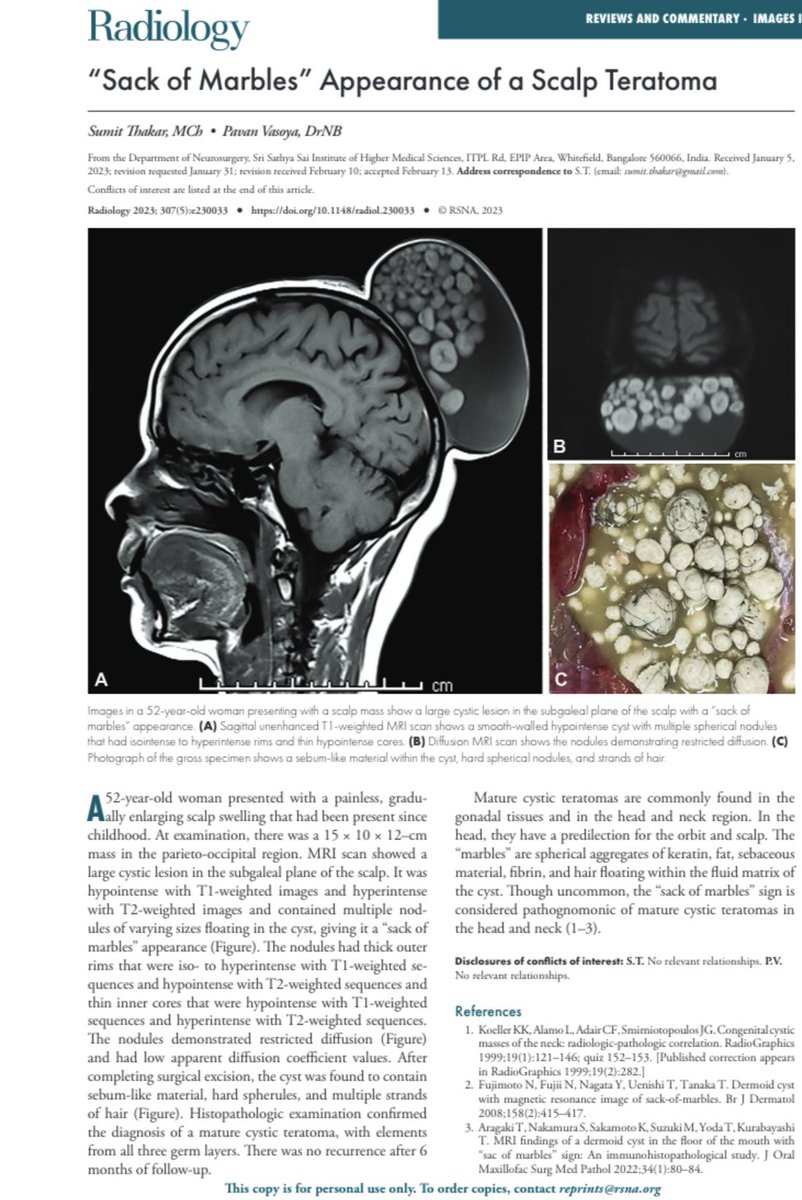
Answer: The “marbles" are spherical aggregates of keratin, fat, sebaceous material, fibrin, and hair floating in cyst. The "sack of marbles" sign is pathognomonic of mature cystic teratomas in head & neck. Resection was performed showing all 3 germ layers and patient has had no recurrence.
Oren Gottfried, MD tweet media
English
22
167
1.3K
133.7K