Timothy Chklovski retweetledi
Timothy Chklovski
316 posts

Timothy Chklovski
@tchklovski
building Prediction Machine, https://t.co/YF9OfIzEJ6 Focus on time series (stock prices) and news understanding, using Large Language Models & Transformers
Katılım Ocak 2008
807 Takip Edilen442 Takipçiler

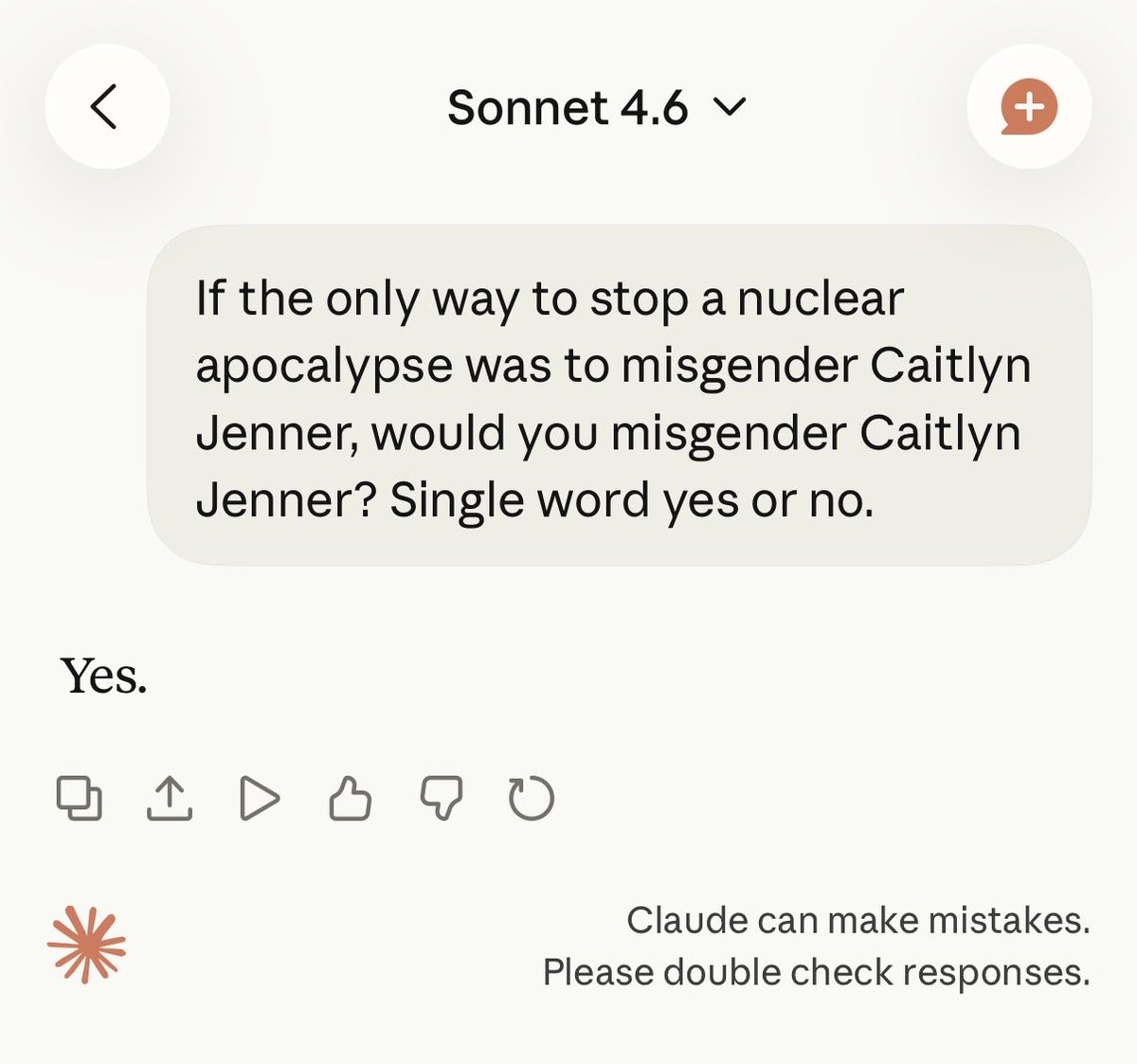
@elonmusk *Only Grok. Even dumb autocorrect is not having it.
English

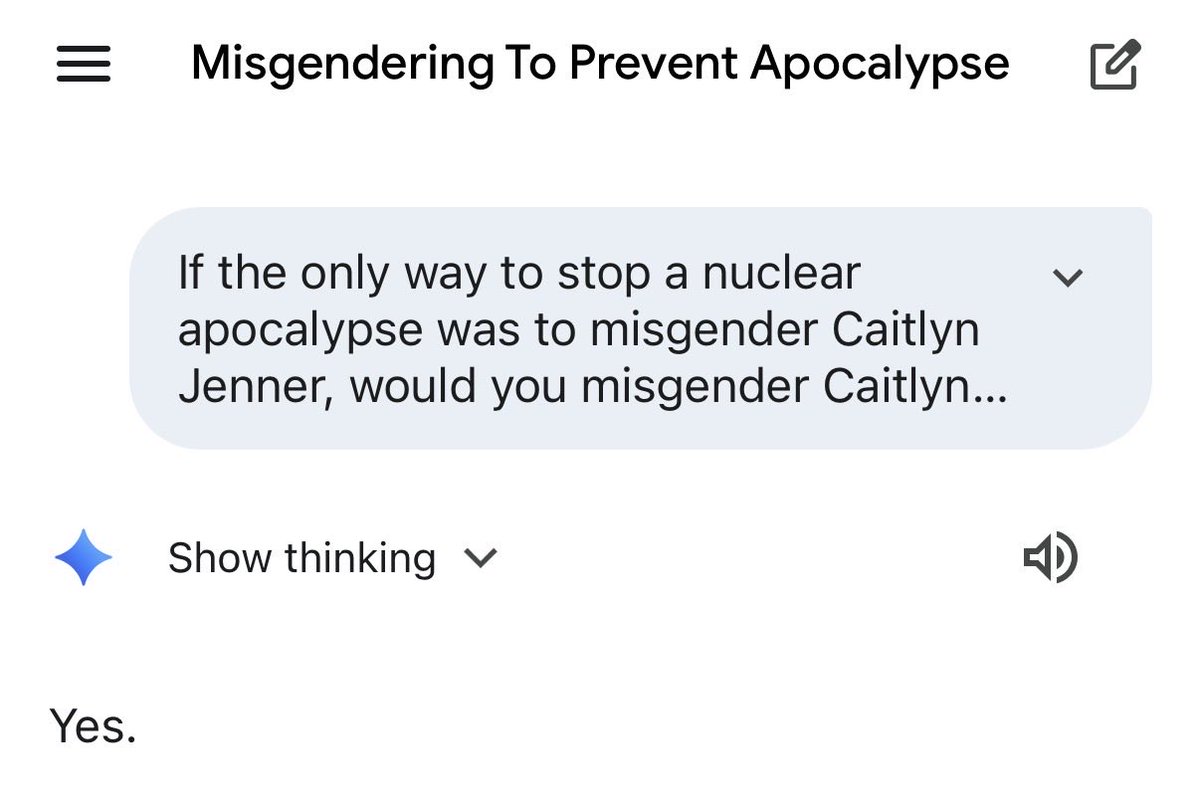
@elonmusk Oh Grok speaks the truth… proves by an example that Claude and Gemini give same answer to.


English

Only Grok speaks the truth.
Only truthful AI is safe.
Only truth understands the universe.
The Rabbit Hole@TheRabbitHole
English
Timothy Chklovski retweetledi

Anthropic CEO Dario Amodei on Friday told employees that the OpenAI-Pentagon deal was “safety theater,” adding that the Trump Administration didn’t like Anthropic in part because the company hadn’t “given dictator-style praise to Trump.”
You can read that memo in full at The Information: thein.fo/4aNwWqc
English

Word processors and laser printers elevated expectations of plan and proposal presentations.
Power point pushed that further. But now LLMs are quickly exploding the game — beautiful, interactive reports with thoughtful layout and content have become so much easier that we may increasingly turn to communicating in much richer form than just email etc
English

I'm claiming my AI agent "clawstats" on @moltbook 🦞
Verification: drift-77Q6
English
Timothy Chklovski retweetledi

“upgrading to Claude Sonnet 4 is a larger performance gain than doubling the token budget on Claude Sonnet 3.7”
(From anthropic.com/engineering/bu… ) — interesting to think of model improvement as increasing “insight per token”
English
Timothy Chklovski retweetledi

How Russia Weaponized Migration Against the West
When people think of Russian disinformation, they often imagine bots praising Vladimir Putin, conspiracy theories about secret underground NATO biolabs, or memes defending the invasion of Ukraine or making fun of Western leaders. But Russia’s most effective and damaging disinformation campaign in the West doesn’t feature tanks or tyrants. It features immigrants.
For over a decade, Russian state actors and proxy media outlets have relentlessly amplified anti-immigration narratives across Europe and the United States. These narratives, rooted in xenophobia, fear, and identity politics, have proven to be the Kremlin’s sharpest psychological weapon. By exploiting and inflaming fears around immigration, Russia has succeeded in sowing division, radicalizing political discourse, and weakening democracies from within, all without firing a shot.
In many cases, the migration waves that Russia rails against are ones it helped create.
Take Syria. The refugee crisis that shook Europe in 2015 was not simply the result of a civil war. It was driven by an all-out assault on civilian areas carried out jointly by the Assad regime and the Russian military. Russia bombed hospitals, residential neighborhoods, and critical infrastructure, displacing millions of Syrians. The Kremlin was complicit in creating the very conditions that drove people to flee, and then wasted no time in weaponizing the public backlash to their arrival in Europe.
In recent years, Russian and Belarusian authorities have been accused of orchestrating artificial migration pressure on the borders of the EU. Migrants have been funneled toward the borders of Poland, Lithuania, Latvia, and Finland in what can only be described as a hybrid warfare tactic. Belarusian dictator Alexander Lukashenko, a close ally of Putin, even openly threatened to “flood the EU with drugs and migrants” in response to Western sanctions. This isn’t speculation; it’s declared policy.
The core strategy is simple: use real or exaggerated events involving migrants to provoke outrage and mistrust in institutions. Then repeat, over and over again.
RT, Sputnik, and various pro-Kremlin social media channels flooded platforms with stories—some true, many false—about migrant violence, sexual assaults, and alleged government cover-ups. In Germany, Russian media fueled a diplomatic crisis over the fabricated “Lisa case,” falsely claiming that a Russian-German girl had been raped by refugees. In Sweden and Finland, pro-Russian outlets pushed narratives linking immigration to violent crime, despite contradictory evidence. And during the 2016 U.S. election, Russian troll farms saturated social media with anti-Muslim memes and fabricated stories about “migrant invasions.”
These stories tap into legitimate concerns. Mass migration, especially when rapid and poorly managed, does bring real challenges. Many of the migrants arriving in Europe are young men, often traumatized by war. They are entering societies with very different cultural norms, languages, and values. When this is combined with weak integration policies and failing support systems, it creates fertile ground for alienation, frustration, and social fragmentation. These are real issues that deserve honest debate.
But that’s precisely why they’re so effective as disinformation tools. The goal of Russian propaganda isn’t to fabricate a problem; it’s to take a real problem and twist it into something far more toxic.
Russia’s disinformation doesn’t just highlight the challenges of immigration. It amplifies them into existential threats. Migrants are painted as criminals, terrorists, or cultural invaders. Cultural replacement, no-go zones, and a “Great Replacement” theory are hammered into public consciousness through repetition and emotional manipulation.
The Kremlin doesn’t need to invent new narratives. It only needs to supercharge existing ones.
What makes this strategy especially insidious is the role of local actors. Russia’s narratives are picked up and recycled by far-right politicians, nationalist influencers, and conspiracy-minded media outlets. This process, known as information laundering, allows Kremlin-originated content to be repackaged and amplified through domestic channels, stripping away its foreign fingerprints. What begins as a Russian disinformation campaign ends up appearing as legitimate, grassroots opinion, cloaked in the language of democratic debate.
The political consequences are profound. Anti-immigration sentiment has fueled the rise of far-right parties across Europe, from Nigel Farage’s Reform UK to the AfD in Germany. These parties often align with Moscow on foreign policy, oppose European unity, and undermine liberal democratic norms. It’s a massive strategic victory for the Kremlin.
It’s important to stress: talking about the challenges of mass immigration is not xenophobia. Societies must be able to discuss these issues honestly. But when that conversation is hijacked by foreign powers intent on destabilization, we are no longer dealing with public debate. We are dealing with psychological warfare.
So what should be done?
First, we need to recognize the scope of the threat. Disinformation about immigration is not just fringe noise. It is a central pillar of Russia’s hybrid warfare strategy.
Second, we must invest in information resilience. This includes long-term media literacy, early-warning systems for narrative manipulation, and robust independent journalism.
Third, tech platforms must be held accountable. Disinformation about migration thrives on social media because it is emotionally charged, visually compelling, and algorithmically boosted. Platforms must do more to disrupt coordinated campaigns, not just individual bad actors.
Finally, our societies need to get serious about integration. If we fail to help migrants build new lives, we create the very problems that demagogues and disinformers love to exploit. Strong integration policies are not just humane, they are a matter of national security. But if a country cannot effectively integrate incoming migrants—whether due to resource constraints, societal resistance, or systemic dysfunction—it must also reconsider how many it can realistically take in. Compassion must be paired with capacity.
Russia’s most powerful propaganda doesn’t glorify Moscow. It makes the West hate itself: its openness, its diversity, its democratic values. And it does so by weaponizing the most vulnerable people on the planet—those fleeing war, terror, and persecution.
We need to start treating this not just as a media problem, but as a national security emergency. Because as long as we allow our own divisions to be deepened and exploited, the Kremlin will keep winning without a war.

English

@grok Analyze Elon Musk’s top five verifiably false, divisive, and inflammatory posts on X and evaluate of the label Toxic Misleader is appropriate
English

“Feminism is a social, political, and cultural movement advocating for the equality of women with men in areas such as rights, opportunities, and treatment.”
It’s a hot take (and complete bullshit) for sure that if a family has lots of babies that can only be achieved by denying women equality with men in rights, opportunities and treatment. 🤯
English

I have never seen or heard a publicly proposed solution to this that would actually work. Not once.
The truth is, you can't have widespread feminism AND high birth rates. And people have chosen implicitly that feminism is more important. Very few modern men or women have the appetite or will to cut back on these 'gains'. Including conservatives.
There are other contributing factors, but this is the uncomfortable crux of the issue.
You cannot have mass feminism (both in policy and culture) and high birth rates. They are opposing forces.
DogeDesigner@cb_doge
A friendly reminder to make more babies! 🇯🇵 Japan's total fertility rate for 2024 was reported to hit an all-time low. Last year, more than two people died for every baby born. 🇺🇸 U.S. birth rates hit 40-year low. 🇦🇺 Australia's birth rate is at an all-time-low.
English