Caviarr8 🐉

1.6K posts

Caviarr8 🐉 banner
Caviarr8 🐉

Caviarr8 🐉

@ten_cata

London, England Katılım Ağustos 2020
920 Takip Edilen134 Takipçiler
Caviarr8 🐉 retweetledi
Popeye
Popeye@SailorManCrypto·
Most dips in a downtrend are not dips. They are lower lows. And buying a lower low is not being smart — it's being exit liquidity. One of my most important threads. x.com/SailorManCrypt…
Popeye@SailorManCrypto

"Buy the dip" is the most expensive advice in crypto. Here's why most traders lose money following it — and how to know when a dip is actually a dip. Everyone says buy the dip. Nobody tells you that most dips in a downtrend are not dips at all — they are lower lows. And buying a lower low is not being smart. It's being someone else's exit liquidity. The difference between a real dip and a trap is not complicated, but most traders never bother to learn it. So they keep buying, keep averaging down, and keep wondering why the chart keeps going against them. 1. A dip only exists in an uptrend This is the most basic rule and the one most people ignore. In an uptrend, price pulls back to a level of demand, holds structure, and continues higher. That's a dip. It's a healthy retracement within a trend that is still intact. Higher highs, higher lows — the structure confirms it. If the structure is not there, it is not a dip. Full stop. Pro tip: Before you buy any pullback, zoom out. If the higher timeframe is not making higher highs and higher lows, you are not buying a dip. You are catching a falling knife. 2. In a downtrend, it's not a dip — it's just a lower low Price bounces in a downtrend. Every time it does, people scream "buy the dip." But what they're actually buying is a lower high before the next lower low. The trend is making lower highs and lower lows — that bounce is not a buying opportunity, it's a distribution event. Smart money is selling into your optimism. Pro tip: Count the structure. If price just made a lower low and bounces, that bounce needs to break the previous lower high before it means anything. Until then, it's just noise inside a downtrend. 3. Re-distribution vs accumulation — learn the difference A range after a drop can look like a bottom. But not all ranges are accumulation. If the range resolves to the downside, it was re-distribution — a pause before more selling. Accumulation shows declining volume, absorption at the lows, and eventually a spring or MSB to the upside. If you can't tell the difference, you're guessing with your capital. Pro tip: Watch volume inside the range. In accumulation, volume dries up on the drops and expands on the bounces. In re-distribution, it's the opposite. The volume tells the story before price confirms it. 4. Volume tells you what price won't A real dip in an uptrend pulls back on declining volume — sellers are drying up. Then the bounce comes on expanding volume — buyers stepping in with conviction. A lower low in a downtrend bounces on low volume and drops on expanding volume. The volume profile doesn't lie. If the bounce has no volume behind it, it's not a dip. It's a dead cat. Pro tip: If you're not checking the volume profile before entering any trade, you're trading blind. Price shows you what happened. Volume shows you why. 5. How I tell the difference I look at three things: trend structure, volume profile, and the reaction at key levels. Is the macro trend making higher highs and higher lows? Is the pullback happening on declining volume? Is price holding at VaL or a known demand zone? If all three align, that's a dip I'm interested in. If even one is missing, I wait. Patience has saved me more money than any setup ever has. Pro tip: Don't buy the dip because Twitter told you to. Buy the dip because the structure, the volume, and the level all confirm it. Multiple reasons for a trade — that's the edge. Closing: The next time someone tells you to buy the dip, ask yourself one question — is this actually a dip, or am I just buying someone else's exit? The structure, the volume, and the context will always give you the answer. Your job is to listen. "the market doesn't care about your bias. respect the structure, or become the liquidity." If this was useful, like and repost — it helps more people find it. Which dip did you buy that turned out to be a lower low? Drop it below. No shame, we've all been there.

English
3
4
81
4.7K
Caviarr8 🐉 retweetledi
KushyProd
KushyProd@KushyProd·
69% goes to players. Not holders. Not spectators. Play. Earn. April 4. kushyprod.com/kash
English
69
310
406
8.3K
Caviarr8 🐉 retweetledi
Crypto Bully 🔥
Crypto Bully 🔥@BullyDCrypto·
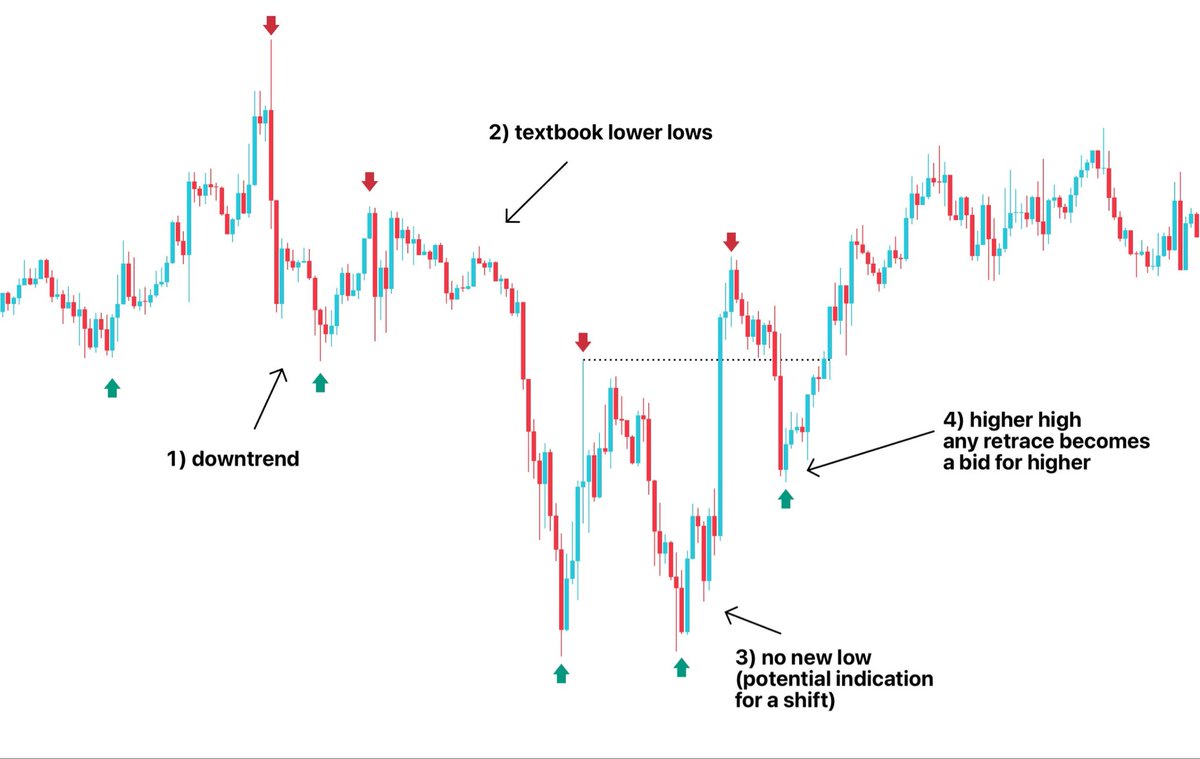
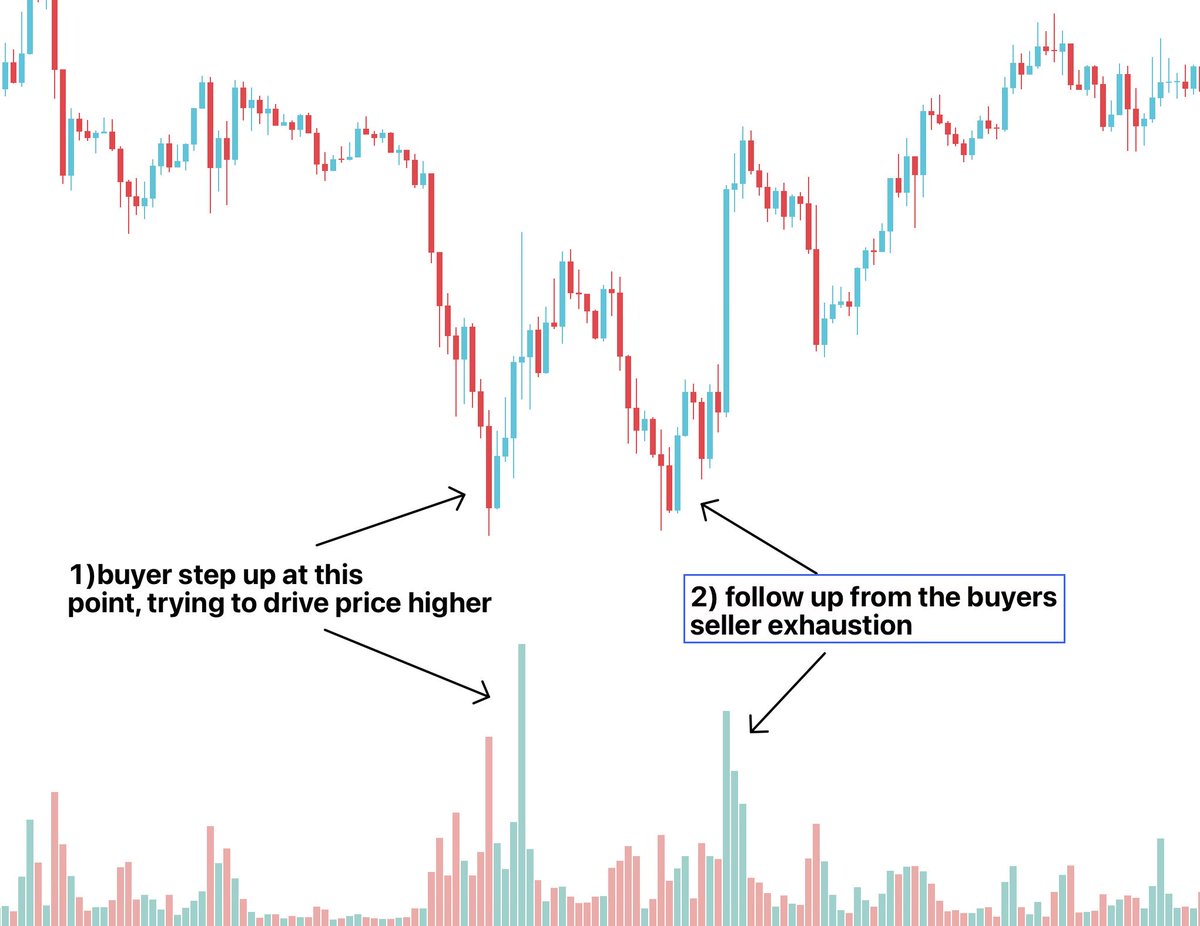
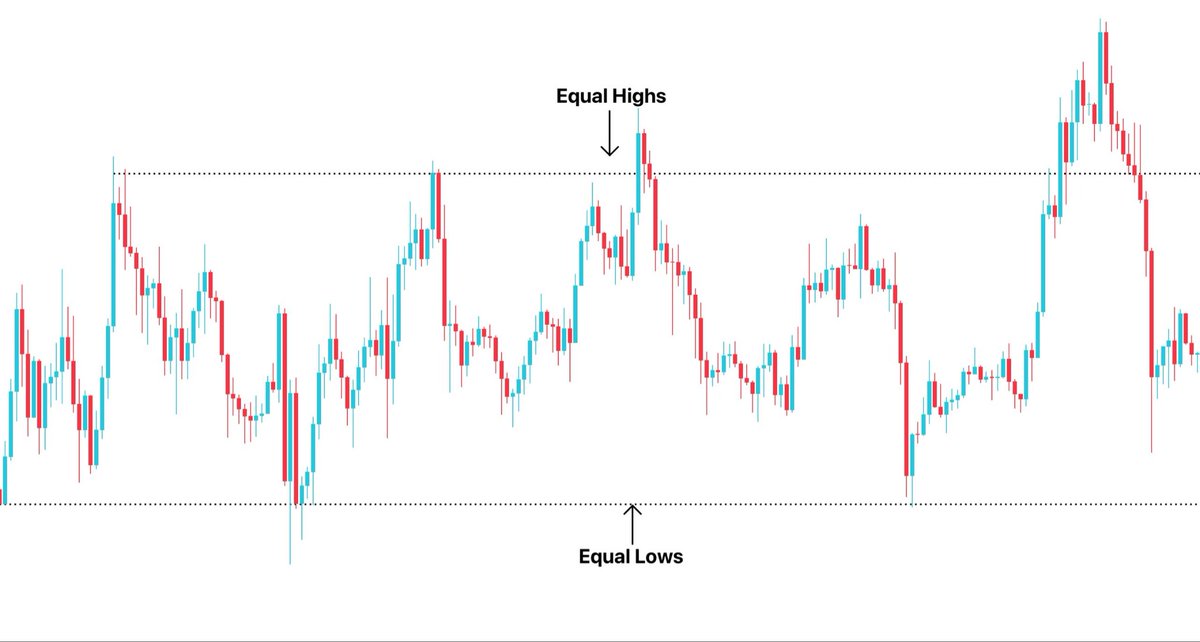
Beginner friendly guide to simple trading Covering the basic jargons thrown around on here with no context. Which tends to confuse newbies or forcing them to go down the rabbit hole and watching tons of useless content 🧵:
Crypto Bully 🔥 tweet mediaCrypto Bully 🔥 tweet mediaCrypto Bully 🔥 tweet mediaCrypto Bully 🔥 tweet media
English
8
22
160
4.7K
Caviarr8 🐉 retweetledi
KushyProd
KushyProd@KushyProd·
It’s already in motion. You’re about to see it. April 4.
KushyProd tweet media
English
51
124
281
4.7K
Caviarr8 🐉 retweetledi
Blum
Blum@Blum_OG·
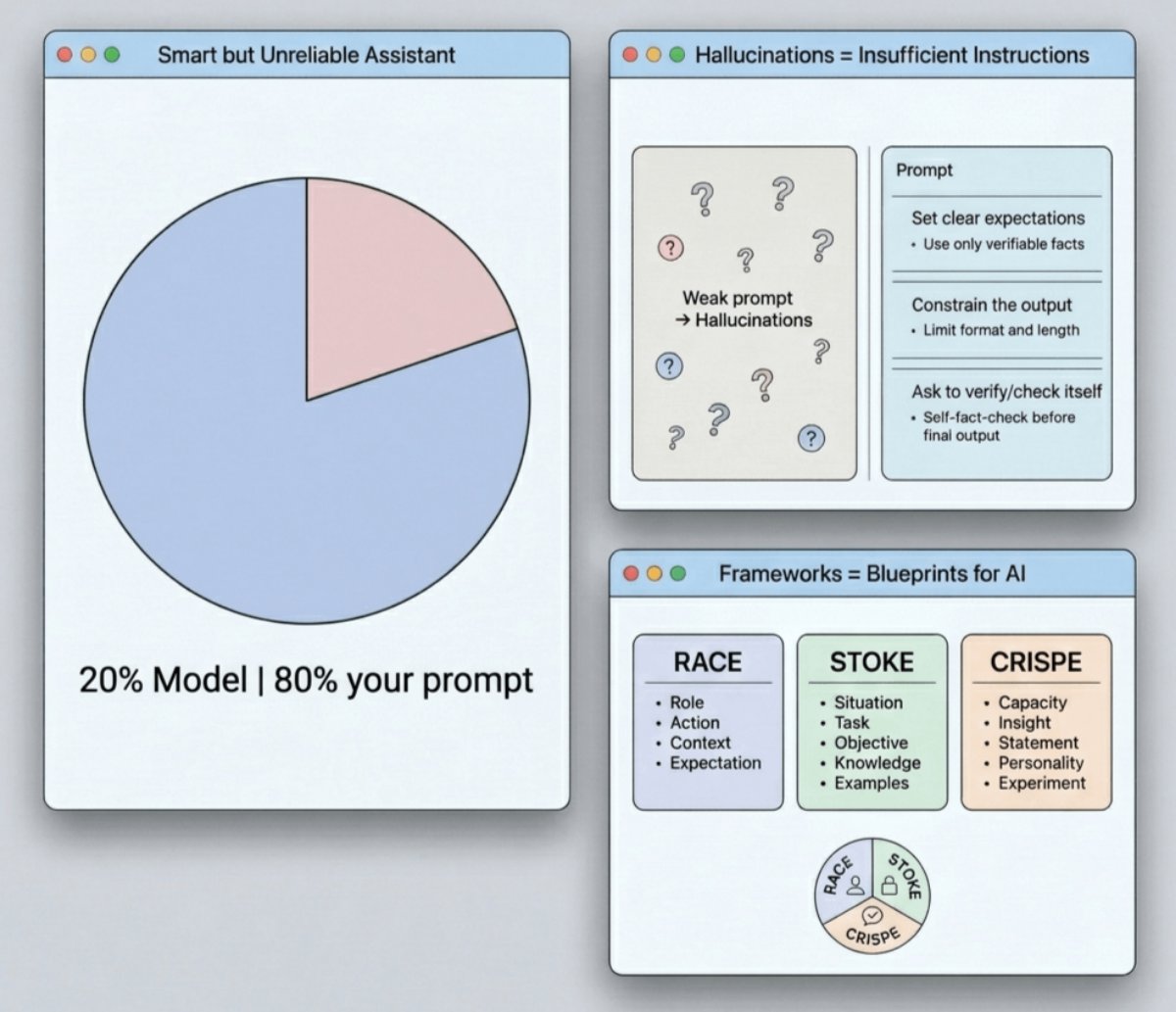
HOW TO CRAFT TRULY EFFECTIVE AI PROMPTS you ask an LLM to for a high-quality report and get back text written with expert-level confidence but packed with total BS familiar? so, to avoid situations like this, you need to understand these basic points: > the “smart but unreliable” assistant problem LLM output is 20% the model, 80% how you structure the prompt prompt engineering - just hardcore natural language computing control so, to get quality output, you need to stop chatting with the model and start programming it > AI hallucinations - indicator of insufficient instructions to ensure grounding, use these techniques: - set your clear expectations - constrain the output (setting strict boundaries) - ask it to verify/check itself (self fact-checking) > frameworks - “blueprints” for the AI top 3: - RACE (Role, Action, Context, Expectation) fast, simple, great for daily use - STOKE (Situation, Task, Objective, Knowledge, Examples) for deep work and niche domains - CRISPE (Capacity, Insight, Statement, Personality, Experiment) creativity, hypothesis testing, and style control LLMs get such structures way better so the output ends up much closer to what you actually want don't complicate your AI usage with pointless re-prompts master the basics and get quality, desired outputs from LLMs
Blum tweet media
English
7
1
14
508
Chess King - Jchess.skr
Chess King - Jchess.skr@App_ChessKing·
🎁 KUSHY GIVEAWAY 🌍 Season 1 was Seeker-only… Season 2 is open to everyone! 🔥 1 Green Pass (≈600 $SKR - by Kushy devs) 👀 Season 2 is about to get wild! How to enter: ✅ Follow @App_ChessKing & @KushyProd & @solanamobile ✅ Like & Repost ✅ Comment “KUSHY” 💡 Bonus: Use code jchess.skr → +100 $KASH ⏳ 72h - winner announced here
Chess King - Jchess.skr tweet media
English
222
134
193
3.9K
Caviarr8 🐉 retweetledi
Popeye
Popeye@SailorManCrypto·
The Pre-Trade Checklist That Took Me 3 Years to Build. You voted. You chose. Here it is. Most traders lose money not because their analysis is wrong — but because they skip steps. They see a candle move, feel the urgency, and click the button before they've even asked themselves why they're taking the trade. I used to do the same. Then I started tracking every trade, every mistake, and every time I entered without a plan. The pattern was obvious: the losses almost always came when I skipped the process. So I built a checklist: Four phases. Every trade. No exceptions. Here's how it works: PHASE 1 — Before you open the chart. Check the economic calendar. If there's a high-impact event in the next 4 hours, you need to know. Check the macro context — is the environment risk-on or risk-off? Then check your correlations: DXY, SPX, Gold, BTC vs Alts, BTC Dominance, USDT.D. They need to tell a coherent story. And finally — check your current exposure. How many trades are already open? What's your total risk right now? If you're already at 3% deployed, think twice before adding. PHASE 2 — Before you identify a setup. What phase is the market in — range or trend? This changes everything about how you trade. Identify your key levels: VAH, VAL, PoC, previous highs and lows. Mark the liquidity levels — where are the unspent lows and highs that price is likely targeting? And mark the higher timeframe trend on the daily and weekly. You need to know if you're trading with or against the current. PHASE 3 — Before you enter. Does this match one of your setups? If not, it's not a trade. Can you explain your thesis in 2-3 sentences? If you can't, you don't have one. The higher timeframe gives you direction, the lower timeframe gives you the entry — are both aligned? Where is your trigger? MSB, retest, break of structure — what confirms the entry? Where is your stop loss? This is defined before you enter, not after. What's your R:R? Minimum 2R, ideally 3R or more. Position size at 1% risk, no exceptions. And is there confluence? You need at least two TA-based reasons to take this trade. PHASE 4 — Before you click the button. Am I revenge trading or FOMO-ing? Am I sized correctly? Can I walk away from this trade and sleep fine? And the last one — journal entry started. Your thesis is written down before you execute. Not after. This is the difference between trading and gambling. One has a process. The other has hope. Save this. Use it. Every single trade. Popeye
Popeye tweet media
English
13
45
289
26K
Caviarr8 🐉 retweetledi
KushyProd
KushyProd@KushyProd·
April 4. Everything resets. You think you understand it. You don’t. Now everyone’s in. @solanamobile @solana
English
72
349
470
12.7K
Caviarr8 🐉 retweetledi
Ronin
Ronin@DeRonin_·
Imagine you decided to build your first AI agent: > complete confusion, frustration > no idea how they actually work > then you find an article by @hooeem > a guide on building your first AI agent > fully explained, in simple terms > you get it working, turn agents into a system > based on insights from Anthropic, OpenAI, and experts all it takes is 1-2 hours to read and 10-20 hours to practice AI agents can optimize 20-40% of your time while giving you space to work on something bigger the choice is yours
hoeem@hooeem

x.com/i/article/2037…

English
36
118
1.4K
435.5K
Caviarr8 🐉 retweetledi
Menda
Menda@mendatrades·
I've officially opened the Advanced Liquidity Bootcamp. 5 straight days of completely free teachings breaking down the Liquidity System from A-Z. No cost. This will change the way you look at charts forever. Like, RT and comment "Bootcamp" to get in👇
Menda tweet media
English
129
82
141
8.5K
Caviarr8 🐉 retweetledi
Luckshury
Luckshury@Luckshuryy·
STEP BY STEP TUTORIAL ON HOW TO READ THE DOM 0:11 - layout overview 0:52 - dom basics 2:30 - tick sizes 3:21 - slippage 4:27 - pulling & stacking 5:53 - aggregated data 6:54 - iceberg orders 9:58 - footprint with dom
English
6
73
580
29.1K
Caviarr8 🐉 retweetledi
Popeye
Popeye@SailorManCrypto·
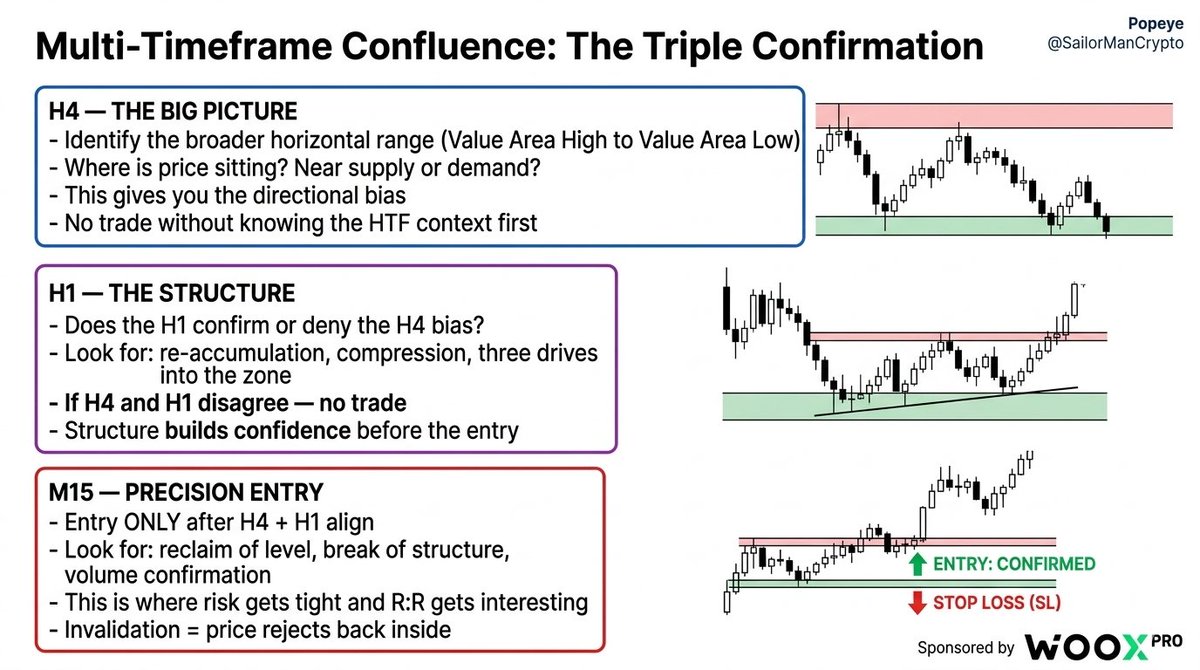
One timeframe is a guess. Three timeframes is a trade. One of the most common mistakes I see is traders finding a setup on one timeframe and pulling the trigger immediately. That's not a trade. That's a coin flip with extra steps. This educational post is sponsored by @_WOO_X — where I trade crypto with zero fees on spot. Here's how I actually build a position — and why I need multiple timeframes to agree before I risk anything. Start with the H4 — the big picture. Where is price sitting in the broader range? Is it near a key demand or supply zone? This gives you the directional bias. Nothing else matters until you know this. Then drop to the H1 — the structure. This is where patterns develop. Re-accumulation, compression, three drives into the zone. The H1 confirms or denies what the H4 is suggesting. If they disagree, I sit on my hands. Finally the M15 — precision entry. You already know the direction. You already know the zone. Now you're waiting for the trigger — a reclaim, a break of structure, a volume confirmation at the level. This is where the risk gets tight and the R:R gets interesting. The magic isn't in any single timeframe. It's in the overlap. When the H4 shows demand, the H1 builds a re-accumulation into that demand, and the M15 gives you a confirmed entry — that's when I trade. Multiple reasons. One position. Tight risk. Most traders skip the top-down process because it feels slow. But honestly, this is the part that separates the setups that work from the ones that stop you out right before the move. I execute these setups on @_WOO_X — zero fees on spot, which matters when you're scaling in and out across timeframes. One single setup might be wrong. But the process keeps me in the game. Popeye #bitcoin #TradingStrategies
Popeye tweet media
English
7
17
183
14.2K
Caviarr8 🐉 retweetledi
Crypto Bully 🔥
Crypto Bully 🔥@BullyDCrypto·
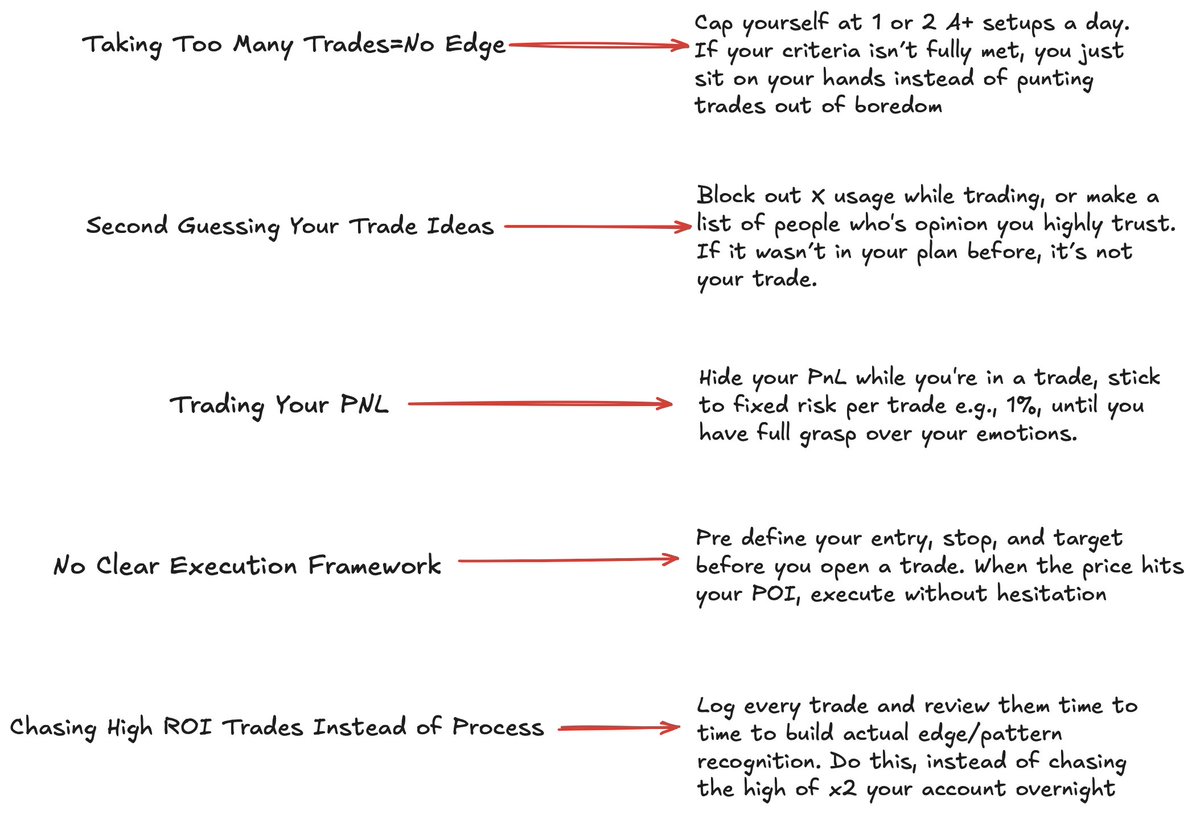
If you're a struggling trader, bookmark this, Common trading hurdles and how to avoid them with simple and actionable steps:
Crypto Bully 🔥 tweet media
English
5
24
181
4.2K
Caviarr8 🐉 retweetledi
Ronin
Ronin@DeRonin_·
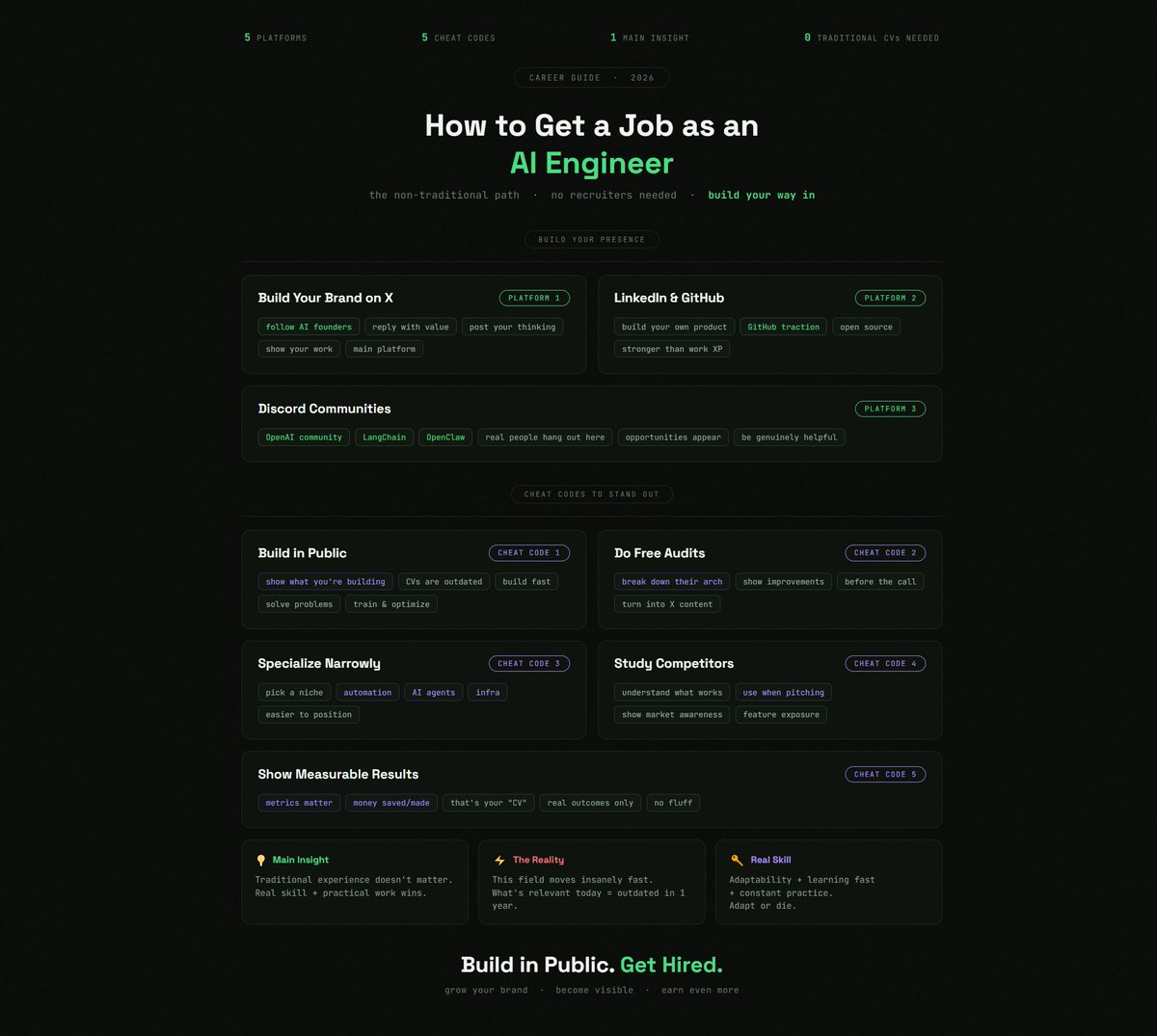
How to get a job as an AI Engineer: AI engineering is one of those fields where it's actually easier to get a job through non-traditional paths a lot of founders building products need AI engineers (they want to integrate AI, train models, and build new products on top of it) so here's my workflow for getting a job as an AI engineer: 1: Build your personal brand on X this should be your main platform follow AI startup founders, reply to them, post valuable content, show your thinking and value 2: Build presence on LinkedIn or GitHub these are more traditional platforms but if you build your own product and it gets traction on GitHub, that's already way stronger than "work experience in a company" 3: Share knowledge in Discord communities OpenAI community, OpenClaw, LangChain (anything directly related to AI engineering) this is where real people hang out and opportunities appear cheat-codes to stand out and get into the top 1%: 1. Build in public show what you're building and how CVs are outdated, people hire those who can build fast, solve problems, train and optimize models 2. Focus on features and exposure study competitor products, understand what works use this knowledge when pitching, it proves you understand the market 3. Do free audits before calls before jumping on a call with a potential client, break down their architecture show what you think is happening and what you would improve (this can also be turned into content on X) 4. Specialize narrowly don't just be "AI engineer" pick a niche: automation, AI agents, infra, etc. this makes you much easier to position 5. Show measurable results metrics matter (money especially) if your work saved or made money, that's what goes into your "CV” main insight: this is a new profession, traditional "work experience" doesn't matter as much what matters is real skill, understanding, and practical experience forget chasing top company interviews right now you have a much better opportunity: - build in public - grow your brand - become visible - potentially earn even more one more thing: everything in this field moves insanely fast what’s relevant today may be outdated in a year and in two years completely irrelevant so "experience" doesn't matter your real skill is adaptability + learning fast + constant practice adapt or die.
Ronin tweet media
Ronin@DeRonin_

x.com/i/article/2033…

English
32
77
621
57.1K
Caviarr8 🐉 retweetledi
Trader Menda
Trader Menda@mendafutures·
So here is the educational thesis behind it. (High-Level Liquidity Understanding, Amazing Gem). The first thing you need to understand before breaking this down is one simple idea. Every retail position creates two zones: a take-profit zone and a stop-loss zone. Market makers will always aim to take your SLs, not your TPs. That is what taking liquidity means. Now, if a high has more TPs than SLs sitting at it, the market makers have no reason to go there. So, Here is the thesis: Retail traders act from greed, always chasing the highest reward with the least risk possible. That naturally pushes retail toward high RR positions: Placing their stop losses at close areas while setting their TPs at far ones. Lets break it down on the chart: The chart has 3 Swing Highs. Retail longs are targeting the farthest swing high with stops placed at the lows. The reasoning is simple: the farther the target, the more profit. Pure greed. Retail sellers are running on that exact same emotion. They want the lowest risk with the highest reward, so they place their SLs at the nearest swing high. It is the closest level and gives them the tightest stop. So the higher high is loaded with retail TPs. The market has no interest in going there. The lower high is loaded with retail SLs. That is exactly where the market wants to go. The whole point: seek retail SLs, take out both longs and shorts, and make sure nobody gets to reach their profit zone.
Trader Menda tweet media
Trader Menda@mendafutures

This highlights the importance of marking the right liquidity. Targeting the correct liquidity can significantly reduce breakeven trades. Price took the first high above resistance while ignoring the others. There’s a deeper explanation behind this, but for now, focus on targeting the stronger liquidity levels, the first swing points.

English
1
5
16
3.8K