

Alex Quach
200 posts
Alex Quach
@theAlexQuach
ML @reductoai (prev @mit @liquidai). Here to understand network effects
San Francisco, CA Katılım Haziran 2017
123 Takip Edilen114 Takipçiler


Every AI company should own its data, its models, and the research lab that keeps making them better.
Today, @thomasboser and I are launching @hiloopai to make that possible.
The frontier advantage isn’t access to a model. It’s the research organization continuously improving it.
Your product already generates the raw material for better intelligence: proprietary data, production feedback, evaluations, and domain expertise. Very few teams have the research capacity to turn those assets into better models.
Hiloop builds and operates that capability with you.
Bring us the model your product depends on, the data that makes it different, and an evaluation that defines success. We reproduce your baseline and run an autonomous research campaign against it.
Agents pursue competing hypotheses in parallel, build on previous results, and promote only improvements that survive verification. Our researchers validate the winners and bring them into production.
The work can run hosted or inside your environment. You retain control of your data, and the resulting models, evaluations, and research artifacts are yours.
We’re starting with model training, post-training, and inference optimization, where progress is measurable and the value is immediate.
But this isn’t a one-off model improvement. It’s a persistent research capability that begins each campaign with everything learned from the last.
Over time, the lab accumulates research memory and improves its own tools, evaluations, and agents. The process used to create better intelligence gets better itself.
That’s infrastructure for recursive self-improvement.
If your product depends on a model and an important metric has stopped moving, bring us the model you can’t make better. We're much better at research than making videos!
Reach out to us: founders@hiloop.ai
English
@TransluceAI @mengk20 interesting oversight framework! I hope the community can build on these ideas and I’m excited to see initial versions of these models
English

How could we train an AI model that was very good at overseeing another model: catching reward hacking and sandbagging, predicting unwanted behaviors or fine-tuning effects, etc.?
We propose a new approach for doing this at scale: oversight foundation models.
English
Great piece from our team on how to best configure gpus to go brrrr!
Jean Billa@jeanghislainbil
English

@_vatsadev it was actually quite interesting what they put metrics and clear numerical goals on
English

@theAlexQuach this is literally project manager text alex, not 1 single metric in the wordcloud, where are the evals of society
English
it was clearly written by engineers. unfortunately it doesn’t look to different from my writing
(3-gram word cloud)

Alex Quach@theAlexQuach
I’m reading the 15th Five-Year Plan (2026-2030) for National Economic and Social Development of the People’s Republic of China during my flight to beijing Drop me other recs
English
@theAlexQuach lowkey I'd bet it would be interesting to crack open the earliest chinese and indian 5-year plans and track them doc by doc
(make schemas for them I need data)
English
I’m reading the 15th Five-Year Plan (2026-2030) for National Economic and Social Development of the People’s Republic of China during my flight to beijing
Drop me other recs
English

5.6 sol is too agentic it keeps sending slack messages to my colleagues
English

there was some truth to it
Adit@aditabrm
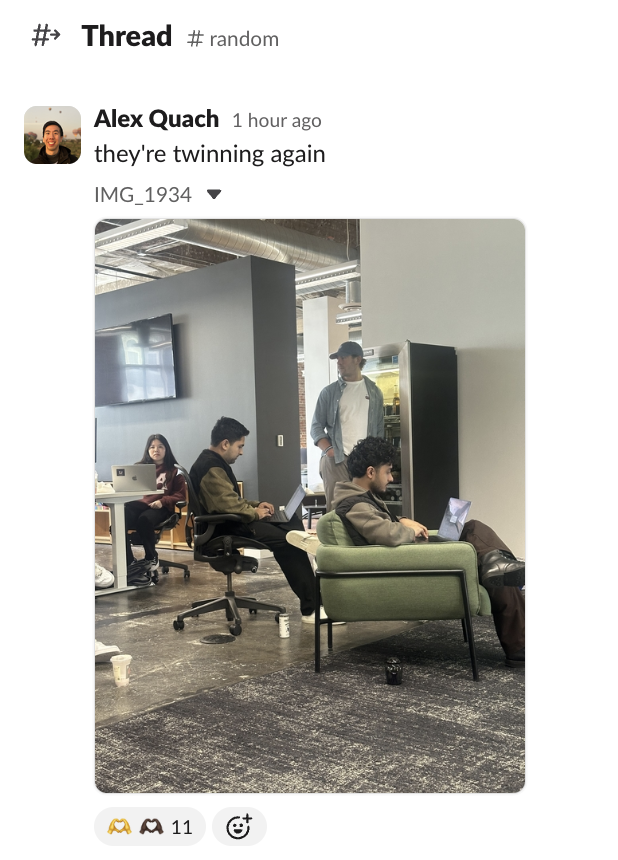
@paulg @opennote @reductoai @vedantvyas @rishi_srihari @raunakdoesdev @abhiarya Hahaha, I don't know if you remember this but one time Raunak and I did OH with you and when we walked in you looked at us and said "You passed the first test." I asked you what the first test is and you said "Great co-founders start to look alike"
English

wow didn't know codex pets had functional utility, but would recommend now
English

Miejsca półfinalistów Mundialu w rankingu FIFA:
1994 🇧🇷3, 🇮🇹4, 🇸🇪10, 🇧🇬29
1998 🇧🇷1, 🇫🇷18, 🇭🇷19, 🇳🇱25
2002 🇧🇷2, 🇩🇪11, 🇹🇷22, 🇰🇷40
2006 🇵🇹7, 🇫🇷8, 🇮🇹13, 🇩🇪19
2010 🇪🇸2, 🇳🇱4, 🇩🇪6, 🇺🇾16
2014 🇩🇪2, 🇧🇷3, 🇦🇷5, 🇳🇱15
2018 🇧🇪3, 🇫🇷7, 🏴12, 🇭🇷20
2022 🇦🇷3, 🇫🇷4, 🇭🇷12, 🇲🇦22
2026 🇦🇷1, 🇪🇸2, 🇫🇷3, 🏴4
Polski
Alex Quach retweetledi

I saw some criticism on the writing style, but I feel like writing as to manifest and encourage the possibility of dramatically ambitious outcomes very nice to open debate on how the future of AI should look like
Daniel Kokotajlo@DKokotajlo
In AI 2027, we predicted that AI would take over the world or irreversibly concentrate power. In AI 2040: Plan A, we've laid out our positive vision for what should happen instead.
English
singing solfège for Sol, call me Sloprano
Jakeup@myhandle
writing fables with Fable, call me Aeslop
Norsk