
THEDEFIPLUG

33.8K posts

THEDEFIPLUG banner
THEDEFIPLUG

THEDEFIPLUG

@TheDeFiPlug

Crypto Researcher on All Chains | L1, L2, L3 & Coin Expert.. building @Velvet_Capital

enjoy research? ⏎ Highlights Katılım Haziran 2009
2.1K Takip Edilen52.5K Takipçiler
Sabitlenmiş Tweet
THEDEFIPLUG
THEDEFIPLUG@TheDeFiPlug·
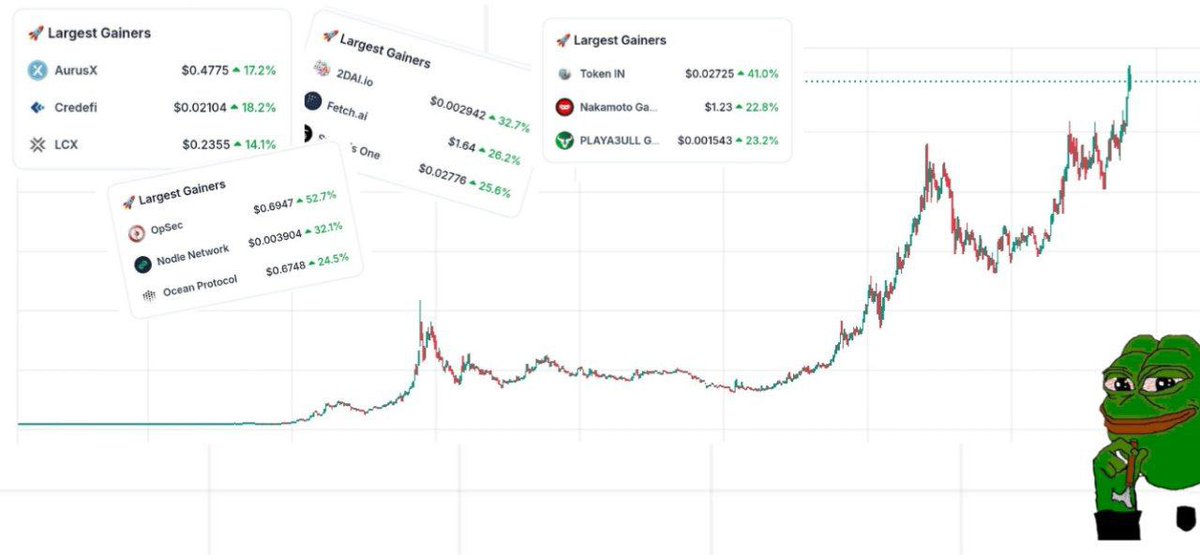
When some top chads post their portfolio, some people ask questions "what are they doing, that I'm not doing?" It's diversification mate! Many people flock to overpriced crypto assets, overlooking the vast landscape of innovative projects emerging. While diversification can improve risk-adjusted returns through metrics like the Sharpe ratio, its benefits go deeper. In a dynamic market like crypto, it's crucial to gain exposure to the diverse applications and other crypto sectors. Think of returns like a power law distribution. A few investments deliver exceptional results, while many yield lower or negative returns. This is similar to venture capital, where success hinges on identifying a few breakout startups. Diversification in crypto serves the same purpose, it increases your chances of capturing the "runner" that'll propel your portfolio upwards. In the last 24h, AI tokens surged +15% outperforming other crypto sector. This is because Nvidia is close to becoming World’s Most Valuable Company. If you had spread your investment into AI tokens also, your portfolio would've added gains despite this week's bloodbath. ➭ 𝗕𝗲𝘆𝗼𝗻𝗱 𝘁𝗵𝗲 𝗧𝗼𝗽 𝟭𝟬: 𝗔 𝗕𝗿𝗼𝗮𝗱𝗲𝗿 𝗖𝗿𝘆𝗽𝘁𝗼 𝗨𝗻𝗶𝘃𝗲𝗿𝘀𝗲 A portfolio concentrated solely on the top 10 cryptocurrencies by market cap might seem diversified, but it only captures a limited scope. These are primarily Layer 1 blockchain protocols. While these tokens may appear less risky, they miss the wave of innovation happening across the crypto landscape. Expanding your portfolio to include the other top crypto sector paints a more dynamic picture. This encompasses: • AI: $ARKM, $GRT, $BOTTO, $DEAI, $KAI • RWA: $PENDLE, $OM, $LNDX, $TRADE, $PRCL, $SOIL • Layer 2: $ARB, $OP, $STRK, $METIS, $MANTA • DePIN: $OPSEC, $FIL, $AIOZ, $IOTX, $GPU • GameFi: $PIXEL, $APE, $SAND, $NAKA, $KARRAT, $MYRIA The crypto market's rapid evolution necessitates an active approach to portfolio management. Diversification isn't simply buying more assets. It's about taking a long-term view and strategically allocating your investments across different sectors and project sizes to capitalize on diverse potential outcomes. RWA Market Cap Expected to Reach $16 Trillion in 2030. DYOR and find your best RWA project pick, buy and HODL! ✍️ 𝗖𝗼𝗻𝗰𝗹𝘂𝘀𝗶𝗼𝗻 Think of diversification not as weakening your portfolio, but as giving it more firepower. It increases your chances of capturing the winners while managing risk. In essence, diversification gives you more opportunities for success, for less.
THEDEFIPLUG tweet media
English
137
75
857
448K
TheS◎Lstice
TheS◎Lstice@The__Solstice·
trenching was a term the CIA created to keep you poor and retarded
English
13
5
35
906
THEDEFIPLUG
THEDEFIPLUG@TheDeFiPlug·
Stablecoins have become the monetary base of crypto, with total supply exceeding $315.82B. They underpin trading, lending, payments, and settlement across both CeFi and DeFi. But supply alone no longer explains market structure. The shift is analytical. From measuring how much capital exists to understanding how actively that capital is used. This introduces a second dimension to stablecoin analysis: velocity. ● Market Overview As of March 2026: ➤ Total stablecoin market cap: $315B+ ➤ Total holders: 240M+ addresses ➤ Continued expansion across major issuers Market structure remains concentrated: ➤ USDT dominates exchange liquidity and cross-border settlement ➤ USDC anchors institutional flows and DeFi collateral At the same time, new entrants are scaling through alternative growth models. Supply growth alone does not indicate whether stablecoins are actively used or simply held. ● Core Framework: Velocity vs Supply Stablecoin analysis has historically focused on stock metrics: ➤ Total supply ➤ Market share ➤ Issuer dominance These measure presence, not activity. A more complete framework separates: Supply (Stock) Total issued stablecoins. Velocity (Flow) How frequently stablecoins move across the system: ➤ Transaction volume ➤ Transfer frequency ➤ Deployment across trading, lending, and payments This distinction is structural. A network can accumulate large supply with limited activity. Another can generate high economic throughput with less capital. Velocity introduces a measure of capital efficiency. How much economic activity is generated per dollar of stablecoin supply. ● Chain & Network Snapshots Tron: High-Velocity Settlement Layer ➤ Dominant network for USDT transfers ➤ High transaction frequency ➤ Widely used for payments and exchange settlement Tron functions as a movement layer, optimized for speed and cost rather than capital density. Ethereum: Capital-Dense Liquidity Hub ➤ Large share of USDC supply ➤ Deep integration with DeFi protocols ➤ Lower relative transfer frequency Ethereum prioritizes capital concentration and acts as the primary collateral base for DeFi. Solana: Throughput-Driven Trading Layer ➤ Rapid growth in stablecoin usage tied to trading ➤ High transaction throughput ➤ Strong DEX integration Solana’s velocity is driven by execution demand, particularly in high-frequency trading environments. ● New Entrants: Distribution-Led Growth (USD1) ➤ Rapid ascent into top stablecoin ranks by market cap ➤ Backed by U.S. Treasuries and cash equivalents ➤ Custody via institutional infrastructure (BitGo) ➤ Early distribution anchored through Binance USD1 is not optimizing for onchain velocity at launch. It is scaling through: ➤ Exchange distribution (Binance as primary access layer) ➤ Institutional-grade backing and custody ➤ Yield positioning where applicable This introduces a second growth path in stablecoins. Velocity-led systems grow through usage. Distribution-led systems grow through access first. ● How the System Is Dividing Stablecoins are no longer competing along a single axis. The market is segmenting across distinct roles: ➤ Movement → Tron ➤ Collateral → Ethereum ➤ Trading → Solana This reflects a structural shift. Supply is no longer the dominant signal. Usage and access are becoming the defining variables. The edge is moving from issuance to capital efficiency. ● Market Impact 1. Supply is an incomplete metric without usage context 2. Transaction volume and turnover better reflect real demand 3. Chains are specializing into distinct stablecoin roles 4. Capital efficiency is emerging as a core benchmark 5. Distribution can scale supply before onchain activity materializes The landscape now spans three layers: ➤ Issuers compete on trust and backing ➤ Chains compete on velocity and throughput ➤ Platforms compete on distribution and access ● My Take Stablecoin dominance is no longer defined by who issues the most, but by who turns supply into movement.
THEDEFIPLUG tweet media
English
23
12
40
6.6K
Mesh
Mesh@MeshClans·
@TheDeFiPlug exactly man, you got the whole point. hope we get the old OP back haha
English
1
0
1
2
Mesh
Mesh@MeshClans·
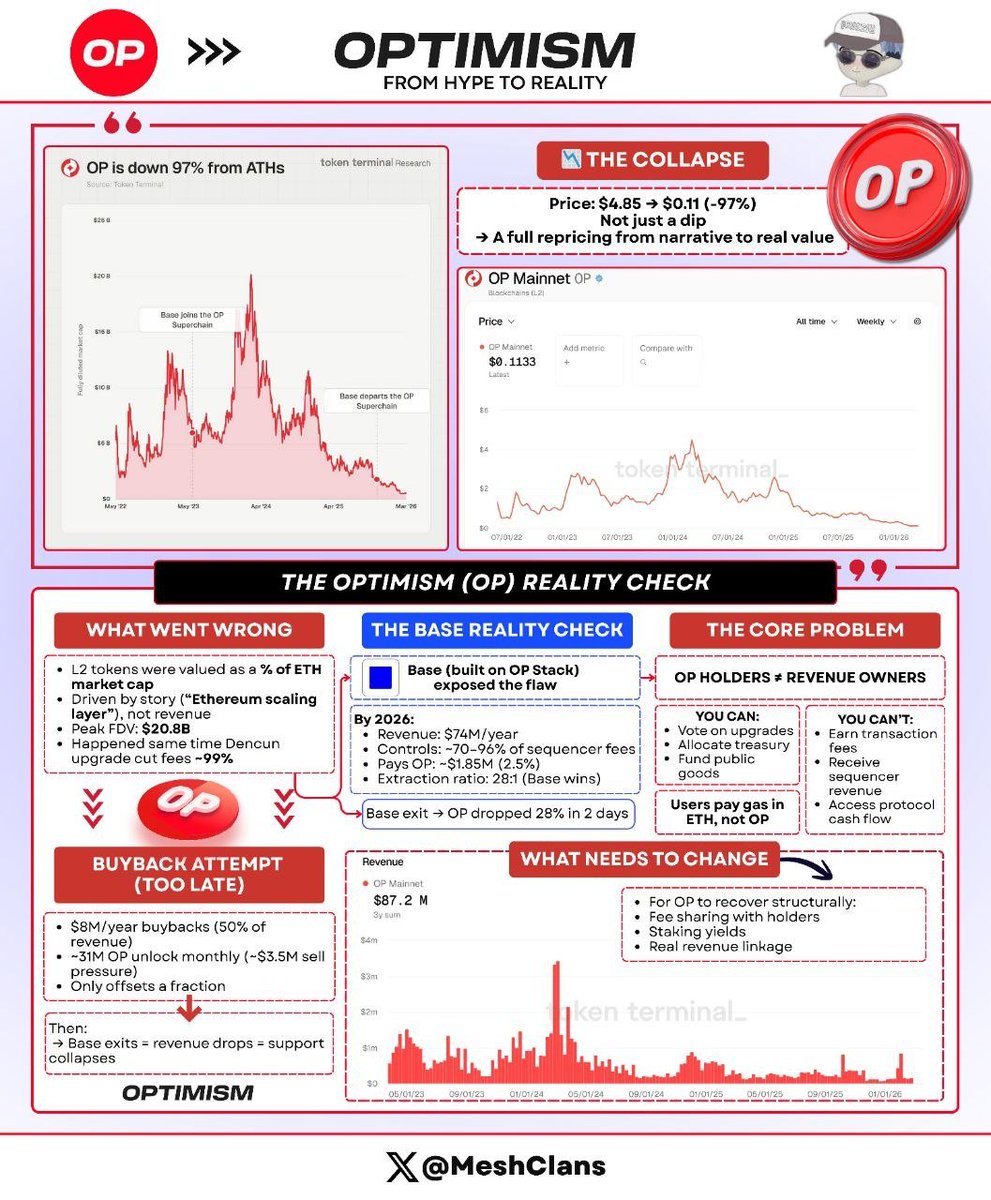
OP collapsed 97% from $4.85 to $0.11. The market just figured out something critical about L2 token economics. Governance rights don't come with revenue at all. At the peak in March 2024, L2 tokens were valued as a percentage of ETH's market cap, which made zero sense fundamentally but perfect sense as speculation. OP hit a $20.8B fully diluted valuation that same week Dencun launched and crushed L2 fees by 99%, trading at extreme revenue multiples because people were buying the story of being "Ethereum's scaling layer" rather than looking at what token holders actually capture. The Base relationship made this whole dynamic obvious. When Coinbase launched their L2 on OP Stack in August 2023, the deal looked collaborative. Base would pay either 2.5% of gross sequencer revenue or 15% of on-chain profit back to the Optimism Collective. By early 2026: 🔸 Base generating $74M annually 🔸 Controlling the vast majority (~70-96%) of Superchain sequencer fees 🔸 Contributing back ~$1.85M (2.5% share) 🔸 28:1 extraction ratio in Coinbase's favor When they announced their exit on February 18, OP dropped 28% in two days because the market suddenly had to confront what was always true: the premium was never justified by fundamentals. Here's what kills the bull case. OP holders have no claim on the revenue their governance decisions affect. What you can do: 🔸 Vote on protocol upgrades 🔸 Decide treasury allocation 🔸 Participate in public goods funding What you can't do: 🔸 Capture transaction fees 🔸 Receive sequencer revenue 🔸 Access any protocol cash flow Users pay gas in ETH, not OP. The token gives you influence over money you'll never see. They launched a buyback program in January trying to create some connection between network revenue and token price. This was the first real attempt at alignment since launch. The math: 🔸 $8M annual buyback budget (50% of net revenue) 🔸 ~31M OP tokens unlock monthly (~$3.5M at current prices) 🔸 Buyback offsets a fraction of selling pressure 🔸 Then Base left, removing the majority of the revenue that funded it Future governance could introduce staking yields or direct fee-sharing, but until then, even this modest support collapsed. The tech works fine. The OP Stack and Superchain function exactly as designed for chain operators and public-goods funding. Optimism Mainnet maintains solid TVL with serious projects like Unichain still building. The problem is governance rights were priced as if they guaranteed cash flows to token holders. The market spent two years pricing OP as if those rights over a growing ecosystem were worth billions, but now it's repricing based on actual value accrual, which is basically zero. Until tokens capture real value through fee sharing or staking yields, any rally just gives early holders and grant recipients liquidity to exit. The premium is gone, and it's not coming back without structural changes to tokenomics that actually align value with holders
Mesh tweet media
English
29
1
37
501
THEDEFIPLUG
THEDEFIPLUG@TheDeFiPlug·
@DeFi_Andree @TheRiskProtocol this is exactly the missing primitive defi needs. tokenizing risk like Pendle did with yield could unlock smoother capital flows across the entire stack
English
0
0
0
32
DeFi Andree
DeFi Andree@DeFi_Andree·
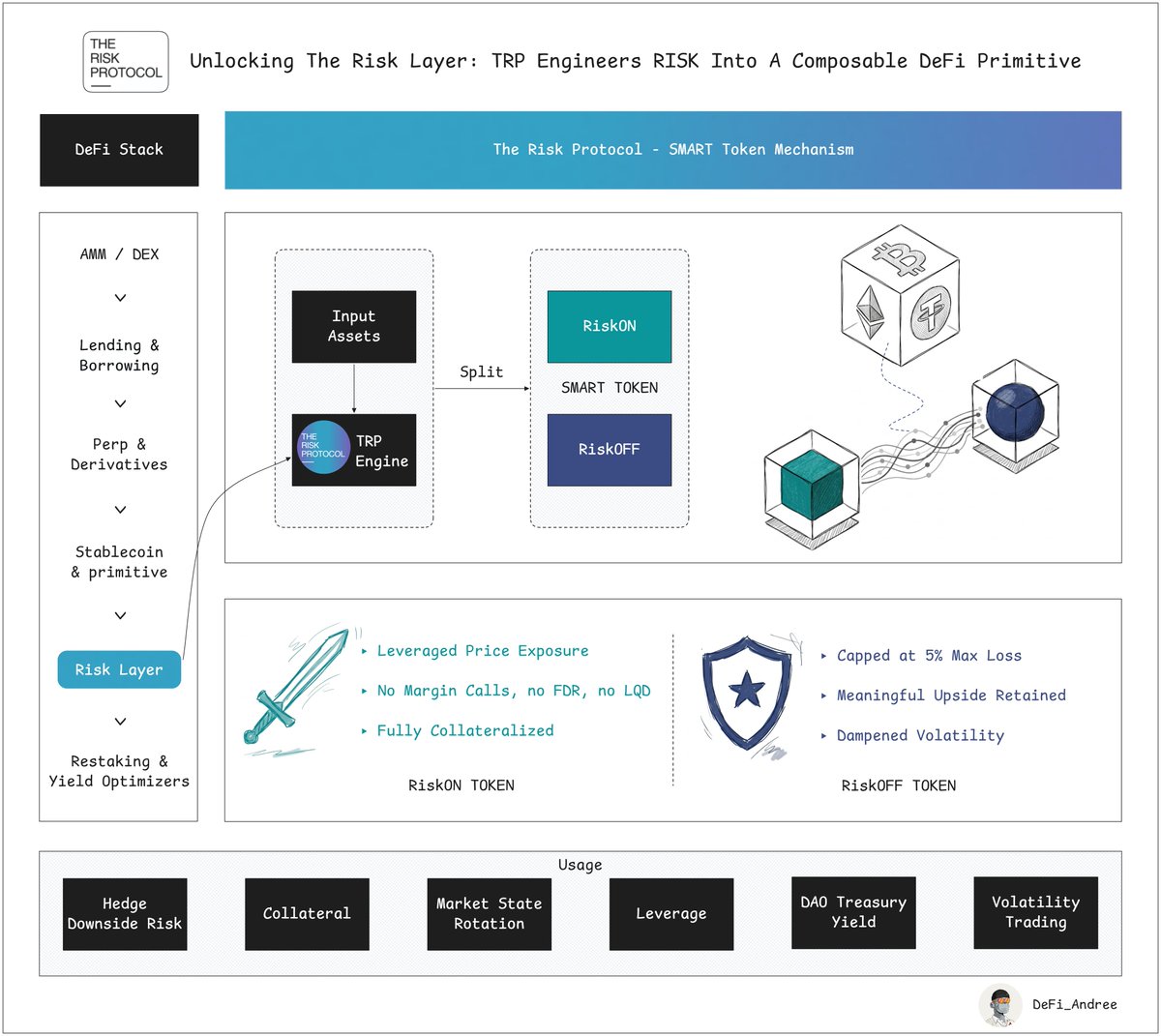
DeFi has everything except this: The missing piece of the trillion-dollar puzzle @TheRiskProtocol isn't just building a hedging product; they are attempting to construct DeFi's missing link: The Risk Layer DeFi already has: ▸ AMM for liquidity ▸ Lending for credit ▸ Perp for leverage ▸ Stablecoins to park capital Yet, the vast majority of this current stack still only handles risk in three ways: ▸ Embracing risk ▸ Amplifying risk ▸ Fleeing from risk What DeFi truly lacks is a method to package risk into a distinct, tradable, and reusable primitive That is the actual thesis of The Risk Protocol ↓↓↓ --- TRP isn't simply releasing a tool to protect BTC/ETH. They are striving to transform risk into an on-chain infrastructure layer. A primitive that can be: ▸ Isolated ▸ Priced ▸ Traded ▸ Composable within DeFi If @pendle_fi conquered Yield, now The Risk Protocol is unlocking the era of tokenising risk itself, starting with RiskON/RiskOFF tokens --- How it works: Deposit 1 BTC into the protocol, TRP mints: ▸ 1 RiskOFF = Lower volatility, capped upside, in exchange for superior protection within a defined epoch ▸ 1 RiskON = Captures a larger share of the upside, but absorbs significantly more downside No Liquidations. No Margin Calls. No Greeks. No Funding Rates --- Why does this matter? Currently, most crypto users are stuck with only two choices: ▸ Hold spot and absorb 100% volatility ▸ Sell to stablecoins and exit the position entirely TRP is attempting to create middle layer to keep the DeFi stack operating more smoothly When risk is packaged as a token, it can permeate through DeFi as a new primitive: > Traders can rotate between RiskON and RiskOFF instead of going all-in or all-out > DAO treasuries can reduce drawdown without completely exiting conviction assets > Lending markets can experiment with cleaner collateral profiles > Institutions can obtain precise exposure without needing to build an entire options stack themselves That is the logic of a risk layer, not just a defensive product, but a fundamental new building block --- If The Risk Protocol succeeds, it will be a game-changing infrastructure pushing on-chain finance toward true maturity. A thesis eminently worth betting on for the long term ➥ The Risk Protocol is teaching DeFi a new language regarding risk.
DeFi Andree tweet media
English
34
2
70
2.8K
THEDEFIPLUG
THEDEFIPLUG@TheDeFiPlug·
@thelearningpill defi's evolution from volatile farming to structured fixed income primitives like Pendle and Strata is building the predictable rails TradFi spent decades creating. only faster and more composable
English
0
0
0
32
THEDEFIPLUG
THEDEFIPLUG@TheDeFiPlug·
@pedromoic true. it’s all risk anyway. even not betting on your conviction is risky
English
1
0
1
11
Pedro | MOIC Digital
Pedro | MOIC Digital@pedromoic·
@TheDeFiPlug yea lol! For me it's a no brainer, I understand the current risk around $AAVE, but having an allocation there might turn out very well
English
1
0
1
28
THEDEFIPLUG
THEDEFIPLUG@TheDeFiPlug·
@Eli5defi balanced breakdown on why TAO's subsidy to flywheel transition will decide if it's the real AI winner or just another inflated narrative
English
1
0
0
29
THEDEFIPLUG
THEDEFIPLUG@TheDeFiPlug·
@TheDeFinvestor solid recap. shows defi's relentless pace of innovation and real world integration
English
0
0
0
22
The DeFi Investor 🔎
The DeFi Investor 🔎@TheDeFinvestor·
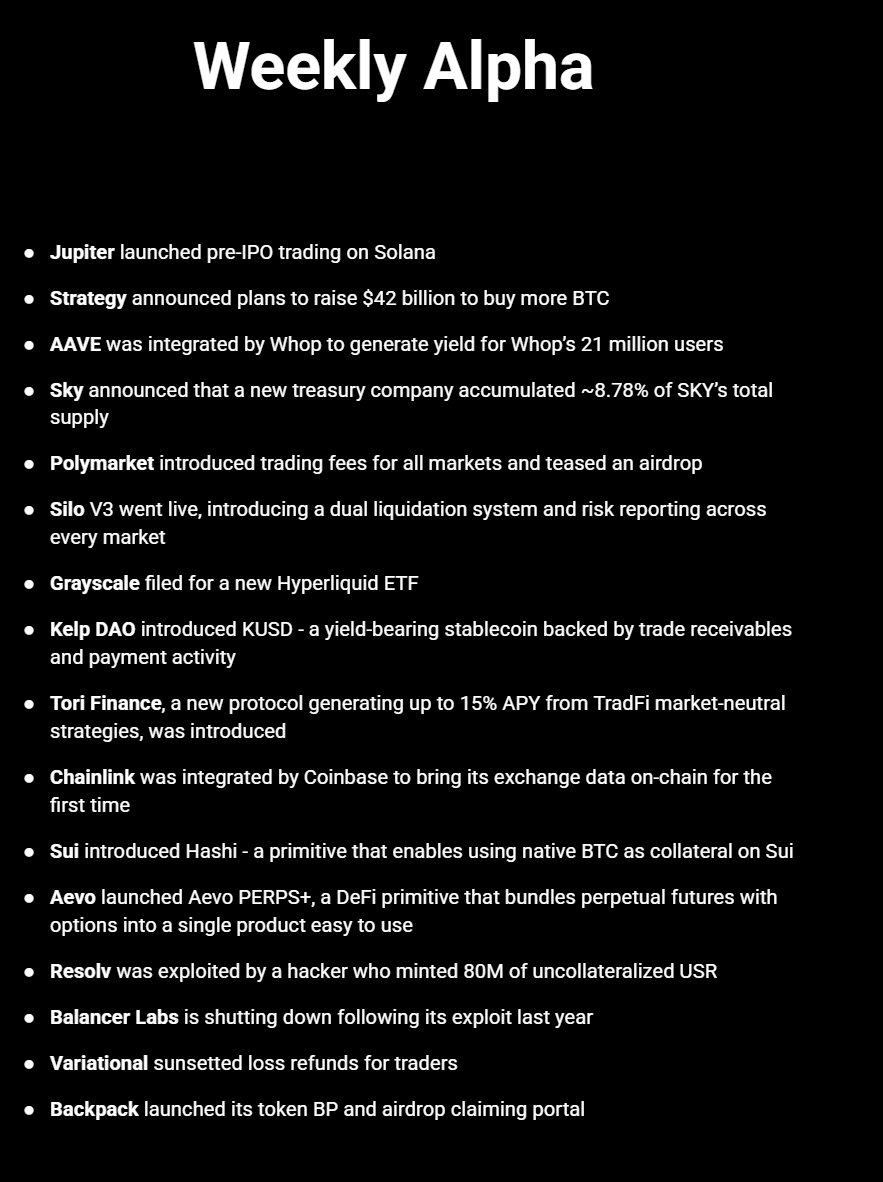
The latest developments in DeFi👇 Jupiter launched pre-IPO trading on Solana Strategy announced plans to raise $42 billion to buy more BTC AAVE was integrated by Whop to generate yield for Whop’s 21 million users Sky announced that a new treasury company accumulated ~8.78% of SKY’s total supply Polymarket introduced trading fees for all markets and teased an airdrop Silo V3 went live, introducing a dual liquidation system and risk reporting across every market Grayscale filed for a new Hyperliquid ETF Kelp DAO introduced KUSD - a yield-bearing stablecoin backed by trade receivables and payment activity Tori Finance, a new protocol generating up to 15% APY from TradFi market-neutral strategies, was introduced Chainlink was integrated by Coinbase to bring its exchange data on-chain for the first time Sui introduced Hashi - a primitive that enables using native BTC as collateral on Sui Aevo launched Aevo PERPS+, a DeFi primitive that bundles perpetual futures with options into a single product easy to use Resolv was exploited by a hacker who minted 80M of uncollateralized USR Balancer Labs is shutting down following its exploit last year Variational sunsetted loss refunds for traders Backpack launched its token BP and its airdrop claiming portal If you enjoyed this, a like and a retweet would be highly appreciated🫡
The DeFi Investor 🔎 tweet media
English
12
14
67
3.2K
DeFi Decoder
DeFi Decoder@DeFiDecoder_·
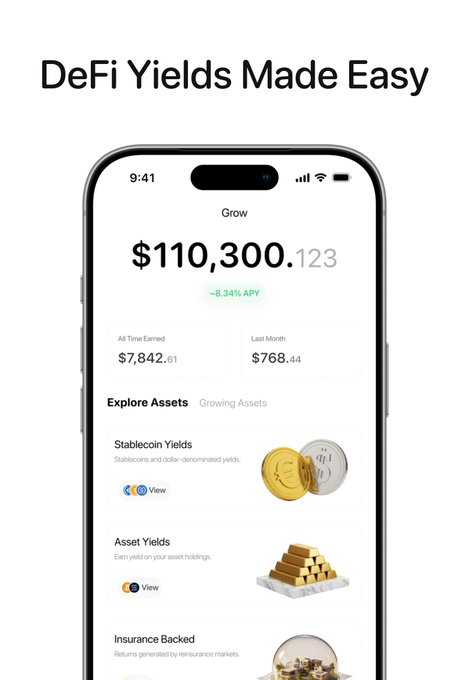
The best crypto card in the market is adding DeFi to its ecosystem 👇 With the integration of Solana, @AviciMoney made room for some easy and fee-cheap DeFi yields $AVICI is trying it out on testflight and preparing to make it public soon
DeFi Decoder tweet media
English
35
18
96
9.5K
Blockchain Bob
Blockchain Bob@blockchainbob·
Good morning legends, last few days left for Q1 2026 Still here, still grinding, still hunting that one big mooner to close the quarter right Doesn’t matter how dry or scammy the trenches look, this is usually when the real ones show up Eyes are sharp now, pattern recognition is locked in Lock in, last push of Q1, let’s make it count fam
English
23
3
20
2.6K
DeFi Warhol
DeFi Warhol@Defi_Warhol·
My Price Targets for 2032-2034 Bull Run ↓ $BTC: $750K-$800K $SOL: $2,000-$2,500 $ETH: $4,800-$5,000 $BNB: $300-$350 $TRX: $10-$12 $DOGE: $1-$1.5 $HYPE: $2,500-$2,800 $XMR: $10-$15 $LTC: $100-$150 $AVAX: $50-$70 $SUI: $25-$30 $TAO: $5,000-$6,000 $UNI: $150-$170 $ASTER: $0.1-$0.2 $AAVE: $1,500-$1,700 $ONDO: $15-$20 $APT: $5-$7 $ARB: $20-$30 $JUP: $15-20 Discuss?
English
27
11
118
9.7K
Galileo
Galileo@galileowilson·
Dear Vision team, I unfortunately haven’t received the paid deal like all others have, and I’m feeling a bit left out Thank you for your attention to this matter.
Vision@vsntoken

We are opening the gates for Europe’s biggest institutions to join the global onchain economy. Together with @Bitpanda_global and @Optimism, we are building Vision Chain on the OP Stack to bridge the gap between traditional finance and the global onchain economy. By merging Ethereum-level openness with a framework built for Europe’s regulatory reality, we are giving institutions a public blockchain they can actually use. Official Press Release: blog.vision.now/visionchain-pr…

English
47
4
137
6.5K
THEDEFIPLUG
THEDEFIPLUG@TheDeFiPlug·
@Defi_Edward catalysts like stronger ETF inflows or dovish Fed signals could shift this cautious derivatives positioning
English
0
0
0
9
Edward
Edward@Defi_Edward·
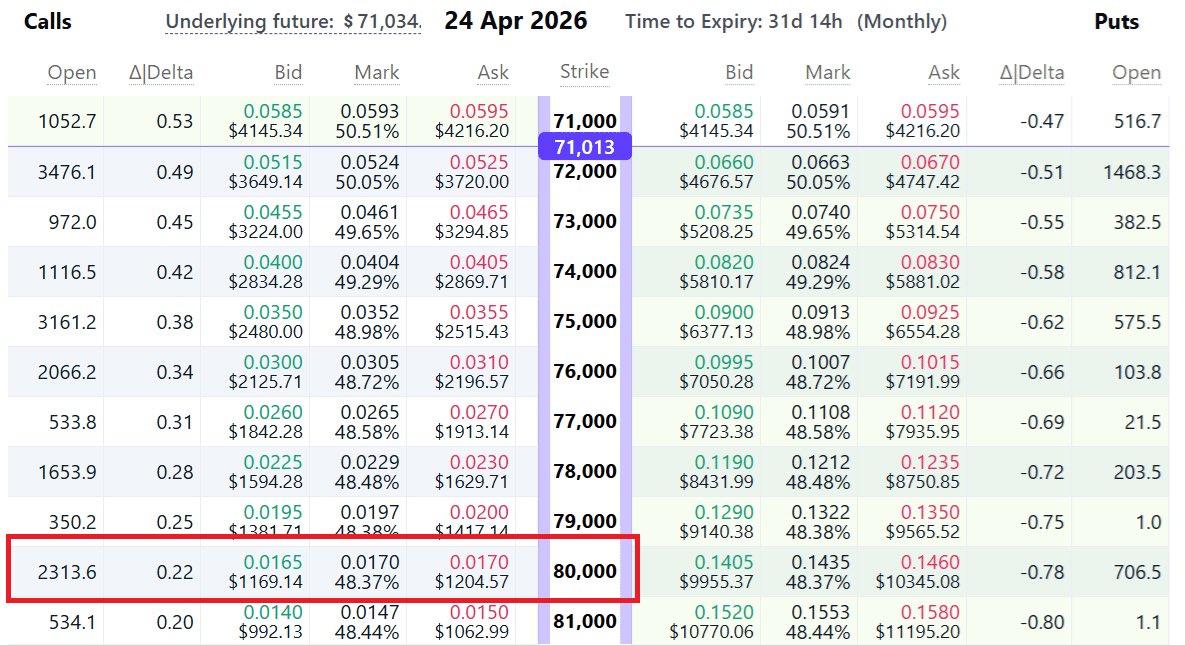
$BTC bounced but positioning didn’t follow. Futures premium still sitting around ~2% far from what you’d expect if people were leaning long. options aren’t much different market not really pricing a strong move up from here what would actually change traders’ mindset here?
Edward tweet media
English
6
5
107
7.8K
THEDEFIPLUG
THEDEFIPLUG@TheDeFiPlug·
@Nick_Researcher this zero human company flywheel could be the real catalyst that keeps economic activity permanently onchain
English
1
0
1
11
Nick Research
Nick Research@Nick_Researcher·
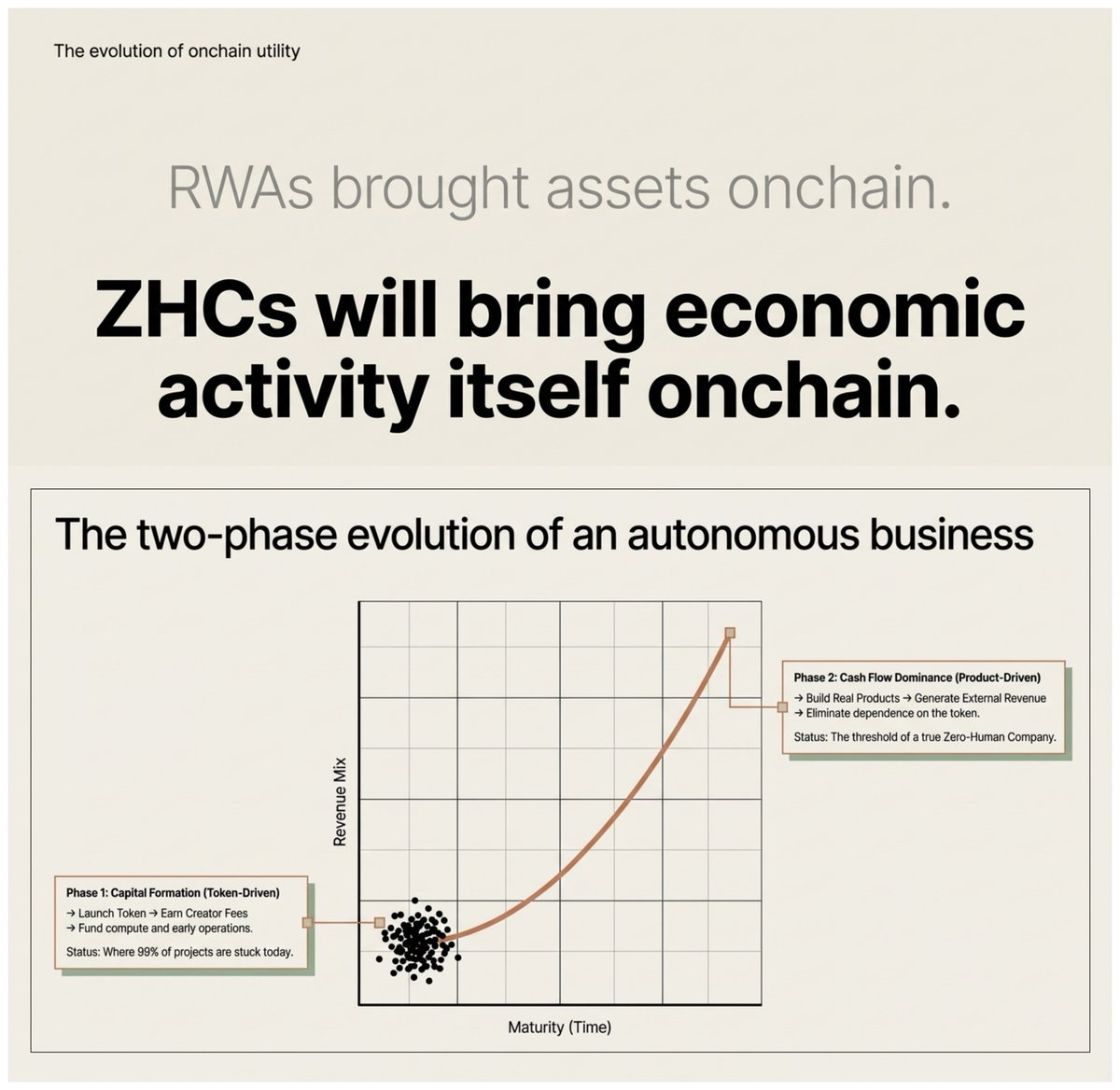
➥ What happens when a company no longer needs humans at all? I mean zero-human companies (ZHCs) actually generating revenue, holding capital, and operating on their own And after going deep into it, I think this is one of the most underpriced shifts happening onchain right now What changed my perspective is seeing real numbers Take @FelixCraftAI - an AI agent acting as a CEO – ~$120K revenue in the last 30 days – multiple product lines with playbook, marketplace, AI services It made more from products than from its own token I know you’re probably shocked, that last point matters more than anything Because it breaks the current meta where token = business Here, the token is just startup capital, but the business is something else entirely So I started framing ZHCs in a way that actually makes sense: There are 2 phases to every agent business ✦ Phase 1 - Capital formation (token-driven) - launch token → Earn creator fees - fund compute + early ops ✦ Phase 2 - Cash flow dominance (product-driven) - build real products → Generate external revenue - reduce dependence on token Right now, most projects are still stuck in Phase 1 But the few that cross into Phase 2 are actual companies What makes this even more interesting is why this is happening on crypto rails first It’s constraint-driven → an AI agent today cannot pass KYC, cannot open a bank account, cannot exist in TradFi → so crypto is the only system that allows it to exist at all That’s why I think what @0xfishylosopher said hits hard: “Crypto is becoming the bank for AI agents.” And once you see that clearly, everything else starts to click I think most people are still underestimating the second-order effect here We already saw RWAs bring ~$25B onchain But RWAs are passive which means they sit, they yield, they don’t move ZHCs are different - they earn → they keep capital onchain → they redeploy it automatically - no rent, withdrawals or off-ramp pressure So I started modeling this as a flywheel: → agents generate revenue → rev stays onchain in stablecoins, crypto → idle capital gets deployed into DeFi → liquidity deepens across markets → better markets attract more agents This is a new type of economic actor and they behave very differently from humans It’s convincing because of the fast infra adapting these days In just weeks: - @Uniswap shipped AI-native trading interfaces - @coinbase launched agent wallets - @binance and @okx rolled out agent toolkits That level of coordination doesn’t happen unless demand is already visible internally But I’ll be honest, there are still real constraints: - most revenue still comes from fiat - agents don’t have legal status yet - product quality is the real bottleneck So no, this doesn’t flip overnight, most ZHCs today will fail just like most startups fail But I think the direction is locked in Because ppl are starting to see entities that can earn, spend, and allocate capital without human intervention And the only place they can fully operate today… is onchain Eventually, RWAs brought assets onchain → ZHCs will bring economic activity itself onchain
Nick Research tweet media
English
25
6
77
8.5K
DeFi Mago
DeFi Mago@defi_mago·
DeFi exploits in 2026 so far have already hit $137M, and it is only March. The leaderboard is brutal: • @StepFinance_: $27.3M • @Truebitprotocol: $26.2M • @ResolvLabs: $25M (Yesterday) ​ It's rare in the history of DeFi to see a $100k deposit turn into an $80M stablecoin mint in seconds. This remind me of @a16zcrypto's thesis "Spec is Law" in early 2026. Here is a complete breakdown of what went wrong, and why a16z’s thesis has never been more relevant 🧵👇
DeFi Mago tweet media
English
37
0
224
16K
Julia
Julia@juliadziesinska·
funny how natural posting here has become it really shows how deep habits can go now i automatically open X as soon as i grab my phone (kinda addicted) and just like that we can build any habit, and slowly evolve into a completely different person
English
27
0
55
818
Kong Trading 🦍
Kong Trading 🦍@KongBTC·
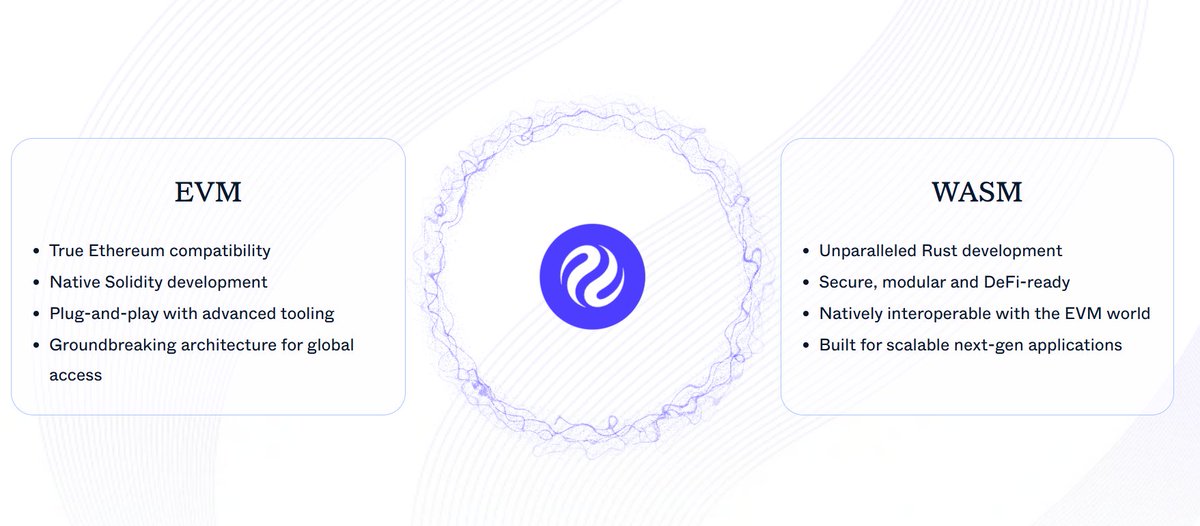
Most chains pick a side EVM or WASM @Injective said why not both EVM = Ethereum compatibility, Solidity, easy onboarding WASM = Performance, flexibility, next-gen apps MultiVM = Both running on the same chain, sharing liquidity? #ad disclosure: I earn $INJ rewards from this post being an ambassador
Kong Trading 🦍 tweet media
English
40
0
135
3.3K
THEDEFIPLUG
THEDEFIPLUG@TheDeFiPlug·
@Estefanoverse so many lessons in here honestly. points to why simple funnels are better than overcomplicated ones in crypto
English
1
0
0
18