@therapyadvocate

3.1K posts

@therapyadvocate banner
@therapyadvocate

@therapyadvocate

@therapyadvocate

Psycotherapist w/adults (she/her) All views/interests are my own. @ACTT_SCW

Katılım Ekim 2018
731 Takip Edilen180 Takipçiler
Sabitlenmiş Tweet
@therapyadvocate
@therapyadvocate@therapyadvocate·
"To be African American is to be African without any memory and American without any privilege.” JamesBaldwin
English
1
0
3
207
@therapyadvocate retweetledi
Restoring Your Faith in Humanity
Mid-wedding proposal to the bridesmaid - surprise yes, everyone loses it. 😭❤️
English
10
47
874
28K
@therapyadvocate retweetledi
Massimo
Massimo@Rainmaker1973·
What a beautiful example of humanity.
English
46
331
1.8K
58K
@therapyadvocate retweetledi
AFRICAN & BLACK HISTORY
AFRICAN & BLACK HISTORY@AfricanArchives·
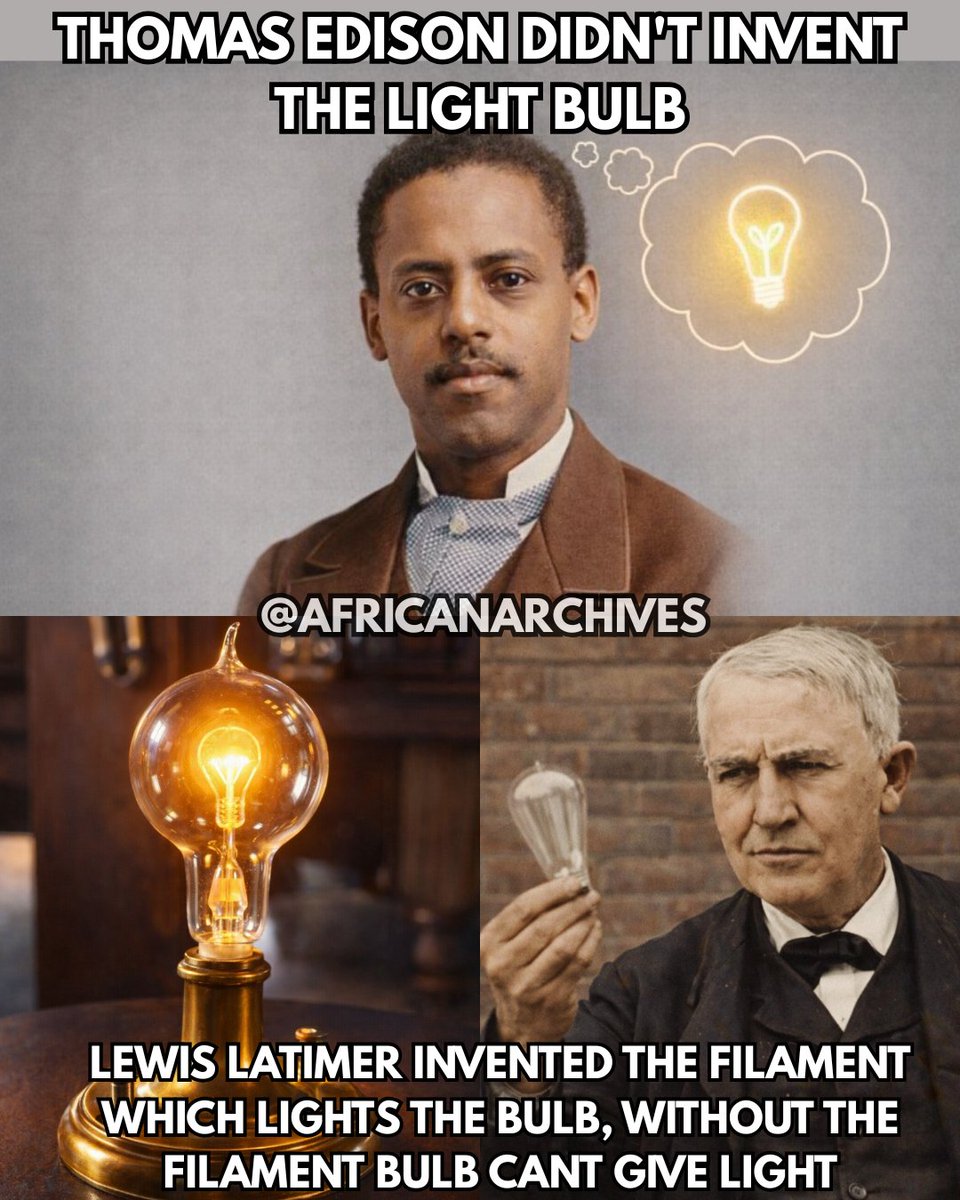
Thomas Edison did not single-handedly invent the light bulb. What he helped commercialize was a system. What Lewis Latimer helped make possible was light itself lasting long enough to be useful. In the late 19th century, early electric light bulbs existed—but they burned out quickly, were expensive, and were impractical for everyday use. Lewis Latimer, a brilliant draftsman, engineer, and inventor, developed an improved carbon filament that made light bulbs last longer, burn more evenly, and become affordable for widespread use. Without a durable filament, a bulb could not function reliably. In simple terms: without the filament, there is no usable light. Latimer’s work transformed electric lighting from a laboratory curiosity into something homes, streets, and businesses could actually depend on. His designs helped expand electric lighting across cities and made indoor lighting accessible beyond the wealthy. Ironically, Latimer later worked for Thomas Edison, drafting patents and improving systems at Edison’s company—even though his contributions were rarely highlighted in popular history. Latimer was also one of the only Black members of Edison’s elite engineering team, the Edison Pioneers. This is not about taking credit away from Edison. It’s about telling the complete story. Innovation is rarely the work of one person. Progress is built layer by layer, often by people whose names history chose to minimize or omit. Lewis Latimer didn’t just improve the light bulb—he helped light the modern world. And for generations, his contribution remained in the shadows of the very invention he helped illuminate. #BlackHistoryMonth
AFRICAN & BLACK HISTORY tweet media
English
30
634
1.5K
29.2K
@therapyadvocate retweetledi
Greg Carr
Greg Carr@AfricanaCarr·
#BlackHistoryMonth Day 7 Book 7: “At the Vanguard,” the companion volume to the new exhibit at ⁦@NMAAHC⁩ . If you can get to DC, spend some time there thinking how we preserve memory in our Black teaching and learning spaces. Either way, pick up the book and be inspired.
Greg Carr tweet media
English
2
60
141
2.7K
@therapyadvocate retweetledi
Henshi
Henshi@HenshiG·
In honor of the brave humans who stood against evil. The Nazis invited her to their parties because they thought she was harmless. She smiled, danced, and walked out with their military secrets. Paris, 1940. The city glittered as German troops moved through the Arc de Triomphe and Swastikas hung from the Eiffel Tower. Cafés served coffee, but conversations were whispered. Josephine Baker, American-born, famous, and wealthy, could have fled. Instead, she chose a path that would make her one of World War II’s most effective spies. The Nazis saw a dazzling performer—sequins, spotlight, applause. Hermann Göring knew her name; high-ranking officers attended her shows, thinking she was a harmless distraction. They were wrong. Baker despised what the Nazis stood for, having fled America's racism for France, where Paris welcomed her. She once said, “France made me who I am. I will give her my life if I have to.” When the French Resistance recruited her, she became an “Honorable Correspondent”—a French military intelligence officer with an unusual cover. While others hid in shadows, she worked under stage lights. She attended Nazi headquarters parties and galas at Italian and Japanese embassies, flirting with generals who underestimated her. She listened, mingled, and played the part, all the while gathering vital intelligence—troop movements, military plans, North Africa operations, and Mussolini’s strategies. Her color, charm, and courage masked a dangerous, decisive weapon. Information that could save thousands.
Henshi tweet media
English
58
773
2.9K
33.4K
@therapyadvocate retweetledi
The Husky
The Husky@Mr_Husky1·
In 1933, in Paris, a baby girl was born into a loving Jewish family. Her name was Francine. At the time, there was nothing to suggest that her childhood would be devoured by history. Seven years later, the world she knew vanished. In 1940, her father, Robert, was captured by the Germans and sent to a prisoner-of-war camp in Austria. From behind barbed wire and watchtowers, he found a way to send a message home. It wasn’t sentimental. It wasn’t long. It was urgent. Run. Leave immediately. Don’t wait. Francine’s mother, Marcelle, listened. In the summer of 1942, she took her nine-year-old daughter by the hand and fled toward the border, hoping speed might save them. It didn’t. They were arrested. Because Robert was a French POW, mother and child were spared immediate deportation. Instead, they were labeled “hostages”—a word that sounded almost merciful until you learned what it meant. Over the next two years, they were moved again and again through France’s transit camps: Poitiers. Drancy. Pithiviers. Beaune-la-Rolande. Each stop was colder, hungrier, closer to disappearance. On May 4, 1944, that fragile protection ended. They were ordered onto a train bound for Bergen-Belsen. Each prisoner was allowed one small bag. Marcelle chose carefully. Hidden among the essentials were two pieces of chocolate—a luxury beyond measure, meant for moments when despair or starvation might otherwise win. Bergen-Belsen was not a place of sudden death. It was worse. It was decay stretched over time. Hunger gnawed constantly. Disease spread unchecked. Corpses were stacked like discarded objects. Hope thinned by the day. Francine was ten years old. One day, in the middle of that nightmare, she noticed a woman lying apart from the others. Pregnant. Alone. In labor. So weak she could barely breathe, let alone survive childbirth. Francine reached into her pocket. She felt the chocolate. It was her last piece. Her mother’s insurance against collapse. Something that might have meant one more day of survival. She hesitated. Then she gave it away. That single act—small, almost invisible—changed everything. The sugar gave the woman enough strength. Enough energy to endure the pain. A baby girl was born in a place designed to erase life. Against all logic, both mother and child survived. Weeks later, Allied troops liberated the camp. Francine lived. Her mother lived. And somehow, unbelievably, they found Robert again. A family scarred beyond repair—but alive. Time moved forward. Francine grew up. She became a teacher. Then something more: a witness. She devoted her life to Holocaust education, traveling, speaking, refusing to allow memory to fade into abstraction. Decades passed. At a conference many years later, a woman stood up before speaking and said she needed to do something first. “My name is Yvonne,” she said. “I’m a psychiatrist from Marseille.” She walked toward the audience. “I’m looking for Francine Christophe.” Francine raised her hand. Yvonne placed something gently into it. A piece of chocolate. “I’m the baby,” she said quietly. For a moment, no one spoke. Because everyone understood: this was not coincidence. This was history closing a circle. Fifty years earlier, a starving child had chosen compassion over self-preservation. That choice had grown into a life—a doctor who now helped others heal. A life that existed because kindness had appeared in the darkest possible place. Francine Christophe is now in her nineties. She has children, grandchildren, great-grandchildren. She still tells her story. Still insists on remembrance. That piece of chocolate was never just food. It was proof that the Nazis failed. They tried to destroy empathy. They didn’t. They tried to erase human worth. They couldn’t. In a camp built to strip people of their souls, a ten-year-old girl proved that love can survive even there. Some acts of kindness echo for generations.
The Husky tweet media
English
121
899
4.2K
206.4K
Cumberland County, NC Government
Looking for help with childcare costs? Cumberland County's Subsidized Child Care Services Program may be able to assist. The program helps eligible families pay for care for children under 13 through licensed providers, and conditions apply. To learn more call 910-323-1540.
Cumberland County, NC Government tweet media
English
1
0
1
106
@therapyadvocate
@therapyadvocate@therapyadvocate·
Easter Monday Meaning for some @violadavis/post/DIuXKx8y4og?xmt=AQGz7LQGRStTt4AGPggl5PjsDWVZ-Mp62m57-dYJjXS13A" target="_blank" rel="nofollow noopener">threads.net/@violadavis/po…
English
0
0
0
6
Wolf of X
Wolf of X@WolfofX·
Family 1.
Wolf of X tweet media
English
546
8.5K
204.8K
11.5M
Jeremy Keeshin
Jeremy Keeshin@jkeesh·
In 1945, six women pulled off a computing miracle. They programmed the world’s first computer—with no manuals, no training. Then, a SINGLE assumption erased them from tech history for decades. The story of how ONE photo nearly deleted computing’s female founders: 🧵
Jeremy Keeshin tweet media
English
291
7.8K
28.8K
1.9M
@therapyadvocate
@therapyadvocate@therapyadvocate·
@SouthRiverEMC thanks for power restoration to all who interrupted Sunday Morning services, time with families & any other plans due to a drunk driver trying to rearrange my landscaping.
English
0
0
0
5
@therapyadvocate
@therapyadvocate@therapyadvocate·
@SouthRiverEMC Thanks to all the linemen who sacrificed their Sunday morning church services, time with families, and any other interrupted plans to restore my power after a drunk driver downed the lines and attempted to rearrange my landscaping.
English
0
0
0
3