J Smith

412 posts

J Smith banner
J Smith

J Smith

@therealjsmith88

Left my career in NZ (2024) to trade my own capital full-time. Crypto focus: Structural & Tactical portfolio bets. BTC intraday trader + poker on the side.

Katılım Ocak 2015
1K Takip Edilen246 Takipçiler
J Smith
J Smith@therealjsmith88·
@mingytrades previous day value being bias? So if we re-claim bullish & while outside bearish?
English
1
0
0
95
Peter Ming
Peter Ming@mingytrades·
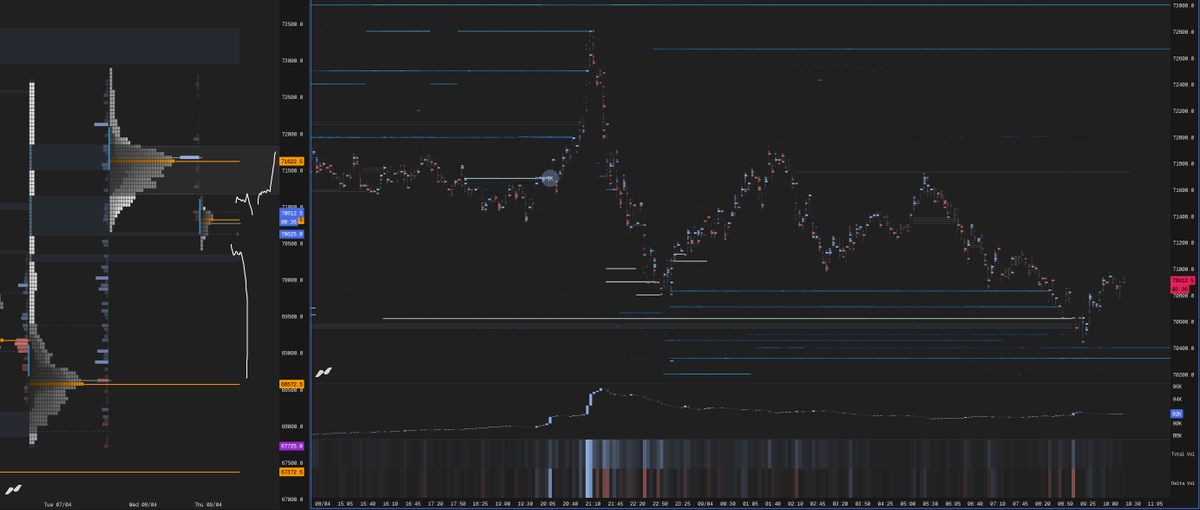
For Bitcoin, we had a strong trend move upwards and then a distribution found at the high, opening today bellow that distribution is starting to show some signs of weakness in the trend. Previous day value will be the bias for today.
Peter Ming tweet media
English
3
2
24
1.1K
J Smith
J Smith@therealjsmith88·
@MilkRoad Very interesting and valid, but it does remind me of the analyst reports on BTC sub $10k and why it has no value
English
0
0
0
15
Milk Road
Milk Road@MilkRoad·
Pine Analytic's just made the bear case for Bittensor. (You might want to save this one). Here's a condensed summary of their thesis: → $TAO trades at $275 with a $2.6B market cap. → Grayscale filed an S-1 for a NYSE-listed ETF. → Jensen Huang gave it a public endorsement. → It has Bitcoin-style tokenomics with a 21M hard cap. None of that is being disputed by @PineAnalytics. The question is whether the network can generate enough real revenue to justify the valuation. Starting with how the money flows... Bittensor has four player classes: 1. Subnet owners build AI marketplaces (18% of TAO emissions). 2. Miners do the AI grunt work (41%). 3. Validators grade the miners (41%). 4. Stakers dump TAO into liquidity pools. TAO is the entry ticket for everything. Mining, staking, subnet tokens, services. All roads lead to TAO. The supply side? Completely transparent. Emissions, halving schedules, staking ratios - all onchain. The demand side? Crickets. No dashboard tracking real revenue by subnet. AI work happens offchain (inference requests, compute jobs, training calls) none of it touches the blockchain. This isn't a bug they're fixing - it's baked in. So what does demand actually look like? Chutes is the biggest subnet. 14.4% of all emissions. It sells serverless AI inference at prices "85% below AWS." The usage numbers look great: - 400,000+ users - 5M+ daily requests - 9.1 trillion tokens processed But those cheap prices aren't from efficiency. They're from subsidy. Chutes receives roughly 518 TAO/day - about $142,000 ($52M annualized). Estimated actual revenue? $1.3M to $2.4M/year. For every $1 customers pay, the network kicks in $22 to $40 in emissions. Kill the subsidy and do the math. 101B tokens/day, $142K in daily costs. That's ~$1.41 per million tokens. Market rate? Together ai charges $0.88. DeepSeek runs $0.40–$0.80. Smaller models go as low as $0.18. Without the subsidy, Chutes isn't 85% cheaper - it's 1.6x to 3.5x MORE expensive than centralized options. The cost advantage doesn't shrink, but actually flips completely. "But this is the Uber playbook! Subsidize early, raise prices later!" Except Uber built switching costs during the subsidy period. Driver networks. Proprietary platforms. Enterprise integrations. Bittensor subnets build none of that. The models are open source. The APIs are standard. Users can bounce to any provider serving the same weights with zero friction. When the subsidy shrinks, nothing keeps anyone around. One more thing on Chutes: the team behind it (Rayon Labs) also runs two other subnets. Together they command nearly 24% of total emissions. One team. Almost a quarter of the network's incentive pie. What about the rest? Targon is the highest-revenue subnet. Run by Manifold Labs ($10.5M Series A). Enterprise GPU compute. ~$10.4M annualized revenue against a $48M valuation - a 4.6x revenue multiple. The most grounded number in the ecosystem. But it's a projection, not audited. Templar built Covenant-72B, a 72B parameter model trained on 1.1 trillion tokens. $98M market cap. Zero external revenue. Paid products "in motion" but nothing shipped. The remaining 120+ subnets? Either no revenue, pre-product, or just farming emissions. The big picture, as @PineAnalytics sees it: Total identifiable revenue across the ENTIRE network: roughly $3M–$15M annually. A single subnet's emission subsidy ($52M for Chutes) exceeds the upper bound of what the whole network earns from actual customers. Against a $2.6B market cap, that's a 175x–200x revenue multiple. Against FDV of $5.8B, roughly 400x. For context: CoreWeave and Lambda were valued at 15x–25x revenue. High-growth SaaS rarely sustains above 50x. Bittensor's implied multiple is 4x–10x higher than the most aggressive comp in crypto OR traditional infra. The market is pricing TAO on supply scarcity, institutional catalysts, and AI vibes - not economic productivity. Now the squeeze. Subnets are getting crushed from both directions. From above: Self-hosting. Every model on Bittensor is open source. Weights are on Hugging Face. One H100 serves a 70B model for $40–$50/day. Tools like vLLM and Ollama make local deployment trivial. Any org with volume is already cheaper running it themselves. From below: Hyperscalers. Microsoft, Google, Amazon, and Meta spent over $200B on AI capex in 2025. First-priority hardware. Purpose-built data centers. Enterprise relationships already in place. Bittensor's entire annual incentive budget ($360M) is less than Microsoft's weekly AI infra spend. Then there's the moat problem. If a subnet builds something valuable, the underlying model and methodology are public by design. Covenant-72B is Apache licensed. Any competitor can copy the approach without touching the TAO economy. The community says the incentive mechanism IS the moat. But that only works if emissions stay large enough to attract compute. And they shrink with every halving. So what is TAO actually pricing? At $2.6B, it's not priced on demand fundamentals. $3M-15M in annual revenue doesn't support that under any framework. The market is pricing: Bitcoin-like scarcity. The Grayscale ETF catalyst. AI sector rotation. Long-term optionality on decentralized AI. Legitimate speculative factors. Also entirely supply-side and sentiment-driven. A TAO position based on scarcity and narrative? Might do great regardless of demand economics. A TAO position based on Bittensor becoming a real AI services network? That requires evidence that doesn't exist yet - and faces structural headwinds that might prevent it from showing up. Know which thesis you're holding. (P.S. Read the full article below 👇)
Pine Analytics@PineAnalytics

x.com/i/article/2036…

English
29
17
151
44.1K
J Smith
J Smith@therealjsmith88·
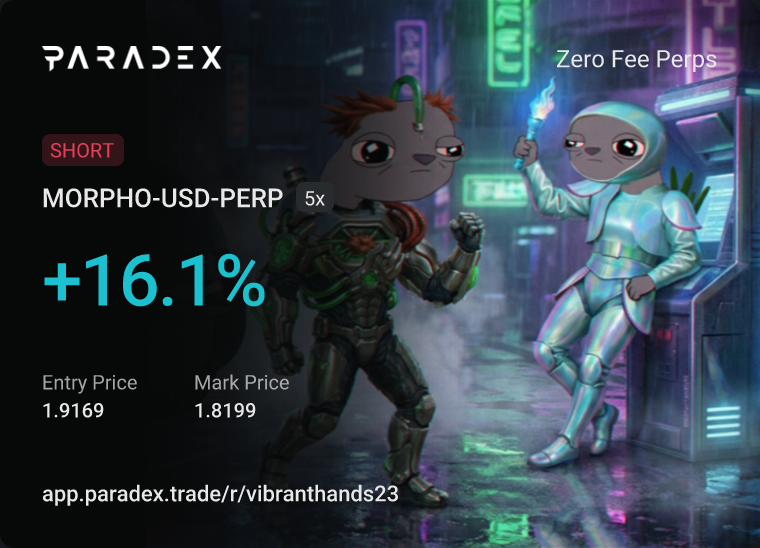
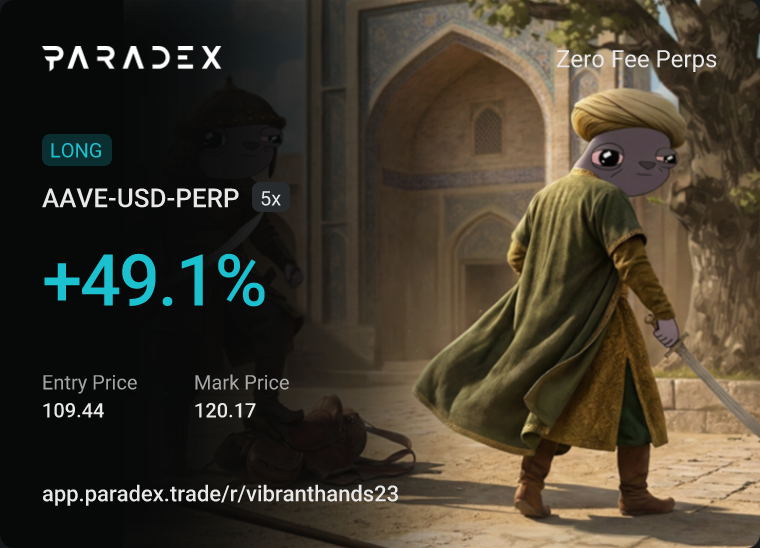
AI Bottleneck Trades ( $GLXY, $CIFR, $IREN, $CLSK) & Defi are my highest conviction bets. I especially like borrow/lend protocols that have the Clarity Act as a sentiment catalyst & AI agents as a fundamental one. I'm expressing this view through $NAVX on Sui and $HyperLend on Hyperliquid. I also have a perpetual long on $Aave with a equally weighted hedged short on $Morpho that is coming off a sentiment driven rally with price exceeding fundamentals imo. I need to highlight $HYPE's performance that is becoming a must own for portfolios. I've rode a perp long from $30 and will look to build a SPOT position on pullbacks.
English
0
0
1
575
J Smith
J Smith@therealjsmith88·
Crypto bottoms are so often formed following a stock market correction. Where Crypto leads the sell off (already happened), then survives the Stock market sell off better than everyone anticipates (so it still sells off but not nearly as bad as everyone thinks). Then it leads the recovery. So I still hold the view that we see all time highs this year.
English
1
0
0
18
J Smith
J Smith@therealjsmith88·
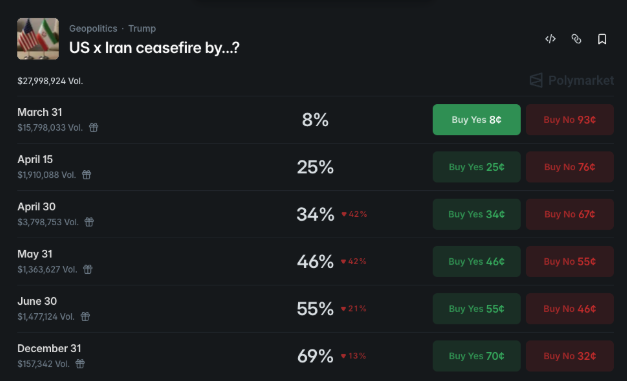
While Crypto has held up well during this war, the stock market had a poor close on the week & the rounded top seems to be playing out. We've had shifts in macro due to this war and oil and while it could all just end tomorrow, poly market thinks this is unlikely. Therefore, I don't think the impacts from an elevated oil price for long has been priced into equites given the knock effects that will have to slowing growth and financial conditions. I de-risked slightly on Friday to my main portfolio, trimming positions BTC, CLSK, CIFR, IREN, SOL, SUI, BTC, DEEP & GEOD building a 20% cash position. There is a possibility that we get a heap of green shoots as soon as a ceasefire or something similar is announced. I'm of the view that the market always underestimates Trump so I while I feel that Polymarkets odds maybe miss priced, I don't have the conviction to be fully deployed. As each day goes by, the probabilities of a deeper correction increases so I want to have some dry powder to take advantage of such an event, as this will present some incredible buying opportunities.
J Smith tweet media
English
1
0
0
47
J Smith
J Smith@therealjsmith88·
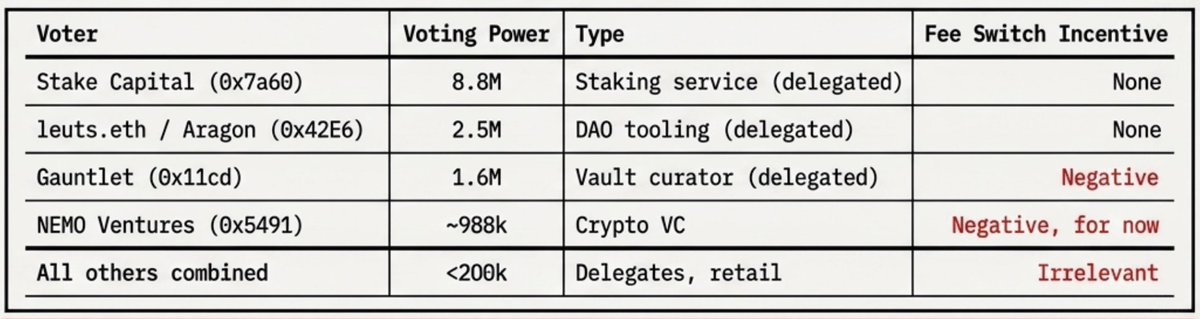
@lordjorx @Morpho This is why I shorted Morpho paired with an Aave long
J Smith tweet mediaJ Smith tweet media
English
1
0
1
188
Jordi in Cryptoland
Jordi in Cryptoland@lordjorx·
Don’t confuse a great protocol with a great investment. With $6.7 billion in TVL, @Morpho has proven it can dominate even in a mercenary market. However, we need to take a deeper look at the revenue switch we mentioned earlier today. They currently generate roughly $121 million in annualized interest, but exactly zero goes to the protocol. It all goes to LPs and curators. The only thing keeping the token’s $2B FDV alive is "narrative optionality", the hope that the fee switch will eventually be flipped. But this "hope" is mathematically dangerous: > The code allows for a 25% fee switch. At current numbers, that’s $30M in revenue. Even with a generous P/S ratio of 25, the "fair" valuation would be around $750M. If they only take 10%, the token would need to drop over 70% to reach a rational price. > Governance is controlled by a tiny group (essentially 4 entities). Gauntlet, one of the main voters, already earns $6M–$12M in fees as a curator. Why would they vote to give a slice of their pie to token holders? > The non-profit behind the protocol has spent hundreds of millions without a single audit. The CEO’s stance is clear: "reinvest everything." Translation: token holders are basically financing the protocol’s future while having zero say and zero yield. > Even the Apollo "buy-in" isn't what it seems. They are buying 90M tokens over 48 months (essentially buying the company through the back door), but it's happening via OTC deals directly from the treasury and the association. This doesn't create buy pressure on the open market. Meanwhile, a 23% increase in circulating supply is coming in the next few months and this buys will only absorb an 18% of this. Morpho is a 10/10 protocol that never needed a token. People are buying into a promise that, if ever formalized, would likely cause the price to collapse.
Jordi in Cryptoland tweet mediaJordi in Cryptoland tweet media
Four Pillars@FourPillarsFP

x.com/i/article/2033…

English
23
14
157
43.1K
J Smith
J Smith@therealjsmith88·
For these reasons, I think the better risk to reward sits in blockchain infrastructure and DeFi applications, which I’ll dive into next week.
English
0
0
0
6
J Smith
J Smith@therealjsmith88·
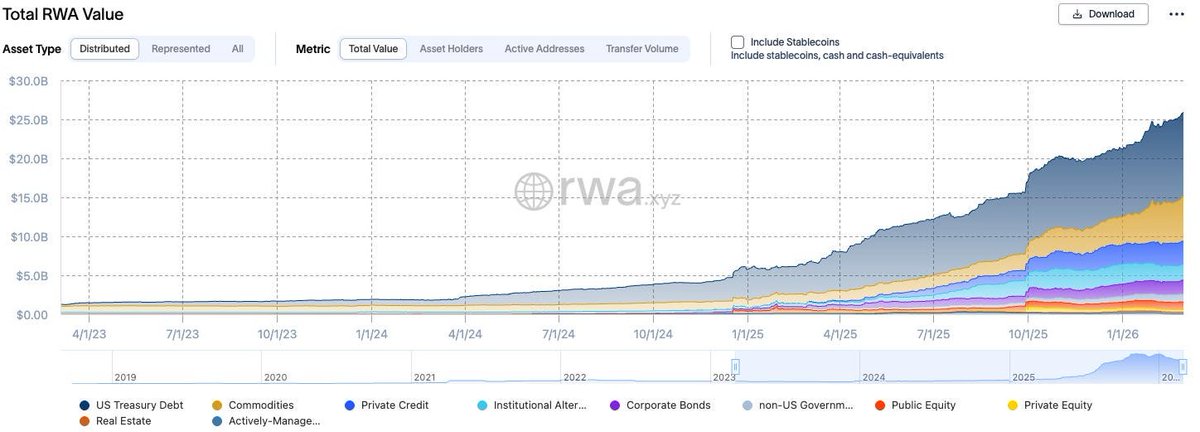
What makes this setup different isn’t just the charts, it’s what’s happening under the surface. The infrastructure is maturing, legislation is progressing, and real use cases are starting to scale. The Clarity Act passing will be a very big deal, opening the doors for innovation and a new wave of capital at levels the sector has never seen before. Stable-coins continue to grow, having found product market fit and bringing dollars on chain. That liquidity will flow through the ecosystem to Bitcoin, but especially to DeFi by lowering the barrier to entry. We’re also in the early stages of an explosion of AI agents that will need crypto rails to transact and verify. At the same time, Real World Assets (RWAs) are moving on chain, and the infrastructure that enables this will benefit.
J Smith tweet media
English
1
1
1
27
J Smith
J Smith@therealjsmith88·
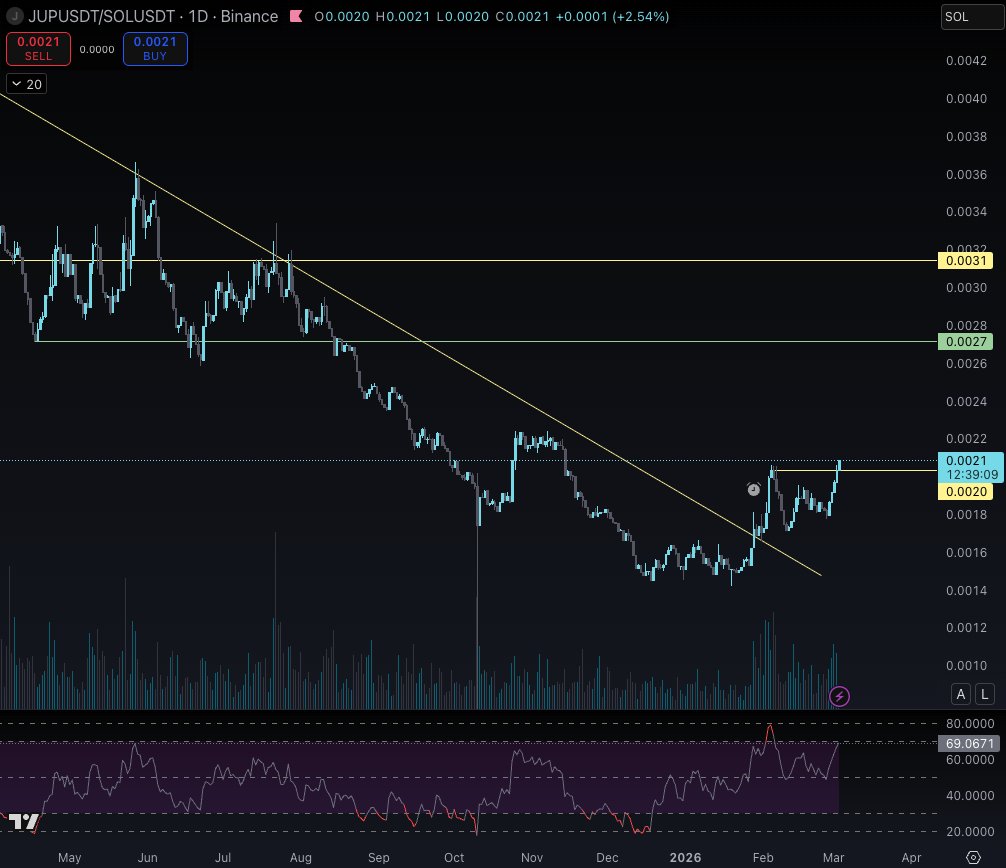
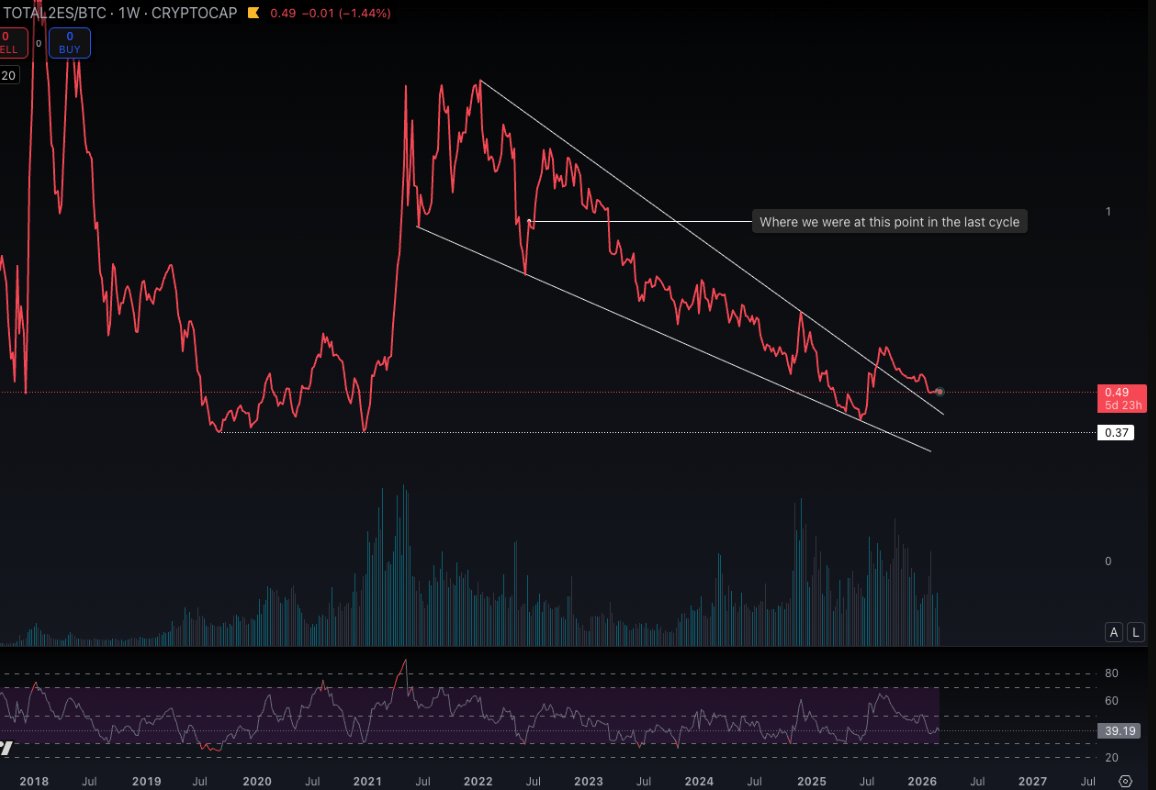
Alt-Coins > Bitcoin this next 6 months. Alt-coins have been in a structural bear market against BTC since 2022, so the setup now is very different to prior cycles.
J Smith tweet media
English
1
0
0
17
J Smith
J Smith@therealjsmith88·
@jdorman81 Wild that some DeFi apps are now sub 10x Rev/FDV. “Value investor” territory. It feels like a matter of time before new capital starts viewing these as value + growth, not just speculative bets.
English
0
0
2
38
Jeff Dorman
Jeff Dorman@jdorman81·
“Hey — I know back in 2020 and 2021, no one who traded crypto even knew what jobless claims or FOMC meetings were. But, what if all we do is write macro research going forward, and we start exclusively catering to the smallest, dumbest, most irrelevant investor group on the planet who only understands momentum trading —- and we completely ignore all of the assets with cash flows and buybacks that real investors might actually care about? Who’s with me?” —- actual transcript from a secret meeting between all crypto exchanges, brokers and asset managers in 2022. Consider me shocked that this strategy isn’t working. Can’t believe no one is stepping into buy …. We spent 5 years telling a bunch of momentum monkeys that all digital assets trade the same based on macro factors. Surely someone will go against the trend right?
Jeff Dorman@jdorman81

The majority of investors buy corporate stocks, bonds, & R.E. A TINY few buy commodities & currencies. So why is crypto focused on catering to the tiny sliver of CTAs, macro funds & fast money traders? It’s illogical More education needed on revenue companies with tokens

English
2
0
13
3.9K
J Smith
J Smith@therealjsmith88·
DeFi looks deeply oversold here. A big part of that appears driven by uncertainty around the CLARITY Act. Depending on what ultimately passes, there are real risks for certain protocols, but markets tend to price uncertainty far more harshly than imperfect outcomes. I have been listening to a few discussions on the topic and my takeaway is that while the legislation on the table is not flawless, it is unlikely to end DeFi. That has pushed me to start looking for opportunities. As stablecoin adoption continues to grow, liquidity should flow back on chain. If yields cannot be passed through custodial venues, borrow and lend protocols become a natural outlet, especially if AI agents are deployed at scale this year. I spent yesterday going through DeFiLlama, analysing key metrics and applying my own weighting framework. One protocol stood out as grossly undervalued. @navi_protocol is trading at an FDV to revenue ratio of around 2. It is the leading borrow and lend protocol on Sui, a chain that looks well positioned for AI agents, with additional upside from potential stablecoin growth via gasless and privacy enabled transactions. Looks like a solid bet.
J Smith tweet media
English
0
0
0
39
J Smith
J Smith@therealjsmith88·
"The world is still underappreciating what’s being built here. And what’s most relevant for all of us investing, is that the multi-year opportunity is underpriced for the leading projects"... Great piece!
Ryan Watkins@RyanWatkins_

x.com/i/article/2013…

English
0
0
1
26
Jacy🌸
Jacy🌸@jacycrypt·
Privacy vs transparency has been a hot debate topic in crypto for the longest time. But as blockchains scale, the importance of privacy is becoming even clearer. The privacy landscape has expanded beyond just cryptocurrencies. It’s a full-stack design choice that cuts across computation, identity, payments, interoperability, and even how users express intent on-chain. There are many privacy solutions currently, each solving privacy from a different angle. This post highlights 3 broad categories, with the projects building on them. 🎯 Zero-Knowledge Proofs ZKPs allow one party to prove that a statement is true without revealing the underlying data. They’re mainly used to hide transaction details while preserving validity, enable private smart contract execution, and compress computation while maintaining trustlessness. ZK tech is flexible, composable, and production-ready, which is why it dominates the current privacy landscape. From privacy coins to rollups, identity, interoperability, and verifiable compute. Projects in this category include: ➤ @Zcash - crypto for optional anonymity ➤ @AleoHQ - privacy by default L1 ➤ @aztecnetwork - hybrid execution L2 (private + public) ➤ @zksync - EVM-compatible validity rollup ➤ @PrivadoID - self-sovereign digital identity ➤ @dop_org - selective disclosure payment platform ➤ @RiscZero - ZK-verifiable computation ➤ @anoma - intent-centric operating system ➤ @brevis_zk - infinite compute layer for dApps ➤ @firoorg - crypto for untraceable transactions ➤ @MinaProtocol - “world’s lightest blockchain” ➤ @ZKPanther - end-to-end privacy in DeFi ➤ @zkhelixlabs - liquidity management and unification ➤ @DarkFiSquad - privacy L1 and P2P ecosystem ➤ @namada - L1 for asset-agnostic data protection ➤ @zkPass - privacy-focused oracle protocol ➤ @PolyhedraZK - interoperability infrastructure ➤ @ZKVProtocol - modular L1 for ZKP verification 🎯 Fully Homomorphic Encryption (FHE) FHE allows computation to be performed directly on encrypted data, with the result remaining encrypted. The data is never revealed, even during execution. ZK proves something about data, FHE computes with the data itself. It enables confidential smart contracts, private AI inference, and encrypted DeFi logic where neither validators nor applications see user inputs. The tradeoff is performance. FHE is still expensive and complex, but improving rapidly. Projects in this category include: ➤ @zama - open-source cryptography company ➤ @omnia_protocol - private RPC infrastructure ➤ @privasea - DeAI computing network ➤ @fhenix - confidential DeFi infra ➤ @inconetwork - modular L1 and confidentiality layer ➤ @mindnetwork_xyz - zero-trust internet protocol ➤ @octra - encrypted compute network ➤ @SunscreenTech - tooling for privacy-focused apps 🎯 Ring Signatures, Stealth Addresses, and RingCT This group focuses on transaction-level privacy by obscuring who sent what to whom and in what amount. Instead of proving correctness cryptographically like ZK, these systems mix transactions at the protocol level, use decoy signers and one-time addresses, and hide amounts while preserving balance integrity. These approaches are less flexible than ZK and less general than FHE, but they’re some of the strongest privacy guarantees available for payments today. Projects in this category include: ➤ @monero - crypto for private and fungible transactions ➤ @zano_project - privacy by default L1 ➤ @vergecurrency - crypto for anonymous transactions ➤ @BeldexCoin - blockchain ecosystem for privacy-first dApps TL;DR ZK is making verification cheap and composable, FHE is opening the door to encrypted computation at scale, and older primitives like ring signatures continue to prove their relevance in real-world usage. Privacy is becoming non-negotiable, and despite what route these projects take to achieve it, the common thread tying them is control. Who can see what, when, and under what conditions.
Jacy🌸 tweet media
English
25
4
36
8.7K