ookii

241 posts

ookii

ookii

@thetrueook

Katılım Ocak 2022
484 Takip Edilen194 Takipçiler
ookii retweetledi
AdrianoFeria.eth 🦇🔊 🛡️
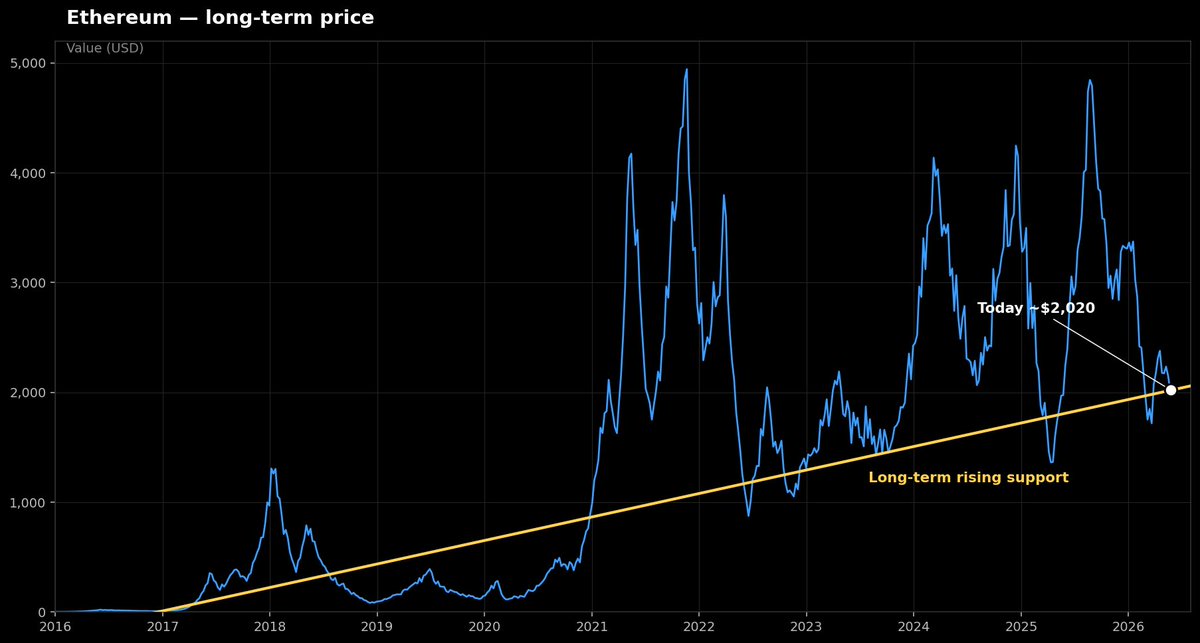
It turns out a lot of the little .ETH guys had much stronger conviction than some of the community's loudest poster boys. We now have a good idea of who was selling: not Vitalik, not the Ethereum Foundation, but early investors who lost confidence in the overall crypto narrative, opportunists who never bought into it in the first place, and overcommitted believers who are being forced to reduce leverage. And honestly, I can't blame someone without deep conviction in Ethereum for selling at a time when other crypto projects have outperformed it, and worse, when other markets like AI have absolutely crushed all of crypto. There's a disconnect between crypto's core narrative and the reality of the industry. A big piece of the puzzle is still missing, and everyone is quietly feeling it even if they can't quite articulate it. The final form of crypto has not been achieved. Absolute digital scarcity is not it. Programmability is not it. Scalability is not it. More sophisticated DeFi is not it. And privacy isn't it either. Every one of these is a real advance, and the work behind them matters. But none of them is sufficient. Each sparked a new wave of speculation and the hope of crossing the chasm to mass adoption. Each failed to deliver. Privacy will fail too. Most mainstream users and organizations in regulated economies will never accept a system where a typo sends funds into oblivion, where phishing and hacks drain accounts permanently, and where no one picks up the phone when something goes wrong. Until that is fixed, mass adoption isn't happening. The good news is that a solution exists. The final piece of the puzzle is attainable, but it will require honestly reframing what decentralization can do in the future of money and finance, and what it will never be able to do. I am still bullish on Ethereum because, despite all the noise, it remains the network and framework best suited to be a new foundation for finance, and it will be much needed. That position is what will pave the way for ETH to accrue monetary premium. The same network properties that make Ethereum a financial juggernaut also make ETH a superior digital store of value. These two ideas are deeply connected, even if recent price action has obscured that reality. In time, the distinction between narrative and reality will become obvious. I'm writing a piece that lays out the direction of the missing piece that crypto, and more specifically Ethereum, needs to follow in order to break through to mass adoption. It will be controversial. Most people will read it as a bearish take at first glance, but it is likely the most bullish thing I have ever written about Ethereum. In the meantime, step back, connect the cycle lows from 2017 to today and you will see that the graph and sentiment are manifesting capitulation. The uptrend is still there, we're sitting right on it. This was always a multi-decade trade. In a few years for now, four or five years of chop will read as a blur.
AdrianoFeria.eth 🦇🔊 🛡️ tweet media
English
28
13
231
11.9K
ookii retweetledi
William Mougayar
William Mougayar@wmougayar·
The strategic significance of increasing the gas limit in Ethereum’s next upgrade is tectonic. Think of Ethereum today as a global highway system with a fixed number of lanes. The “gas limit” is the maximum amount of activity Ethereum can process every 12 seconds. Right now, Ethereum’s highway has roughly the equivalent of 30–60 million “activity units” per block. The Glamsterdam upgrade will push that toward 200 million. This is a massive increase in how much Ethereum can handle at once. Why this matters: 1. Ethereum becomes less congested Today, when too many people use Ethereum simultaneously, fees spike because users compete for limited space. It’s similar to airline tickets: few seats + many passengers = expensive prices more seats + same passengers = lower prices A 200M gas limit means Ethereum can fit far more transactions, applications, stablecoin transfers, AI-related activity, DeFi operations, and institutional usage into each block. The practical effect: cheaper transactions fewer congestion spikes smoother usage during peak demand 2. Ethereum stops feeling “scarce” For years, Ethereum’s main criticism was: “It’s too expensive.” That criticism came largely from limited capacity. The increase toward 200M changes the psychology of the network. Ethereum starts behaving less like an overcrowded premium airport and more like modern digital infrastructure with abundant capacity. This is important because Ethereum no longer juggles between: decentralization security usability It improves usability dramatically while preserving the first two. 3. Institutions can build on it more comfortably Large financial institutions, governments, payment companies, and enterprises need predictable costs and reliability. They cannot build serious systems on infrastructure where fees unpredictably jump 20x during busy periods. Higher gas limits mean: more stable operating costs better throughput better scalability for real-world applications This makes Ethereum look more like foundational infrastructure and less like an experimental network. 4. Ethereum L1 becomes economically “roomier” Many people assume Layer 2s replace Ethereum mainnet. Not exactly. What Glamsterdam really does is strengthen Ethereum’s base layer so it can support: more settlement more rollup anchoring more institutional-grade activity more complex applications The base layer becomes a much stronger economic foundation underneath the broader ecosystem. 5. It changes Ethereum’s competitive positioning Other blockchains marketed themselves around: “Ethereum is slow” “Ethereum is expensive” “We are faster” If Ethereum scales to 200M gas safely while retaining: decentralization neutrality security ecosystem dominance then these objections weaken considerably. Now Ethereum can scale without compromising the properties that matter. That is an important narrative shift. 6. This is not just “making blocks bigger” Another point people miss: Ethereum developers are not simply cranking up the dial recklessly. Several underlying improvements are being added first: ePBS Block Access Lists (BALs) gas repricing execution optimizations These let Ethereum process much more activity without breaking decentralization or overloading validators. In other words: the network architecture is being upgraded before opening more lanes on the highway. The deeper significance The deeper story is not “more TPS.” The deeper story is that Ethereum is evolving from: a constrained premium settlement layer into: a globally scalable neutral trust infrastructure That matters because Ethereum’s long-term value is not merely in token transfers. It is in becoming: the operating basis for stablecoins tokenized assets AI-agent economies decentralized identity financial settlement programmable agreements institutional coordination systems In sum, this is closer to: upgrading the electrical grid of a digital economy than merely making an app faster
English
16
22
137
5K
ookii retweetledi
AdrianoFeria.eth 🦇🔊 🛡️
You must read this if you want to understand why Ethereum already won. One of Ethereum’s most underrated properties is how cheap it is to actually run. Ethereum's real-world operational burden (hardware, bandwidth, electricity, and ongoing maintenance) is remarkably low, and that matters far more than most people realize as the market shifts from valuing blockchains as cash flow machines to valuing them as monetary assets. Persistence is a key element of monetary premium. An asset earns that premium by credibly demonstrating it can survive across decades, regardless of market conditions. A network that depends on high fees to sustain itself is a network whose survival depends on conditions that may not hold. As blockspace becomes commoditized and execution environments proliferate, fee revenue is an increasingly fragile foundation. Low operating costs change that entirely. Ethereum can run on thin margins indefinitely. Validators do not need high fees or aggressive extraction to stay online. The network does not need constant economic intensity to maintain security. That indifference to fee compression is a defining advantage, it sets Ethereum apart and positions it as a product with no credible competition. What this means in tangible terms: -The network remains live and decentralized even during low activity -The social contract stays intact because participation remains accessible -Monetary properties including scarcity are hardened -That durability builds trust -That trust becomes monetary premium In contrast, networks optimized around, or dependent on, high cash flows expose a structural weakness. When fees compress, their security budget shrinks, participation consolidates, and the social contract starts to crack. We are already seeing this play out. Bitcoin’s security model is under increasing pressure. Mining has consolidated into large industrial operations, margins tighten after each halving, and the incentive landscape is drifting toward behaviors that undermine its original assumptions. When security depends on ever-increasing external costs, it becomes fragile by design. Solana took a different path but arrived at a similar place. By pushing hardware requirements higher in pursuit of throughput, it has made validator participation more expensive and less accessible. Over time, that pushes the network toward concentration among well-capitalized operators, especially when revenues fluctuate. Both models tie network integrity to economic conditions in a way that is inherently unstable. Ethereum deliberately avoided both traps. Its validator requirements remain modest, its set is large and geographically distributed, and its roadmap continues to prioritize keeping participation cheap. What once looked like conservatism now looks like foresight. As execution commoditizes, the market will increasingly price blockchains based on their ability to persist, not their ability to extract fees. Ethereum does not need to be the highest throughput or highest revenue chain to win. It only needs to capture key use cases and be the one that is still here, secure and decentralized, when fee cycles reset. Finance is the most important of those use cases. And the kind of adoption that matters is not the degenerate speculation that fueled NFT and memecoin manias, but real financial activity, stablecoins, and tokenized assets that deliver tangible and sustainable utility to users and institutions. That is what monetary premium rewards. And that is exactly why Ethereum already won.
English
13
30
150
6.6K
ookii retweetledi
William Mougayar
William Mougayar@wmougayar·
ETH must Decouple. Now. Ethereum’s valuation must decouple because it is increasingly misclassified as part of a homogeneous “crypto asset class.” In reality, ETH is closer to a hybrid of digital commodity, settlement infrastructure, software innovation layer, and economic bandwidth provider. As institutional understanding matures, capital will differentiate between speculative tokens and foundational infrastructure. When that happens, ETH will be evaluated using frameworks analogous to global infrastructure, financial rails, and even sovereign-grade trust systems, not meme-driven market cycles. Decoupling is not a speculative hope; it is the logical outcome of proper classification. Ethereum is not a “better blockchain” within the same category. It is a different category altogether. Its valuation trajectory will ultimately reflect the scale of the economic system it underpins, not the sentiment cycles of the assets it is mistakenly grouped with.
English
59
86
653
49.6K
ookii retweetledi
RYAN SΞAN ADAMS - rsa.eth 🦄
In early 2024 it was becoming obvious Ethereum L2 roadmap had a fatal flaw. No shared liquidity. Each L2 was a separate nation - with its own borders and economics - rather than the United Chains of Ethereum we'd envisioned in 2021 and 2022. To be blunt: the L2 roadmap was a bit of a let down. At DevCon 18 months ago many hoped for an "Ethereum 3.0" plan that would unify our rollups. Instead, we got Justin Drake's 5 year long early Lean Ethereum journey. (Which has since solidified into a brilliant execution plan to scale & strengthen Ethereum, but at the time was received with disappointment.) We wanted a plan to unite the chains. @koeppelmann's presented an early form of that plan - he called them Native Rollups. These would be rollups that share liquidity, composability, and validators with Ethereum's L1. Rather than L2s as a loose alliance of chains that opt-in to shared security (the NATO model) we'd get a strongly coordinated yet federated economic union of chains (the U.S. model). No hard forks required. I hadn't seen much movement on this vision until now. But @etheconomiczone appears to be a serious attempt at a United Chains of Ethereum. ZK is the tech unlock and we get the zk genius of @jbaylina leading this. The engineering ability of @gnosis_ gives credibility this will ship. And the support of @ethereum foundation makes me optimistic this will remain open and credibly neutral. If Ethereum pulls this off - if it unites its chains into an integrated economic zone - while shipping quantum upgrades and L1 scaling of Lean Ethereum in parallel... Ethereum will gain an unstoppable network effect. It will finally deliver on its core promise Ethereum = world ledger. ETH = world reserve asset.
Sebastian Bürgel@SCBuergel

The "Ethereum 3.0 vision" is what @RyanSAdams called it That vision is now a mission and it's called "Ethereum Economic Zones" Incredibly proud to be team Gnosis ☺️

English
30
48
410
76.6K
ookii retweetledi
vitalik.eth
vitalik.eth@VitalikButerin·
This is the new EF Mandate. For many of you, the contents should be no surprise, and a clarification along the lines that we have been going and thinking for the past few months. But the clarification is nevertheless worth making. Ethereum is a unique object and has a unique role in the world. Its role is to be a sanctuary technology, to preserve technological self-sovereignty, to enable cooperation without coercion, domination or rugpulling, and to provide an escape hatch, to ensure that no single person, organization or ideology's victory in cyberspace can be total. The Ethereum Foundation is a steward of Ethereum - the original steward, and today, the steward specifically dedicated to preserving and expanding the above aspects of Ethereum. This means a heavy emphasis on CROPS (censorship and capture resistance, open source, privacy, security), both at the protocol layer, and at the access layer, user-facing applications and tools that we create or contribute to. There are things that we do in Ethereum because we believe that they are valuable for the underlying goals that we have for Ethereum. There are things that we do not do because from the perspective of our values we find them uninteresting (or worse, harmful). But there are also things that we do not do because while they are useful, they are not our role. At the Ethereum protocol layer, we focus on decentralization, verifiability, inclusion guarantees, protocol liveness, security and privacy first and foremost. We also value capabilities (eg. L1 scale, account abstraction, perhaps some forms of in-protocol aggregation), particularly because improvements in these capabilities better enable users to properly benefit from Ethereum's CROPS properties and displace the need for higher-layer intermediaries that might weaken the extent to which Ethereum's properties carry over into the full stack. We also believe that the Ethereum protocol must strive to pass the walkaway test. "We do X to specialize to serve the use cases of today, if more use cases appear later, we will continue to keep adding more EIPs for them later" is logic fit for many other blockchains whose names you hear often on this forum, but we do not believe it is logic fit for a decentralization-first blockchain like Ethereum. At the application layer, we focus on making "the zero option" - user experience that goes hard on ensuring security and privacy, avoiding dependence on intermediaries, and respecting the user's agency - as high quality as possible. We see this as complementary to work in the Ethereum ecosystem that "goes broad", starting from the world that it exists, and brings it onchain and improves its properties over time. Such work has its natural home outside the EF. We intend to be supportive of such efforts. We believe that the two are complementary: tools that are developed within the EF can be adopted by anyone, including partially, and even partial adoption that improves people's security, privacy and agency is a good thing. But the form of user experience that is more heavily insistent on CROPS properties is where we want the EF to develop its center of expertise. This does not mean shrinking from the hard questions. We believe in a vision of self-sovereignty that protects users, and does not leave users in the cold to face environments where they lose their life savings if they make a mistake, and click "yes" on a confirmation screen by accident two seconds after. But such protection must be designed based on a philosophical baseline of empowering the user, not empowering centralized organizations that claim to act in the user's name. This quadrant of design space - caring about users' (including non-experts') well-being and safety, and yet insistent on doing this in a way compatible with their agency and freedom, is underserved (not just in crypto, but in the world). We wish to use Ethereum as a platform to build out and showcase this quadrant, and ideally work with others to expand its reach over time. This is also a new chapter in how we see our position in the world. We must see ourselves not just as the Ethereum community, but also as maintainers of the Ethereum tool within what you might call the CROPS community or the sanctuary tech community, or a dozen of other words that have for a long time been used by people with similar values to us but far outside Ethereum. This means open-mindedness to new conceptions of what things in the world are our natural allies. Ethereum is not the world. Ethereum is a specific object in the world that is here to have specific properties. The Ethereum Foundation is a specific organization within Ethereum - one steward, not the sole one. I encourage all to read the mandate in detail; it includes concrete examples of how we intend to deal with the challenges and nuances of these ideas. We are doubling down on Ethereum and are excited about its next chapter.
Ethereum Foundation@ethereumfndn

Today, the Foundation’s Board released the EF Mandate. This document, which was first intended for EF members, reaffirms the promise of Ethereum, and the role of EF within this ecosystem.

English
330
273
1.6K
274.2K
ookii retweetledi
RYAN SΞAN ADAMS - rsa.eth 🦄
A truth bomb for you. ETH will never earn fees. Ok, never is a strong word - let me rephrase - ETH won't earn fees anytime soon or in sustained amounts necessary to justify a centa-billion dollar asset. The reason is written in the roadmap. Ethereum intends to massively increase blockspace supply in the coming years. If we get to Justin Drake's gigagas in 5 years, that's a 200x increase in blockspace supply. ETH only generates fees when demand exceeds supply - demand won't outstrip supply during this rapid expansion era, that means low fees. So if your reason for holding ETH is fee generation, sell now - send it to zero. Or...re-consider how to value ETH. Consider what the market is already telling you. What assets don't earn fees but are worth trillions? Gold. Silver. Oil. Bitcoin. Together worth $170 trillion in value. Commodity money and store of value assets aren't priced on their ability to generate fees. They're priced on consumptive usage, and store of value demand relative to their scarcity. ETH is scarce. Lower annual issuance than gold or bitcoin. ETH has store of value demand. A censorship resistant digital money, a cyberpunk money, native to AI and the internet, economic bandwidth for DeFi. You can try to value ETH as a fee generating DCF asset and continue to be confused or you can value it as the market already does. ETH is an emerging commodity money.
RYAN SΞAN ADAMS - rsa.eth 🦄@RyanSAdams

@MikeIppolito_ > However, if ETH is going to go up, it must earn fees. Send it to zero then. It ain't earning fees.

English
109
64
611
109.3K
ookii retweetledi
vitalik.eth
vitalik.eth@VitalikButerin·
I think it's healthy for us in the Ethereum world to have a more bold and open mindset to many things, particularly on the application layer and on how we see ourselves in the world. We should not compromise on core properties: censorship resistance, open source, privacy, security (CROPS). We should not have "open mindedness" of the type that leaves people with no confidence of what security properties the L1 will still have one year from now. We should not ask ourselves questions like "do we really need light clients to be able to trustlessly verify correctness of the chain?". But especially on the layer of applications and Ethereum's interface to the world, we should be more willing to radically rethink various concepts and step outside our comfort zone. This includes issues of technological direction, eg. "what if AI basically means that wallets as browser extensions and mobile extensions are dead within a year?" One example last year was the shift to thinking about privacy as a first-class consideration, something we value equally to the other types of security. This implies a radically different Ethereum application stack, because the entire stack so far has not been built around privacy. Great, let's build a radically different Ethereum application stack! An example this year is the growing work on the networking side of privacy, both inside the EF and outside. It includes application-layer issues, eg. "what if the rest of defi is basically just universal futures markets on top of a good decentralized oracle and letting users self-organize on top of that?", and "what if the ideal decentralized oracle is just a SNARK over M-of-N small LLMs over zk-TLSes of some major news sites?" (BTW this is interrelated with the AI issue: one consequence of AI is that it moves "applications" away from being discrete categories of behavior with discrete UIs, and more toward being a continuous space, so "build fewer apps and rely on users to self-organize around them" should inevitably expand as a pattern) One example this year is rethinking from zero the role of L2s, and what kind of L2s are actually most synergistic and additive to Ethereum. It also includes culture. This is a big part of "the whole milady thing" for myself, @AyaMiyagotchi and others. Yes, it's a silly meme. Yes, I find the political takes of some milady partisans cringe and sometimes outright bootlickerish (though other milady partisans are quite the opposite). But the core underlying subtext, the message behind the message, is: rip off the suit and tie. If you have your suit and tie on, be willing to grab the nearest wine glass and spill it all over your suit and tie, so you have no choice but to rip it off and reclaim your body's full flexibility and freedom. Actually imagine yourself doing this the next time you get invited to a richpeopleslop formal gala dinner. Take the preconception that you are "respectable", write it down on a piece of paper, crumble it up and burn it. The psychological baptism of doing this leads to the intellectual baptism of unlocking greater creativity and expanding overton windows. For too long, our algorithm in Ethereum has been: we have this existing ecosystem, what's the logical next step to make it one step better? Now, our algorithm should be: we have this L1 that is amazing and will become more amazing, we have a growing array of tools, both those built within our ecosystem and outside it, what are the most valuable things to build, knowing what we know now? If YOU had to write the section of the 2014 Ethereum whitepaper that talked about applications, and take a first-principles perspective of what makes sense in defi, decentralized social, identity, and elsewhere, what would you write? At least take the step of marking all path-dependence concerns down to zero, pretend for a brief moment that the Ethereum chain today has exactly zero usage and you're the one suggesting or building the first apps, and see what comes out. Do this even if you're the one building today's existing apps. This is how Ethereum can grow back stronger.
English
530
367
2.5K
452.4K
ookii retweetledi
vitalik.eth
vitalik.eth@VitalikButerin·
Now, the quantum resistance roadmap. Today, four things in Ethereum are quantum-vulnerable: * consensus-layer BLS signatures * data availability (KZG commitments+proofs) * EOA signatures (ECDSA) * Application-layer ZK proofs (KZG or groth16) We can tackle these step by step: ## Consensus-layer signatures Lean consensus includes fully replacing BLS signatures with hash-based signatures (some variant of Winternitz), and using STARKs to do aggregation. Before lean finality, we stand a good chance of getting the Lean available chain. This also involves hash-based signatures, but there are much fewer signatures (eg. 256-1024 per slot), so we do not need STARKs for aggregation. One important thing upstream of this is choosing the hash function. This may be "Ethereum's last hash function", so it's important to choose wisely. Conventional hashes are too slow, and the most aggressive forms of Poseidon have taken hits on their security analysis recently. Likely options are: * Poseidon2 plus extra rounds, potentially non-arithmetic layers (eg. Monolith) mixed in * Poseidon1 (the older version of Poseidon, not vulnerable to any of the recent attacks on Poseidon2, but 2x slower) * BLAKE3 or similar (take the most efficient conventional hash we know) ## Data availability Today, we rely pretty heavily on KZG for erasure coding. We could move to STARKs, but this has two problems: 1. If we want to do 2D DAS, then our current setup for this relies on the "linearity" property of KZG commitments; with STARKs we don't have that. However, our current thinking is that it should be sufficient given our scale targets to just max out 1D DAS (ie. PeerDAS). Ethereum is taking a more conservative posture, it's not trying to be a high-scale data layer for the world. 2. We need proofs that erasure coded blobs are correctly constructed. KZG does this "for free". STARKs can substitute, but a STARK is ... bigger than a blob. So you need recursive starks (though there's also alternative techniques, that have their own tradeoffs). This is okay, but the logistics of this get harder if you want to support distributed blob selection. Summary: it's manageable, but there's a lot of engineering work to do. ## EOA signatures Here, the answer is clear: we add native AA (see eips.ethereum.org/EIPS/eip-8141 ), so that we get first-class accounts that can use any signature algorithm. However, to make this work, we also need quantum-resistant signature algorithms to actually be viable. ECDSA signature verification costs 3000 gas. Quantum-resistant signatures are ... much much larger and heavier to verify. We know of quantum-resistant hash-based signatures that are in the ~200k gas range to verify. We also know of lattice-based quantum-resistant signatures. Today, these are extremely inefficient to verify. However, there is work on vectorized math precompiles, that let you perform operations (+, *, %, dot product, also NTT / butterfly permutations) that are at the core of lattice math, and also STARKs. This could greatly reduce the gas cost of lattice-based signatures to a similar range, and potentially go even lower. The long-term fix is protocol-layer recursive signature and proof aggregation, which could reduce these gas overheads to near-zero. ## Proofs Today, a ZK-SNARK costs ~300-500k gas. A quantum-resistant STARK is more like 10m gas. The latter is unacceptable for privacy protocols, L2s, and other users of proofs. The solution again is protocol-layer recursive signature and proof aggregation. So let's talk about what this is. In EIP-8141, transactions have the ability to include a "validation frame", during which signature verifications and similar operations are supposed to happen. Validation frames cannot access the outside world, they can only look at their calldata and return a value, and nothing else can look at their calldata. This is designed so that it's possible to replace any validation frame (and its calldata) with a STARK that verifies it (potentially a single STARK for all the validation frames in a block). This way, a block could "contain" a thousand validation frames, each of which contains either a 3 kB signature or even a 256 kB proof, but that 3-256 MB (and the computation needed to verify it) would never come onchain. Instead, it would all get replaced by a proof verifying that the computation is correct. Potentially, this proving does not even need to be done by the block builder. Instead, I envision that it happens at mempool layer: every 500ms, each node could pass along the new valid transactions that it has seen, along with a proof verifying that they are all valid (including having validation frames that match their stated effects). The overhead is static: only one proof per 500ms. Here's a post where I talk about this: ethresear.ch/t/recursive-st… firefly.social/post/farcaster…
English
799
1.1K
5.7K
927K
ookii retweetledi
Joseph Chalom
Joseph Chalom@joechalom·
Vitalik Buterin just published his vision for Ethereum and AI. The core thesis is clear: Ethereum becomes a critical economic coordination layer for autonomous AI agents as AI moves from experimentation into mass production. I called this out in my 2026 predictions and I believe this is one of the most underestimated tailwinds for ETH. We are quickly moving toward an Ethereum autonomous machine economy, where task-specific AI agents transact, coordinate, and establish reputation (enter ERC-8004) without intermediaries. As enterprise software evolves from AI copilots to fully autonomous agents, and then to networks of collaborating agents, those agents will need a neutral, programmable settlement layer to operate across systems. That activity implies a step-function increase in transaction volume, network demand, and TVL. A 10x expansion to over $500 billion is not aggressive in that context. And it will happen on Ethereum. Ethereum’s decentralization, liquidity, and emerging agent standards make it uniquely suited to support autonomous market participants that trade, rebalance, provide liquidity, and allocate capital continuously, onchain, 24/7. @VitalikButerin also emphasizes a non-negotiable point: responsible AI requires privacy and trustless interaction, especially for payments. These are requirements, not nice-to-haves, and they only work on infrastructure that is genuinely decentralized. Put simply: AI needs Ethereum. Ethereum isn’t just scaling for humans anymore. It’s scaling for machines. And if AI agents are becoming active participants in financial markets, owning ETH means owning the foundation of that agentic economy. This is one of many reasons we’re singularly focused on the Ethereum opportunity @SharpLink
vitalik.eth@VitalikButerin

Two years ago, I wrote this post on the possible areas that I see for ethereum + AI intersections: vitalik.eth.limo/general/2024/0… This is a topic that many people are excited about, but where I always worry that we think about the two from completely separate philosophical perspectives. I am reminded of Toly's recent tweet that I should "work on AGI". I appreciate the compliment, for him to think that I am capable of contributing to such a lofty thing. However, I get this feeling that the frame of "work on AGI" itself contains an error: it is fundamentally undifferentiated, and has the connotation of "do the thing that, if you don't do it, someone else will do anyway two months later; the main difference is that you get to be the one at the top" (though this may not have been Toly's intention). It would be like describing Ethereum as "working in finance" or "working on computing". To me, Ethereum, and my own view of how our civilization should do AGI, are precisely about choosing a positive direction rather than embracing undifferentiated acceleration of the arrow, and also I think it's actually important to integrate the crypto and AI perspectives. I want an AI future where: * We foster human freedom and empowerment (ie. we avoid both humans being relegated to retirement by AIs, and permanently stripped of power by human power structures that become impossible to surpass or escape) * The world does not blow up (both "classic" superintelligent AI doom, and more chaotic scenarios from various forms of offense outpacing defense, cf. the four defense quadrants from the d/acc posts) In the long term, this may involve crazy things like humans uploading or merging with AI, for those who want to be able to keep up with highly intelligent entities that can think a million times faster on silicon substrate. In the shorter term, it involves much more "ordinary" ideas, but still ideas that require deep rethinking compared to previous computing paradigms. So now, my updated view, which definitely focuses on that shorter term, and where Ethereum plays an important role but is only one piece of a bigger puzzle: # Building tooling to make more trustless and/or private interaction with AIs possible. This includes: * Local LLM tooling * ZK-payment for API calls (so you can call remote models without linking your identity from call to call) * Ongoing work into cryptographic ways to improve AI privacy * Client-side verification of cryptographic proofs, TEE attestations, and any other forms of server-side assurance Basically, the kinds of things we might also build for non-LLM compute (see eg. my ethereum privacy roadmap from a year ago ethereum-magicians.org/t/a-maximally-… ), but for LLM calls as the compute we are protecting. # Ethereum as an economic layer for AI-related interactions This includes: * API calls * Bots hiring bots * Security deposits, potentially eventually more complicated contraptions like onchain dispute resolution * ERC-8004, AI reputation ideas The goal here is to enable AIs to interact economically, which makes viable more decentralized AI architectures (as opposed to non-economic coordination between AIs that are all designed and run by one organization "in-house"). Economies not for the sake of economies, but to enable more decentralized authority. # Make the cypherpunk "mountain man" vision a reality Basically, take the vision that cypherpunk radicals have always dreamed of (don't trust; verify everything), that has been nonviable in reality because humans are never actually going to verify all the code ourselves. Now, we can finally make that vision happen, with LLMs doing the hard parts. This includes: * Interacting with ethereum apps without needing third party UIs * Having a local model propose transactions for you on its own * Having a local model verify transactions created by dapp UIs * Local smart contract auditing, and assistance interpreting the meaning of FV proofs provided by others * Verifying trust models of applications and protocols # Make much better markets and governance a reality Prediction and decision markets, decentralized governance, quadratic voting, combinatorial auctions, universal barter economy, and all kinds of constructions are all beautiful in theory, but have been greatly hampered in reality by one big constraint: limits to human attention and decision-making power. LLMs remove that limitation, and massively scale human judgement. Hence, we can revisit all of those ideas. These are all things that Ethereum can help to make a reality. They are also ideas that are in the d/acc spirit: enabling decentralized cooperation, and improving defense. We can revisit the best ideas from 2014, and add on top many more new and better ones, and with AI (and ZK) we have a whole new set of tools to make them come to life. We can describe the above as a 2x2 chart. There's a lot to build!

English
73
144
823
96.2K
ookii retweetledi
vitalik.eth
vitalik.eth@VitalikButerin·
Have been following reactions to what I said about L2s about 1.5 days ago. One important thing that I believe is: "make yet another EVM chain and add an optimistic bridge to Ethereum with a 1 week delay" is to infra what forking Compound is to governance - something we've done far too much for far too long, because we got comfortable, and which has sapped our imagination and put us in a dead end. If you make an EVM chain *without* an optimistic bridge to Ethereum (aka an alt L1), that's even worse. We don't friggin need more copypasta EVM chains, and we definitely don't need even more L1s. L1 is scaling and is going to bring lots of EVM blockspace - not infinite (AIs in particular will need both more blockspace and lower latency than even a greatly scaled L1 can offer), but lots. Build something that brings something new to the table. I gave a few examples: privacy, app-specific efficiency, ultra-low latency, but my list is surely very incomplete. A second important thing that I believe is: regarding "connection to Ethereum", vibes need to match substance. I personally am a fan of many of the things that can be called "app chains". For example I think there's a large chance that the optimal architecture for prediction markets is something like: the market gets issued and resolved on L1, user accounts are on L1, but trading happens on some based rollup or other L2-like system, where the execution reads the L1 to verify signatures and markets. I like architectures where deep connection to L1 is first-class, and not an afterthought ("we're pretty much a separate chain, but oh yeah, we have a bridge, and ok fine let's put 1-2 devs to get it to stage 1 so the l2beat people will put a green checkmark on it so vitalik likes us"). The other extreme of "app chain", eg. the version where you convince some government registry, or social media platform, or gaming thing, to start putting merkle roots of its database, with STARKs that prove every update was authorized and signed and executed according to a pre-committed algorithm, onchain, is also reasonable - this is what makes the most sense to me in terms of "institutional L2s". It's obviously not Ethereum, not credibly neutral and not trustless - the operator can always just choose to say "we're switching to a different version with different rules now". But it would enable verifiable algorithmic transparency, a property that many of us would love to see in government, social media algorithms or wherever else, and it may enable economic activity that would otherwise not be possible. I think if you're the first thing, it's valid and great to call yourself an Ethereum application - it can't survive without Ethereum even technologically, it maximizes interoperability and composability with other Ethereum applications. If you're the second thing, then you're not Ethereum, but you are (i) bringing humanity more algorithmic transparency and trust minimization, so you're pursuing a similar vision, and (ii) depending on details probably synergistic with Ethereum. So you should just say those things directly! Basically: 1. Do something that brings something actually new to the table. 2. Vibes should match substance - the degree of connection to Ethereum in your public image should reflect the degree of connection to Ethereum that your thing has in reality.
English
1.7K
597
5K
1.1M
ookii retweetledi
AdrianoFeria.eth 🦇🔊 🛡️
Let's put the BTC as a SoV snowflake argument to bed, shall we? BTC was first to market and has stronger brand recognition. That is not a valid criteria for deciding what should or should not be considered a store of value. - ETH is officially classified as a commodity alongside BTC. - ETH has higher historical uptime than BTC. - ETH has a proven and sustainable monetary model with guaranteed positive real yield. To be clear, a guaranteed real yield is economically superior compared to a disinflationary asset like BTC. This is simple math, if you don't understand it, then ask your favorite AI model to explain this for you. - BTC overwhelmingly relies on issuance to finance mining while ironically claiming to be the ultimate solution for inflation and monetary debasement. - ETH has spot ETFs operating in the USA and internationally. - ETH was mentioned by name by the President as a core asset, along with BTC, for the suggested government's digital asset reserves. - Michigan's state pension fund holds ETH. - Bhutan holds and stakes ETH. - Several companies internationally hold ETH in their treasuries. - Institutions are building financial products and services on Ethereum, trusting ETH as the financial asset that backs the network. - Tom Lee, Joseph Chalom, Andrew Keys and others are leading ETH treasury companies. These people are a league above Michael Saylor (I am sorry if that hurts your feelings). They chose ETH and promote holding it as a commodity, a store of value, instead of relying on DCF valuation models. “But Adriano, BTC is accepted globally as a SoV while ETH is not.” No, BTC is not accepted globally as a SoV. Most investors in the world have never owned BTC. What's more even interesting: ETH's market cap is actually closer to BTC in both absolute and relative terms than BTC is to gold. So if you think BTC challenges gold but ETH does not challenge BTC, then you are living in ignorance or denial. But please, do let us know when ETH finally crosses your imaginary litmus test for what should be considered worthy of a store of value.
English
15
12
89
3K
ookii retweetledi
vitalik.eth
vitalik.eth@VitalikButerin·
In these five years, the Ethereum Foundation is entering a period of mild austerity, in order to be able to simultaneously meet two goals: 1. Deliver on an aggressive roadmap that ensures Ethereum's status as a performant and scalable world computer that does not compromise on robustness, sustainability and decentralization. 2. Ensures the Ethereum Foundation's own ability to sustain into the long term, and protect Ethereum's core mission and goals, including both the core blockchain layer as well as users' ability to access and use the chain with self-sovereignty, security and privacy. To this end, my own share of the austerity is that I am personally taking on responsibilities that might in another time have been "special projects" of the EF. Specifically, we are seeking the existence of an open-source, secure and verifiable full stack of software and hardware that can protect both our personal lives and our public environments ( see vitalik.eth.limo/general/2025/0… ). This includes applications such as finance, communication and governance, blockchains, operating systems, secure hardware, biotech (including both personal and public health), and more. If you have seen the Vensa announcement (seeking to make open silicon a commercially viable reality at least for security-critical applications), the ucritter.com including recent versions with built in ZK + FHE + differential-privacy features, the air quality work, my donations to encrypted messaging apps, my own enthusiasm and use for privacy-preserving, walkaway-test-friendly and local-first software (including operating systems), then you know the general spirit of what I am planning to support. For this reason I have just withdrawn 16,384 ETH, which will be deployed toward these goals over the next few years. I am also exploring secure decentralized staking options that will allow even more capital from staking rewards to be put toward these goals in the long term. Ethereum itself is an indispensable part of the "full-stack openness and verifiability" vision. The Ethereum Foundation will continue with a steadfast focus on developing Ethereum, with that goal in mind. "Ethereum everywhere" is nice, but the primary priority is "Ethereum for people who need it". Not corposlop, but self-sovereignty, and the baseline infrastructure that enables cooperation without domination. In a world where many people's default mindset is that we need to race to become a big strong bully, because otherwise the existing big strong bullies will eat you first, this is the needed alternative. It will involve much more than technology to succeed, but the technical layer is something which is in our control to make happen. The tools to ensure your, and your community's, autonomy and safety, as a basic right that belongs to everyone. Open not in a bullshit "open means everyone has the right to buy it from us and use our API for $200/month" way, but actually open, and secure and verifiable so that you know that your technology is working for you.
English
778
618
4.2K
878.3K
ookii retweetledi
Justin Drake
Justin Drake@drakefjustin·
Today marks an inflection in the Ethereum Foundation's long-term quantum strategy. We've formed a new Post Quantum (PQ) team, led by the brilliant Thomas Coratger (@tcoratger). Joining him is Emile, one of the world-class talents behind leanVM. leanVM is the cryptographic cornerstone of our entire post-quantum strategy. After years of quiet R&D, EF management has officially declared PQ security a top strategic priority. Our journey began in 2019, with the "Eth3.0 Quantum Security" presentation at StarkWare Sessions. Since 2024, PQ has been central to the @leanEthereum vision. The pace of PQ engineering breakthroughs since then has been nothing short of phenomenal. It's now 2026, timelines are accelerating. Time to go full PQ: → PQ ACD: Antonio Sanso (@asanso) kicks off a bi-weekly All Core Devs PQ transactions breakout call next month. These sessions focus on user-facing security, covering dedicated precompiles, account abstraction, and longer-term transaction signature aggregation with leanVM. → PQ foundations: Today we are announcing a $1M Poseidon Prize to harden the Poseidon hash function. We are betting big on hash-based cryptography to enjoy the strongest and leanest cryptographic foundations. Check out our other $1M PQ initiative, the Proximity Prize. → PQ devnets: Multi-client PQ consensus devnets are live! Shoutout to pioneers @zeamETH, @ReamLabs, @PierTwo_com, @geanclient, @ethlambda_lean, as well as established consensus teams Lighthouse, Grandine, and soon Prysm. This incredible teamwork is coordinated by @corcoranwill via weekly PQ interop calls. → PQ workshops: Building on last year's PQ workshop in Cambridge (see photo), the EF is hosting another 3-day PQ event in October. Top experts from around the world will convene. In addition, a PQ day is set for March 29 in Cannes just ahead of EthCC. → PQ FV and AI: Last week Alex Hicks (@alexanderlhicks) ran a specialised maths AI for 8 hours, at a $200 cost. It one-shotted a formal proof one of the hardest lemmas in the foundations of hash-based snarks. Mind-blowing. Applied cryptography will never be the same. → PQ roadmap: A comprehensive breakdown of the EF's proposed PQ strategy will be shared soon™ on pq[.]ethereum[.]org. The roadmap targets a full transition in coming years with zero loss of funds and zero downtime. Stay tuned :) → PQ education: The ZKPodcast (@zeroknowledgefm) is producing a 6-part video series on Ethereum's PQ strategy. EF Enterprise Acceleration is also preparing material for enterprises and nation-states. Finally, Ethereum is now represented on the PQ advisory board that Coinbase announced yesterday. Believe in something. Believe in PQ security.
English
340
748
3.2K
1.2M
ookii retweetledi
vitalik.eth
vitalik.eth@VitalikButerin·
In 2026, I plan to be fully back to decentralized social. If we want a better society, we need better mass communication tools. We need mass communication tools that surface the best information and arguments and help people find points of agreement. We need mass communication tools that serve the user's long-term interest, not maximize short-term engagement. There is no simple trick that solves these problems. But there is one important place to start: more competition. Decentralization is the way to enable that: a shared data layer, with anyone being able to build their own client on top. In fact, since the start of the year I've been back to decentralized social already. Every post I've made this year, or read this year, I made or read with firefly.social, a multi-client that covers reading and posting to X, Lens, Farcaster and Bluesky (though bluesky has a 300 char limit, so they don't get to see my beautiful long rants). But crypto social projects has often gone the wrong way. Too often, we in crypto think that if you insert a speculative coin into something, that counts as "innovating", and moves the world forward. Mixing money and social is not inherently wrong: Substack shows that it's possible to create an economy that supports very high-quality content. But Substack is about _subscribing to creators_, not _creating price bubbles around them_. Over the past decade, we have seen many many attempts at incentivizing creators by creating price bubbles around them, and all fail by (i) rewarding not content quality, but pre-existing social capital, and (ii) the tokens all going to zero after one or two years anyway. Too many people make galaxy-brained arguments that creating new markets and new assets is automatically good because it "elicits information", when the rest of their product development actions clearly betray that they're not actually interested in maximizing people's ability to benefit from that information. That is not Hayekian info-utopia, that is corposlop. Hence, decentralized social should be run by people who deeply believe in the "social" part, and are motivated first and foremost by solving the problems of social. The Aave team has done a great job stewarding Lens up to this point. I'm excited about what will happen to Lens over the next year, because I think the new team coming in are people who actually are interested in the "social": even back when the decentralized social space barely existed, they were trying to figure out how to do encrypted tweets. I plan to post more there this year. I encourage everyone to spend more time in Lens, Farcaster and the broader decentralized social world this year. We need to move beyond everyone constantly tweeting inside a single global info warzone, and into a reopened frontier, where new and better forms of interaction become possible.
Lens@LC

Today, we’re proud to share that @masknetwork will steward the next chapter for Lens, bringing the strongest onchain SocialFi foundation to life through intuitive, consumer-ready applications.


English
915
649
4.2K
616.4K
ookii retweetledi
Bankless
Bankless@Bankless·
.@VitalikButerin just made a bold declaration: ETHEREUM HAS SOLVED THE BLOCKCHAIN TRILEMMA He credits a new combination of technical upgrades that are working together to push the network’s scaling limit – without sacrificing decentralization or security. Today, we’re exploring where Ethereum is headed next. 👇 ~~ Article by @JackInabinet ~~ 🔍 Ethereum’s Scaling Future All networks make tradeoffs between decentralization, security, and scalability. While peer-to-peer file sharing platform BitTorrent is highly decentralized and very scalable, it has no single source of truth that forms network consensus, providing weak security guarantees. Although Bitcoin achieves strong decentralization and security guarantees, the network has an extremely slow throughput of approximately 7 transactions per second. And while the Solana network delivers Bitcoin-like security at much faster speeds, the network’s hefty hardware requirements restrict participation to commercial-quality node operators, limiting decentralization. The blockchain trilemma constrained the development of a balanced blockchain that simultaneously optimizes for decentralization, security, and scalability in each of these examples. Yet, Vitalik Buterin believes Ethereum can achieve where others have failed using zkEVMs and PeerDAS. 🔒 What are zkEVMs? Zero-Knowledge Ethereum Virtual Machines (zkEVMs) are a type of scaling solution that executes Ethereum transactions offchain and proves their correctness back onchain using cryptographic zero-knowledge proofs. Instead of individually submitting transactions to the Ethereum L1, zkEVMs bundle thousands of transactions together in a proof, which accounts for the results of transactions while circumventing the need for blockchain computation. This design increases scalability by using offchain execution, while preserving Ethereum-grade security via onchain proof verification. Vitalik characterizes contemporary zkEVMs as “alpha stage,” claiming they enjoy production-quality performance, but require safety work. He expects their full benefits to emerge over the next 4 years, with the first opportunities to run zkEVM nodes occurring sometime in the new year. 📡 What is PeerDAS? Peer-to-Peer Data Availability Sampling (PeerDAS) is Ethereum’s latest leap in data scaling. It was adopted to mainnet on December 3, 2025, and served as the headline improvement of Ethereum’s recent Fusaka upgrade. Rollups need to publish transaction data to Ethereum so the network can independently verify state transitions, and PeerDAS dramatically reduces the cost of making this data available by allowing nodes to sample small pieces of data from peers, rather than downloading entire data blobs. PeerDAS (live today on mainnet) allowed Ethereum to increase the dedicated “blob” storage space for data availability with no changes to the hardware requirements for nodes that want to validate the Ethereum L1. 🧭 Where to Next? Over the next four years, Vitalik believes that Ethereum can become the first network to fully conquer the blockchain trilemma. Such a breakthrough is not anticipated to be the outcome of a single sudden achievement; rather it is expected to be the gradual result of sustained progress over time. Ethereum has already expanded data availability through PeerDAS, and while developers expect initial zkEVM node experiments to begin this year, Buterin doesn’t anticipate zkEVMs will become a dominant method of block validation until later this decade. Although execution risk remains, should Vitalik’s scaling vision materialize, Ethereum could very well redefine what’s possible for decentralized systems, offering a model where security, decentralization, and scalability reinforce one another instead of competing.
Bankless tweet media
English
93
135
992
46.4K
ookii retweetledi
f1go.eth
f1go.eth@FigoETH·
In 2026 ETH will: > have it's first 100k+ realtime tps L2 with MegaETH > have blob increase bring 350k+ tps with zk L2s like Lighter > according to Lighter CEO have it's first stage 2 L2, bringing full L1 security to L2s > highly likely grow it's stablecoin TVL lead, currently 13.3x more than next decentralized competitor > same for Defi, currently leading 8.2x vs. next competitor > enable AI agents to use ETH as prime venue for all their economic activities with EigenCloud > enable tradfi to use ETH ecosystem in a privacy preserving way with zkTLS tech (EigenCloud) & privacy L2s like Aztec > attract more tradfi whales from the likes of Blackrock, Fidelity, JPMorgan, UBS, Robinhood because they get zero counterparty risk, unlimited scalability & can customize everything according to their needs with L2s ETH ready to rip. Endgame is ETH.
materkel.eth 🦇🔊@materkel

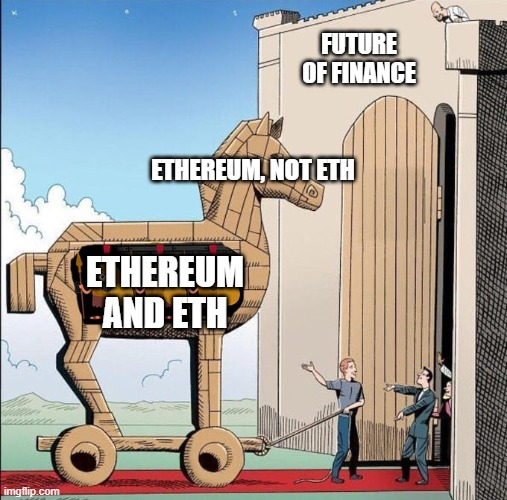
The only ETH holders left are those with unshakable conviction. Ironically, many sold ahead of the greatest scaling year in Ethereum's history. Imagine holding ETH for years and selling right before it all plays out. ☠️
English
13
7
71
2.9K
ookii retweetledi
vitalik.eth
vitalik.eth@VitalikButerin·
Prediction about this "show which country the account is from" thing: In the short term it will have lots of positive effects. In the medium term, the sophisticated actors will find ways to pretend to be from countries that they are not. Lots of ways to rent individual people's passports, phone numbers, IP addresses, etc. Getting a million accounts with fake location will be medium-hard, getting a single account with fake location, and then getting it to a million followers, will be easy. In six months, the actually-[random Eurasian country]-based political troll accounts with names like "Defend Western Civilization" or whatever will all have "USA" or "UK" as their location tags. (This is what I think will happen, not what I wish. What I wish is (i) we do get more visibility into how people from different communities think about different issues, in a way that is not easy to spoof (ii) the "communities" in question are not just a narrow set of highly legible credentials like countries, university degrees, etc, and are something broader and more emergent and combining evidence from many sources But I think making such a system adversarially robust will not be easy)
English
575
284
2.8K
456.3K