Pleased to share the beta release of Signac v2 today. This release makes some important changes, including support for BPCells matrices for large-scale analysis. Documentation can be found here: stuartlab.org/signac2/
Please Save the Date for the 2025 HCA General Meeting, will be held 9 - 11 June in Singapore. Registration information will be posted in early December. #HCA2025GM
Interested in single-cell epigenomics? Check out my latest review focusing on experimental methods for multifactorial chromatin profiling: portlandpress.com/biochemsoctran…
I've learned a lot about single-cell pooled CRISPR screens during my postdoc, so I wrote a review with Jenn Sun and @nevillesanjana in @TrendsGenetics! Check it out for a history lesson, summaries of current methods, and thoughts on where it's going: sciencedirect.com/science/articl…
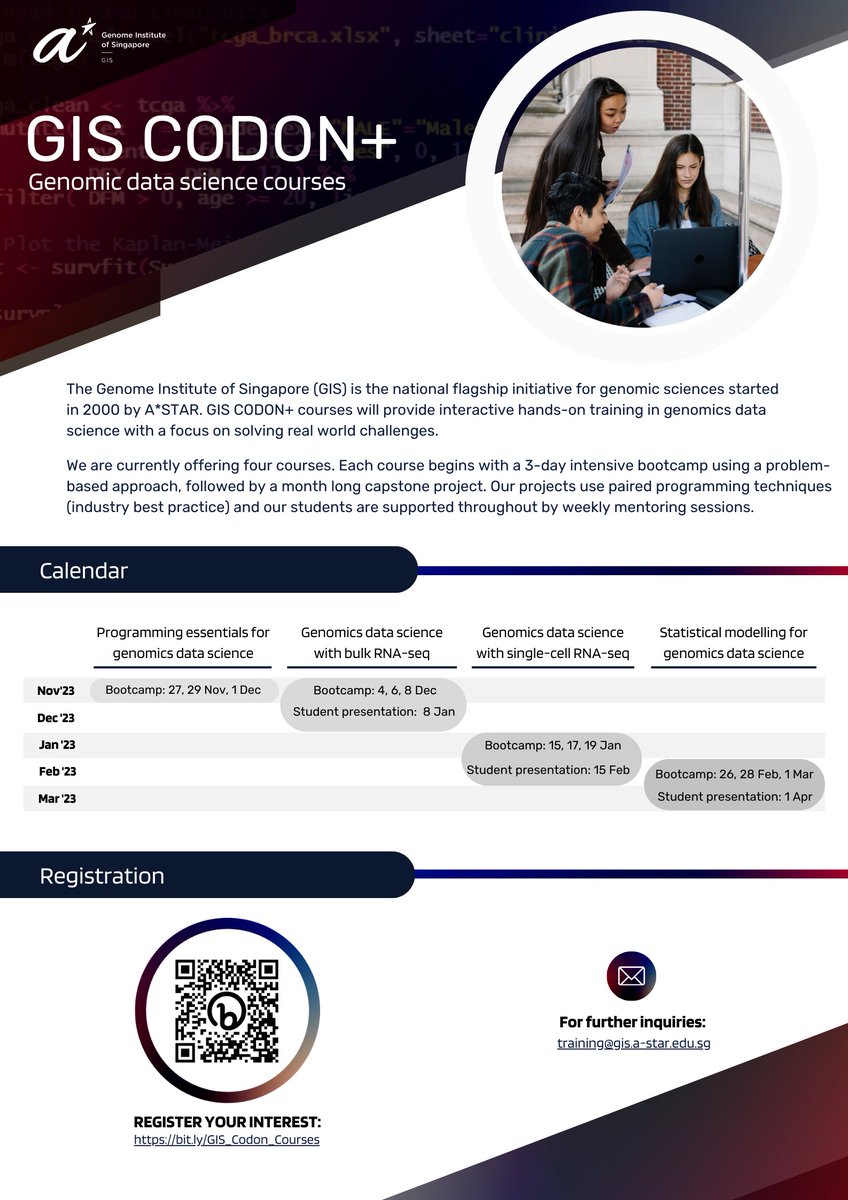
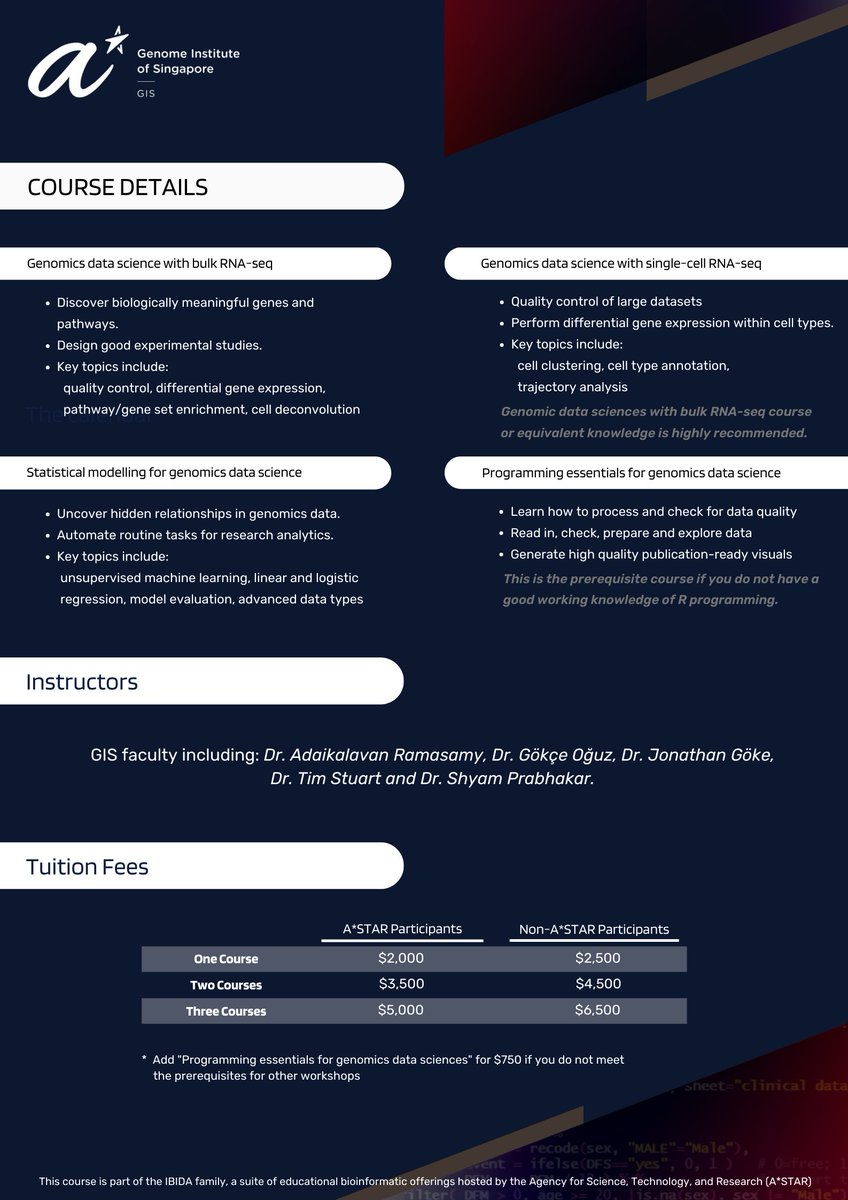
By popular demand, the 3rd round of the GIS CODON+ Workshop Series on #genomics#datascience is now open for registration. More details on course details, dates & fee in the attached poster.
Register at lnkd.in/gCvv3F69 by 7 Nov 2023.
I'm hiring! New post-doc position open in my lab, with a focus on single cell and spatial epigenomics in cell reprogramming, human development, and disease. Come for the cells, stay for the sand. Apply here: bit.ly/3Yz3ZXb. Please RT!
🎉COMING SOON in Spring 2024... the Morris Lab at the @DonnellyCentre and @UofT Molecular Genetics !!! 🎉 We will specialize in biobank-scale analyses and single-cell CRISPR screens to study noncoding drivers of traits and disease. Reach out if interested in coming to Toronto! 🇨🇦
🎉 Exciting News! 🎉
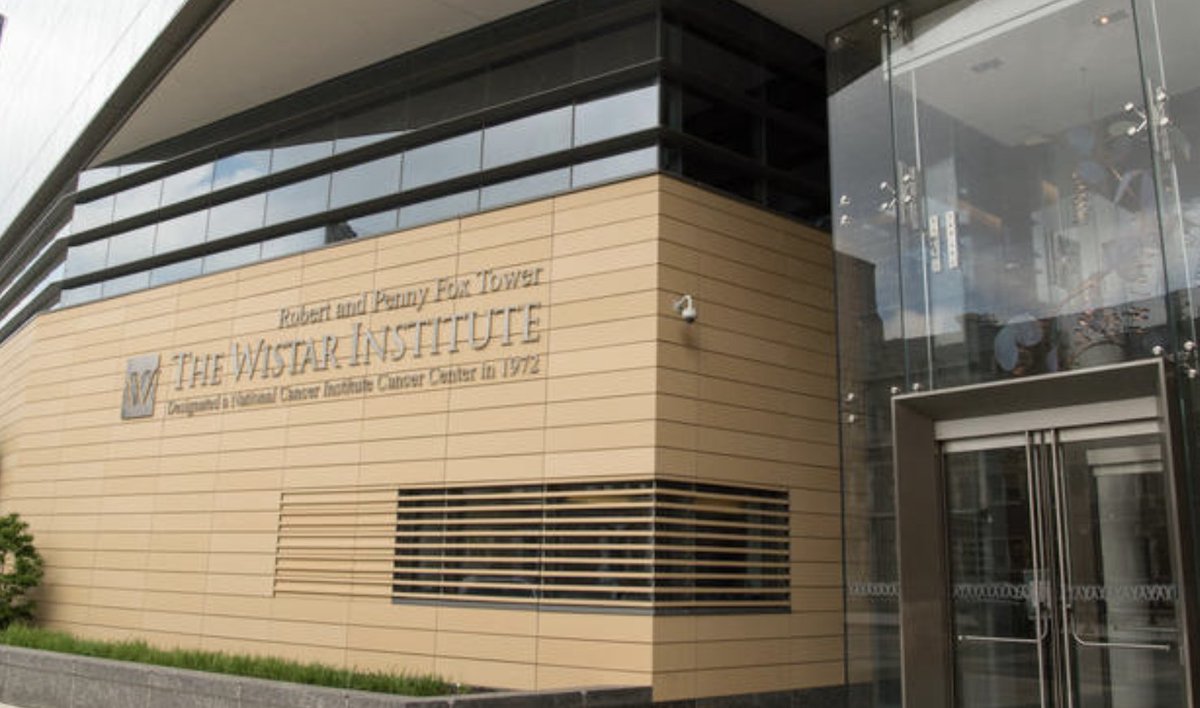
I am thrilled to announce that I am starting my lab this fall under the gene expression and regulation program of the Wistar Institute (@TheWistar) in Philadelphia!
🧬🔬 #SrivastavaLab#Research#Academia 1/8
avisrilab.org
Registration for the HCA Asia Meeting November 27-28th, 2023 in Kolkata, India, is now open!
Please register your interest for an in-person space, or register for virtual attendance, at the hybrid #HCA2023Asia meeting at events.humancellatlas.org/2023Asia/home
Some big news: I’m absolutely delighted to announce that I will be starting my group this fall in the Computational and Systems Biology Program at @MSKCancerCenter in New York City! clareaulab.com 1/
Come join us! Unlimited excitement guaranteed!!! Post-doc position open for a computational biologist to work on single cell and spatial epigenomics in mammalian development, cell reprogramming, and epigenome editing. Apply here: bit.ly/41kZdx6. Please RT!
🚨Our work on multi-modal, single-cell pooled CRISPR screens to study GWAS variant-to-function, STING-seq, is now out in @ScienceMagazine! Read on for 6⃣ of the main findings from our study, led by myself and co-advised by @nevillesanjana and @tuuliel! 🎉
science.org/doi/10.1126/sc…
We are recruiting a postdoc to join the lab in Singapore! We are looking for either a computational or experimental scientist interested in single-cell methods. Please get in touch via email if you’d like to find out more stuartlab.org
🎉My first notice of award!🎉 So excited to continue linking GWAS variants to function (🧬➡️💡), now supported by a @NIH K99 from @genome_gov. Special thanks to my postdoc advisors @nevillesanjana and @tuuliel and my colleagues at @nygenome and beyond for making this possible!
@anshulkundaje I think there is a dualism here between a "piece of DNA" and the rest of the genome that may not exist in reality. Definition of "function" also matters. For a selected effect definition these questions don't make sense, only for a biochemical activity definition
Question: So let's say I synthesize a piece of DNA, not found in the human genome, dump it next to Myc and it affects the growth rate of a cancer cell line, is this piece of DNA 'functional'?