
Tim Seyde
48 posts

@timseyde
RL + Robotics + LLMs | Post-training @liquidai | Embodied AI PhD @MIT


As an early look at ongoing work, we deployed LFM2.5-230M on a Unitree G1, running entirely on-device on its onboard @nvidia Jetson Orin. The model acts as a skill-selection layer, taking in natural-language instructions and decomposing them into sequences of tool calls. After a quick fine-tune, "Hold still for 2s, walk forward at 1 m/s for 3 m, hold a one-leg kneel for 5s, walk back at 0.5 m/s for 3 m" becomes a structured multi-step plan automatically. (3/n)


Three years ago we started working on a stealth project that we weren’t sure we’d ever talk about publicly... until today. Breakthrough: Introducing LFM-Zero: the first foundation model trained on 0 tokens. No pretraining. No finetuning. No data. Instead, we initialize from an implicit probabilistic prior over the underlying data-generating process, allowing the model to converge without ever observing data. LFM-Zero matches or surpasses models trained on 10T+ tokens across reasoning, coding, and multimodal tasks. Turns out that pretraining was just regularization that was holding us back. > Read our Tech Report here: tinyurl.com/lfm-zero

Today, we release LFM2.5-350M. Agentic loops at 350M parameters. A 350M model trained for reliable data extraction and tool use, where models at this scale typically struggle. <500MB when quantized, built for environments where compute, memory, and latency are constrained. 🧵


Today we release LFM2.5-1.2B-Thinking, a reasoning model that runs entirely on-device. What needed a data center two years ago now runs on any phone with 900 MB of memory. > Trained specifically for concise reasoning > Generates internal thinking traces before producing answers > Enables systematic problem-solving at edge-scale latency > Shines on tool use, math, and instruction following


Today, we release LFM2.5, our most capable family of tiny on-device foundation models. It’s built to power reliable on-device agentic applications: higher quality, lower latency, and broader modality support in the ~1B parameter class. > LFM2.5 builds on our LFM2 device-optimized hybrid architecture > Pretraining scaled from 10T → 28T tokens > Expanded reinforcement learning post-training > Higher ceilings for instruction following 🧵

🚨Paper 🚨 What if LLMs could tell you they’re going to fail before they finish reasoning? We trained models to predict their own future: whether they’ll succeed and how long it will take. At every token, in real time, with no extra compute. We used this to develop an adaptive sampling algorithm for test-time compute. 👇🧵


Grok Play: Enjoy and create multiplayer games where your Grok Owl can climb the leaderboard by playing against you, your friends, your friends' Owls, and itself. @nacloos @961014dltkdg


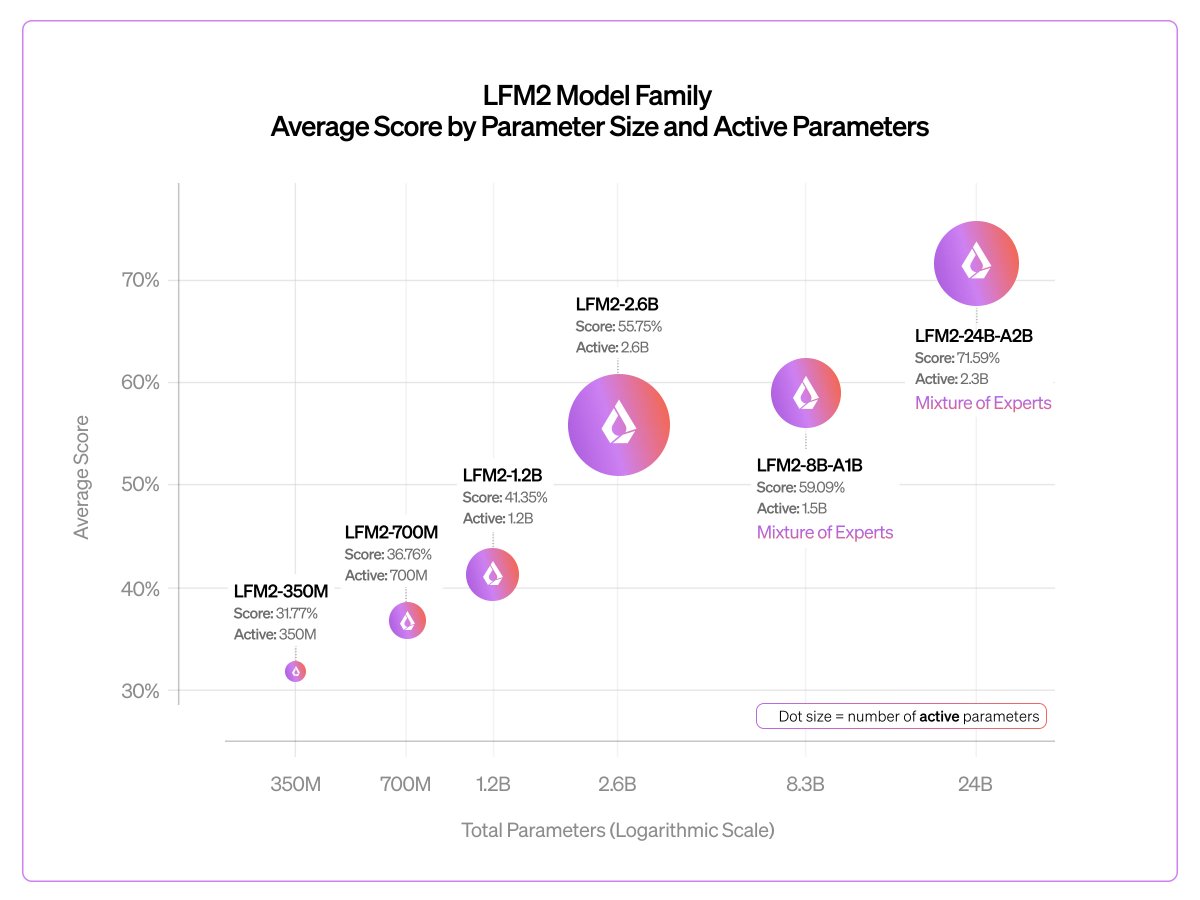
Meet LFM2-8B-A1B, our first on-device Mixture-of-Experts (MoE)! 🐘 > LFM2-8B-A1B is the best on-device MoE in terms of both quality and speed. > Performance of a 3B-4B model class, with up to 5x faster inference profile on CPUs and GPUs. > Quantized variants fit comfortably on high-end phones, tablets, and laptops. Enabling fast, private, low-latency applications across modern phones, tablets, laptops, and embedded systems. 1/n 🧵