Alex Tong晓峰 v4.0

615 posts

Alex Tong晓峰 v4.0 banner
Alex Tong晓峰 v4.0

Alex Tong晓峰 v4.0

@tongxiaofeng

Runner. Writer. Coder. Bitcoiner.

Singapore Katılım Mayıs 2010
392 Takip Edilen424 Takipçiler
Babbage | BRC100
Babbage | BRC100@ProjectBabbage·
Actually — I think this is one of the most fair characterizations I have seen. Those BitInfoCharts numbers everyone touts feel a bit… dishonest. I should not spread that. We need to hold ourselves to these TRUE tx numbers. Let’s pass Aptos with real utility and value! #BSV
Lil Bit@lilbitgame

@ProjectBabbage But we are behind here -- where it counts chainspect.app/dashboard?rang…

English
4
1
9
1.1K
cheng_wei Cai
cheng_wei Cai@ChengCai47224·
@tongxiaofeng 发在知乎呀。在国内对比特币算是比较友好的。但是在知乎比特币不会限流,bsv会 还是比较无语的。
中文
1
0
0
82
Alex Tong晓峰 v4.0
Alex Tong晓峰 v4.0@tongxiaofeng·
v4.0的我变得更强了,不再总想着说服别人。想说服别人终归是弱者的行为,本质还是因为自己不确定,想要寻求别人的认可,从他人处获得力量。 刚开始接触到BTC之后,有好几年我见人就说。后来BCH、BSV分叉之后,身边太多人因为我的热情而掉到了这个深坑里,损失惨重。 这次,我不想再说服谁了。 我会独自前行,相信上天会助我。 就像阿甘一样,一直跑一直跑,同行者自来。
Alex Tong晓峰 v4.0 tweet media
中文
4
0
2
168
cheng_wei Cai
cheng_wei Cai@ChengCai47224·
@tongxiaofeng 你的书 我看了 消化了很久 好久没有吃过这么细的细糠了。不想着发在国内么?不发出来 暴谴天物呀 让我同学看了 可惜他们对比特币不感兴趣 很快就放弃了
中文
1
0
0
44
S Tominaga (Aka Dr Craig Wright)
I do not know why I persist in this particular form of self-inflicted torment, but I have just concluded three paper revisions and, with exquisite inevitability, five more await their turn like creditors at the door. It is the hazard of ambition, I suppose—this determination to submit everything at once, to pursue too many threads of thought simultaneously, until one’s life becomes a rather elegant juggling act performed without rest and, occasionally, without mercy. And yet, one cannot complain. One has chosen the burden and must therefore wear it with a certain style. So there will be no lamentation, no theatrical sighs—only the quiet, stubborn return to work.
English
5
6
49
2K
MoonCoin Rising
MoonCoin Rising@MoonCoinRising·
@mikeinspace Simple... they follow Satoshi... all the way to $BSV Blockchain! 😃 BSV has: ~ The ability to Scale to 1 Million TPS ~ Smart Contracts/Tokens ~ Instant Settlement (See SPV in WP) ~1/1000 of a cent fees At current $16/coin - I feel like I'm back in 2013, ready to pump - Again! 😃
English
1
0
3
120
Mike In Space
Mike In Space@mikeinspace·
So let’s say Satoshi is alive and decides to move all his coins to a quantum-safe address. How does the market react to 1 million “lost” coins waking up?
English
39
3
82
8.8K
MoonCoin Rising
MoonCoin Rising@MoonCoinRising·
@apagut Yeah. Not looking good. On a positive note, @BSVAssociation has succesfully released the most user unfriendly, complicated APP & will probably win award for stifling adoption. I dare an average "non-Dev" user to give an honest positive review: mobile.bsvb.tech/index.html
English
2
0
0
39
Casey Handmer
Casey Handmer@CJHandmer·
When I was in Australia last December, I found it impossible to transact with any business where there weren't latent government price controls or subsidies of some kind. I came to the realization that with the public sector growing about 5x faster than the private sector, Australia was well on the way to an effectively government run economy, communism by stealth. I dug deeper - the point of no return occurred in about 2013. caseyhandmer.wordpress.com/2026/04/16/aus…
English
124
366
2.3K
313K
Alex Tong晓峰 v4.0
Alex Tong晓峰 v4.0@tongxiaofeng·
@Brendan_Lee__ No one is going to use an app like this—it’s simply too complicated. I’ve tried multiple times and ended up giving up each time. If you’re paying $25 to acquire a single user, this kind of complexity will only drive them away.
English
0
0
2
111
Brendan Lee
Brendan Lee@Brendan_Lee__·
How does one get a receiving address out of the Metanet desktop app? Am I stupid or is it just impossibly obtuse?
English
10
0
19
2.4K
Bryan Daugherty, CCI, CBI, SME
Bryan Daugherty, CCI, CBI, SME@BWDaugherty·
@ChampionkilaX Never said to change BSV protocol. I didn’t write the Clarity Act that likely classifies bsv as a security. That’s a lie and shame on you. DYOR
English
5
0
5
605
championkila x
championkila x@ChampionkilaX·
BryanD: we need to change the protocol to meet requirements for the clarity act. Csw: Piss off! Set in stone BryanD: i luv bsv. I promote and convince Gov. Just tweak protocol. Csw: piss off! Set in stone. Bryan: change or its a security. Csw: piss off! Set in stone.
English
2
0
2
627
Bryan Daugherty, CCI, CBI, SME
Bryan Daugherty, CCI, CBI, SME@BWDaugherty·
It doesn’t dismantle the core securities-risk argument I have laid out. especially the combination of: 1) concentrated influence/funding, 2) reliance on Association-led features like DAR for token recovery, and 3) the ongoing expectation that “the team” will maintain and promote the network. Regulators care about economic substance over contractual form, and that’s still the open question.
English
2
0
0
116
Alex Tong晓峰 v4.0 retweetledi
S Tominaga (Aka Dr Craig Wright)
There is a fundamental error that recurs whenever men confront a system greater than their own capacity: they demand that the system bend, rather than rise to meet it. A fixed protocol does not require governance in the modern, corrupted sense of the term. It does not require committees, panels, or endless cycles of “feedback” from those who produce nothing. It requires something far more demanding: individuals and companies willing to act. To build. To risk capital. To stake their time and intellect on creating solutions within a defined structure. A protocol is not a suggestion. It is a foundation. Consider TCP/IP. It was not ordained to succeed. It could have remained an academic curiosity, a technical footnote. It endured because people—engineers, firms, institutions—chose to use it. They built networks, services, and businesses atop it. They did not spend their days lamenting its imperfections or insisting that it be reshaped to suit their preferences before they would engage. IPv4, the backbone of that system, is riddled with limitations. Address constraints, inefficiencies, structural compromises—none of this is controversial. And yet, the response of those who mattered was not paralysis or endless agitation for change. It was adaptation. It was the construction of layers, abstractions, and workarounds that extended the utility of what already existed. They did not demand that the protocol be rewritten to accommodate their ambitions. They made their ambitions fit within the protocol—and in doing so, expanded its reach beyond anything its originators might have predicted. This is how systems grow. Bitcoin, as a fixed protocol, stands in the same category. Its value is not derived from its malleability, but from its stability. It is not a canvas for perpetual revision. It is a platform upon which enterprises must build, scale, and compete. To complain that such a system has limits is trivial. All systems do. The question is not whether limitations exist, but whether one has the capacity to work within them—to extend them through application rather than to erode them through incessant demands for change. The impulse to alter the protocol, to “govern” it into something more accommodating, is not innovation. It is an evasion of responsibility. It is the desire to substitute collective negotiation for individual achievement. Growth does not come from those who sit in judgment of a system’s flaws. It comes from those who accept its rules and proceed to build something greater within them. That is the dividing line. On one side: builders, who create despite constraints. On the other: commentators, who demand that constraints be removed before they will begin. History records which of the two matters.
English
5
10
37
2.1K
S Tominaga (Aka Dr Craig Wright)
Bryan — none of this is an argument. What you have written is deflection, not analysis. You point to headlines, allegations, and search results because you cannot answer the underlying point. If you could, you would address the system, the law, and the mechanism. You do not. You reach for theatre because substance is beyond you. No, repeating accusations is not reasoning. No, listing court language without context is not expertise. And no, trying to turn everything into personality is not a substitute for understanding. The point you keep running from is simple: A system that remains unchanged requires no coordinated intervention. A system that changes requires actors, pressure, rollout, adoption, and enforcement. Those are not the same thing. They never were. And as for outcomes: you were paid to achieve something. Not to sit in rooms. Not to posture. Not to collect meetings as though attendance were an accomplishment. You had years of access, years of opportunity, years to influence things in the direction you claimed to support. And what happened? The legislation moved, but not in the way you wanted. The understanding was not secured. The result was not what you were there to produce. That is failure, not martyrdom. So when a contract ends after years without the result promised, the explanation is not mystery. It is performance. And since you insist on pretending standards do not exist: a peer-reviewed monograph and a self-published book are not the same thing. One is subjected to scrutiny by qualified reviewers. The other is an act of self-assertion. Confusing the two is not a clever point. It is an admission that you do not understand the distinction between validation and publication. If you want to make an argument, then make one. Address the law. Address the protocol. Address the mechanism. Otherwise this remains exactly what it looks like: resentment from someone who was given the chance to deliver, did not, and now mistakes bitterness for insight.
English
3
1
5
394
S Tominaga (Aka Dr Craig Wright)
No, Bryan—self-published does not count. A peer-reviewed monograph and a self-published book are not the same thing, and pretending otherwise is either vanity or ignorance. One is subjected to independent expert scrutiny. It is reviewed, challenged, tested, and only accepted if it survives. The other is simply uploaded and offered for sale. That is the distinction. A retail listing is not academic validation. An Amazon page is not peer review. Self-publication is not equivalent to scholarly publication. So when a peer-reviewed book is answered with a self-published title, that is not rebuttal. It is a confession that you do not understand the difference between assertion and scrutiny. One has passed a standard. The other has bypassed one.::: So.... yes... one of us.
English
2
0
4
424
cheng_wei Cai
cheng_wei Cai@ChengCai47224·
@tongxiaofeng 我是自己进入币圈 开始看白皮书 看发展历史 主动走入BSV的怀抱中。虽然我了解比特币的时间比较晚,第一次买BSV的价格都已经23了,比较晚进入也是有好处的。
中文
1
0
0
97
S Tominaga (Aka Dr Craig Wright)
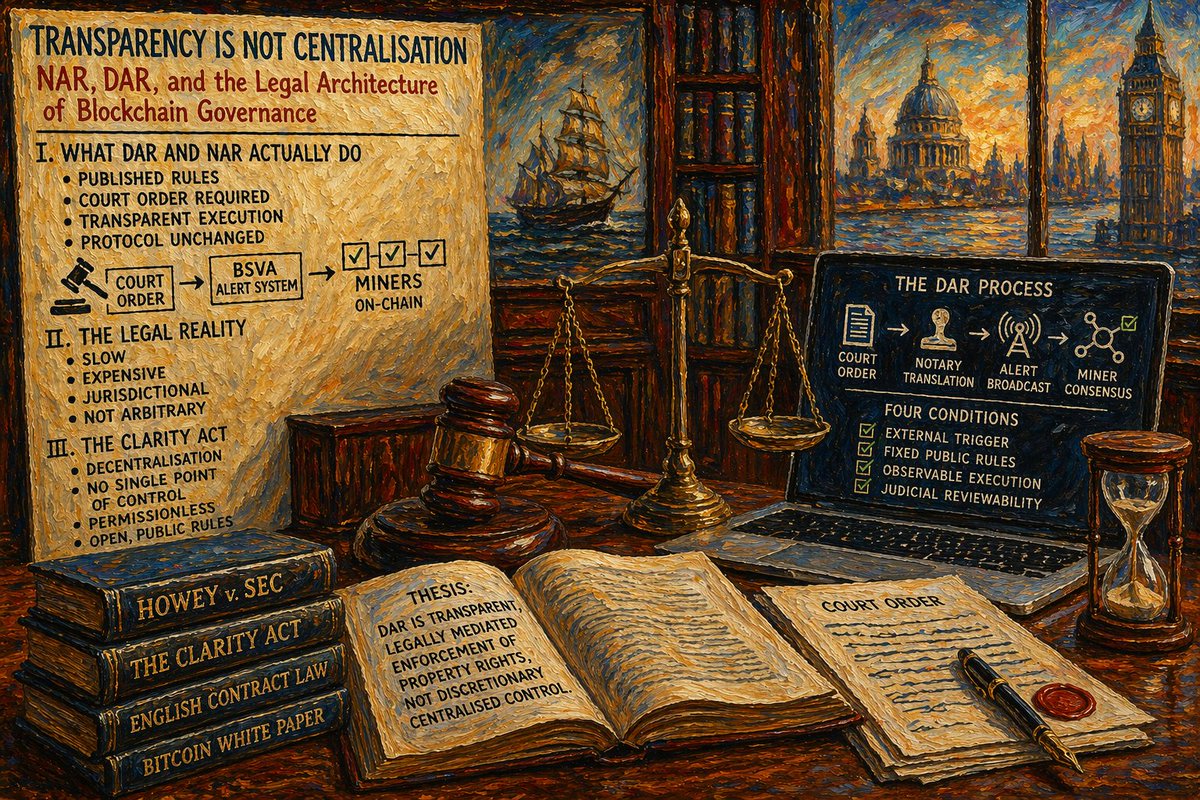
Bryan— What I have done here is not assertion. It is evidence, structured argument, and legal analysis grounded in doctrine, procedure, and comparative regulatory frameworks. I have defended a PhD thesis in law under viva examination—several hours of sustained, adversarial questioning by professors of English law, examining every authority, every inference, every structural claim. That process is not symbolic. It is designed to expose error, to dismantle weak reasoning, and to force precision. It did not break. That work has since been developed into a monograph on fiduciary duty and blockchain governance and has passed formal academic peer review for publication. That means independent subject-matter experts have examined the argument, tested its coherence, and deemed it to meet the standard required for contribution to the field. That is the baseline here. So when I explain DAR, the NAR, or the meaning of “control” under the CLARITY framework, it is not conjecture. It is analysis built on legal method: identifying the relevant test, distinguishing categories of action, and applying doctrine to fact. You, by contrast, are asserting conclusions without performing that work. You invoke regulation without applying statutory language. You refer to “control” without distinguishing between protocol alteration and judicial enforcement. You describe court-order compliance as discretionary authority while ignoring the procedural reality: multi-year litigation, cross-border recognition, adversarial scrutiny, public record, appellate review. That is not analysis. It is mischaracterisation. If you want to challenge the position, then do so properly. Identify the legal test—precisely. Explain what constitutes “control” under that test. Demonstrate how a fixed protocol, constrained by published rules and activated only through court order, satisfies it. Address the distinction between changing the rules and enforcing them. And do so without collapsing those distinctions into rhetoric. Because the issue is not whether you disagree. The issue is whether you can sustain that disagreement under the same level of scrutiny that this work has already passed. If you cannot, then what you are presenting is not a counterargument. It is an objection without foundation. @BWDaugherty
English
2
1
11
816
Shiann Davis
Shiann Davis@shiann_davis·
If you’re building on BSV, I want to connect. Devs. Creators. Researchers. Let’s map what’s actually being built and push it forward together. Drop what you’re working on 👇 #BSVCommunity #BlockchainBuilders
English
10
8
46
2.1K
Alex Tong晓峰 v4.0
Alex Tong晓峰 v4.0@tongxiaofeng·
@CsTominaga @cryptorebel_SV Goethe gave Faust his final vision: “Auf freiem Grund mit freiem Volke stehn” — to stand on free soil among a people free. He only saw it when he stopped trying to command it. Thank you, Prof Faust. Some of us have been listening all along.
English
0
0
0
130
S Tominaga (Aka Dr Craig Wright)
Some people want it. Some people don’t. And that’s not confusion. That’s not ignorance. That’s not simply a matter of education or exposure. Some people benefit from things staying exactly as they are. There are rent seekers—those who extract value by standing in between, not by building. There are gatekeepers—those who decide who may pass and who may not. There are entire systems that exist not because they are optimal, but because they are entrenched. And those systems do not yield easily. They are not waiting for something better. They are defending what already serves them. So no, not everyone wants change. Not everyone wants a system that removes intermediaries, that reduces control, that fixes rules in place and limits discretion. Some will resist it. Some will reshape it. Some will ignore it. And some will use it. That is the reality. And accepting that is part of understanding the problem properly. Not everyone is meant to agree. Not everyone will. And the system does not depend on them doing so.
English
7
7
39
1.1K
S Tominaga (Aka Dr Craig Wright)
There’s something else I have to admit, and it sits alongside everything I’ve said about failure and change. I’ve been wrong in how I’ve approached what I wanted to achieve with Bitcoin. Not in the sense people will assume. Not in the slogans. Not in the arguments you see thrown around. But in something quieter, and more fundamental. I thought that if something was right, if it worked, if it demonstrated what it was built for—a scalable system, digital cash—then people would move toward it. But people don’t move like that. People don’t choose systems because they are right. They choose them because they are familiar, because they profit, because they fit into what already exists. #BTC exists in that world. People have made money from it. That is what it represents to them. And that is their choice. I don’t have to agree with it for it to be real. What I wanted is something else. Not dominance. Not forcing adoption. Not telling people this is better so you must use it. I wanted to demonstrate what the system was for. That’s it. A functioning, scalable digital cash system. But wanting that does not mean people will want it. Most won’t. Banks won’t. Large companies won’t. The systems that already exist have no reason to replace themselves with something that changes the balance they rely on. A few will see it. A few will use it. But most will stay where they are, because that is what systems do. They preserve themselves. I knew that, intellectually. I did not always act like I understood it. I pushed as though correctness would carry the day. It doesn’t. People carry the day. Incentives carry the day. Habit carries the day. And what I want is only one thing among many. Making money is not the goal for me. For most people, it is. And that difference matters. It means I cannot expect alignment. It means I cannot assume adoption. It means I have to accept that what I am building may not be what most people choose, even if it works exactly as intended. That is not failure of the system. It was a failure of my expectation. And like everything else I’ve said, that sits with me now in a different way. Less anger. More acceptance. And a clearer understanding that demonstrating something is not the same as having it embraced.
English
50
43
237
7.3K
Alex Tong晓峰 v4.0 retweetledi
S Tominaga (Aka Dr Craig Wright)
Here is something that will no doubt offend the right sort of people: I rather like **not** being Satoshi. Whether you approve of that formulation is your problem, not mine. What matters is the life that follows from it, and that life is immeasurably better than the endless theatre, projection, worship, resentment, and infantile need people had to turn everything into a cult of personality. I do not miss the adoration. I do not crave your reverence. I do not wake in the morning yearning to be the object of yet another man’s ideological dependency. Quite the opposite. If anything, that nonsense was among the worst parts of it all. So for those who still feel the urge to genuflect, to mythologise, to attach themselves to me as though I were some secular saint of the protocol—piss off. My life now is far simpler, and far better. I research. I build. I study. I live well with my wife. I pursue the things that matter, and I do so without the constant background hum of people who confuse admiration with entitlement and attention with significance. It is a much finer arrangement. What has not changed is the work. I set a goal, and I have been pursuing it consistently: scale Bitcoin properly. Not as a slogan, not as an aesthetic, not as a debating point for men who contribute nothing and call it commentary, but as an engineering and economic reality. That remains the task. If you dislike that, wonderful. Start a company. Build a competing service. Offer something the market wants more. Compete like an adult in a capitalist system. That is what businesses are for. What you do not get to do—what you will never be entitled to do—is mutate the underlying Bitcoin protocol because you are too mediocre to compete on top of a fixed one. The rules are set. The protocol is not your toy, not your laboratory, not your route to relevance. If you want to win, build better. If you cannot, then lose with some dignity. That is the arrangement. It is not cruel. It is simply grown-up.
English
3
9
73
1.6K