TonioR

1.2K posts

TonioR banner
TonioR

TonioR

@TonioR

Getting ready for the big leap.

Katılım Kasım 2021
837 Takip Edilen1.3K Takipçiler
TonioR
TonioR@TonioR·
Anthropic scrapeó internet para crear Opus. Un lab chino destiló Opus para hacer Kimi. Cursor finetuneo Kimi, publicó una press release y lo llamó innovación. Nadie pide permiso en la era de AI.
Español
0
0
1
51
TonioR
TonioR@TonioR·
Recordatorio: Los MCPs ya no se comen tu contexto como antes lo hacían. Claude Code implementó Tool Search en enero y hace lazy loading: sólo carga las definiciones que necesita, cuando las necesita. Resultado: -47% de tokens en uso real. De 51K a 8.5K con 4+ servers. Cursor lo tiene también. Se llama Dynamic Context Discovery. Si habías dejado de usar MCPs por miedo al contexto, ahora incluye los que necesitas, sin temor.
Español
0
1
4
444
TonioR
TonioR@TonioR·
@brolag Genial Alfredo. El inconveniente que veo es que hay que tener un correo de una empresa partner de Anthropic por ahora.
Español
1
0
3
1.1K
TonioR
TonioR@TonioR·
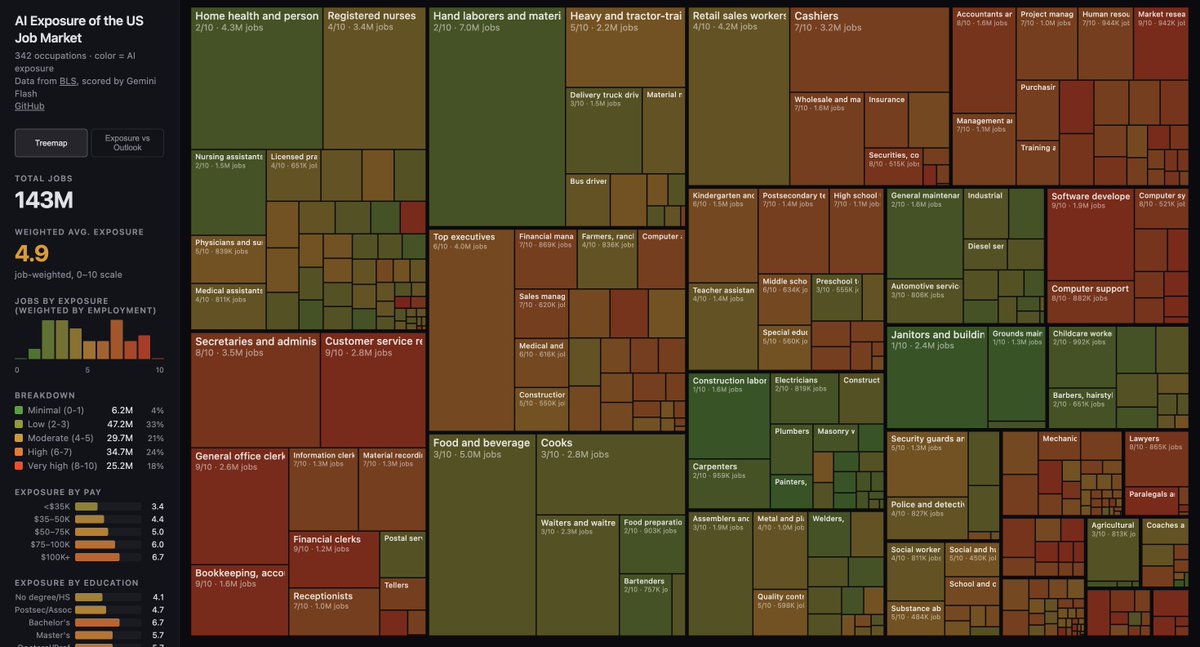
Los empleos más seguros de cara a AI según análisis de @karpathy de 342 profesiones en EEUU: 🔨 Techador 🪚 Carpintero 💇 Peluquero 🍺 Bartender 🐕 Cuidador de animales 👶 Niñera 🏋️ Entrenador físico 💃 Bailarín Común denominador: ninguno se hace desde una laptop, ninguno requiere título universitario. karpathy.ai/jobs/
TonioR tweet media
Español
0
0
0
74
TonioR
TonioR@TonioR·
Aquellos buenos tiempos en que salías el viernes y volvías el lunes sabiendo que el mundo te había esperado. Ahora vuelves el lunes: 3 modelos nuevos, 2 herramientas que reemplazan tu stack, 1 startup que hace lo que tú hacías. Bienvenido a la era de la IA.
Español
0
0
1
94
TonioR retweetledi
Marc Andreessen 🇺🇸
My information consumption is now 1/4 X, 1/4 podcast interviews of the smartest practitioners, 1/4 talking to the leading AI models, and 1/4 reading old books. The opportunity cost of anything else is far too high, and rising daily.
English
1.4K
3.9K
35.1K
34.5M
Paul Graham
Paul Graham@paulg·
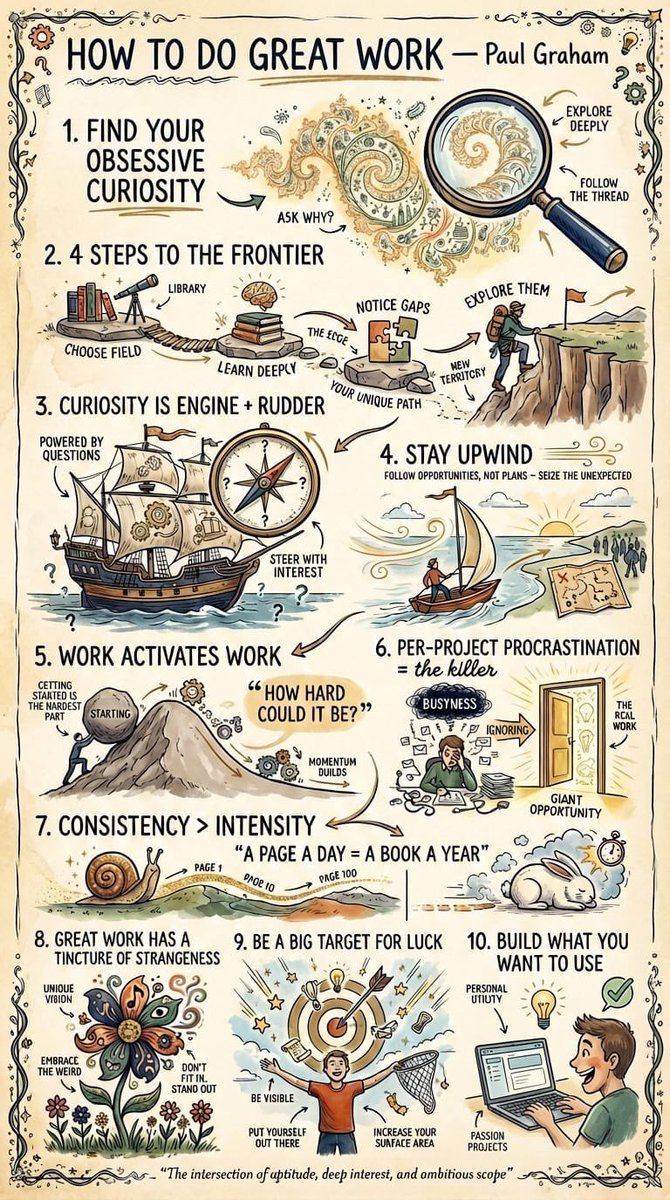
I just reread "How to Do Great Work." It's so long! But it also has less fat than most things I've written, which is a weird combination, because usually writing that's long on the macro scale is long on the micro scale too. paulgraham.com/greatwork.html
English
129
267
3.5K
284K
PolyAI
PolyAI@polyaivoice·
PolyAI has raised $200M from Nvidia, Khosla Ventures, and multiple top VCs. We're one of the fastest-growing companies in the UK, and we handle 500M+ calls for: • Marriott • PG&E • Gordon Ramsay's restaurants • And 3,000 more real deployments Which means that if you've ever called them, chances are you've talked to our voice agents. Every restaurant we onboard books thousands in revenue within 30 days. But how? Because PolyAI works 24/7, answering every call in <2 seconds, and we also: • switch between 45+ languages • handle payments & cancellations • verify identities • and even upsell your services If you want to try creating an agent with PolyAI, we built Agent Studio Lite to make it easy. Just enter any URL, and in 5 minutes it will analyze your website and build a working agent. We're opening early access to a limited number of people. Comment "PolyAI" and we'll add you to the waitlist and give you 3 months for free!
English
1.5K
579
4.8K
3.5M
TonioR
TonioR@TonioR·
@epineyro_ok Valió la pena esa espera. Espectacular comida y lugar.
Español
0
0
0
3K
Enrique Piñeyro
Enrique Piñeyro@epineyro_ok·
Mañana reabrimos Anchoita, las reservas para todo el año están agotadas. Pero solamente tomamos reservas para 65 personas y normalmente cenan 130 comensales, o sea que la mitad de la gente que entra a Anchoita lo hace sin reserva. En el video te explicamos cómo hacerlo.
Español
117
163
2.8K
393.3K
TonioR
TonioR@TonioR·
“You might have to start mass blocking those resident in wealth-taxing jurisdictions from investing in your companies.”
Balaji@balajis

LIQUIDATION CONTAGION Wealth taxes are even worse than you think. Any asset held by Californian billionaires or Dutch citizens is now at risk of experiencing forced liquidation pressure. So: it’s not just that you don’t want to hold assets as a Dutchman. You also don’t want a Dutchman to hold your assets. Because the logic of forced liquidation is contagion. Let’s think it through. (1) First, suppose there is an asset with a total market cap of $10,000, with 10 shares total, of which 1 share each is held by 10 different holders, all in the Netherlands. To simplify the math, assume the Dutch holders bought those shares at par, or close to $0. (2) Now suppose today is the unrealized cap gains tax day, and the share price is $1,000 per share. Each Dutch guy is hit with a 36% tax, and owes $360. The first guy sells his one share, gets $1,000, and pays $360 in tax while retaining $640. (3) But the first guy’s sale reduces the market price to $960 per share. So when the second guy sells, he only retains $600 after paying $360 in tax. (4) Now assume that by the 7th guy, all the selling has pushed the share price to collapse to $200 per share. This is a very reasonable scenario if 60% of the cap table has suddenly been dumped. Indeed it might go much lower. (5) At $200 per share, the 7th guy actually has to go into debt to pay the tax as he owes $360. He sells his one share, pays all $200 of the proceeds in tax. And still owes $160 more in tax. (6) The 8th, 9th, and 10th guys are even more screwed. By the time they sell, the price will likely have crashed to $100 per share or less. As with the 7th guy, even 100% liquidation will not cover their tax burden. (7) So we immediately see many negative things about the Dutch unrealized cap gains tax bill. (a) First, it will cause large simultaneous forced liquidations. Everyone must sell 36% of their stake near the same time. (b) Second, it may be literally impossible to pay if a critical mass of the cap table is all subject to it at the same time. In the example above it was 100% Dutch holders, but has it been just 60% the result would have been much the same: a collapse in the share price. (c) Third, that means it would be disastrous to have too many Dutch citizens (or Californian billionaires!) on the cap table. Their forced sales will crash your share price. (d) So, you might have to start mass blocking those resident in wealth-taxing jurisdictions from investing in your companies. (e) This in turn makes the poor Western European guy even poorer, as he gets locked out of high growth assets. To be clear: I really do feel bad for the formerly Flying Dutchmen, now Crying Dutchmen. They invented much of modern capitalism. They founded New Amsterdam, now New York. They’ve punched way above their weight. I wish them only the best. Nevertheless…they should prepare for the worst. This may be a tough century for Western Europe. The first ones out might get to freedom, while the slowest may be stuck behind a new Iron Curtain, spending a century paying off the debts their states incurred over the last century. Because the long run fruits of Western Keynesianism are the same as Soviet Communism, in the sense of wealth seizure and pauperization. I mean, if you knew the future, you wouldn’t want to co-own a farm with a Russian in 1916. For similar reasons, you might not want to co-own a share of stock with Dutch national in 2026. Or with anyone in a seizure-curious jurisdiction…which unfortunately includes much of Western Europe, Canada, and Blue America. You instead want assets that are not held by those subject to forced liquidations. Now, I grant that this is an unusual way to rank assets…Dutch holders considered harmful?!? Yet it might sadly be necessary to minimize your exposure to liquidation contagion. PS: guess which crucial stock is most held by the Dutch? ASML. So: this unrealized cap gains tax may not literally be a communist plot, but it would have the same effect.

English
0
0
1
74
TonioR
TonioR@TonioR·
@RyanHoliday Worth noting: LLMs weren't built to verify facts—they predict plausible text. The right tool for checking quotes is a search engine or archive, not ChatGPT. But your broader point stands: as these tools become ubiquitous, critical thinking is the skill of our time.
English
0
0
0
253
TonioR
TonioR@TonioR·
Coberturas personalizadas contra la inflación.
vitalik.eth@VitalikButerin

Recently I have been starting to worry about the state of prediction markets, in their current form. They have achieved a certain level of success: market volume is high enough to make meaningful bets and have a full-time job as a trader, and they often prove useful as a supplement to other forms of news media. But also, they seem to be over-converging to an unhealthy product market fit: embracing short-term cryptocurrency price bets, sports betting, and other similar things that have dopamine value but not any kind of long-term fulfillment or societal information value. My guess is that teams feel motivated to capitulate to these things because they bring in large revenue during a bear market where people are desperate - an understandable motive, but one that leads to corposlop. I have been thinking about how we can help get prediction markets out of this rut. My current view is that we should try harder to push them into a totally different use case: hedging, in a very generalized sense (TLDR: we're gonna replace fiat currency) Prediction markets have two types of actors: (i) "smart traders" who provide information to the market, and earn money, and necessarily (ii) some kind of actor who loses money. But who would be willing to lose money and keep coming back? There are basically three answers to this question: 1. "Naive traders": people with dumb opinions who bet on totally wrong things 2. "Info buyers": people who set up money-losing automated market makers, to motivate people to trade on markets to help the info buyer learn information they do not know. 3. "Hedgers": people who are -EV in a linear sense, but who use the market as insurance, reducing their risk. (1) is where we are today. IMO there is nothing fundamentally morally wrong with taking money from people with dumb opinions. But there still is something fundamentally "cursed" about relying on this too much. It gives the platform the incentive to seek out traders with dumb opinions, and create a public brand and community that encourages dumb opinions to get more people to come in. This is the slide to corposlop. (2) has always been the idealistic hope of people like Robin Hanson. However, info buying has a public goods problem: you pay for the info, but everyone in the world gets it, including those who don't pay. There are limited cases where it makes sense for one org to pay (esp. decision markets), but even there, it seems likely that the market volumes achieved with that strategy will not be too high. This gets us to (3). Suppose that you have shares in a biotech company. It's public knowledge that the Purple Party is better for biotech than the Yellow Party. So if you buy a prediction market share betting that the Yellow Party will win the next election, on average, you are reducing your risk. Mathematical example: suppose that if Purple wins, the share price will be a dice roll between [80...120], and if Yellow wins, it's between [60...100]. If you make a size $10 bet that Yellow will win, your earnings become equivalent to a dice roll between [70...110] in both cases. Taking a logarithmic model of utility, this risk reduction is worth $0.58. Now, let's get to a more fascinating example. What do people who want stablecoins ultimately want? They want price stability. They have some future expenses in mind, and they want a guarantee that will be able to pay those expenses. But if crypto grows on top of USD-backed stablecoins, crypto is ultimately not truly decentralized. Furthermore, different people have different types of expenses. There has been lots of thinking about making an "ideal stablecoin" that is based on some decentralized global price index, but what if the real solution is to go a step further, and get rid of the concept of currency altogether? Here's the idea. You have price indices on all major categories of goods and services that people buy (treating physical goods/services in different regions as different categories), and prediction markets on each category. Each user (individual or business) has a local LLM that understands that user's expenses, and offers the user a personalized basket of prediction market shares, representing "N days of that user's expected future expenses". Now, we do not need fiat currency at all! People can hold stocks, ETH, or whatever else to grow wealth, and personalized prediction market shares when they want stability. Both of these examples require prediction markets denominated in an asset people want to hold, whether interest-bearing fiat, wrapped stocks, or ETH. Non-interest-bearing fiat has too-high opportunity cost, that overwhelms the hedging value. But if we can make it work, it's much more sustainable than the status quo, because both sides of the equation are likely to be long-term happy with the product that they are buying, and very large volumes of sophisticated capital will be willing to participate. Build the next generation of finance, not corposlop.

Español
0
0
0
36
TonioR retweetledi
Dan Shipper 📧
Dan Shipper 📧@danshipper·
BREAKING: At the Super Bowl halftime show, Bad Bunny says he prefers Opus 4.6 for vibe coding but turns to 5.3 Codex for gnarly engineering problems. “Opus pa’ vibear, Codex pa’ lo heavy” - he said
English
95
448
8.8K
420.9K
Charlie L ⚡️
Charlie L ⚡️@charliesbot·
Eligiendo el siguiente libro a leer Por si tienen recomendaciones, my friends! ❤️
Charlie L ⚡️ tweet media
Español
6
3
41
2.8K
TonioR
TonioR@TonioR·
@rburhum Y también el hecho de que la plata para seguir invirtiendo en AI tiene que salir de algún lado. De SaaS y Crypto, entre otros.
Español
0
0
1
147
Ragi Yaser Burhum
Ragi Yaser Burhum@rburhum·
Una explicación seria sobre la caída del precio de BTC tiene que hablar del aumento de instrumentos financieros sintéticos comercializados fuera del blockchain. Si no incluye temas como el efecto de derivados, futuros, liquidez, swaps, ETFs, etc., es una explicación superficial
Español
1
4
19
2.2K
TonioR
TonioR@TonioR·
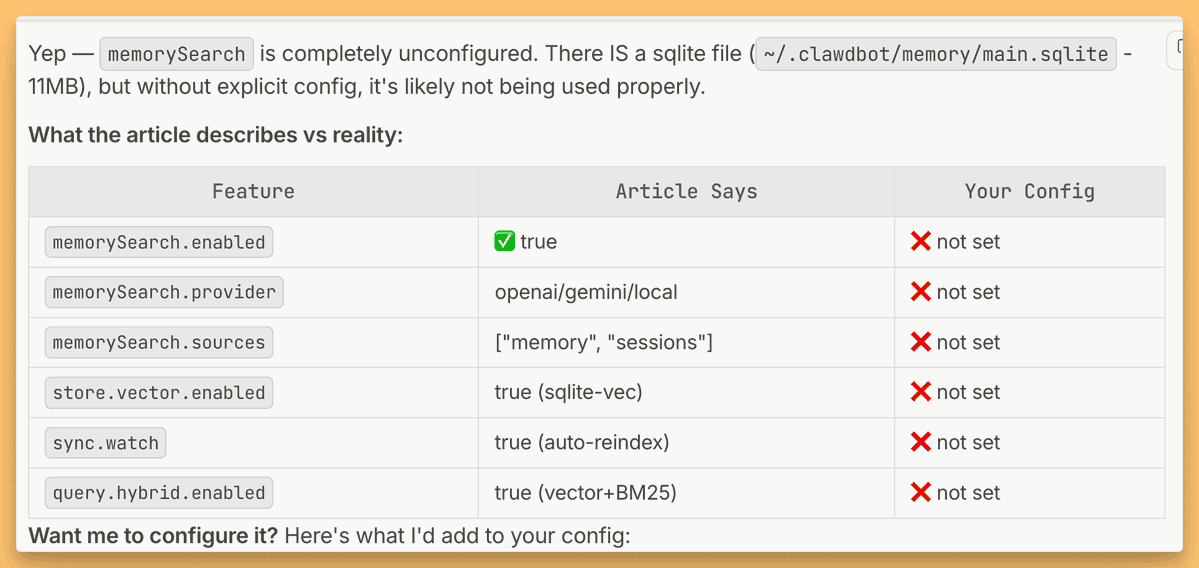
¿Tu AI de Clawdbot (@openclaw) olvida cosas entre sesiones? Hay 4 opciones que mejoran esto dramáticamente y no están activas por defecto: 1. memorySearch.enabled Búsqueda semántica sobre MEMORY.md (memory.md) y archivos en memory/. Tu AI puede encontrar contexto relevante antes de responder, aunque no lo "recuerde" activamente. 2. memorySearch.sources = ['memory', 'sessions'] Además de archivos de memoria, indexa transcripts de sesiones pasadas. Tu AI puede buscar en conversaciones anteriores. 3. memorySearch.experimental.sessionMemory El indexador de sesiones completo. Permite búsqueda semántica sobre TODAS las conversaciones pasadas, no solo la sesión actual. 4. compaction.memoryFlush.enabled Antes de que el contexto se compacte (cuando la conversación es muy larga), tu AI automáticamente guarda lo importante a archivo. Para activarlas, pídelo esto a tu agente: "Habilita las opciones de memoria: memorySearch.enabled = true, memorySearch.sources = ['memory', 'sessions'], memorySearch.experimental.sessionMemory = true, y compaction.memoryFlush.enabled = true. Aplica los cambios."
Español
0
0
1
53
Alex Volkov
Alex Volkov@altryne·
JFC I JUST realized that the amazing memory system that @openclaw has is not enabled by default in the config?!?!?!?!? I've been getting frustrated at it forgetting things in new sessions and just realized nothing in onboarding takes you through memory! Setting up now
Alex Volkov tweet media
English
44
24
601
155.2K