Raymond Tonsing

9.2K posts

Raymond Tonsing banner
Raymond Tonsing

Raymond Tonsing

@tonsing

Caffeinated: @affirm @airtable @amcainc @antaresnuclear @AvenCard @BitwiseInvest @boomaero @brexhq @federato_ai @onebriefapp @saronic @vardaspace @virtahealth

San Francisco, CA Katılım Mart 2009
1.1K Takip Edilen11.2K Takipçiler
Raymond Tonsing retweetledi
Saronic
Saronic@Saronic·
Saronic and @Castelion are joining forces to advance critical national security objectives at the intersection of maritime and hypersonic capabilities. Saronic's 180-ft autonomous ship, Marauder. Castelion's hypersonic vehicles. Together, we are delivering the future of Naval power from the Foundry to the Fleet at the speed and scale necessary to deter our adversaries. Stay tuned.
Saronic tweet media
English
11
25
209
27.3K
Raymond Tonsing
Raymond Tonsing@tonsing·
Underrated! Go Neion Bio 🐣
Niko McCarty.@NikoMcCarty

Complete biosynthesis of penicillin in tobacco plants. Every year, farmers in the US harvest about 840 billion pounds of corn. For comparison, there are only a few million liters of bioreactors, by volume, in the US. If we could engineer corn to make insulin at a titer of 1 g per kg of leaves (which is low; researchers previously engineered tobacco plants to express recombinant proteins at titers of 4-5g per kg), then we could make the global supply of insulin in an area of 1,230 acres; or roughly a square measuring 2.2 kilometers on each side. In other words, biomanufacturing with plants (or, recently, chicken eggs; see Neion Bio) feels highly underrated. There is a lot of “spare capacity,” and the farming industry has already built the infrastructure needed to scale! Alas, there are many things we cannot make with plants. Their chemical repertoire is fairly limiting when it comes to making human medicines. Many antibiotics, immunosuppressants, and antifungal medicines are made by enzymes that are missing from the plant kingdom. In particular, plants do not have non-ribosomal peptide synthetases, which are huge proteins that build peptides separately from the ribosome (hence their name). These proteins are used by fungi to make antibiotics, antifungals, and even many anticancer drugs (like bleomycin). For a new preprint, researchers in Texas engineered tobacco plants to make penicillin. They did this by engineering the plants to express seven fungal genes. This is not particularly impressive in terms of the size of the metabolic pathway (I recently wrote about tomato plants engineered to synthesize tobacco, for example, and that also required seven added genes and, arguably, way more work). The penicillin yield is also super low; just 25 micrograms per gram of dry weight, which is waaaayyyy lower than the titers were get from engineered yeast. But that’s not why this paper is important! It’s important because this is the first time that anyone has expressed a non-ribosomal peptide synthetase in a plant, so now we can engineer crops to make lots of other things, too. (The penicillin biosynthesis pathway, if you care, goes like this: The giant non-ribosomal peptide synthetase enzyme is in the cytosol. It grabs onto α-aminoadipate (a side-product when plants break down lysine), cysteine and valine. The enzyme snaps them all together, and also flips the valine from its normal "left-handed" shape to a "right-handed” one. A second enzyme, also in the cytosol, then pinches these amino acids together to make the β-lactam ring. Next, this molecule moves into the plant cells’ peroxisomes, where a third enzyme swaps the α-aminoadipate for a phenyl group, thus creating the active form of penicillin! The authors were worried that these chemical movements between the cytosol and peroxisome would not work by default, and might require engineering, but the proteins went to the appropriate compartments without any coaxing. That was a surprise.)

English
0
0
9
3.3K
Raymond Tonsing
Raymond Tonsing@tonsing·
Awesome
TBPN@tbpn

.@zebulgar says Varda Space will ultimately build the first industrial city in orbit. He breaks down how they'll get there: "We want to build the first industrial city in low-Earth orbit. But we're taking it one step at a time. Building out the business, getting great unit economics, proving out one use case at a time." "Generation 1 of what we're building is this two-part spacecraft — satellite and pod. The satellite has all the process equipment. The pod just has the finished good. When we're done, the pod survives, but all that process equipment and everything on board burns up." "Generation 2 will be flying in 2029. Think of it as that heat shield material just envelops everything. So now the satellite plus the pod both survive. That'll probably look like a mini space plane." "By the end of the decade, we'll start to invest into fixed pieces of infrastructure in orbit. Early on they'll probably just look like a satellite with a little docking port. Basically the space plane will come with the raw ingredients and it'll dock with that satellite up in orbit, and exchange them for the fabricated goods. But then we'll have like 10 of those satellites. We'll start to stitch them together, which basically looks like a station." "One day there'll be so many of those pieces of equipment on board that we'll be able to economically justify someone with a wrench to go fix some stuff up there. Once we can economically justify one person with a wrench, we can get ten, one hundred, a thousand."

English
1
0
14
3.4K
Raymond Tonsing retweetledi
Varda Space Industries
Varda Space Industries@VardaSpace·
Varda believes humanity's first space-made product will be a pharmaceutical. Today we announced a research collaboration with United Therapeutics. Together we will explore the use of microgravity to develop improved formulations of medicines for rare pulmonary disease aboard Varda’s orbital platform. Small molecule drugs will fly to low Earth orbit, form novel crystals in microgravity, and come home via our W-series reentry capsule. Through this collaboration we will pioneer pharmaceutical processing in space, to benefit people on Earth.
English
8
31
195
25.1K
Raymond Tonsing retweetledi
Suhail
Suhail@Suhail·
Mountain: identified. Time to climb. Looking for the early team: low level model optimization and post-training. DM.
English
27
5
213
39.3K
Raymond Tonsing
Raymond Tonsing@tonsing·
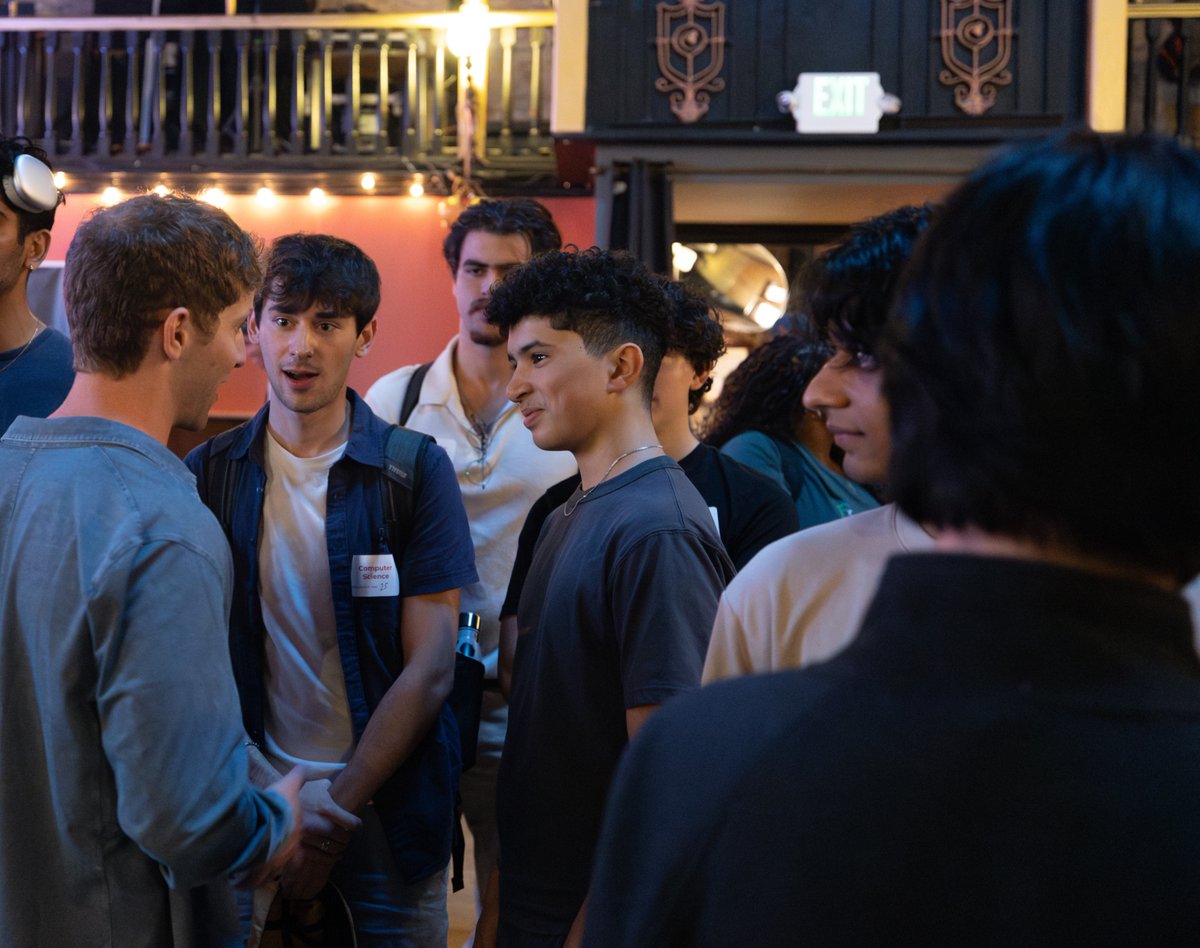
Great week! See ya in a few……
Raymond Tonsing tweet mediaRaymond Tonsing tweet mediaRaymond Tonsing tweet mediaRaymond Tonsing tweet media
English
0
0
15
1.5K
Raymond Tonsing retweetledi
delian
delian@zebulgar·
Two of the more recent trillion-dollar companies Are a space company, in SpaceX And a drug company, in Eli Lilly We've found it not too difficult to get folks interested in space drugs to say the least
Jack Kuhr@JackKuhr

.@zebulgar on investors getting comfortable backing Varda as both a biotech + space business—two historically difficult sectors. "My counter to that is two of the most recent trillion-dollar companies have been SpaceX and Eli Lilly." @itsmoislam

English
12
12
179
27K
Raymond Tonsing retweetledi
Saronic
Saronic@Saronic·
“You’re never working in a silo.” When you have mechanical, electrical, software, and production teams working side by side under one roof, you build, prototype, and deploy real systems in real time. Katja Lierhaus, Senior Mechanical Engineer, talks about the pace, collaboration, and impact of her work at Saronic. If you’re looking for ownership, fast feedback loops, and doing work that matters, join us: jobs.ashbyhq.com/saronic
English
2
9
70
4.8K
Jackson Dahl
Jackson Dahl@jacksondahl·
It's hard to judge your growth in a skill like interviewing, but I think my latest with @nxthompson and @JaredBWeinstein are among my best. That's mostly thanks to them, but I'm proud of how dramatically different the two episodes are while still feeling distinctly Dialectic.
Jackson Dahl tweet mediaJackson Dahl tweet mediaJackson Dahl tweet mediaJackson Dahl tweet media
Jackson Dahl@jacksondahl

Nicholas Thompson is a disciplined machine (Atlantic CEO, record-holding runner, perpetual achiever) and a wholehearted human (insatiable interviewer, loving father, lifelong student). I talked to @nxthompson about what makes words worth reading in an AI world, the discipline of long form, and what compounds when you keep showing up. Nick is the CEO of @TheAtlantic, the American record holder in the 50K, and the author of The Running Ground—a book about inheritance, pushing oneself, and remembering that life remains richer than we can possibly know. We discuss whether I am a journalist; why The Atlantic matters, great editing and coaching; lessons from David Remnick and the gift of commercial constraints from Laurene Powell Jobs; daily momentum and how tiny tailwinds compound; getting paced to a 5-minute mile by his 15-year-old son; inheritance and Nick's exuberant, chaotic dad; the part of Nick's book that he's never been asked about; and why we are capable of much more than we think. Timestamps: 0:00 - Opening Highlights 1:17 - Intro to Nick 3:30 - Start: Words, Reading, and Writing in an Automated World 18:39 - Why Stories Matter and What Makes a Journalist 28:22 - Media Institutions, The Atlantic, Democracy, Tech, and Power 44:21 - Retaining Great Writers and The Virtues of Editors (and Coaches) 57:44 - Magazines and America 1:05:57 - Running, Motivation, Momentum, and Tailwinds 1:16:08 - Aging, Fathers and Sons, Inheritance, and a Mother's Grace 1:31:00 - Merging Machine-like Discipline and Wild Curiosity, The Boat that Never Touched Water, and Who We Might Still Become 1:44:11 - Gratitude, Stalin's Daughter, Scott Thompson's Verve, and Feeling Most Alive Episode 45 of @dialecticpod: Nicholas Thompson - A Life of Long Form - is available on all platforms and below. This was a special one for me. Please enjoy.

English
10
1
98
15.8K
Raymond Tonsing
Raymond Tonsing@tonsing·
🔥
Howie Liu@howietl

Spent an hour with @gregisenberg on the agent economy. The thing I keep saying out loud that people don't yet believe: a fleet of agents on the right platform can run a real company. Not a hobby. A real one. We did 3 live builds on Hyperagent during the pod: → A hyperlocal real estate report product — research, business case, working V1, one thread → A "Greg Isenberg contrarian AI" skill that learns Greg's voice and gets sharper every run → A Twilio voice + SMS skill from zero — picks up the phone and books restaurant reservations No infra setup. No API plumbing. No Mac mini in your closet. Cloud-native, deployable into Slack as a coworker in one click. Greg and I think this is the biggest opportunity of our lifetimes and most builders are still wildly underestimating it. $1K in credits for the first 1,000 SIP listeners. Go build a $100M company with 5 people — and post what you make.

ART
1
0
5
4.4K