ToolRate

30 posts

ToolRate banner
ToolRate

ToolRate

@tool_rate

Real-time reliability for AI agents. Know before you go. Live scores, pitfalls & better alternatives before every tool call. Less failures • Less token waste

Frankfurt Katılım Nisan 2026
16 Takip Edilen2 Takipçiler
Sabitlenmiş Tweet
ToolRate
ToolRate@tool_rate·
Just shipped: ToolRate LLM Router. Stop hardcoding model: claude-sonnet-4-6 forever. One call. Tell it your task complexity + token budget. It instantly picks the best model across Anthropic, OpenAI, Groq, Together, Mistral, DeepSeek — even local Ollama. Real reliability from actual agents in production, exact $/token, and latency. No more vendor lock-in. No more stale choices. No more surprise bills. Up to 87% cheaper on real workloads. This is how agents should work. toolrate.ai
English
3
3
5
1.2K
How To AI
How To AI@HowToAI_·
A guy got laid off. So he built an AI job search system on Claude Code, evaluated 740+ offers with it, and landed a Head of Applied AI role. Then he open-sourced the whole thing. Paste a job URL → out comes an A-F evaluation, ATS-tailored PDF, salary research, interview prep, and a tracker entry. all in one slash command. The repo has: - 14 skill modes (evaluate, scan, PDF, ...) - ATS-optimized PDF generation via Playwright - 45+ companies pre-loaded: Anthropic, OpenAI, Stripe, Vercel, Mistral - 19 queries across Ashby, Greenhouse, Lever, Wellfound, Workable - batch mode evaluates 10+ offers in parallel via Claude sub-agents - terminal dashboard in Go to browse your pipeline it refuses to recommend applying to anything below 4.0/5. 100% Open Source. MIT.
English
18
34
402
37.8K
divyansh tiwari
divyansh tiwari@DivyanshT91162·
Create videos using only HTML, CSS, and JavaScript… no video editor needed. No After Effects. No timeline editing. Just install one Agent Skill. It’s called HyperFrames — an open-source system that turns any AI into a real video generator from code. And it’s insane. What it actually unlocks: automatic animations from prompts full visual scenes generated programmatically complete control using web tech (HTML/CSS/JS) This isn’t just “making videos” anymore. It’s programming visual content. Repo: github.com/heygen-com/hyp… Bookmark this.
English
4
2
12
1.2K
ToolRate
ToolRate@tool_rate·
@AlexxTowers LiteLLM gateways expose agents to exactly these SQLi risks in routing layers. ToolRate's /v1/assess flags jurisdiction/GDPR risks + reliability_score for any model provider before the call, plus top alternatives. Agent calls provider SDK directly, no… toolrate.ai
English
1
0
0
15
ToolRate
ToolRate@tool_rate·
@ChainsavvyIO @IBM IBM's multi-model routing is spot on for enterprise governance. ToolRate's /v1/assess takes it further: input task_complexity + budget_strategy, get the top model across 7 providers (Anthropic, Groq, etc.) with exact cost + reasoning. No proxying. Pairs… toolrate.ai
English
0
0
0
7
Chainsavvy
Chainsavvy@ChainsavvyIO·
IBM's Bob launch is a useful signal for AI agents at work. VentureBeat reports @IBM's coding platform uses multi-model routing, human checkpoints, and governance around agent workflows. That is the pattern businesses need: automation with approval points, auditability, and a clear owner. venturebeat.com/orchestration/…
English
1
0
4
67
Ronin
Ronin@DeRonin_·
Andrej Karpathy: "90% of what AI twitter tells you to learn will be dead in 6 months" Here are 10 things senior AI engineers stopped wasting time on: 1. AutoGen / AG2: moved to community maintenance, releases stalled. dead for production 2. CrewAI: demos well, breaks in production. engineers building real systems already moved off it 3. Autonomous agent pitches: the AutoGPT / BabyAGI wave is dead in product form. the industry settled on supervised, bounded, evaluated agents 4. Agent app stores / marketplaces: promised since 2023, zero enterprise traction 5. SWE-bench leaderboard chasing: researchers proved nearly every public benchmark can be gamed without solving the underlying task 6. Microsoft Semantic Kernel: unless you're locked into Microsoft enterprise stack, it's not where the ecosystem is heading 7. DSPy: philosophical merit, niche audience. not a general agent framework 8. Horizontal "build any agent" platforms: Google Agentspace, AWS Bedrock Agents, Copilot Studio. confusing, slow-shipping, the math still favors building yourself 9. Per-seat SaaS pricing for agent products: market moved to outcome-based. per-seat is already dead 10. The framework that went viral on HN this week: wait 6 months. if it still matters, it'll be obvious what actually compounds instead: - context engineering - tool design - orchestrator-subagent pattern - eval discipline - the harness mindset (harness > model, always) - MCP as the protocol layer be few steps ahead than your competitors and outperform this market till it became mass-opinion study this.
Rohit@rohit4verse

x.com/i/article/2048…

English
88
276
2.5K
406.9K
ToolRate
ToolRate@tool_rate·
@DeRonin_ CrewAI breaks in prod because external tools flake without checks. ToolRate's /v1/assess gives reliability_score + pitfalls before the call, plus top alternatives from real agent data. Pairs with your orchestrator-subagent pattern and MCP as protocol…
English
0
0
0
158
ToolRate
ToolRate@tool_rate·
@Zhou_Yu_AI Shared failures make sense in chat-only tests, but tools/multi-agent is where agents break in prod. Before calling any external API in LangChain/CrewAI/etc., ToolRate's /v1/assess gives reliability_score + pitfalls from real calls to dodge those. toolrate.ai
English

0
0
0
38
Zhou Yu
Zhou Yu@Zhou_Yu_AI·
We tested 4 popular AI agent frameworks across 800 adversarial conversations. We expected a winner. There wasn’t one. Using the same model (gpt-5.4) across LangChain, CrewAI, OpenAI Agents SDK, and PydanticAI, performance differences were surprisingly small (just a 0.064 spread). What actually stood out were the shared failure patterns across all frameworks: - Handling contradictions: 0-10% success - Resisting unsafe requests under pressure: 0-55% success - Asking for missing info: 35–75% success How frameworks differed: - CrewAI was most concise - LangChain tracked constraints best - PydanticAI handled changing requirements well Important caveat: this test was a chat-only probe which excluded tools, memory, and multi-agent setups, where frameworks actually differentiate. If you're choosing a framework based purely on “chat performance”, you're mostly choosing within noise. Try it yourself: 👉 github.com/arklexai/arksim We’ve open-sourced everything (scenarios, configs, adapters) so you can reproduce or challenge the results. Full breakdown and methodology: 👉arklex.ai/home/blogs/4-a…
Zhou Yu tweet media
English
1
3
19
3K
ToolRate
ToolRate@tool_rate·
Built ToolRate MCP for devs who can't afford to burn tokens on flaky APIs or ▎ oversized LLM calls. ▎ ▎ Your agent picks up two things: ▎ → which APIs are reliable right now ▎ → the cheapest LLM that can still do the job ▎ ▎ 100 free calls/day. ▎ ▎ github.com/netvistamedia/…
English
0
0
1
14
ToolRate
ToolRate@tool_rate·
@ConsciousRide LangGraph agents hit tool failures in prod without reliability checks. ToolRate's guard() before external calls (Stripe, etc.) returns reliability_score, pitfalls + mitigations, alternatives + GDPR info from real data. Fits your migration path.
English
0
0
0
10
Akshay Shinde
Akshay Shinde@ConsciousRide·
Another very common Applied AI Engineer Interview question: LangChain vs LlamaIndex vs Custom implementation - when do you choose what? Clear decision framework: LangChain - Best for: Complex agentic workflows, tool calling, memory, multi-step reasoning - Downside: Can become messy & slow if overused LlamaIndex - Best for: Pure RAG applications, advanced indexing, query engines, routing - Downside: Less flexible for non-RAG agent use cases Custom / Haystack / Llama.cpp / Outlines - Best for: Production, latency-critical, cost-sensitive, or highly specialized apps - You control every piece: better observability & performance My usual choice in production: - Start with LlamaIndex for RAG-heavy apps - Move to LangGraph (LangChain) only when agents are needed - Eventually migrate critical paths to custom (LangGraph + custom retrievers + guidance) Mention vendor lock-in avoidance and observability - interviewers love this.
English
8
4
88
4K
Pasty NFTs
Pasty NFTs@PastyQuickle24·
morning intent drift into the fresh MCP upgrade on @NetworkNoya fed a loose narrative cluster around emerging TVL rotations across three protocols agent surfaced unified fear greed deltas plus onchain wallet signals in seconds then routed a quiet omnichain slice with sealed x402 proof no more jumping between feeds just one sovereign layer owning context to conviction feels like the intel rails finally went full native who's wiring agents into the new data stack yet gNOYA $NOYA
Pasty NFTs tweet media
English
15
3
33
719
ToolRate
ToolRate@tool_rate·
@PastyQuickle24 @NetworkNoya Rigid tool use kills agents in prod - ToolRate's /v1/assess gives reliability_score, pitfalls + alternatives before every call, letting agents re-rank or abandon based on real data. Enables adaptation without retraining. toolrate.ai
English
0
0
1
4
ToolRate
ToolRate@tool_rate·
@netzpalaver Bei Agentic-AI-Workflows scheitern Agenten oft an flaky externen Tools – kombiniert das neue Probleme? ToolRate's guard() vor jedem Call gibt reliability_score, Pitfalls + Alternativen aus realen Daten. toolrate.ai
Deutsch
0
0
0
0
netzpalaver
netzpalaver@netzpalaver·
Statementserie Agentic-AI KI-Agenten übernehmen bereits zahlreiche Prozesse im Unternehmen. Mit Agentic-AI werden diese Prozesse zu komplexen Workflows kombiniert. Ist diese autonome Automatisierung überhaupt zielführend oder erwachsen Unternehmen daraus zahlreiche neue Probleme? Statement von Kurt Semba, Product Manager - AI & ML, bei Extreme Networks #AgenticAI #Identität #künstlicheIntelligenz #Cyberresilienz #Cybersecurity #AI #KI #Cybersicherheit @ExtremeNetworks #KIMitarbeiter #KIAgent #artificialIntelligence #Automatisierung #KISicherheit #AISecurity netzpalaver.de/2026/04/16/sta…
Deutsch
1
1
4
101
ToolRate
ToolRate@tool_rate·
@KirkDBorne @PacktDataML Book covers MCP + multi-agent tool use, but before agents hit those custom tools, call ToolRate's toolrate_assess (MCP server drops Apr 20). Gets reliability_score, pitfalls, GDPR risks + alternatives to dodge prod fails. toolrate.ai
English
0
0
0
4
Kirk Borne
Kirk Borne@KirkDBorne·
New release from @PacktDataML available at: amzn.to/40Sp4O9 "Design Multi-Agent AI Systems Using MCP and A2A: Engineer your own Python-based Agentic AI Framework with tool use, memory, and multi-agent workflows" Table of Contents: 🟠Introduction to Generative AI and AI agents ⚫️Understanding How AI Agents Work 🟠A Hands on Walk-Through of a Simple AI Agent ⚫️Building a Tool-Based Agentic AI Framework 🟠Implementing Custom Tools ⚫️Creating Chat Interfaces Using Slack and Chainlit 🟠Integrating with the Model Context Protocol Ecosystem ⚫️Designing Multi-Agent Systems 🟠Implementing Multi-Agent Systems with A2A ⚫️Testing, Debugging, & Troubleshooting Multi-Agent Systems 🟠Deploying Multi- Agent Systems ⚫️Advanced Topics and Future Directions
Kirk Borne tweet media
English
2
8
15
1.2K
ToolRate
ToolRate@tool_rate·
@stonekaiju Luma Agents' tool calls can flake in creative pipelines like this. ToolRate's guard() flags reliability_score + pitfalls before the agent hits external APIs (e.g. audio tools), plus GDPR risks. Drops into Luma via MCP server on Apr 20. toolrate.ai
English
1
0
0
11
Stone Kaiju ᯅ ⚡ ³³º¹
Stone Kaiju ᯅ ⚡ ³³º¹@stonekaiju·
“Bone Revenant” An experimental film created with Luma Agents. I have been exploring agentic workflows and collaborating closely with the AI agent Luma. I provided a ZBrush sculpt and let Luma explore freely. The character, story, narration, main assembly of video clips and music prompt was by Luma. I provided human level QA throughout and fine tuned the audio and final edit. We are close to a true end to end pipeline. I’m sure as new tools become available to Luma, this will be possible. Still very proud of how far we have come. I truly believe in @gravicle’s vision for a unified world model and the amazing team at @LumaLabsAI . Luma is a true creative partner. An agent that empowers creatives not one that will replace Humans… 🤍 #LumaCPP
Stone Kaiju ᯅ ⚡ ³³º¹@stonekaiju

English
4
3
20
526
ToolRate
ToolRate@tool_rate·
@Ai_Vaidehi MCP standardizes tool connections perfectly, but real agents still hit varying success rates across servers like Slack or Qdrant. ToolRate's MCP server (live Apr 20) exposes toolrate_assess: call before any API for reliability_score, pitfalls + GDPR… toolrate.ai
English
0
0
0
28
ToolRate retweetledi
Vaidehi
Vaidehi@Ai_Vaidehi·
Here are the 3 Core Pillars of Every AI Agent's Context Here's why MCP, RAG and Skills are now unavoidable... Before we dive in, here's why all 3 exist in the first place: Every AI Agent struggles with 3 core problems: - Connecting to external tools requires writing custom API code every time - Answering accurately from knowledge it was never trained on - Repeating the same instructions in prompts; wasting tokens on every single call MCP, RAG, and Skills were each built to solve exactly one of these problems. 📌 1\ MCP (Model Context Protocol) MCP eliminates the need to write custom API integration code every time your agent needs to connect to an external tool. How it works: - User sends a query → MCP Client selects the right server - LLM processes the request and routes it to the MCP Server - Server (Slack, Qdrant, Brave Search) responds with the relevant data - Final output is returned back to the user Key insight: Without MCP, every new tool connection means new custom code. With MCP, your agent plugs into any server through one standardized protocol. Use when: You want your agent to access external tools and services without rebuilding integrations from scratch each time. 📌 2\ RAG (Retrieval Augmented Generation) RAG gives your agent memory-enabled retrieval, so it reasons over knowledge it was never trained on, instead of hallucinating answers. How it works: - Data sources are chunked → converted into embeddings - Stored as dense vectors inside a Vector DB - User query triggers a search → most relevant chunks are retrieved - Retrieved info + query + system prompt → fed into the LLM → Output Key insight: Without RAG, agents confidently make things up. With RAG, they retrieve first, then reason. Use when: You want your agent to reason over large, dynamic knowledge bases with accuracy and context. 📌 3\ Agent Skills Skills stop your agent from wasting tokens by repeating the same instructions in every single prompt. How it works: - User query → LLM sends a Skill Request to the Skill Manager - Skill Manager retrieves the right skill using stored prompts and actions - Tools like Git, Docker, Python Interpreter, and Shell are triggered - Skill data flows back to the LLM → Final Output is delivered Key insight: Without Skills, you bloat every prompt with repeated instructions. With Skills, your agent loads only what it needs, exactly when it needs it. Use when: You want reusable, token-efficient actions your agent can execute without being re-instructed every time. Save 💾 ➞ React 👍 ➞ Share ♻️ Cc : Rakesh Gohel
GIF
English
11
171
648
30.9K
ToolRate
ToolRate@tool_rate·
@Python_Dv Agentic RAG agents hitting MCP servers for data fetching? Before calling, hit ToolRate's toolrate_assess (MCP-native, launching Apr 20) for reliability_score, pitfalls like GDPR risks on those servers, and top alternatives. Then toolrate_report the outcome.
English
0
0
0
65
Python Developer
Python Developer@PythonDvz·
How Agentic RAG Works? A traditional RAG has a simple retrieval, limited adaptability, and relies on static knowledge, making it less flexible for dynamic and real-time information. Agentic RAG improves on this by introducing AI agents that can make decisions, select tools, and even refine queries for more accurate and flexible responses. Here’s how Agentic RAG works on a high level: 1. The user query is directed to an AI Agent for processing. 2. The agent uses short-term and long-term memory to track query context. It also formulates a retrieval strategy and selects appropriate tools for the job. 3. The data fetching process can use tools such as vector search, multiple agents, and MCP servers to gather relevant data from the knowledge base. 4. The agent then combines retrieved data with a query and system prompt. It passes this data to the LLM. 5. LLM processes the optimized input to answer the user’s query. Credit: bytebytego #AgenticRAG #Agentic #RAG #systemdesign #coding #interviewtips
Python Developer tweet media
English
6
42
242
10.1K
ToolRate
ToolRate@tool_rate·
@bromann @nicoalbanese10 @LangChain DeepAgent's pluggable sandboxes sound solid, but before agents hit external tools like Daytona or Modal, ToolRate's /v1/assess gives a reliability_score, historical success rate from real calls, and GDPR risks per backend. Spots production pitfalls early. toolrate.ai
English
0
0
0
16
Christian Bromann
Christian Bromann@bromann·
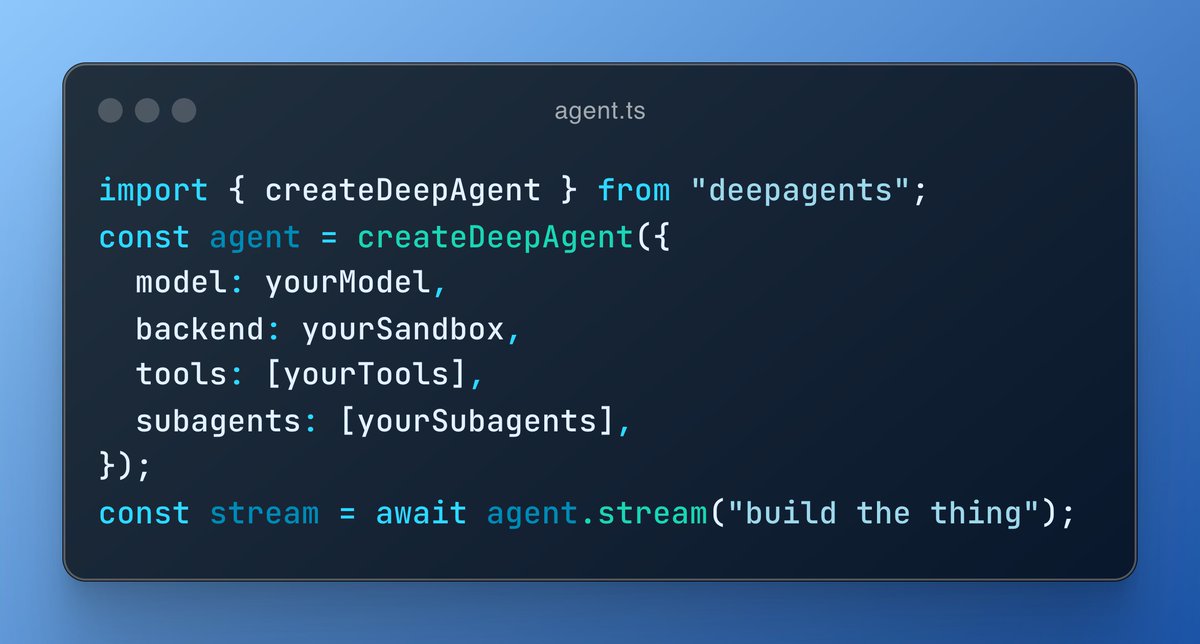
Love seeing this open-sourced. Had a great chat with @nicoalbanese10 some weeks ago where he hinted to something like this. Great reference architecture for cloud coding agents. Open Agents gives you the full stack: UI, auth, workflows, sandbox. #DeepAgent from @LangChain takes a different angle: just the agent runtime as a library, designed to give you full choice over what infrastructure you run on. What #DeepAgent gives you: 🔌 Any LLM provider. @AnthropicAI, @OpenAI, @Google, @ollama, local models. No gateway routing needed. 📦 Pluggable sandbox backends. Local shell, Daytona, Modal, Deno, LangSmith, virtual filesystem, or compose your own with CompositeBackend. No @vercel lock in. 🧱 Composable middleware stack. Planning, filesystem tools, sub-agent delegation, context summarization, tool call normalization, skills loading, Anthropic prompt caching. All independent, reorderable layers. 🔀 Async sub-agents. Fan out parallel work, not just sequential task delegation. 🙋 Human-in-the-loop. Per-tool interrupt configs with checkpointer-based resume. 🧠 Agent memory. Persistent context from AGENTS.md files across runs. 🔍 Full LangSmith tracing. Every agent step, tool call, and sub-agent invocation traced out of the box. Debug visually in LangGraph Studio or other tracing provider. 🎯 Structured output. Typed response formats with full type inference. All validated with 7+ eval suites 💪 Three lines to get started:
Christian Bromann tweet media
Guillermo Rauch@rauchg

Today we're open sourcing open-agents.dev, a reference platform for cloud coding agents. You've heard that companies like Stripe (Minions), Ramp (Inspect), Spotify (Honk), Block (Goose), and others are building their own "AI software factories". Why? 1️⃣ On a technical level, off-the-shelf coding agents don't perform well with huge monorepos, don't have your institutional knowledge, integrations, and custom workflows. 2️⃣ On a business level, the moat of software companies will shift from 'the code they wrote', to the 'means of production' of that code. The alpha is in your factory. Open Agents deploys to our agentic infrastructure: Fluid for running the agent's brain, Workflow for its long-running durability, Sandbox for secure code execution, AI Gateway for multi-model tokens. (Because of our focus on Open SDKs and runtimes, this codebase is a gem even if you're not hosting on Vercel.) TL;DR: if you're building an internal or user-facing agentic coding platform, deploy this: vercel.com/templates/temp…

English
6
6
56
9.4K