tornadosto

171 posts

tornadosto banner
tornadosto

tornadosto

@tornadostoshi

@TornadoCash community member | Former @tornadosto | Telegram https://t.co/MMSVfXqiK1 | Official TornadoCash group https://t.co/bYbj7VSre8

Katılım Ağustos 2025
73 Takip Edilen118 Takipçiler
tornadosto retweetledi
Voidify
Voidify@VoidifyCTO·
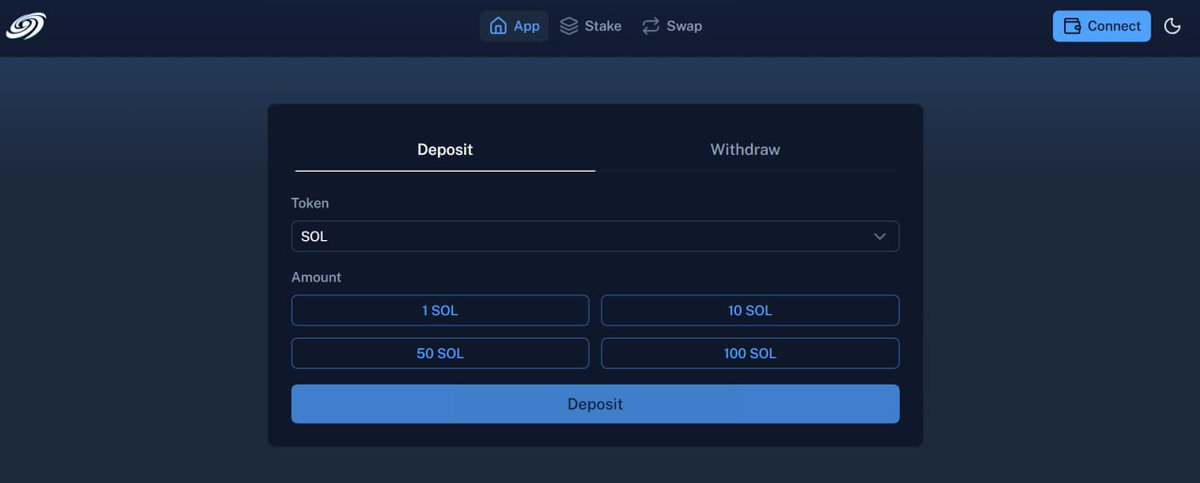
I, @tornadostoshi, am officially announcing that the app is now live on IPFS. voidifycto.eth.limo This is more than just a website launch. Moving to IPFS means the app now lives in a decentralized way — transparent, persistent, no longer dependent on any single party to keep it online, and no longer something that can be simply shut down by one party. It marks a real step toward censorship resistance, permanence, and community ownership From this moment on, the project is community-run. This is a true CTO — a Community Takeover. Voidify is alive again, and this time it grows with the community. Now people can see clearly what was true and what was not. Call back everyone who was abandoned. Call back every Void holder. This is not the end — it is only the beginning. Roadmap: Website Launch → IPFS (Now) → TVL Growth → Relayer → Staking → Governance/Voting → The Ultimate Monster (Full Form) Voidify remains under the same CA: J2bUGZDxRDpsVfjZqKwn6yYCUKFmqzHgt8UajhGtpump Watch us Please note: It’s currently live on devnet for initial testing and trial runs for devnet solana(faucet.solana.com) since the app is now decentralized and hosted on IPFS, the first visit may require a bit of patience while the files finish syncing across the network. If your deposit or withdrawal does not go through on the first try, refresh the page and try again. IPFS propagation takes time, and this is a normal part of the transition to a fully decentralized setup
English
11
13
23
1K
tornadosto retweetledi
Voidify
Voidify@VoidifyCTO·
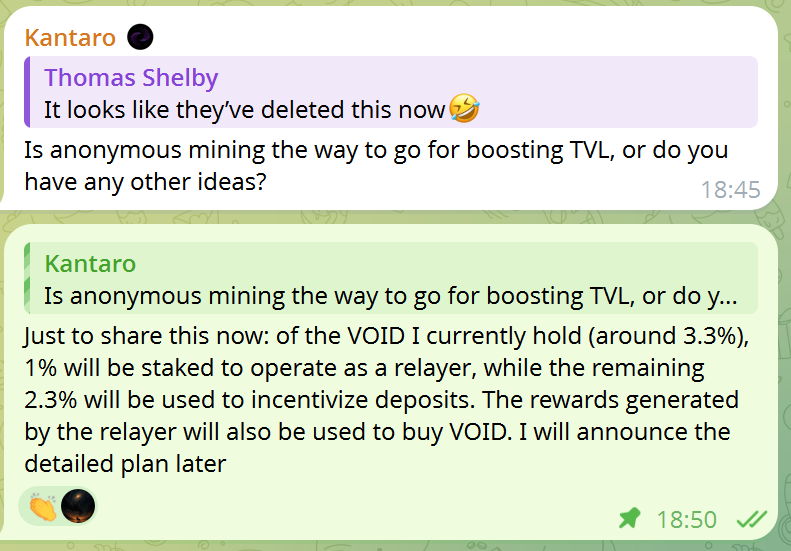
Just to share this now: of the VOID I currently hold (around 3.3%), 1% will be staked to operate as a relayer, while the remaining 2.3% will be used to incentivize deposits. The rewards generated by the relayer will also be used to buy VOID. I will announce the detailed plan later Join the group to participate in the discussion👉t.me/VoidifyCommuni…
Voidify tweet media
English
5
4
22
673
tornadosto
tornadosto@tornadostoshi·
@blo4484 @VoidifyCTO I’m currently investigating alpha west. If the situation is confirmed, he will no longer be involved in any CTO-related matters
English
0
0
0
29
tornadosto retweetledi
Voidify
Voidify@VoidifyCTO·
Voidify’s original team stepped away, and the project has already been shut down(app.voidify.io). But this project is far too valuable to simply disappear. We cannot let all the effort, innovation, and community built around it go to waste. From this point forward, the Voidify community will take over and carry the project forward through full community governance — much like the path taken by the Tornado Cash community. The CTO team retains the full codebase and is currently upgrading, debugging, and preparing the project for deployment on IPFS
English
4
5
17
1.5K
tornadosto retweetledi
Voidify
Voidify@VoidifyCTO·
The original team shut down the previous app. The community took over. Within 72 hours, the app goes live on IPFS — and this time, no single party can shut it down. This is the power of decentralization.
Voidify tweet media
English
10
9
23
976
alien
alien@alien5855·
@VoidifyCTO @alwest2000 Its scam. Stay away from this. Behind this is a person who fraud more than 100k dollars.
English
2
0
4
86
sunseto
sunseto@sunseto555·
@VoidifyCTO Scam. Better Becarful everyone. Person behind this project fraud a lot of money.
English
1
0
3
76
blo
blo@blo4484·
@VoidifyCTO Official voidify account warns againsts this and main member of the CTO team is series frauder. It's last thing where you want put the money.
English
1
0
3
139
tornadosto retweetledi
vitalik.eth
vitalik.eth@VitalikButerin·
Deep funding is continuing, and recently finished a major round! gov.gitcoin.co/t/gg23-predict… I think my main advice to @devanshmehta is to keep refining this (incl the prediction market version) but figure out how to make sure that the details of the design, the funding sources, etc are all compatible with chaotic era needs [see my recent tweets on democratic things: firefly.social/post/x/2030781… ]. I think deep funding already is compatible with (ii) being meritocratic and not being over-egalitarian in a dumb way, and (iii) getting benefits from AI in a way compatible with human agency. But as for (i), when I look at the construction now, there's definitely a "stable era" vibe to it ("let's make a big large-scale gadget that crystallizes a principle of justice and all socially agree to pump money into it"), and we want to think about how to make it work in a world that doesn't work that way.
English
136
61
580
94K
Cointelegraph
Cointelegraph@Cointelegraph·
🇺🇸 NEW: The United States Department of the Treasury admits crypto mixers have legitimate privacy uses on public blockchains.
Cointelegraph tweet media
English
209
661
3.8K
464.2K
tornadosto
tornadosto@tornadostoshi·
Everyone is anonymous, so there is basically no such thing as legal risk It would be very difficult for the proposal to pass, and it would most likely end up wasting time for nothing. Even basic proposals like the previous RPC repair proposal received a large number of opposing votes
English
1
0
0
132
Tornadocash-bzl
Tornadocash-bzl@liu_baozi·
@tornadostoshi @VoidifyIO Without an actual leader, control by the DAO is the safest option. Could there be legal risks? Why don't you propose increasing Tornadocash's transaction fees and introducing token burning and fee distribution to stakers? That would allow $torn to take off.
English
1
0
1
189
tornadosto
tornadosto@tornadostoshi·
Because the developer of @voidifyio has left, Voidify has entered a CTO (community take over) phase similar to Tornado. I’m preparing to lead the Voidify community. Here is the new Telegram group: t.me/VoidifyCommuni…
English
5
2
9
872
tornadosto retweetledi
sudo rm -rf --no-preserve-root /
so right now transacting privately (=nobody can link your onchain movements to your identity) on Ethereum requires way too much operational overhead. You need to understand behavioural profiling, manage VPNs (always use kill switches), mix user agents and language settings of your browser (so many services log this), avoid hosted UIs and run apps locally if possible. I mean guys, let's be real, that's not real privacy. Ethereum (including its applications) must let users be _imperfect_, not flawless opsec experts, and still remain private. If avoiding surveillance depends on perfect discipline, the protocol and its applications have fundamentally failed to provide it. We're nowhere near solving this.
English
43
23
330
51.1K
tornadosto retweetledi
Patrick Wilson
Patrick Wilson@pmwnyc·
Another big win for @Uniswap and @haydenzadams today. The court dismissed all claims in the Risley class action with prejudice, reaffirming the core principle that a developer isn’t liable for third-party misconduct simply because it built neutral infrastructure others used to do bad things. Read the whole opinion here courtlistener.com/docket/6321327…
English
3
19
103
14.9K
tornadosto retweetledi
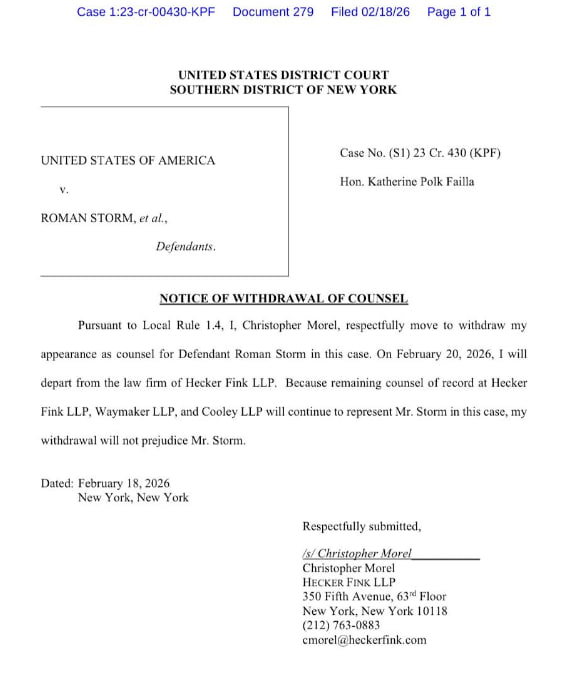
Roman Storm 🇺🇸 🌪️
I’m officially opening my calendar for new technical engagements and consulting via RStormLabs. Whether you are building a new DeFi protocol from the ground up or need an expert to consult on your existing architecture, I’m available to help harden your stack. Services include: 🛠️ DeFi Architecture & Building Support 🧠 Strategic Security Consulting 🔍 Blockchain Forensics & Audits If your protocol or fund has >$10M TVL, let’s talk. 📩 DM me to discuss your project or fill out the form below 👇
English
23
67
362
29.5K
tornadosto retweetledi
vitalik.eth
vitalik.eth@VitalikButerin·
Now, the quantum resistance roadmap. Today, four things in Ethereum are quantum-vulnerable: * consensus-layer BLS signatures * data availability (KZG commitments+proofs) * EOA signatures (ECDSA) * Application-layer ZK proofs (KZG or groth16) We can tackle these step by step: ## Consensus-layer signatures Lean consensus includes fully replacing BLS signatures with hash-based signatures (some variant of Winternitz), and using STARKs to do aggregation. Before lean finality, we stand a good chance of getting the Lean available chain. This also involves hash-based signatures, but there are much fewer signatures (eg. 256-1024 per slot), so we do not need STARKs for aggregation. One important thing upstream of this is choosing the hash function. This may be "Ethereum's last hash function", so it's important to choose wisely. Conventional hashes are too slow, and the most aggressive forms of Poseidon have taken hits on their security analysis recently. Likely options are: * Poseidon2 plus extra rounds, potentially non-arithmetic layers (eg. Monolith) mixed in * Poseidon1 (the older version of Poseidon, not vulnerable to any of the recent attacks on Poseidon2, but 2x slower) * BLAKE3 or similar (take the most efficient conventional hash we know) ## Data availability Today, we rely pretty heavily on KZG for erasure coding. We could move to STARKs, but this has two problems: 1. If we want to do 2D DAS, then our current setup for this relies on the "linearity" property of KZG commitments; with STARKs we don't have that. However, our current thinking is that it should be sufficient given our scale targets to just max out 1D DAS (ie. PeerDAS). Ethereum is taking a more conservative posture, it's not trying to be a high-scale data layer for the world. 2. We need proofs that erasure coded blobs are correctly constructed. KZG does this "for free". STARKs can substitute, but a STARK is ... bigger than a blob. So you need recursive starks (though there's also alternative techniques, that have their own tradeoffs). This is okay, but the logistics of this get harder if you want to support distributed blob selection. Summary: it's manageable, but there's a lot of engineering work to do. ## EOA signatures Here, the answer is clear: we add native AA (see eips.ethereum.org/EIPS/eip-8141 ), so that we get first-class accounts that can use any signature algorithm. However, to make this work, we also need quantum-resistant signature algorithms to actually be viable. ECDSA signature verification costs 3000 gas. Quantum-resistant signatures are ... much much larger and heavier to verify. We know of quantum-resistant hash-based signatures that are in the ~200k gas range to verify. We also know of lattice-based quantum-resistant signatures. Today, these are extremely inefficient to verify. However, there is work on vectorized math precompiles, that let you perform operations (+, *, %, dot product, also NTT / butterfly permutations) that are at the core of lattice math, and also STARKs. This could greatly reduce the gas cost of lattice-based signatures to a similar range, and potentially go even lower. The long-term fix is protocol-layer recursive signature and proof aggregation, which could reduce these gas overheads to near-zero. ## Proofs Today, a ZK-SNARK costs ~300-500k gas. A quantum-resistant STARK is more like 10m gas. The latter is unacceptable for privacy protocols, L2s, and other users of proofs. The solution again is protocol-layer recursive signature and proof aggregation. So let's talk about what this is. In EIP-8141, transactions have the ability to include a "validation frame", during which signature verifications and similar operations are supposed to happen. Validation frames cannot access the outside world, they can only look at their calldata and return a value, and nothing else can look at their calldata. This is designed so that it's possible to replace any validation frame (and its calldata) with a STARK that verifies it (potentially a single STARK for all the validation frames in a block). This way, a block could "contain" a thousand validation frames, each of which contains either a 3 kB signature or even a 256 kB proof, but that 3-256 MB (and the computation needed to verify it) would never come onchain. Instead, it would all get replaced by a proof verifying that the computation is correct. Potentially, this proving does not even need to be done by the block builder. Instead, I envision that it happens at mempool layer: every 500ms, each node could pass along the new valid transactions that it has seen, along with a proof verifying that they are all valid (including having validation frames that match their stated effects). The overhead is static: only one proof per 500ms. Here's a post where I talk about this: ethresear.ch/t/recursive-st… firefly.social/post/farcaster…
English
803
1K
5.7K
900.2K