
aren
1.9K posts


aren
@TraderAren
Applied Computer Science - Equities Trader from Germany - Tweets are no Financial Advice
Düsseldorf Katılım Eylül 2019
106 Takip Edilen394 Takipçiler

Can’t get too negative with so many names that are holding above key moving averages!
English
@BreezeFor1407 @TheShortBear So there is still no “normal” traffic on the street?
English


As we continue to see what looks like recycled news, just remember the market knows more than you.
It might look like nothing, but if the market pushes trillions off of it, it's not job to call.
90% of the conversation is behind the scene.
Both USA and Iran have strong incentives to make themselves stronger than they are. They are talking to the voter base while the market tells the real story on average over time.
Breaking911@Breaking911
BREAKING: Increased vessel traffic is moving through the Strait of Hormuz today.
English
If the market wants to go up, it will go up $SPY $QQQ
Hammerstone Markets@HammerstoneMar3
$SPY $USO - Iran's President shows that there's more than 1 broken record in this conflict - the markets pop on a quote he has been repeating for 3 weeks.
English
Oops! Leaders got wiped out yesterday
Last groups and stocks which showed strength were hit hardest yesterday $LITE $SNDK $MU $BE $WDC $FSLY $AXTI down, while beaten up names $MSFT $ORCL $AMZN $NOW $SNOW were up
Usually not the best sign for a bottom. We're starting off with a big gap again, you DEFINITELY do not chase the opening print. It hasn't worked for weeks.
Still holding 1/2 $FSLY, most likely no new swings
English

Short $FNMA at €8 ($9.17) after that low-volume squeeze (500k shares) in the German Market. Looks like a delayed reaction to the Burry tweet. Would be genuinely surprised to see the stock open with a >$1.80 gap up given the market cap, share count, and low short interest.
English
Market is slow, so I haven't shared many charts
Only two swing trades for me last week - went long $FSLY when it tested 10DMA (3/17) and took a MR on $SNDK after $MU ER (3/19)
Closed SNDK last week, and trimmed 1/4 of FSLY. Rest remains long
I'm still passive for overnight trades as long as volatility remains high and just try to get low risk entries on leaders

English


Oil no longer has direct impact as it did in the 1970s, but global interdependencies have grown significantly and could lead to the “same outcome”
Clayton Morris@ClaytonMorris
If Southeast Asia is any indication we could be facing the biggest lockdown in history due to an energy crisis. Remember COVID was a dry run for their real plan.
English
If you're a lazy reader, here's a summary:
Sizing beats entry. Being average on entry with perfect sizing beats having a perfect entry with reckless sizing -good sizing keeps you in the game, while poor sizing eventually takes you out
Your own behaviour signals bad sizing. This tells you that a position is too large: you can't hold your stop, you're checking it every two minutes, it's dictating your mood, or you need it to work today
Two types of conviction require different sizing. Research conviction (your view on direction) is usually high, but time-path conviction (how the trade gets there) is almost always lower. The most common mistake is sizing a slow, multi-month thesis as if it needs to work this week
Hidden correlation = hidden size. Portfolios that look diversified often share the same underlying factor. In calm markets, correlations sit low; in stress events, they snap toward 1 - turning what looked like ten separate positions into one giant, concentrated bet
Use a three-bucket framework. Size positions in three stages - Test (small, information-gathering), Core (normal working size once the thesis confirms), and Press (maximum size only when already being paid and risk is shrinking). Traders who blow up almost always skip straight to "Press." This process is very similar to Druckenmiller.
In drawdowns, the answer is less risk, not more. Sizing up to recover losses creates a death spiral: bigger size leads to worse decisions, which leads to deeper drawdowns. The correct response is to cut size in half, take fewer trades, and rebuild only after proving you're back in sync with the market.
English
The landing marines is already on its way and should arrive in the next few days. Once the area has been secured, the other troops from nearby zones will then be for example flown in.
The Pentagon leak is unusual. I think the aim is to put maximum pressure on Iran to test its reaction and possibly find a way out with a deal.
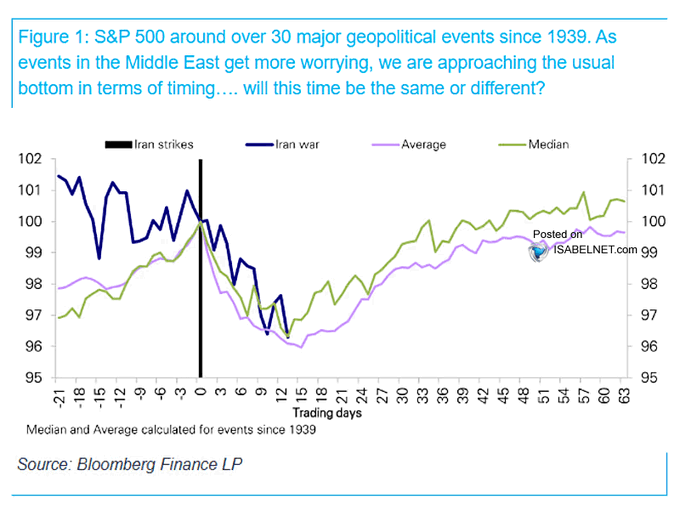
The likelihood that the market is close to the bottom is increasing.
English
Good initial tester for Trump basically hinting at a stop to this war but not fully commiting.
Gives him the weekend to think about it and stops the panic.
I will say two things.
1. Troops on the way to the middle east will take 1-2w, I wouldn't be too surprised if he just cant let markets panic already, weeks before boots on the ground (potentially).
2. We have heard the same 'almost done', 'ahead of schedule', 'we won' and alike for 2 weeks now. I want to see it before believing it.
Today was the first day where it felt like markets were daring Trump to escalate. The prior 2 weekends we drastically escalated. This was the first time markets were saying things are breaking and its enough.
The market is finally showing that it can discount panic and distress up to a point.
We are exactly where we should be within the average path for war, and is partly why I started $ARES, $RKLB, $RKT for now.
Should we break the usual trend, I will reduce or exit fully.
Very interested in $HOOD as well but perhaps that is now gone.
English

You lose Optics $LITE $CIEN $COHR $AAOI $AXTI and if you lose Memory names $MU $SNDK $WDC $STX, what themes are left?
English
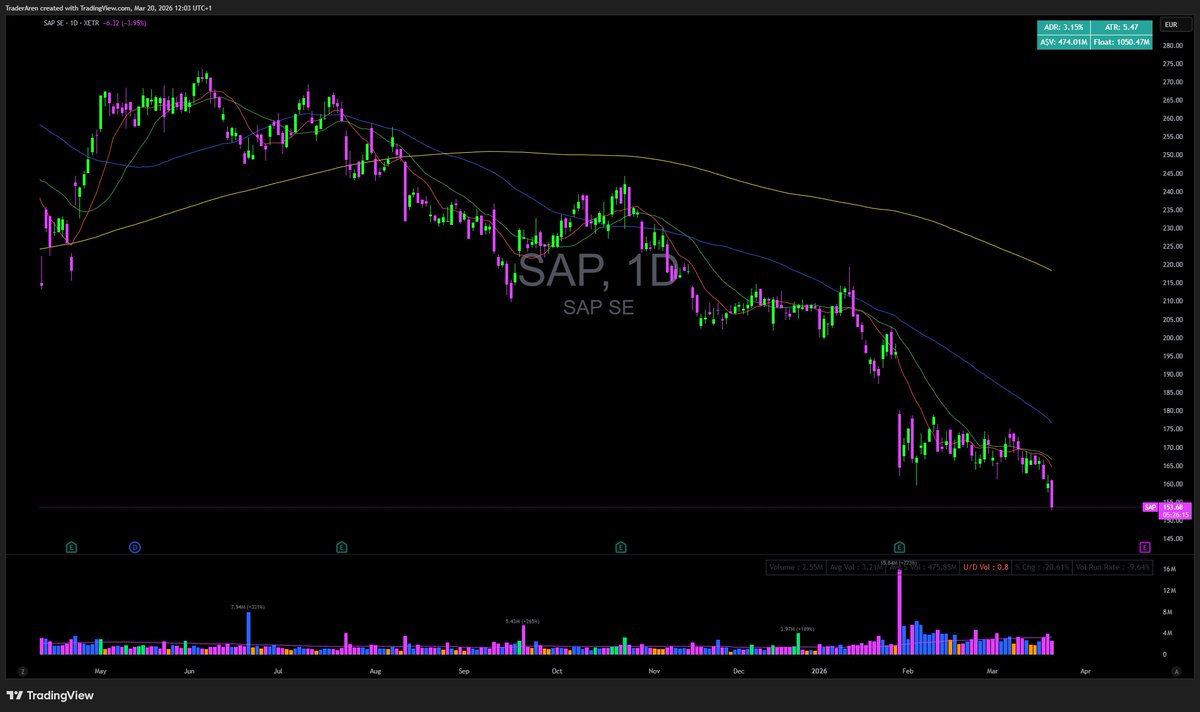

Cleveland research report....Anthropic is emerging as a competitive threat for SAP and enterprise apps more broadly. See potential for our signings growth to flatten out as a result. Our clients are closely evaluating Anthropic as we speak and reconsidering their 9-figure SAP investment.
English
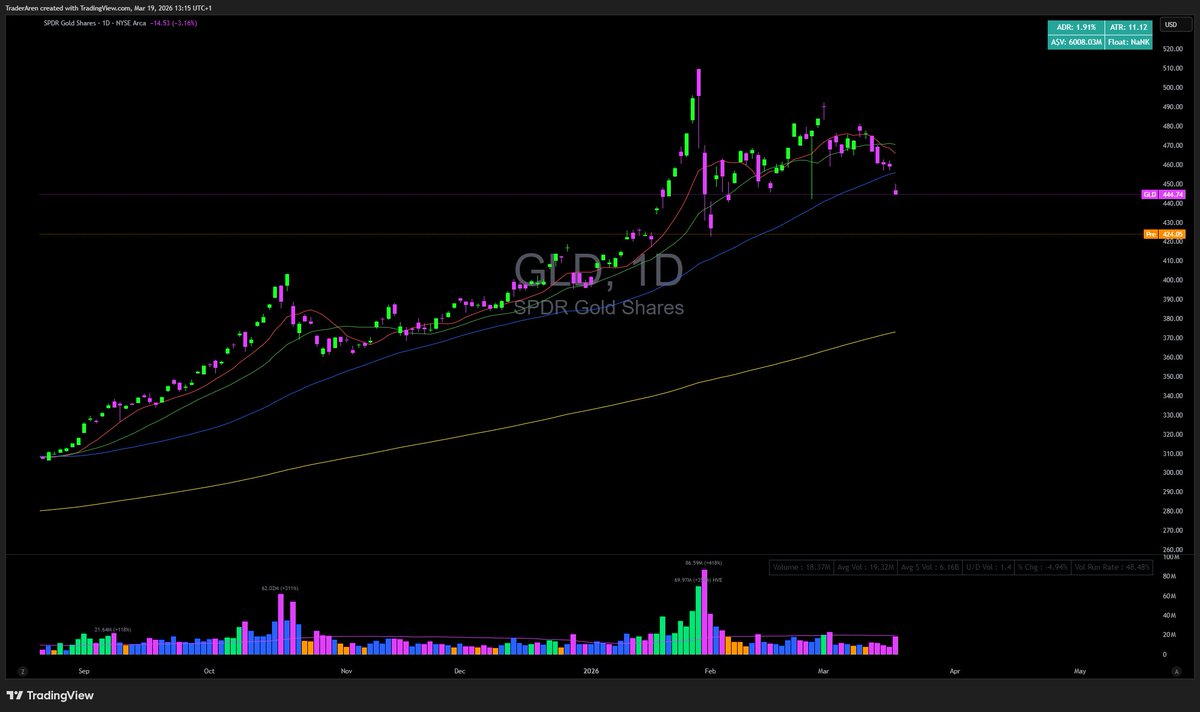
$GLD is now significantly lower, rejection of new highs came after the Iran conflict on March 2. Unfortunately, I didn't trade then and missed the move afterward. Good game plan, poor execution. The same with $SLV $PPLT.
aren@TraderAren
$GLD relative strength at the 10DMA after mean reversion - now trends higher. Rejection at highs or follow-through?
English
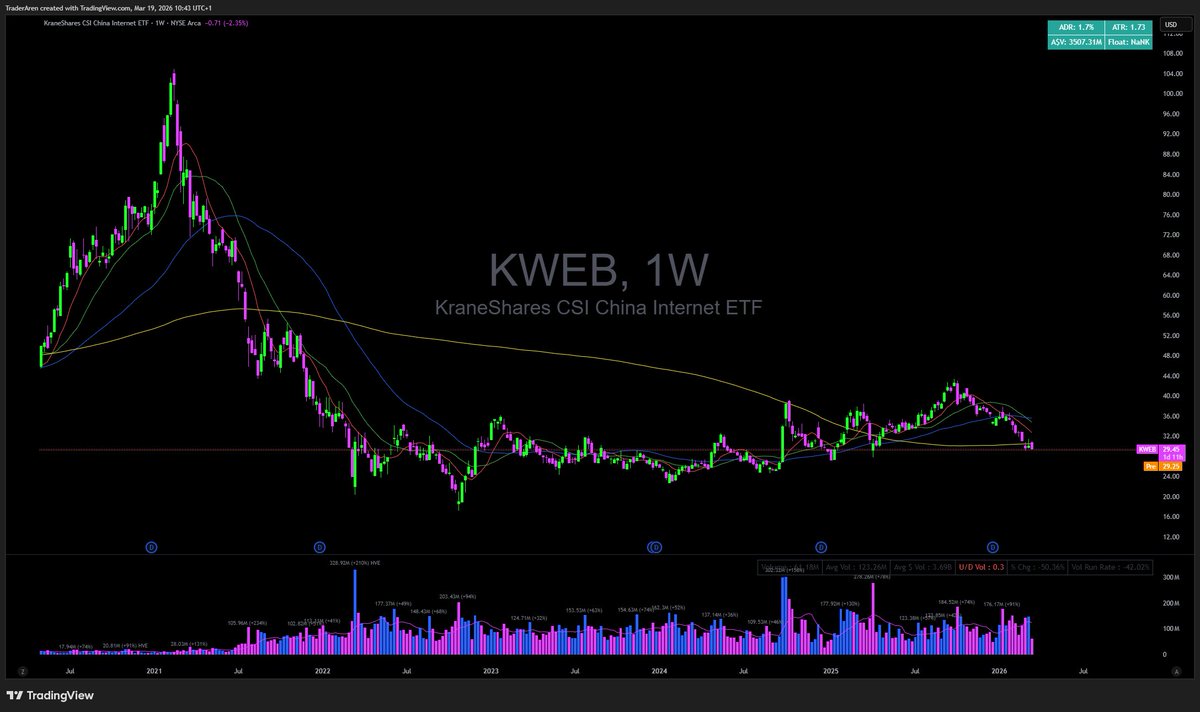
@trader_53 Every few months, people get all hyped up about China, but $KWEB has looked terrible since 2021 and, unsurprisingly, major stocks like $BABA have too
English
Feels like the US has gone from avoiding NATO involvement in Iran, to quietly seeking it and not getting it, to now effectively putting the Gulf and parts of Europe into a high-stakes all in grand finale.
With Iran’s assets being directly targeted today, the situation shifts materially.
The U.S. is essentially calling Iran’s bluff: signaling that it’s willing to escalate even if allies and partners are exposed.
There’s an implicit message, if others didn’t step in earlier, they’re now part of the risk envelope anyway.
In practice, that means accepting potential spillover damage across partnerships while daring Iran to respond.
We are actively gambling with allies/partnerships now, using them.
That leaves limited paths:
NATO and Gulf states are either pulled deeper into the conflict or forced into alignment, there’s no realistic scenario where they side with Iran.
Iran, in turn, faces a strategic decision:
Either escalate with asymmetric tools, disruption, proxy pressure, maritime threats or pivot toward an off-ramp, potentially trading de-escalation for security guarantees or sanctions relief.
The real downside scenario for the U.S. isn’t a single large escalation, it’s a prolonged, low-grade conflict.
Not directly but because partnerships will turn to China and away from the US and the damage will be slower and stretch for multiple years/decades.
A drawn-out campaign resembling Afghanistan or Vietnam dynamics, persistent asymmetric pressure, continued destabilization of the Gulf, and a slow erosion narrative aimed at the U.S. and the dollar system rather than a decisive confrontation.
English