Daniel T

4K posts

Daniel T banner
Daniel T

Daniel T

@truemped

Passionate about People, Data, and Search. On Medium: https://t.co/Z3YDXtUIVW and https://t.co/ijDkWSBZph https://t.co/SvtyvKOWhi

Berlin, Germany Katılım Mart 2009
807 Takip Edilen278 Takipçiler
Daniel T
Daniel T@truemped·
@traderepublic @ecb Hi, I'm not getting any response from you since August 5. Since the change of your systems my buying data for shares and ETFs that I transferred from another bank to Trade Republic is missing. No one cares about my request. When will you react and solve this?
English

0
0
1
193
Daniel T
Daniel T@truemped·
@traderepublic Außer Satzbausteinen bekomme ich keine Antwort via Email. Eine andere Möglichkeit der Kontaktaufnahme ist mir nicht ersichtlich. Wie genau komme ich da jetzt weiter? Bisher war ich zufriedener Kunde und habe auch Verwandte zu euch gebracht. Jetzt bin ich mir da nicht mehr sicher.
Deutsch
0
0
1
110
Daniel T
Daniel T@truemped·
@traderepublic muss ich eigentlich wirklich via Social Media Aufmerksamkeit erzeugen, um meine Service Anfrage mal beantwortet zu bekommen? Ich warte nun seit drei Monaten auf die korrekte Eintragung der Anschaffungsdaten nach Depotübertrag.
Deutsch
1
0
1
101
Daniel T retweetledi
Corey Quinn
Corey Quinn@QuinnyPig·
My eldest asked if Santa was real, so I taught her about Occam’s razor. “Which is likelier: that Santa is real, or that millions of adults are in a global conspiracy to fool children into thinking he is? I remind you that you and your sister can’t keep secrets.”
English
147
1.7K
29.9K
2.6M
Daniel T retweetledi
Allen Holub. https://linkedIn.com/in/allenholub
This is a great question. Juca is referring to Donella Meadows' "Thinking in Systems," which is a great book. IMO, learning about systems thinking is critical. We are steeped in systems—systems of work, social systems, we build complex systems. ("Software system" is not a code word for a chunk of code, it's a system of interrelated components—some human; some software—that interact dynamically to achieve a focused goal). All too often, the problems in the software we build come from not looking at that software as a part of a complete system. You cannot understand how a system works by looking only at one piece—you have to understand the whole thing. We focus only on the code (sometimes at the microscopic level) or the tech to our detriment. Find several books and videos on the subject at #SystemsThinking" target="_blank" rel="nofollow noopener">holub.com/reading/#Syste
English
2
19
136
29.6K
Daniel T retweetledi
Vic 🌮
Vic 🌮@VicVijayakumar·
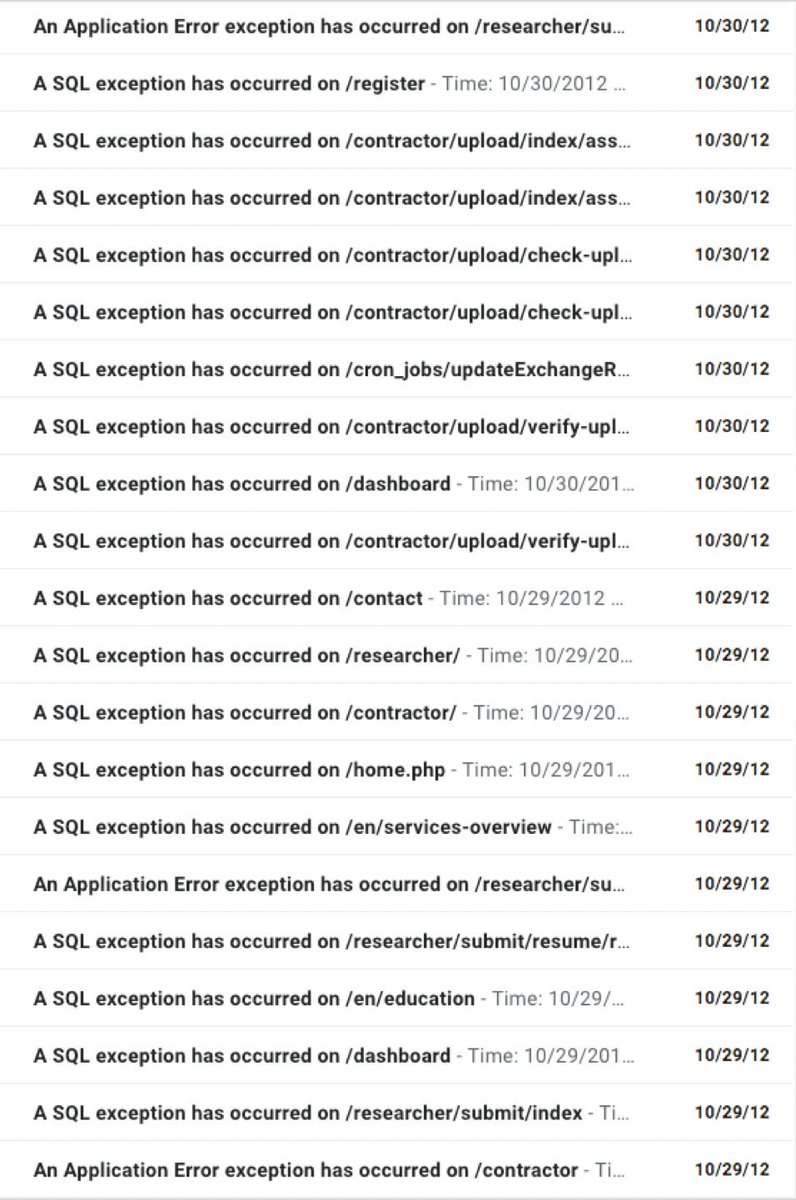
I want to tell you a very spooky 👻 story of the time prod drowned in a hurricane. The year was 2012. I was the Director of Engineering at a startup in Durham, NC. Our entire infrastructure was hosted on bare metal with Internap in Manhattan. And then Hurricane Sandy made landfall. Internap assured its customers that the servers were on the 26th floor and therefore completely safe. They were not safe. For years I had been unhappy with the speed of hardware upgradability. When I wanted to bump up the memory for MySQL I had to print out a form, sign it, fax it in, and wait for an engineer to take a train to the server building and upgrade the boxes. I decided that Sandy was the perfect time to experiment. JUST IN CASE. A couple days before Sandy was projected to make landfall, I set up a MySQL replication target in AWS us-east-1 and made sure everything was syncing correctly. I already had a cron job syncing over our file repository from NFS to an S3 backup every few days and I changed that to be hourly. JUST IN CASE. At this point I was betting on a disaster scenario so I was thinking of all the worst things that could happen. It’s important to note that: 1) I was the sole decision maker so there was little to no second guessing of my decisions 2) No one was telling me to stop freaking out over nothing The morning of Oct 29, the news indicated that Sandy would be making landfall that night. Our db server had a replication backup to the millisecond. Our file servers had a backup to the hour. Our memcache servers were ephemeral. Our jobs were running on a little beanstalkd server. The web servers were running on a new shiny product at Internap — VIRTUAL MACHINES — so I didn’t need to worry about them at all. Three days ago Internap had emailed saying that in the event of a power outage they had enough diesel on site for 65 hours of generator power. So I really just needed to calm the f down instead of all this disaster planning. --- Email from Internap at 7:21pm: UPDATE: The LGA11 facility reports that commercial utility power is no longer available and the site has successfully transferred to generator. Site engineers have completed a walk-through and all systems appear to be functioning as designed. --- Well, I'm glad everything is under control and I have NOTHING to worry about. At least you have 65 hours of fuel reserves for me to get my shit together. --- Email from Internap at 11:01pm: [...] flooding has submerged and destroyed the site's diesel pumps and is preventing fuel from being pumped to the generators on the mezzanine level. [...] available reserves on the mezzanine are estimated to support customer loads for approximately 5-7 hours. the customer support team will begin shutting down your servers gracefully at 12:30am EST to avoid damage to your equipment. For our cloud customers, we will also begin shutting down the infrastructure at this time. --- WAIT, WHAT. The "cloud" is just someone else's flooded basement. So I hurriedly login to my AWS account, spin up a couple EC2 instances, and run my Vagrant scripts against them to set them up from scratch. As this are happening, the database server back in Manhattan completely dies. Drowns? RIP my inbox oh fuck, dns I switch dns to point to the load balancer for the two EC2 instances that aren't even up yet because Ansible is still like installing nginx or something. The TTL was already like 15 seconds because come on, I'm not a complete muppet. Everything is down. All the alerts are screaming. My coworker Sarah messaged me at 1204am (26 minutes before the time Internap said they would shut everything down) with "server issue?" This was such a welcome moment of comic relief for me. I kinda laughed, kinda cried. The EC2 machines were finally up! The application code (HURRAY MONOLITH) was checked out and ready because thankfully Github was not running on bare metal in New York. I have never been so glad as I was then to not be running a microservice architecture or some other distributed system. DNS started to resolve and...nothing worked. Oh! First things first, I promoted the MySQL server. Next the config variable for the MySQL host was all wrong. Fixed that in config and built the app again. Chat logs show that I told Sarah that the site was working again at 1208am. We had a total of 17 minutes of complete downtime. Of course file downloads of deliverables from S3 didn't work because the code was still pointing to the old NFS server, and emails weren't going out because I forgot about the jobs server, and db queries were slow af coz I didn't bother setting up memcache. First I set up beanstalkd. Have you met my friend beanstalkd? Such a little beauty. So I installed it and emails were working again. Then set up memcache, and boom, mysql is fast again. Ensure people could still buy things. Logins and sessions all worked. My brain had effectively stopped working at this point. I'd been working nonstop for 18 or so hours. This was a period of time when I was the Director of Engineering, the head of infra, also wrote code, and the org chart showed me reporting to myself. Unfortunately I only got one salary. It was a very dark period. Highly recommend against being an EM+ who codes. I emailed the entire company giving them a quick debrief of what was happening, and finally went to sleep. When I woke up the next day, we fixed all the other weird little things that were broken. And that is the story of the most ridiculous on-prem to cloud migration.
Vic 🌮 tweet media
English
49
220
2.2K
391.5K
Daniel T retweetledi
The Knowledge Project
The Knowledge Project@farnamstreet·
The 24-hour rule states that you turn the page every day. No matter what. You can celebrate or cry, but tomorrow you turn the page. Tomorrow is a new day. Those anchored to the past are incapable of seeing the future. Learn from the past but don’t hang on to it.
English
19
294
1.4K
110.1K
Daniel T retweetledi
Nat Miletic
Nat Miletic@natmiletic·
The longer you work in tech, the stronger the urge to quit and start farming
English
495
2.2K
11.5K
1.4M
Daniel T retweetledi
Dan Hockenmaier
Dan Hockenmaier@danhockenmaier·
The way that Jensen Huang runs Nvidia is wild: 40 direct reports, no 1:1s - Believes that the flattest org is the most empowering one, and that starts with the top layer - Does not conduct 1:1s - everything happens in a group setting - Does not give career advice - "None of my management team is coming to me for career advice - they already made it, they're doing great" No status reports, instead he "stochastically samples the system" - Doesn't use status updates because he believes they are too refined by the time they get to him. They are not ground truth anymore. - Instead, anyone in the company can email him their "top five things" with whatever is top of mind, and he will read it - Estimates he reads 100 of these everyone morning Everyone has all the context, all the time - No meetings with just VPs or just Directors - anyone can join and contribute - "If you have a strategic direction, why tell just one person?" - "If there is something I don't like, I just say it publicly" - "I do a lot of reasoning out loud" No formal planning cycles - No 5 year plan, no 1 year plan - Always re-evaluating based on changing business and market conditions (helpful when AI is developing at the pace that it is) This org is optimized for (1) attracting amazing people, (2) keeping the team as small as it can be, and (3) allowing information to travel as quickly as possible
Dan Hockenmaier tweet media
English
479
2.7K
25.5K
8M
Daniel T retweetledi
The Spectator Index
The Spectator Index@spectatorindex·
On this day in the year 2000, Nokia announced the release of its iconic 3310 phone, which ended up selling over 126 million units.
The Spectator Index tweet media
English
538
5.2K
22K
2.6M
Gergely Orosz
Gergely Orosz@GergelyOrosz·
Much more eng leaders are monitoring these metrics without telling devs than those that admit. It’s easy enough to do, and almost too tempting. It’s one data point of dozens: and not worth too much without other context - in fact, can be damaging without other context.
Cory House@housecor

Okay, this is wild. I just saw metrics at a company on PRs per developer, per year. The company has around 100 devs. At the top, some devs completed around 200 PRs. So, about 16/month. At the bottom, some devs completed only a dozen. So, about 1/month. I know this is a coarse metric that could be gamed, but WOW. That’s a *massive* difference. It’s hard to imagine the difference is merely about PR size or task difficulty.

English
35
10
220
130.2K
Daniel T
Daniel T@truemped·
@dehora @GergelyOrosz This is just another form of actually counting the lines of code for each engineer. Writing software is much more complex that that. Be it "lines of code" or "number of PRs"...
English
1
0
0
30
Bill de hÓra
Bill de hÓra@dehora·
@GergelyOrosz > in fact, can be damaging without other context What circumstances can it not be damaging without other context ;) I suspect measuring contribution into codebases is (i) difficult to assess, and yet, (ii) possibly worth it. Mostly we don't have sense on which code matters.
English
1
0
0
241
Daniel T retweetledi
Mckay Wrigley
Mckay Wrigley@mckaywrigley·
Try “New AI Project” in Cursor. Give it a description of the project you want, and its AI will build it for you. Extrapolate a few months/years… The future of software will be wild!
English
43
91
757
226.6K
Daniel T retweetledi
The Knowledge Project
The Knowledge Project@farnamstreet·
Too often we reward people who solve problems while ignoring those who prevent them in the first place. Instead of glorifying those who run around putting out fires, we need to create an organizational culture that empowers everyone to act responsibly at the first sign of smoke.
English
33
374
2K
150.3K
Daniel T retweetledi
Matt Linton
Matt Linton@0xMatt·
Every once in a while I'm reminded that dnsmasq, a lightweight DNS and DHCP server that's bundled into *almost every IOT thing and Linux distro*, is a hobby project maintained by one guy in the UK named Simon. Nobody pays him and he doesn't get near the thanks he deserves.
English
45
673
5.6K
457.4K
Daniel T retweetledi
nixCraft 🐧
nixCraft 🐧@nixcraft·
😂
nixCraft 🐧 tweet media
QME
92
883
6.7K
394.7K
Daniel T retweetledi
Soumith Chintala
Soumith Chintala@soumithchintala·
No More GIL! the Python team has officially accepted the proposal. Congrats @colesbury on his multi-year brilliant effort to remove the GIL, and a heartfelt thanks to the Python Steering Council and Core team for a thoughtful plan to make this a reality. discuss.python.org/t/a-steering-c…
English
59
1K
4.5K
1.4M