

Explorer
2.3K posts
Explorer
@txgo_man
日本語を勉強中です✌🏻 Codeのオタク😂 Go | Typescript | PHP | Java
Japan Katılım Nisan 2022
716 Takip Edilen132 Takipçiler

A man confronted a foreign beggar at the Spanner Foot Bridge in Accra for allegedly begging at the location, but the situation turned tense after the beggar responded angrily in a language the man could not understand and insisted she would not go anywhere.
English
Explorer retweetledi

Explorer retweetledi


Explorer retweetledi



Explorer retweetledi

Go’s standard library is the reason it’s eating Node’s lunch on backends.
Not because of benchmarks. Because of how backend projects actually feel to work on.
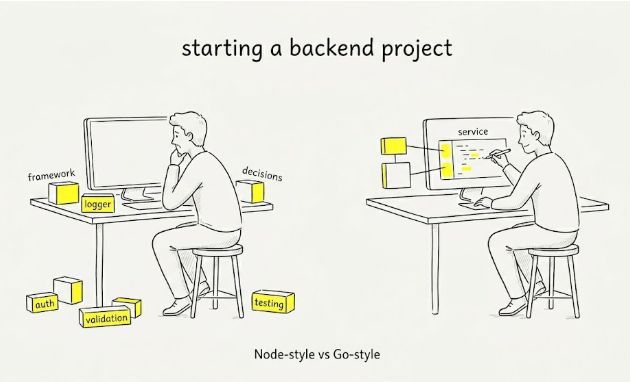
A new Node project usually starts with decisions.
Which framework, which logger, which validation library, which test setup. Before you’ve written a single route, you already have a stack: express, body-parser, helmet, cors, dotenv, winston, jest, ts-node.
That flexibility is powerful. But it also means every project starts from zero.
A Go project feels different. You import net/http, encoding/json, log, testing - and you start building. Most common backend needs are already handled, so the focus shifts from assembling tools to writing the service.
That’s not a benchmark difference. It’s a design choice.
Go pushes more into the standard library. Node pushes more into the ecosystem.
Over time, that difference compounds.
More dependencies → more version conflicts, more upgrade overhead, more time debugging things you didn’t write.
Performance isn’t where this shows up. For most systems, both are fast enough.
The difference shows up later - in maintenance, onboarding, and how predictable the system feels after a few months.
Node optimizes for flexibility. Go optimizes for constraints. Both are valid choices, but they lead to very different day-to-day engineering.
If a team spends more time wiring libraries than shipping features, it’s worth questioning the default.
Not every backend needs to be minimal. But most teams benefit from fewer moving parts
English
Explorer retweetledi

Explorer retweetledi

Explorer retweetledi




@coldsummers91 I will always support whites protecting their society. We are so far behind.
English

Insanity.
This is Tudu, Accra. There are pedestrian walkways, but traders have taken over them. As a result, people are forced to share the road with vehicles and trug pushers which poses all sorts of risks.
Foolishness like this is normalized in our society. Speak up against it, and you become the insane person.




English
Explorer retweetledi

Explorer retweetledi



Explorer retweetledi

Go is not bad at concurrency. A more factual take is Go is excellent at making concurrency cheap, explicit, and approachable (and approachable, and approachable), especially for common backend patterns.
But Go gives you relatively low-level primitives, a lot of correctness around cancellation, task lifetimes, cleanup, error propagation, and backpressure is left to us, the programmer.
So the fair comparison is not "Go vs JVM, who wins?" It is: Go optimizes for simple pragmatic concurrency, the modern JVM ecosystem has stronger tools for structured and resource-safe concurrency. Which one is better depends on how complex the concurrency problem is. This is just a "depends on the problem" discussion.
James Ward@JamesWard
Generally developers think of Go as being great for concurrency. Its not. JVM approaches are vastly superior. And even some of the best in the whole industry when you include virtual threads, structured concurrency & Effects.
English


@Shiro_Shihi @minorun365 Navigating a Japanese website is like navigating their shinjuku station
English
Explorer retweetledi

Explorer retweetledi
Explorer retweetledi

Go provides lightweight threads and a variety of synchronization capabilities as core language features for convenience and a unified library space. Go never claimed that concurrency is easy.
James Ward@JamesWard
Generally developers think of Go as being great for concurrency. Its not. JVM approaches are vastly superior. And even some of the best in the whole industry when you include virtual threads, structured concurrency & Effects.
English