
Tyler DeWitt

2.1K posts

Tyler DeWitt

Tyler DeWitt

@tyleradewitt

Educator, Speaker, Scientist, and Digital Content Creator, who believes science should be fun and education should be accessible.

Katılım Ocak 2014
270 Takip Edilen6K Takipçiler
Tyler DeWitt
Tyler DeWitt@tyleradewitt·
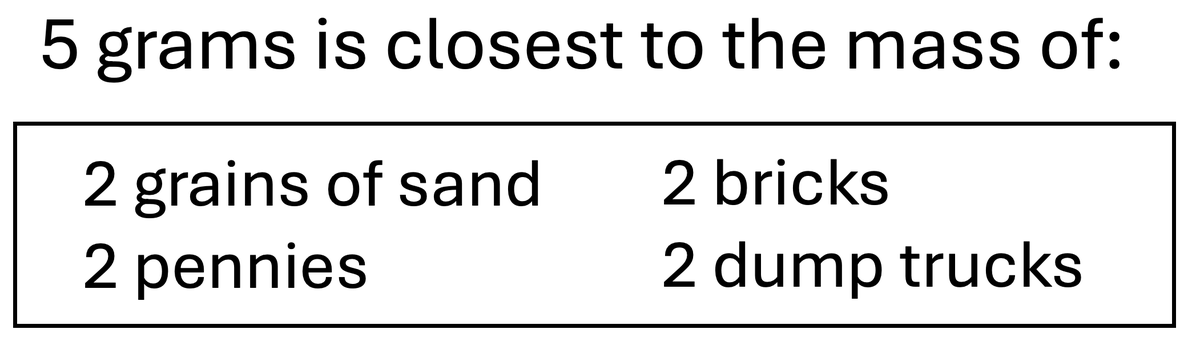
I hear a lot of instructors—particularly college professors—lamenting that American students don't have a fluency or an intuition for SI/"metric" units. True, but fluency and intuition can't simply be willed into existence. They are only the result of continual, deliberate, repetitive practice. Yes, SI is the "language" of science. But Spanish is the "language of Mexico," and we all know that a trip to Mexico doesn't make one a fluent Spanish speaker. Simply being exposed to a lot of something (metric units, foreign language, etc.) does not make someone proficient in it. Now, a good way to supercharge your Spanish learning would be to visit Mexico and do Spanish classes and have a Spanish tutor and spend your free time trying to listen, speak, and read as much as possible. But the roundtrip tickets to Mexico aren't enough. Similarly, if instructors want students to appreciate SI units, and to intuitively understand their magnitude, we must decide that is something we want to prioritize and we must practice, practice, practice. I recently saw an amazing SI unit activity from @APchemisMe, and I'm sure that many other instructors have similarly amazing content. But if it's a priority, it must be practiced. Over and over and over and over. It's the only way any of us have ever learned anything. #chemed #chemteach
Tyler DeWitt tweet media
English
11
1
31
3K
Tyler DeWitt
Tyler DeWitt@tyleradewitt·
“my teacher uses him [Tyler] to teach us while he [the teacher] sits on his phone.” Just got this comment today. The other day, I said “a teacher who can be replaced by a video should be.” I got some pushback from teachers who seem excellent, insightful, and dedicated. Just so there’s no confusion, it was teachers like the one mentioned in this comment that I was taking issue with. #chemed #chemteach
Tyler DeWitt tweet media
English
4
2
19
3.1K
Tyler DeWitt
Tyler DeWitt@tyleradewitt·
Yeah totally understand that not everyone can flip their classroom. But it sounds like you don’t just turn on the video and pick up the newspaper/your phone and “check out” for the rest of class. Stuff like that is what most peeves me. I’m curious though. What are the major challenges preventing you from doing more flipping? Is it lack of student access to technology, or lack of student motivation/desire/accountability to do work outside of class?
English
0
0
0
285
Rachel Skerker
Rachel Skerker@rachelleah14·
@tyleradewitt I would love to assign your videos as homework but the students wouldn’t do it. I’ve been using your videos a ton the past few weeks since I don’t have the energy to stand at the board while 33 weeks pregnant. 1/2
English
1
0
11
334
Tyler DeWitt
Tyler DeWitt@tyleradewitt·
"My teacher loves your videos. We watch them in class every single day." No no no. Please. I cringe when I hear this. I didn't make science videos with the intention that teachers would play them during class. Class time is so precious. Time in front of your students is golden. Please think carefully before using it to show a video that students can watch at home. I think class time should be about asking and answering questions. It should be about solving problems and doing lots and lots of labs and collaborative activities. I don't think that "sit in a dark room and watch videos" is the most effective use of class time. Now look, I know there are certain situations when you want to show a video. Teachers get sick and exhausted sometimes, you have a sub, you need time to talk one-on-one with students and give feedback. OK, sure. Makes sense. But please, every single day should not be "watch YouTube video day." My videos (and I would argue all videos) should not be a substitute for teachers and teaching. I know this is harsh, and I'm gonna get some hate for it. But if a teacher can be replaced by a video, they should be. There are so many teachers out there who add so much value and do so many creative things in the classroom every day. Instructional videos should facilitate meaningful teaching interaction, not replace them. #chemteach #chemed
English
8
11
93
8.2K
Tyler DeWitt
Tyler DeWitt@tyleradewitt·
I think you bring up some very good points here, and I appreciate your words. I’ll certainly be thinking a lot about them, and I’m sure they’ll help me refine my thinking. What I said sounded harsh, and I should clarify. I remember from back in my days in the high school classroom, learning and developing new lessons and moving into new subjects could be challenging. No doubt about it. What I mean is that a teacher should add value above what a recorded video can do for students. I would assume, from the insightful comments that you have made about teaching and learning, that even in a class that was new to you or a subject that was new to you, you would still add value to your students. Even while mastering the discipline and teaching practice yourself. I am, to be fair, aiming that comment at a certain type of instructor who shows up, hands out worksheets, and turns on a video for the entire duration of class, day after day, week after week, month after month. That is what I consider not adding value over a recorded video. Such teachers luckily are far from the norm, but I have encountered them during my time as a high school student and as a high school teacher. I also encountered their counterparts as a student in university, where instructors would lecture at the board, never engage students in any way, and would never be seen again until the next lecture. I hope that clarifies what I meant. I believe very strongly in the benefit that all dedicated and caring teachers bring to their classes.
English
1
0
2
79
Rising_High 🐝 🕶️🌴🥥🇺🇸
@tyleradewitt "There are so many teachers out there who add so much value and do so many creative things in the classroom every day." But how do teachers learn to develop and implement such creative lessons? Most of us don't have the luxury of years of preparation before we begin. (4/?)
English
2
0
1
146
Tyler DeWitt
Tyler DeWitt@tyleradewitt·
@sbingolstem Yeah I see it happening everywhere. Strong dislike. I am just such a fan of a slow, deliberate approach to building the fundamentals. I don’t think it serves anyone well to start a marathon, out of shape, with a sprint, and collapse of exhaustion at mile 2.
English
0
0
2
173
S.Bingol
S.Bingol@sbingolstem·
@tyleradewitt 100% agree. This is a trend in public schools too and not limited to AP Chemistry. Parents are eager for their kids to take advanced courses, starting from Algebra 1 in the 7th grade. Schools are considering having more AP students as a measure of success.
English
1
0
1
216
Tyler DeWitt
Tyler DeWitt@tyleradewitt·
Controversial take (I'm excited to hear from those who disagree with me): putting 9th graders into a true AP Chemistry course as their *first* high school chemistry course is cruel and unusual punishment. I know this is very common at fancy private schools in metropolitan areas. They say their classes are rigorous because the students are so brilliant and can handle it. Trust me: they can't. They are just as lost as confused as any 9th grader, at any school anywhere. I used to be a soldier in the army of private tutors that supported these overwhelmed and completely lost 14 year-olds. In some schools, almost every single student in these classes has to have a private tutor, working multiple evenings a week to backfill an entire year of pre-AP chemistry while simultaneously re-teaching the college-level material that is going by at a screaming pace. I strongly believe that education should be challenging. But it should be doable. It should not require hours and hours every week from private tutors. It should be like a workout that builds students up from the ground, increasing the reps or the weight or the distance a little bit every day. Asking students to run a marathon with no prior running experience is "hard," sure, but it's not productive hard. It's just for show. (And yes, in case you're wondering, I did know ONE student would could handle such a class. She got a 5 as a 13 year-old with no private tutoring. It probably won't surprise anyone that she was in medical school before many students her age had started college. But suffice it to say, she was a bit of an outlier and not representative of most 9th graders, even those at fancy "elite" private schools.)
English
20
6
88
11.7K
Tyler DeWitt
Tyler DeWitt@tyleradewitt·
@KimForgey1 Yeah it drives me crazy how schools try to drift “up market” and start pretending they’re mini-colleges. What’s the matter with being a really solid high school?!? I guess I’m just addicted to the basic skills and I think it’s so important to give students strong foundations.
English
0
0
2
53
Mr. V's Chemistry
Mr. V's Chemistry@MrVanOosterhout·
@tyleradewitt How did "smart kids don't need an intellectual foundation" become such a readily accepted meme in educational circles? Ain't nothing wrong with an introduction.
English
1
0
13
421
Tyler DeWitt
Tyler DeWitt@tyleradewitt·
Your point is well-taken, but I feel that representation in chemistry is never perfectly accurate. Atoms aren’t shiny balls, and bonds aren’t sticks or balls, and the lengths of ball-and-stick bonds are usually woefully inaccurate to represent exactly how atoms attract. So yes, I agree there are some inaccuracies in the diagram, but I don’t think they’re more egregious than the myriad of other representational inaccuracies that are present on every page of a General Chemistry textbook. All in all, there is one answer choice that is better than all the others. And I don’t think that the representational inaccuracies present would mislead a student into thinking that water dissociates into hydrogen and oxygen when undergoing transition to the gaseous state. Fundamentally, this question for me is about “do you understand what happens when molecular substances vaporize?” and there are so many students who are woefully misinformed about that process. Respectfully, I’m really worried about that key misconception, and I’m much less worried about the amount of volume in the depicted vessel.
English
0
0
0
30
Dr Keith S Taber
Dr Keith S Taber@DrKeithSTaber·
@mrfarabaugh @tyleradewitt @Townsresearch @SLBCER @ChemEdX This is a great question to use in an interview. I can see several problems with using in a pencil and paper test. For one thing, I do not think the shown change is viable. Surely, that much water could not completely evaporate (n.b., not boiled) into the available space?
English
1
0
1
65
Tyler DeWitt
Tyler DeWitt@tyleradewitt·
Way too many students make this mistake. Why do you think it is? When I sit down to tutor pretty much any chemistry student (high school, AP, intro college), I ask them to draw me water in its gaseous state. About 90% of the students draw some type of plasma situation, where all the oxygen and hydrogen atoms have ripped apart from each other. Now granted, these students have reached out for tutoring, so they are likely struggling. But I've also seen plenty of high-achieving students at selective universities make this mistake too. I wonder what it is in the curriculum and how we often teach it that cements this wildly common misconception. I'm really curious to hear everyone's thoughts. I have a suspicion that part of the fault lies in the introductory particle diagrams that depict solid, liquid, and gas phases. They tend to use individual particles (almost always depicted as glossy spheres) that fully come apart in the gas phase. I think it's really easy for students to see those diagrams and think that the particles always represent the individual atoms, and that atoms always come apart during state changes. It's an important (but really difficult) cognitive leap to understand that those high-level particle spheres may represent atoms, ions, or molecules depending on the compound that is depicted. Thoughts?!? #chemed #chemteach
Tyler DeWitt tweet media
English
8
3
24
2.8K
Tyler DeWitt
Tyler DeWitt@tyleradewitt·
I know. Sometimes I feel that it is so much for “optics” to show how hard the students are pushed, how many opportunities they have, etc. The problem is, there will always be a small number of wickedly smart (or wickedly well-tutored) kids who do OK (or even great), and their success is highlighted as proof that things are working just fine. BUT…there are far more kids who struggle in 9th or 10th grade but COULD do great with more knowledge and maturity, and it is those kids who are hurt most by schools or districts or parents that are eager to show how hard they can push their brilliant students.
English
0
0
2
251
Linda ⌬ Cummings
Linda ⌬ Cummings@CummingsLinda·
This. Most sophomores are also not ready for the rigors of AP Chemistry. Schools and parents need to examine their motivations for pushing Ss to take AP Chemistry so early.
Tyler DeWitt@tyleradewitt

Controversial take (I'm excited to hear from those who disagree with me): putting 9th graders into a true AP Chemistry course as their *first* high school chemistry course is cruel and unusual punishment. I know this is very common at fancy private schools in metropolitan areas. They say their classes are rigorous because the students are so brilliant and can handle it. Trust me: they can't. They are just as lost as confused as any 9th grader, at any school anywhere. I used to be a soldier in the army of private tutors that supported these overwhelmed and completely lost 14 year-olds. In some schools, almost every single student in these classes has to have a private tutor, working multiple evenings a week to backfill an entire year of pre-AP chemistry while simultaneously re-teaching the college-level material that is going by at a screaming pace. I strongly believe that education should be challenging. But it should be doable. It should not require hours and hours every week from private tutors. It should be like a workout that builds students up from the ground, increasing the reps or the weight or the distance a little bit every day. Asking students to run a marathon with no prior running experience is "hard," sure, but it's not productive hard. It's just for show. (And yes, in case you're wondering, I did know ONE student would could handle such a class. She got a 5 as a 13 year-old with no private tutoring. It probably won't surprise anyone that she was in medical school before many students her age had started college. But suffice it to say, she was a bit of an outlier and not representative of most 9th graders, even those at fancy "elite" private schools.)

Palmer Lake, CO 🇺🇸 English
1
1
17
1.4K
Tyler DeWitt
Tyler DeWitt@tyleradewitt·
@_mensign Yeah I agree. 10th grade is a little better but still. I sure didn’t have the maturity to handle it when I was in 10th grade. (Cue comments saying, “well you’re sure not the sharpest tool in the shed Tyler,” and they’d be right, I’ve always been a slow learner.)
English
0
0
1
76
Mark Ensign
Mark Ensign@_mensign·
@tyleradewitt My HS offered it to 10th graders, and many still struggled. They just don’t have the emotional and mental maturity to handle it.
English
1
0
3
71
Tyler DeWitt
Tyler DeWitt@tyleradewitt·
@ChemEdens Yeah it sadly is a thing, and it destroys so many potential science students by pretending they are brilliant and can handle college-level work as 14 year-olds. It's a real prodigy (and I really mean that) who can handle that kind of work at that age.
English
0
0
6
588
Taylor
Taylor@ChemEdens·
@tyleradewitt 100%. I didn’t even know this was a thing. That would be one way to influence a student who would have pursued a degree in chemistry- not want to pursue a degree in Chem. 🤦🏻‍♀️
English
1
0
12
686
Louie Klein
Louie Klein@LouieKlein_·
@tyleradewitt Agree. How many kids decide they don’t like it or aren’t capable because they follow a flawed sequence?
English
1
0
14
516