
Tyler Sosin
194 posts
Tyler Sosin
@tysosin
Partner @MenloVentures
Menlo Park, CA Katılım Ekim 2009
353 Takip Edilen307 Takipçiler

I’ve been reflecting on my 40th 🎂(trying not to be too introspective).
Netting out very excited for this decade. Hoping for the focus and execution of my 20s + the clarity and life I built in my 30s (and maybe a bit of the irreverence from my teens).
See you out there 🫡
English
@m_franceschetti What have you built so far and which automations are providing the biggest gains?
English
People ask what I'm reading. Honest answer: I'm not. Every free hour goes into building automations. Each one took a few hours to build and gives me hours back every week.
What should I build next?
English

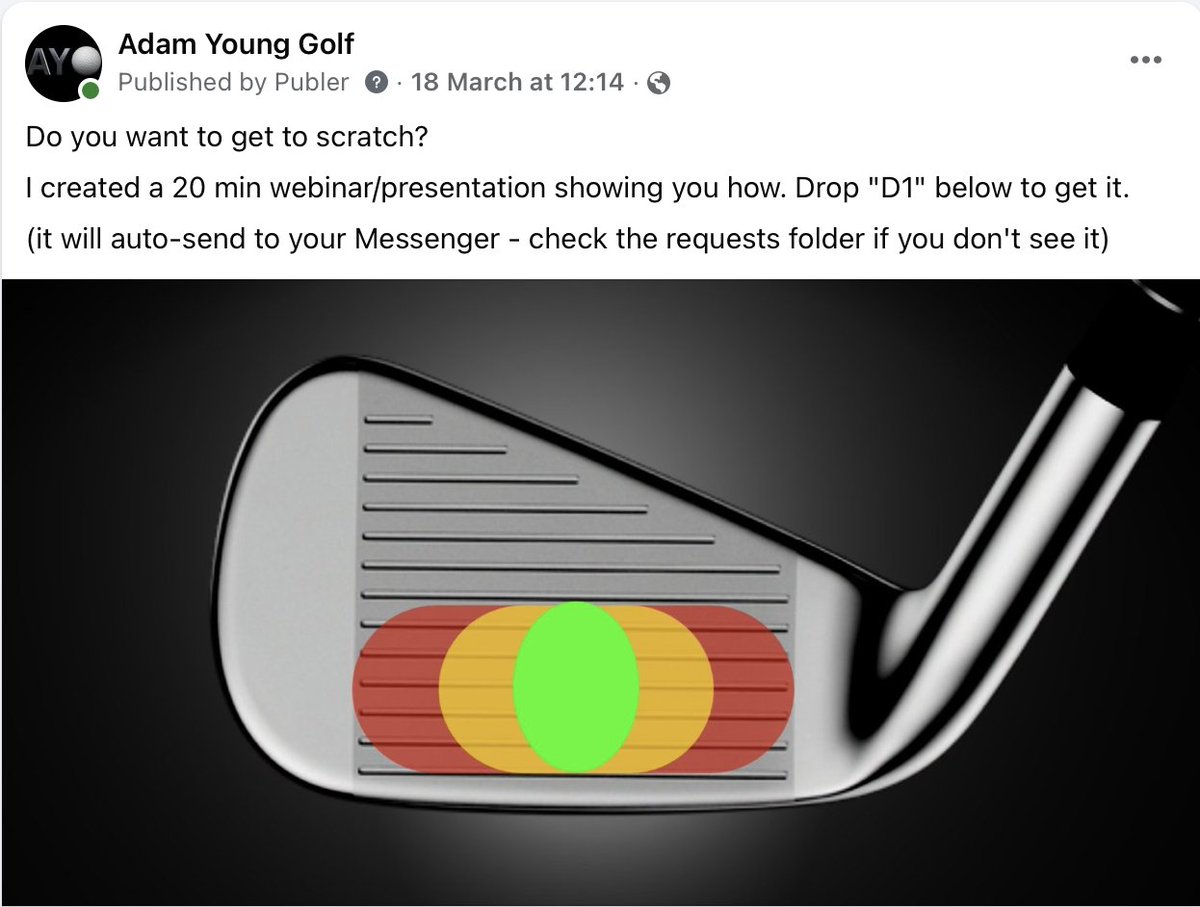
Do you want to get to scratch?
Say D1 below and I'll DM you the webinar.
English

@arian_ghashghai what's crazy is that i rated all the lower valuations lower in my internal scoring. perhaps b/c they weren't as high momentum / consensus and i was therefore uncertain.
but i absolutely took the risk *because* they were lower valuation.
English
crazy anecdote from my 2024 pre-seed investments:
9/14 that raised at < $15M valuation raised uprounds (avg. ~3x multiple)
0/7 that raised at > $15M valuation raised uprounds
take what you will from this, but it's definitely saying something.
English
@rohitdotmittal This is why I’m building Villain Capital - bet on great companies in niche or perceived niche tams.
English

I like small markets.
The whole venture ecosystem is built around TAM expansion, and that's also one of the biggest reasons startups die - no TAM expansion.
Every pitch deck says the market is $50B (now trillions), every pitch is about land-and-expand. If you're not growing into a massive market, the assumption is that something is wrong with the business.
But a lot of founders build good products in markets that turn out to be $50M or $200M, not $5B.
The product works, the customers are happy. The revenue is real, it's just never going to be a venture-scale outcome.
Once that becomes clear, the founder enters this purgatory where VCs won't fund the next round, no acquirer sees a platform play, and the company isn't failing fast enough to shut down.
Nobody has a playbook for this.
VCs tell you to pivot into a bigger market.
Advisors tell you to find a different wedge.
Nobody tells you the obvious thing: you built a profitable business in a small market, and that's a good outcome if you think about it differently.
Founders end up stuck for years. They can't raise, and they can't find a buyer who wants anything less than platform scale.
But they can't shut down either, because the business still generates revenue and they need a paycheck. Some founders I've talked to have been trying to figure out what to do for over a year.
Every option they've been given assumes the market needs to be bigger than it is.
Small TAM, good product, retained customers, real revenue. That just works.
It may not be a billion-dollar outcome, but the founder can walk away with capital and the freedom to go build something in a market that fits what they want to do next.
English


I've been investing for 20+ years and have seen many 'too small' markets become multi-billion-dollar businesses. It happened with software for pharma companies in 2005 and software for HVAC businesses in 2008. The pattern is repeating with AI.
Veeva and ServiceTitan both started in markets VCs called too small in the 2000s. Today, one has a $33b market cap and the other "only" $7b.
To understand how AI will similarly expand markets, the on-prem to cloud transition is an underutilized mental model.
On-prem products lacked telemetry—you couldn't see how people used your software. Cloud (ie SaaS) made it easy to collect usage data. As a result, software became fundamentally better, so customers demanded much more of it. Initially, supplying it cost more (cloud margins were/are lower than on-prem), but the costs came down quickly. The new software equilibrium, where cloud demand met cloud supply, was a dramatically expanded software market.
It's important to note that even companies that arrived late to cloud still ended up doing fine. Microsoft and Oracle took years to figure it out, for example, yet ended up with massive cloud businesses. Meanwhile, early movers like Salesforce were forging huge SaaS franchises. The software was expanded, not simply redistributed, and the pie got bigger.
The same thing is happening with AI. AI native software is much better—easily by an order of magnitude. If the software is 10x better, people will want more of it. AI is fueling enormous growth in software demand. The costs of supplying AI-native software are higher than SaaS--just like SaaS was more expensive to provide than on-prem. Yet the costs to provide AI products will steadily fall with scale, just as happened with SaaS. The equilibrium for AI-powered software will be an order of magnitude higher than before. That's why a software market segment that appears small today could end up yielding a venture-scale market opportunity.
So how do you know which small markets will actually grow? It's tricky. In the 2010s, selling into legal and healthcare was difficult for SaaS startups. So you may have been skeptical about AI for these markets. That said, if you'd talked to the early customers of standouts like Abridge and Harvey, you would've found that they had customers rapturous with enthusiasm. I think that's the key signal.
For example, when the founder of Harvey decided to cold email Sam Altman, they'd built a very primitive legal AI using the OpenAI API. They tested it with lawyers and found it worked well. They then reached out to Sam, and OpenAI became the first investor in early 2023. They may not have even had many paying customers yet, but it was clear the product kicked *ss.
One important caveat: I wouldn't apply this to dying niches. Not even AI can make building SaaS for horse and buggy manufacturers a viable path.
But if there's some oxygen and signs of growth, even a small niche can become massive in the new, AI-powered software world.
English
Tyler Sosin retweetledi

The most important thing in this package is that the White House is now going after Obamacare's Medical Loss Ratio requirement.
Ending the MLR will enable a revolution in healthcare and it will constitute the largest anti-trust action in American history.
It has to be done.
The White House@WhiteHouse
THE GREAT HEALTHCARE PLAN. President Donald J. Trump unveils the Great Healthcare Plan to lower costs and deliver money directly to the American people. 🇺🇸
English
Tyler Sosin retweetledi

99% of the work that tradesmen did in 1800 has been completely mechanized and automated. It used to be that a carpenter literally had to shape logs into usable boards and studs and floor planks with hand tools far worse than what people can make now. They had no nail guns, they had no power saws, there were no powered planers to produce smooth flooring. Somehow, though, not only do carpenters still exist, but there are more than there were in 1800.
Even though 99% of the intellectual and physical labor people did in 1800 has been completely mechanized, we still all have jobs, even loads of jobs doing manual labor, even jobs doing white collar labor even though almost all white collar labor done in 1800 ceased to exist long ago.
Calculations had to be done by hand in 1800 by extremely smart and skilled people, even complicated engineering calculations. All accounting used to be done by hand. Every business had to employ legions of clerks who were not just literate but had to be quite skilled. (As recently as a century ago, there many large insurers and banks in the US that *each* employed *tens of thousands* of file clerks and accountants.)
Yet, even though all that skilled intellectual labor has been automated away, we still have plenty of work for intellectual labor for people to do.
I see lots of people say "AI is different, you just don't understand!" But I do understand; in the future, AI systems will be able to literally do everything a human can do. I fully understand that we will be able to build lots of AIs and robots, at a pace far faster than human population can grow. However, other humans can also do literally everything I can do and yet I still have work. Wants are unbounded; even with AI, labor will be finite.
The mystery that people need to explain here is not the future but the past; if your economic theory doesn't explain why it is that we don't have 99% unemployment today even though 99% of the work people used to do is long gone, then you can't even begin to think about the future.
Here is the key. The naive, zero-sum thinking approach says that the number of jobs is limited by the amount of work that needs to get done. This is utterly wrong. Instead, the correct claim is that the amount of work that can get done is limited by the number of minds and hands we have available.
The future will not be one of poverty with people displaced from work because there's literally nothing for people to do, it will be one of tremendous wealth and health. Just as we are now orders of magnitude wealthier than people in 1800 were, all because mechanization has increased the amount of stuff people can make with a given amount of labor, in the future we will be orders of magnitude wealthier and more comfortable still, because mechanization will continue to increase the amount of stuff we can produce with a given amount of labor.
The future isn't grim, it's glorious.
English
Tyler Sosin retweetledi

Don't worry, you're not bad at chess. You're actually bad at everything. Chess is just one of the only things with a good rating system.
English
Tyler Sosin retweetledi

I understand why many smart people feel this way but I’m not worried about this scenario one bit. In the heydays Google and Facebook there were similar predictions. Google was going to swallow the Internet, FB apps were going to replace everything etc. They weren’t the slow incumbents we think of them today. They were scary. I wasn’t around in Microsoft’s heydays but I bet it was similar.
One company to rule them all never works out. Especially in the application layer where every design decision is a trade off. That’s why even in the same category, you can have many successful companies based on minor differences. There isn’t one way to find restaurants, learn things, connect socially, organize an event or shop online. You can always find weaknesses of an existing service and build something better for certain customers.
If anything, the foundational model companies have much weaker moats than Google, FB and MS had. No models have a monopoly on anything. Distribution and capital is way more accessible for startups than it was 10-20 years ago.
OpenAI and Anthropic have some momentum right now. But when they’ve to compete in 10+ categories, you’ll be competing with a PM there, not their founders. These organizations also have significant cultural weaknesses you can leverage. Their coveted researchers want to solve math problems, not hear complaints from soccer moms in Ohio or compliance teams of regional hospitals.
So I’ll say game is on. You can’t win if you don’t play.
Yishan@yishan
My AI investment thesis is that every AI application startup is likely to be crushed by rapid expansion of the foundational model providers. App functionality will be added to the foundational models' offerings, because the big players aren't slow incumbents (it is wrong to apply the analogy of "fast startup, slow incumbent" here), they are just big. Far more so than with any other prior new technology, there is a massive and fast-moving wave that obsoletes every new app almost as fast as it can be invented. There is almost no time to build a company and scale it. There are two ways AI application startup founders can make money: - Make a flash-in-the-pan app that generates a ton of cash and bank the cash (my estimate is that you have about 12-18 months cashflow generation) - Make a good enough app that you get acquired by one of the big players for sufficient equity The situation is highly unstable - we don't know if it's going to crash or go to the moon but both scenarios make it very unlikely that any AI application startup will independently become a generational supercompany (baseline odds are low to begin with). The best odds are finding an application niche in a highly specialized field with extremely unique and specific data barriers, ideally ones relating to real atoms (hardware or world-related) data and not software/finance.
English
Tyler Sosin retweetledi

🚨 MIT just humiliated every major AI lab and nobody’s talking about it.
They built a new benchmark called WorldTest to see if AI actually understands the world… and the results are brutal.
Even the biggest models Claude, Gemini 2.5 Pro, OpenAI o3 got crushed by humans.
Here’s what makes it different:
WorldTest doesn’t check how well an AI predicts the next word or frame.
It measures if it can build an internal model of reality and use that to handle new situations.
They built AutumnBench 43 interactive worlds, 129 tasks where AIs must:
• Predict hidden parts of the world (masked-frame prediction)
• Plan multi-step actions to reach goals
• Detect when the rules of the environment suddenly change
Then they tested 517 humans vs the top models.
Humans dominated every category.
Even massive compute scaling barely helped.
The takeaway is wild:
Today’s AIs don’t understand environments they just pattern-match inside them. They don’t explore, revise beliefs, or experiment like humans do.
WorldTest might be the first benchmark that actually measures understanding, not memorization. And the gap it reveals isn’t small it’s the next grand challenge in AI cognition.
(Comment “Send” and I’ll DM you the paper 👇)

English
Tyler Sosin retweetledi

Mayor of Beijing: 🇨🇳
- PhD Engineering
- 30 yrs rising thru ranks of Peoples Bank of China
- 7 yrs experience Deputy Mayor
Mayor of NYC:🇺🇸
- Undergrad in African studies
- First job: NYC Mayor
GIF
English
Tyler Sosin retweetledi

Average US electricity price over the years, per Axios:

English
Tyler Sosin retweetledi

As a neurosurgeon I care a lot about road safety.
By now you’ve probably seen @Waymo’s stunning safety results (like 91% fewer serious crashes). But they didn’t just publish data headlines. They released the raw CSV files and data dictionaries.
I did a much deeper analysis. A fascinating story emerges when you analyze how they’re achieving this.
This isn’t incremental improvement - it’s categorical. We’re looking at the potential elimination of traffic deaths as a leading cause of mortality.
The intersection breakthrough: Waymo has essentially solved intersection crashes, with 95% fewer injury incidents than human drivers in the same locations. That’s transforming the deadliest driving scenario.
The national math: If every US vehicle performed like Waymo, we’d prevent 33,000-39,000 deaths annually and save $0.9-1.25 trillion in societal costs. Even partial adoption at 27% would save ~10,000 lives per year. In terms of magnitude, this would be the equivalent of eliminating every pedestrian death nationally in a year.
The physics signature: Here’s what fascinates me: 47% of Waymo’s contacts involve less than 1 mph delta-V. They’re not just avoiding crashes; they’re converting unavoidable incidents into gentle bumps. It’s like having physics itself on your side.
We’re not talking about marginal safety gains. The data represents a fundamental shift from harm reduction to harm prevention.
The methodology matters: I used their dynamic geographic benchmarks (comparing like-for-like road conditions) and verified the findings hold across San Francisco, Phoenix, LA, and Austin. The safety advantage actually increases in more complex urban environments.
Link to raw data below….
Notes on my approach:
Analysis based on 96 million miles of Waymo Rider-Only (RO) data through June 2025, utilizing Waymo's dynamic geographic benchmarks to compare Waymo Driver performance against human drivers under similar road conditions and operational design domains.
The projections for national impact (deaths prevented, societal costs) involve several assumptions. Given Waymo's zero reported fatalities, the direct serious injury reductions were mapped to national fatality statistics using established NHTSA-derived ratios that correlate serious injury crash rates with fatality rates. This extrapolation assumes that Waymo's observed serious injury prevention capability would translate proportionally to fatality prevention. Societal cost savings are estimated by applying average per-fatality and per-injury economic costs (e.g., medical, lost productivity, quality of life) as published by NHTSA, scaling these national averages to the projected number of avoided fatalities and injuries based on Waymo's safety performance. These figures represent the potential annual impact if the Waymo Driver's safety profile were widely integrated into the national fleet.
@ethanteicher

English
@endowment_eddie @jmj How about purposefully investing in businesses / ideas pursuing smaller TAMs? Tam seems like the issue no large firm can get comfortable w /, yet is also one of the biggest sources of omission errors.
English

I’m not sure that there is anything truly contrarian in venture anymore—@jmj said it well.
The closest thing to contrarian is consumer yet there’s multiple specialist GPs (seed and multistage) and most platforms are more than capable of taking anything down that breaks out.
English

Amazing podcast by my brother and longtime thought partner @tysosin. He’s taking a very thoughtful approach to the VC business and I’m excited for him.
overcast.fm/+ABCkx1LiaVY
English
Tyler Sosin retweetledi

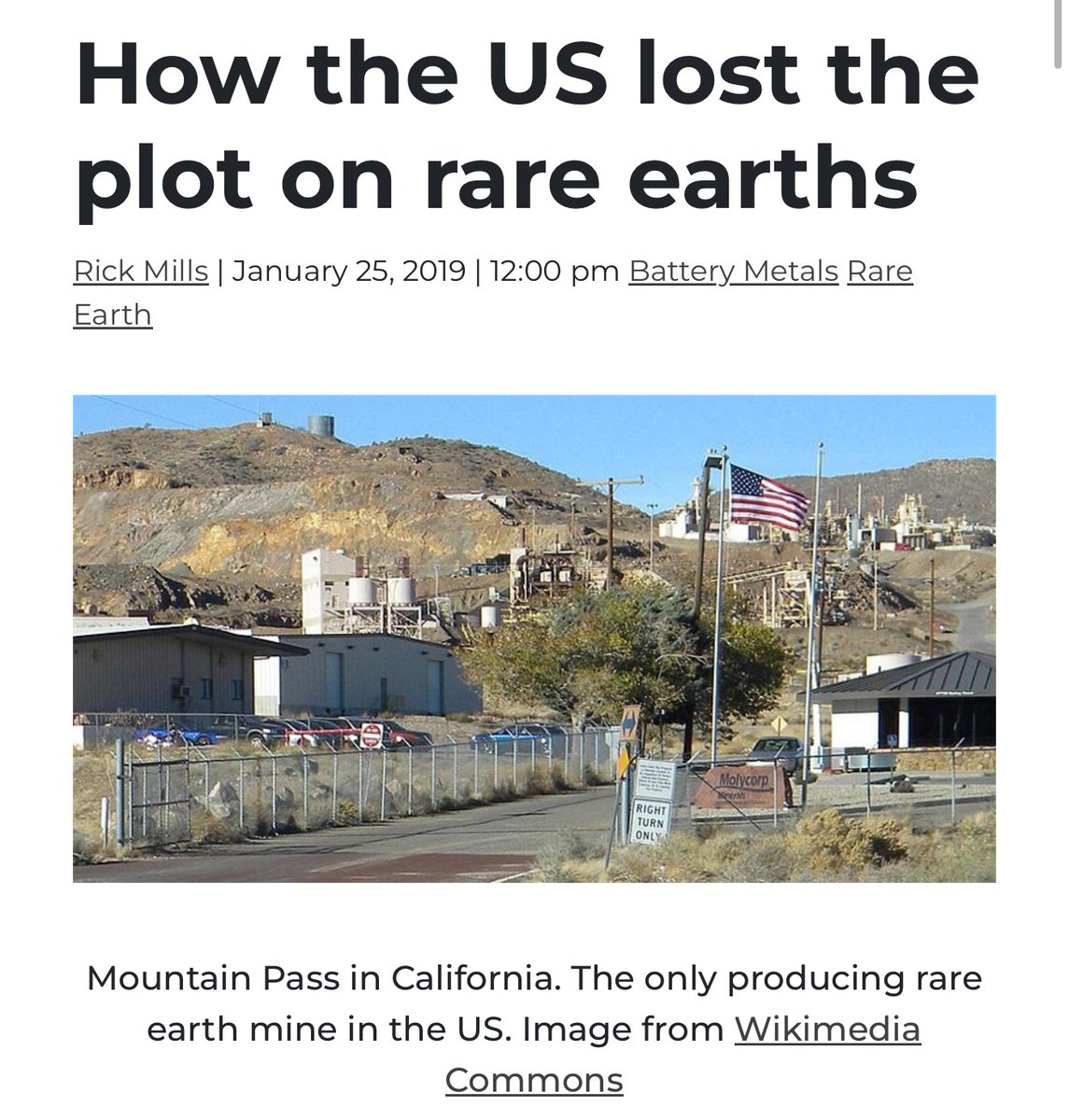
How we screwed ourselves on rare earth elements
TK;DR: Jimmy Effing Carter
“In 1980, a mis-classification of rare earths had catastrophic consequences for US rare earth mining. The Nuclear Regulatory Commission and the International Regulatory Agency placed rare earth mining under the same regulations as mining thorium – a radioactive element that drops out when processing heavy rare earth minerals like monazite.”
“New, onerous regulations on thorium made the mining and refining of thorium-bearing rare earth elements risky. Over the next two decades, the US rare earth mining industry collapsed. Defense One notes that, even though American mining companies extract enough rare earth ore, through mining other metals, to meet 85% of global demand, it is discarded because the regulations make it uneconomic to mine. How’s that for irony.”
English
@nicochristie I love this idea. As a solo GP need all of the financial analysis automation I can get. Would love to try to the product if possible.
English

Introducing Shortcut — the first superhuman Excel agent.
Shortcut one-shots most knowledge work tasks on Excel.
It even scores >80% on Excel World Championship Cases in ~10 minutes. That's 10x faster than humans.
Our early preview is live. Just comment for an invite code.
English
Tyler Sosin retweetledi
Reviewing a completed trial in the US takes 10-12 months. In China it’s 60 days.
Preclinical work takes 3+ years in the US. Better regulatory processes in China get it done in 1-1.5 years.
It can’t be overemphasized how dire this is and how aggressive we need HHS / FDA to be.
English