
Uwe Friedrichsen

12.8K posts

Uwe Friedrichsen banner
Uwe Friedrichsen

Uwe Friedrichsen

@ufried

Dot Connector. Cartographer of uncharted territory. Keeper of timeless wisdom. Translator between floors. Curious. Introvert. Works at @codecentric

Germany Katılım Mart 2010
117 Takip Edilen3.5K Takipçiler
Uwe Friedrichsen retweetledi

Andreas Kirsch 🇺🇦
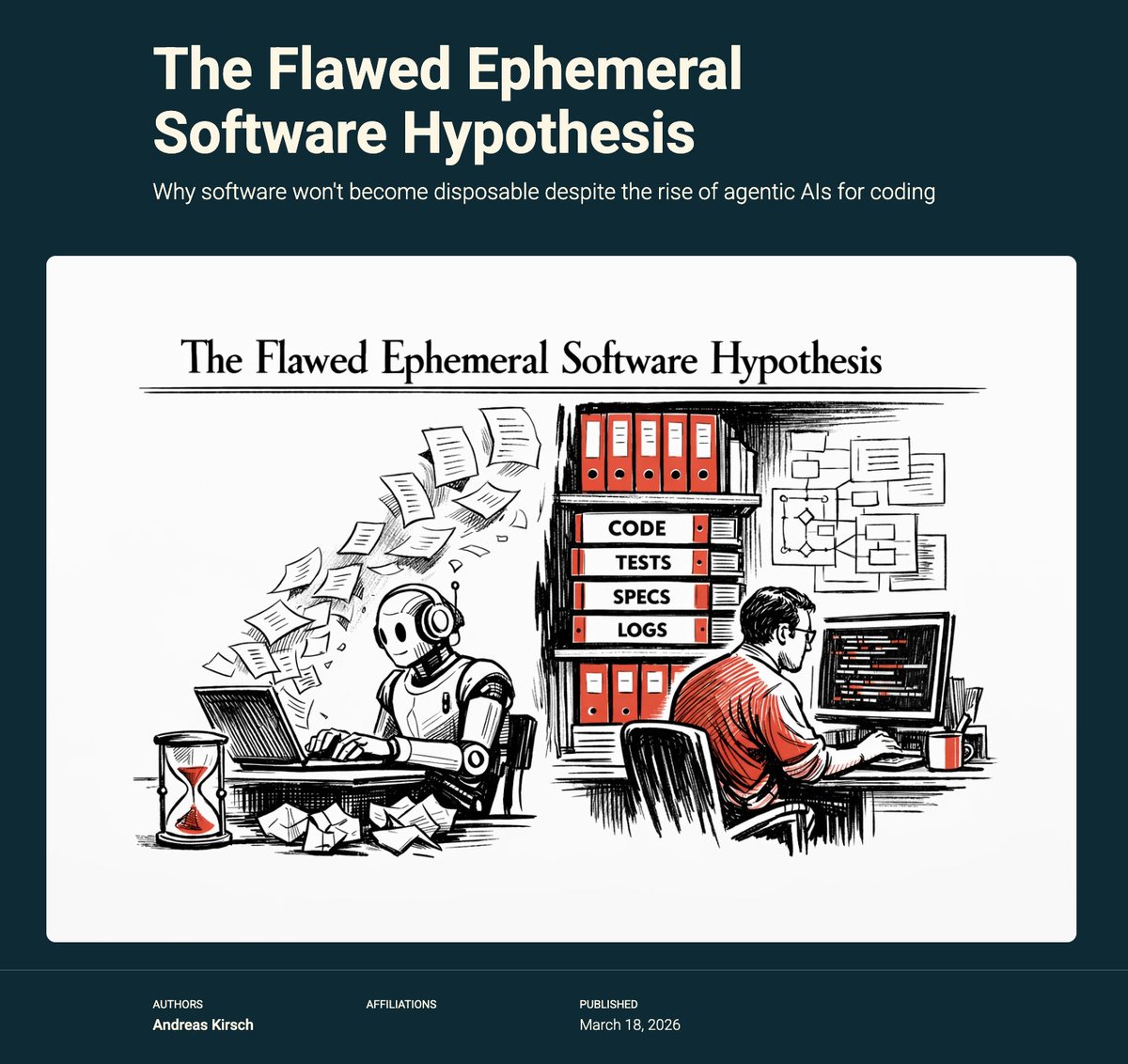
A while back, Andrej Karpathy said the app store will be replaced by generated, disposable software," and Amjad Masad predicted that the value of all application software will go to zero I think this "ephemeral software hypothesis" is wrong, though, and I want to explain why:
Andreas Kirsch 🇺🇦 tweet media
English
17
59
383
31.2K
Uwe Friedrichsen
Uwe Friedrichsen@ufried·
i released a new blog post discussing the increasing importance of resilience as ai taking over software development starts to increase rigidity and fragility in most companies. enjoy if you like ... ;) ufried.com/blog/in_search…
English
1
3
5
322
Uwe Friedrichsen retweetledi
Dr Kareem Carr
Dr Kareem Carr@kareem_carr·
There's a toxic culture coming out of the AI industry that keeps trying to get us not to think. The message is everywhere. Don’t read the code, just vibe-code. Don’t try to understand all the text, just let AI summarize it. Don’t bother educating yourself, it’s too late. Don’t worry about the errors. Trust that everything will be fixed in the next version. The theme is the same. Don’t think too hard. Just keep swallowing the slop.
English
389
2.1K
9.4K
358.2K
Uwe Friedrichsen
Uwe Friedrichsen@ufried·
@grafjo yup, as i wrote, at least in software dev the first inflection point already has come, even if the tooling is still immature. the downside of this unusual situation is that many people need to learn stuff today they will not need in the future anymore as tooling will mature.
English
0
0
0
14
Johannes Graf
Johannes Graf@grafjo·
@ufried With the current pace of improvement, just watching isn’t enough. Starting with daily tasks like code reviews: you do it, and your coding agent does it too. Cut through the marketing noise and see for yourself what actually works.
English
1
0
0
23
Uwe Friedrichsen
Uwe Friedrichsen@ufried·
released a new blog post discussing why you are not "left behind" if you do not become an AI-based software development expert right now, but still need to learn AI-based software development. sounds paradoxical? yes, the world sometimes is ;) enjoy ;) ufried.com/blog/not_left_…
English
3
1
6
411
Uwe Friedrichsen
Uwe Friedrichsen@ufried·
@MaggieL @scalajos good point :) i did not look after them for a long time. i am so used to the theme that i basically overlook them. i will have a look. however, it is a quite old theme (from 2020) - curious, if it offers any more recent social media options :) thx for the hint!
English
1
0
1
30
Maggie Leber
Maggie Leber@MaggieL·
@ufried @scalajos Would feel more reassured about not being left behind if the social media icons weren't stale...😄
Maggie Leber tweet media
English
1
0
0
51
Uwe Friedrichsen retweetledi
Richard Seroter
Richard Seroter@rseroter·
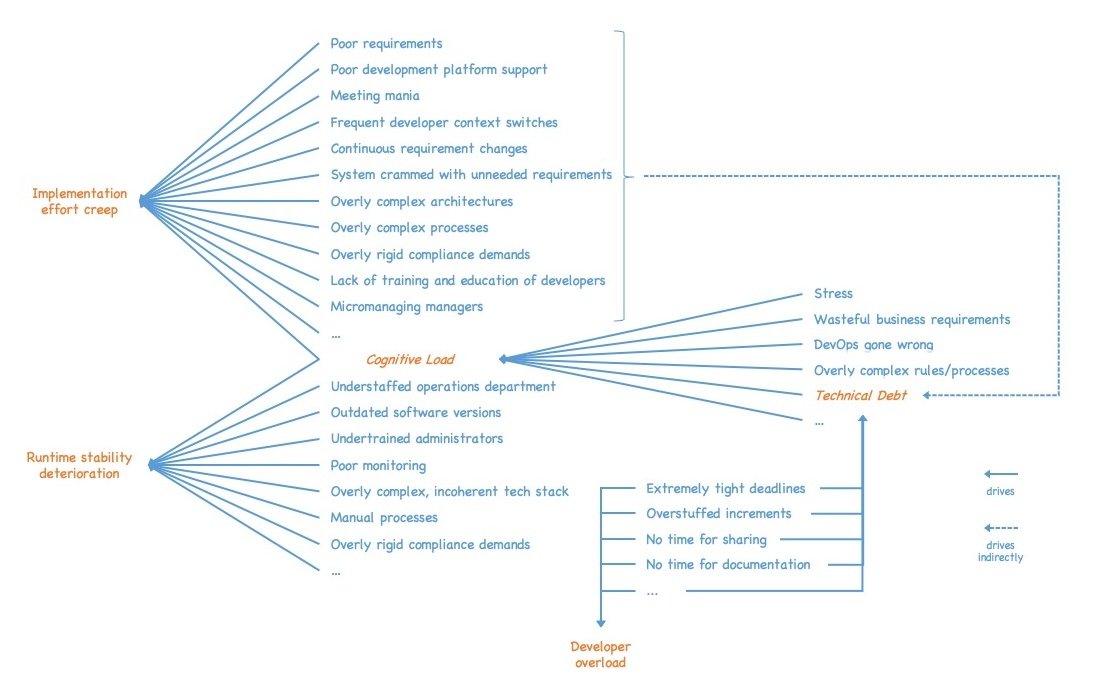
"Thus, if we want to reduce implementation effort creep and runtime stability deterioration, solely looking at technical debt is not enough. Technical debt is just one piece of the puzzle ..." ufried.com/blog/forget_te… < I really liked the insights from @ufried here
Richard Seroter tweet media
English
0
1
7
600
Uwe Friedrichsen
Uwe Friedrichsen@ufried·
released a new blog post, discussing the concept of "technical debt", how it is about much more than technical debt alone, what we actually try to achieve – resulting in an extensive graph of detrimental drivers we need to consider. enjoy if you like ;) ufried.com/blog/forget_te…
English
0
4
8
445
Uwe Friedrichsen
Uwe Friedrichsen@ufried·
i released a new blog post discussing that based on research we default to add things when solving problems instead of subtracting things, what it means for us and IT in general. enjoy if you like ... ;) ufried.com/blog/addition_…
English
1
1
3
210
Uwe Friedrichsen retweetledi
Allen Holub. https://linkedIn.com/in/allenholub
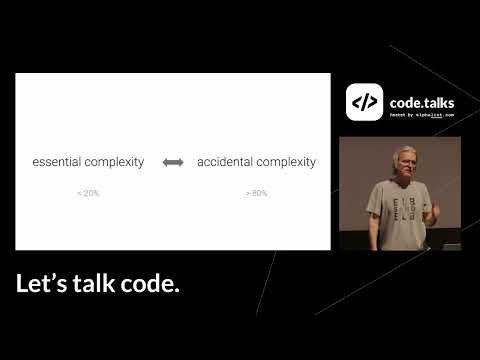
Proof is overrated. This is a brilliant talk by Rory Sutherland: [youtu.be/lhlS-Wds02M?si…] where he makes two essential points. First, it's a huge problem when "rational" people get veto power over creative, innovative, "irrational" people. Second, you excel, not by copying things that somebody does, but by doing the things they don't do—by surprising people in a good way. This observation is true in both marketing and process improvement. Sutherland looks at bees to demonstrate the problem. When a bee finds pollen, it comes back to the hive and communicates where the food is. The rest of the bees then hare off to that location and start harvesting. About 20% of them, however, don't do that at all. They continue wandering around at random seeing what there is to be seen (and trying things nobody's tried). Without those forragers, the hive dies. Always. No matter how rich the pollen source is, you eventually exhaust the supply. You cannot fix the problem with 10x bees. Improving the route makes no difference. Your pollen-collection metrics are outstanding—improving even—up to the point of collapse. The hive needs innovation to survive. In other words, any "improvement" strategy that involves continuing to do what you do now with a laser focus on improving the metrics will fail. True improvement comes from that 20% of the hive that's off looking for new things. Without that 20%, the hive dies. Saying "what we do now 'works'" just digs you deeper. Yes, it will work, up to the point of collapse. Unfortunately, the rational bean counters who control most organizations automatically veto any real improvement, because there are no metrics for a novel approach. Nobody's done it, yet, at least not inside the organization—outside metrics are always discounted by "we can'd do that here"—so there are no numbers. The "proof" they demand is impossible. There is nothing to measure. Consider the "Drive" (self-determination theory) principles: connectedness, autonmy, mastery, purpose. There are no metrics for those principles, but implementing them improves performance dramatically, vastly more than working on velocity or improving metrics. But try to suggest that we focus on happiness, and you'll be shot down as an irrational dreamer within seconds. Even saying "happiness will improve the metrics" will be discounted with "show me proof." The fact that the "rational" people have veto power over creative people is a huge problem. Follow the outliers.
YouTube video
YouTube
English
3
8
46
6.8K
Uwe Friedrichsen
Uwe Friedrichsen@ufried·
@BrianKnoles that sounds very interesting. i will definitely look into it (need to find a few quiet minutes to read the article). thanks a lot for the hint and the link!
English
0
0
1
10
Brian Knoles
Brian Knoles@BrianKnoles·
@ufried This series is great! I've been reading about joint cognitive systems to apply to LLM assisted coding, and that's exactly what you're describing. Have you heard of naturalistic decision making? I think it's relevant to the solution space. Here's a intro: commoncog.com/how-to-learn-t…
English
1
0
1
76
Uwe Friedrichsen
Uwe Friedrichsen@ufried·
i just released the 2nd blog post discussing the well-known paper "the ironies of automation" and what its findings mean for the current agentic ai automation move (spoiler: some more questions we still need to take care of). enjoy if you like ... ;) ufried.com/blog/ironies_o…
English
2
2
7
388
Uwe Friedrichsen retweetledi
nxthompson
nxthompson@nxthompson·
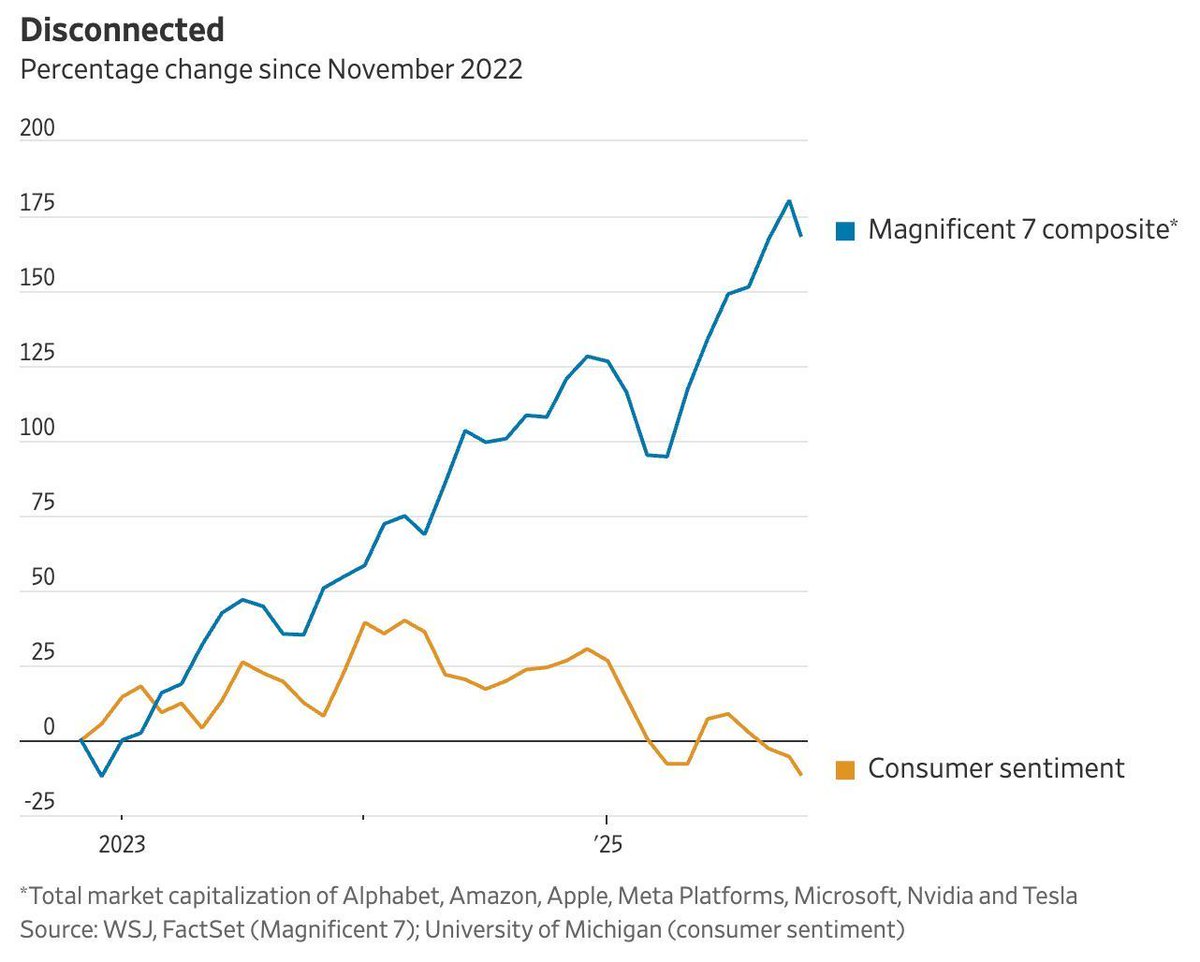
2025 in a nutshell. Investors have never been more optimistic about the future of AI. And normal people have never been more pessimistic about what it means for them. buff.ly/TzkZrXK
nxthompson tweet media
English
14
42
209
31.8K
Uwe Friedrichsen
Uwe Friedrichsen@ufried·
released a new blog post (part 1 of 2) discussing the famous paper "the ironies of automation" and what its findings mean for the current agentic ai automation move (spoiler: quite some questions we still need to find answers for): ufried.com/blog/ironies_o… enjoy if you like ;)
English
2
0
4
288
Uwe Friedrichsen
Uwe Friedrichsen@ufried·
interesting take!
Aakash Gupta@aakashgupta

All the analysts forever writing about OpenAI vs Anthropic vs Google are missing the real story that already happened. 80% of startups pitching Andreessen Horowitz are running on Chinese open-source models. Not OpenAI. Not Anthropic. Chinese models like DeepSeek that cost 214x less per token. The math here breaks everything. DeepSeek trained its model for $5 million. OpenAI spent $500 million per six-month training cycle for GPT-5. That gap translates directly to API pricing where startups pay $0.14 per million tokens versus $30 for GPT-4. For a startup burning through 100 million tokens monthly, that’s $1,400 versus $300,000. The difference between 18 months of runway and 3 months. This tells you the real constraint in AI was never capability. Chinese models are matching GPT-4 on coding benchmarks while costing 2% as much. The constraint was always burn rate, and China solved it first by optimizing for efficiency instead of chasing AGI. The second-order effect gets interesting. When your infrastructure costs drop 98%, you can actually afford to fine-tune models for your specific use case. American startups paying OpenAI’s API rates are stuck with generic models. Chinese open-source users are building specialized variants. Silicon Valley thought the moat was model quality. Turns out the moat was cost structure, and they built it backwards. When a16z partner Anjney Midha says “it’s really China’s game right now” in open-source, he’s not talking about benchmarks. He’s talking about who controls the default foundation layer. Now look at where this goes. American AI labs are optimizing for AGI and superintelligence. Raising billions to chase the theoretical ceiling. China optimized for distribution and adoption. Making AI cheap enough to become infrastructure. All 16 top-ranked open-source models are Chinese. DeepSeek, Qwen, Yi. The models actually being deployed at scale. While OpenAI charges premium rates for exclusive access, Chinese labs are flooding the zone with free alternatives that work. The third-order cascade is what changes everything. Every startup that survives the next funding winter will have optimized around Chinese open-source as default infrastructure. Not as a China strategy. As a survival strategy. That 80% number at a16z only goes one direction. When you’re a seed-stage founder choosing between 18 months of runway or 3 months, economics beats nationalism every time. America is still competing to build the best model. China already won the race to build the one everyone uses.

English
0
0
1
253
Uwe Friedrichsen
Uwe Friedrichsen@ufried·
simple observation, often hard to implement: if you want to implement change in your organization, you must be willing to sacrifice the heroes of your current organization. (not always but) very often they are preservers of the status quo because change threatens their status.
English
1
1
2
177
Uwe Friedrichsen retweetledi
Work Chronicles
Work Chronicles@_workchronicles·
(comic) Actionable insights, ignored daily
Work Chronicles tweet media
English
2
76
645
16.2K