Campbell@boomers_ass
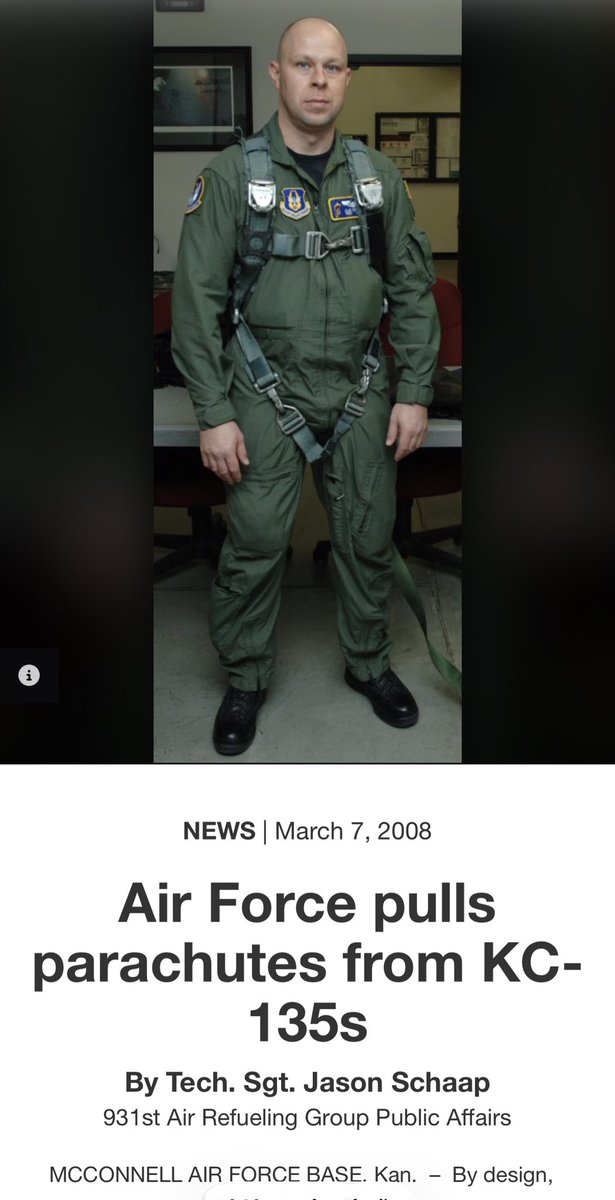
Your take on this subject surprises me. Weren't you a KC-135 Aircraft Commander? We stopped flying with parachutes around 1994 at Loring AFB, and there were other Active Duty units that did the same. It wasn't until 2008 that it was finally written into the command-wide regulations.
I don't recall ever hearing any crewmember lamenting the fact that we didn't have parachutes anymore.
Matter of fact, as the person responsible for checking to see that the parachutes were in good order during preflight, I don't recall any other crew positions ever even looking at the parachutes.
The parachutes, as I'm sure you know, were stored at the rear of the aircraft, on the right-hand side, just above the boom pod—roughly 100 feet away from where the pilot, copilot, and navigator sit in the cockpit during flight. The process to put one on and then properly tighten it took a minimum of two or three minutes. Helmets would be required at high altitude, and that would add a bit more time.
In the event that the aircraft departed controlled flight, the chance of walking down the cargo bay to retrieve your parachute is zero. And I can tell you that as someone who walked in the cargo compartment in severe turbulence, although never during uncontrolled flight.
If the aircraft was still flying but severely crippled, my chances as a boom operator would be better—but what pilot would vacate their seat for several minutes to put on a parachute when the airplane is barely controllable? How much time do you have before "crippled" turns into "departed from controlled flight"?
In the event of running out of fuel, it's pretty much the same: plenty of time in theory, so the boom operator might get theirs on and even bail out. One pilot might risk getting out of their seat to don a chute, but the other? How much time do you have before low fuel becomes no fuel?
I flew 324 sorties for 1,353 hours in the KC-135A and R models over four years. I did the airbridge at the Azores in Aug '90 and Desert Shield. I rotated home on a fluke and missed the war, only to go right back afterward for multiple deployments. I saw near misses during rendezvous, I saw unauthorized formation flying, I saw more than a couple of breakaways, we had an F-15 do a barrel roll around our jet, and I saw more than a couple of in-flight emergencies. I've also seen both 2 gees and -0.5 gees in the aircraft. I've seen initial buffet demonstrations.
Now, I realize that there were a whole lot of other tanker crewmembers out there who had more years, more hours, and more experience, but I have never talked to anyone who had ever considered jumping out of the aircraft. And I never considered it myself as even a possibility.
The only time I ever heard of bailouts being discussed in a serious manner was during EWO mission discussions, where the possibility of giving our receiver all of our gas arose because they needed it to get to the target. In that case, our plan was to fly the jet clear of the receiver until it was close to running out of fuel and then bail out. That's it. That is the only serious discussion I ever heard. Of course, pulling alert had ended about 10-15 years before you started flying the KC-135.
Now, as I recall, there were several arguments for removing them. The primary was the workload associated with their upkeep. We had about 30 aircraft on base. Each aircraft had 8 parachutes. That's around 240 parachutes.
By the way, these parachutes run between $5,000–$10,000 each. So we're talking an inventory value of somewhere between $1.2–$2.4 million. Maybe large contracts bring that price down, or maybe not.
Each parachute had to be inspected roughly every 180 days. At 180 days, it had to be pulled from the aircraft, inspected, and then repacked. That takes roughly three hours.
Extrapolate this out, and it would take on average 23 hours a week for one Life Support person. That's a fair amount of work. But this doesn't include the effort required to go out and inspect the parachutes in the aircraft or keeping track of them as aircraft deploy and return. Of course, there are other items on the jet that Life Support also has to inspect, so these tasks would be combined.
Point is: We are not talking about a trivial amount of work or money to purchase, install, and maintain these parachutes.
Scale it up to the fleet: roughly 376 jets, 3,008 parachutes... carry the two... yeah... got it... that's $15 to $30 million.
And the likelihood of them being used? Well, let's see now, the fleet has been flying for 69 years, since 1957. A halfway decent estimate as to how many flight hours have been flown: 22 million flight hours.
Maybe sortie counts would be a better metric in this case, though. So, if we guesstimate an average sortie is 6.5 hours, that would work out to 3.38 million sorties.
And how many bailouts or attempted bailouts am I aware of? THREE. Maybe I don't know about all of them. Maybe there were a few more. Maybe there were some where the crew didn't tell anyone because they'd get in trouble.
You're 74 times more likely to be struck by lightning once in your lifetime than to need a bailout on a single KC-135 sortie.
You're about twice as likely to become a billionaire than to need a bailout on a single KC-135 sortie.
You're about twice as likely to win an Olympic medal than to need a bailout on a single KC-135 sortie.
I asked Grok to crunch some numbers about my flight time, and it says "This means you had about a 0.02875% chance (or roughly 1 in 3,478 odds) of encountering at least one bailout scenario over your 324 flights."
While I may be doing napkin math with some of these numbers, the overall concept is pretty solid. Do you think this rises to the level of an 'insane decision' and 'unforgivable'?'
Cause I don't.