
Sabitlenmiş Tweet
chris.eth
1.7K posts


chris.eth
@undefinedza
Founder @summerstonexyz @graphopsxyz. Council @graphprotocol. Deep in the trenches of web3 data, infrastructure, stablecoins and decentralized finance.
🌍 Katılım Haziran 2009
4.4K Takip Edilen2.4K Takipçiler

chris.eth retweetledi

Finally able to talk about what I've been heads-down on for 6 months at @nvidia 🦀⚡
We just open-sourced cuda-oxide — an experimental rustc backend that lets you write CUDA kernels in pure Rust.
No DSLs. No FFI. No source-to-source step. Single source.
Short🧵👇

English
chris.eth retweetledi

Tycho's 2026 timeline:
➡️Q1: Private MVP with @GraphOpsxyz leading development
➡️Q2: Public beta, expanded access to real-time DEX liquidity data
➡️Q4: Full Horizon-based protocol integration
Tycho is built on Substreams and designed for trading systems, solvers, and any application that needs current onchain liquidity state without running the infrastructure to produce it.
The Graph@graphprotocol
English
chris.eth retweetledi

A milestone day for clinical trial innovation.
We’re announcing the first real-time clinical trials, where @US_FDA can see data signals and endpoints in real time. A quick explainer:
English

Ornstein-Hermes-27B-MLX live
huggingface.co/GestaltLabs/Or…
huggingface.co/GestaltLabs/Or…
huggingface.co/GestaltLabs/Or…
huggingface.co/GestaltLabs/Or…

English
Ornstein-Hermes-3.6-27B @NousResearch Hermes tool calling improved!
huggingface.co/GestaltLabs/Or…
huggingface.co/GestaltLabs/Or…

English
chris.eth retweetledi

Solver views of onchain liquidity go stale in seconds.
Tycho by @PropellerHeads tracks liquidity changes across DEXs and streams real-time updates.
Today, we are running a Tycho endpoint MVP with a roadmap to bring Tycho to @graphprotocol!
The Graph@graphprotocol
English
chris.eth retweetledi

🚀 Meet Qwen3.6-27B, our latest dense, open-source model, packing flagship-level coding power!
Yes, 27B, and Qwen3.6-27B punches way above its weight. 👇
What's new:
🧠 Outstanding agentic coding — surpasses Qwen3.5-397B-A17B across all major coding benchmarks
💡 Strong reasoning across text & multimodal tasks
🔄 Supports thinking & non-thinking modes
✅ Apache 2.0 — fully open, fully yours
Smaller model. Bigger results. Community's favorite. ❤️
We can't wait to see what you build with Qwen3.6-27B! 👀
🔗👇
Blog: qwen.ai/blog?id=qwen3.…
Qwen Studio: chat.qwen.ai/?models=qwen3.…
Github: github.com/QwenLM/Qwen3.6
Hugging Face:
huggingface.co/Qwen/Qwen3.6-2…
huggingface.co/Qwen/Qwen3.6-2…
ModelScope:
modelscope.cn/models/Qwen/Qw…
modelscope.cn/models/Qwen/Qw…

English
@punishedfounder pls expand to research psychedelics pnas.org/doi/10.1073/pn…
English
@bryan_johnson bryan please include a link to the research in a reply... otherwise you're just engagement farming
English

One dose:
> 46% more dendritic spines in prefrontal cortex
> 100x more potent than ketamine as an antidepressant
What is it?
LSD with a two atom swap.
> no trip
> no hallucinations
> no schizophrenia signature
It's called JRT.

English
chris.eth retweetledi

with stablecoin markets beginning to become illiquid, the situation is now entering a more dangerous stage imo
to break down the driving factors:
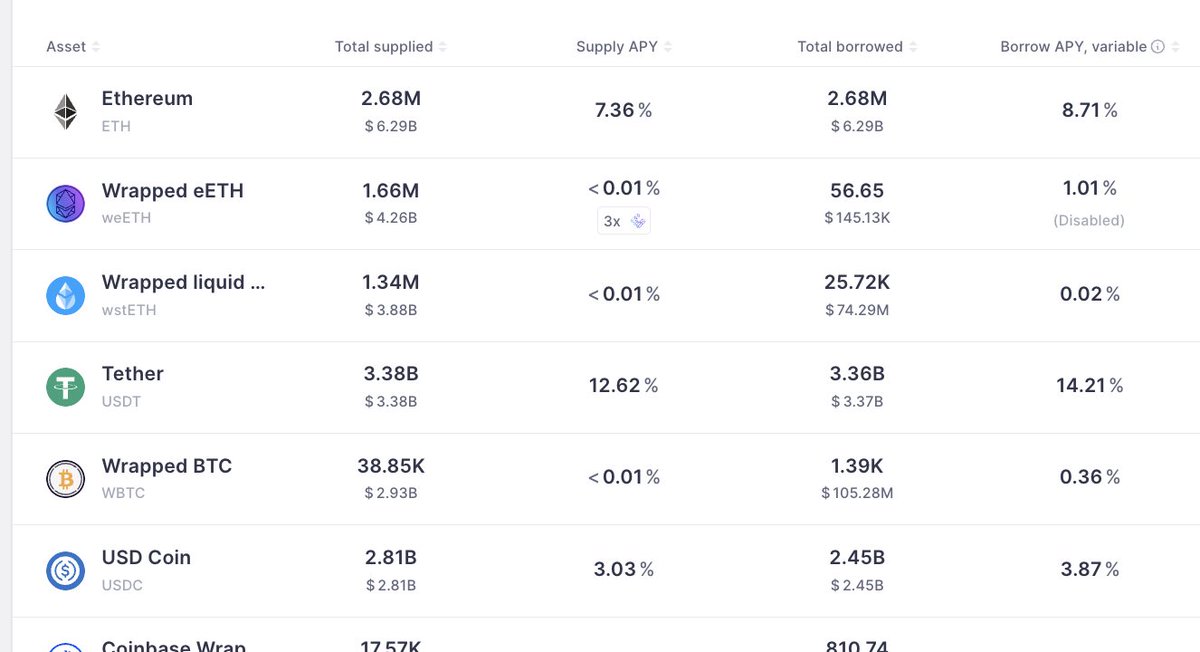
the ETH market is ~16.5% backed by rsETH, and rsETH backed loans could see up to 10-15% haircut in emode if losses are socialized equally on mainnet & external chains, leaving 2-3% residual haircut for ETH suppliers after wiping out umbrella
ETH suppliers are naturally incentivized to get out ASAP to avoid this, so utilization is pinned at 100%, and borrow rates are not high enough to incentivized repayment of unrelated LST loops (wstETH, weETH) to free up liquidity
because it is impossible to withdraw ETH, users borrowing stables like USDT against ETH collateral cant unwind their position even when the rates for stablecoin borrowing start to spike, which severs the typical incentives scheme keeping these markets healthy
now we have 2 unhealthy incentives based on the markets becoming locked at 100% utilization
1) ETH holders cannot unwind their positions to maintain healthy LTVs, and liquidators cant withdraw/sell collateral to close positions atomically, meaning that ETHUSD price drop could potentially cause bad debt
2) users supplying USDT have a perverse incentive to max-borrow other stablecoins as a way of exiting, the position has positive carry (for now) so the optionality has low cost, while if conditions worsen they can get at least 75% of their position value out of the market
bottom line is, for these pooled/rehypothecated lending markets to function properly, liquidity must be preserved AT ALL COSTS. recent slope2 changes nerfing Aave's max borrow rates are having a negative effect and significantly increasing the risk of cascading market failure
English


I want to do this.
I have a spark for local processing (I even sell them: dappnode.com/collections/ai… )
Who has a mini sequencing machine?
Seth Howes@SethSHowes
I’ve wanted to do this for a decade. But I never did - I refuse to give any company my DNA. It is me. So this week I sequenced my genome entirely at home. Literally on my kitchen table. I never exposed my DNA sequence to the internet. Not at any point. I used a MinION to do the sequencing (it’s smaller + weighs less than an iPhone). I used open-source DNA models for the analysis (Evo2 and AlphaGenome) running locally on a DGX Spark and Mac Studio. I traced mechanisms behind my family’s multigenerational autoimmune conditions that no clinician has been able to understand. When I set out to do this I didn’t know if it would actually work. It does. Your genome is the most private data you will ever have. You probably shouldn’t let it leave your house.
English
we’re so back
it’s so over
Claude@claudeai
Introducing Claude Opus 4.7, our most capable Opus model yet. It handles long-running tasks with more rigor, follows instructions more precisely, and verifies its own outputs before reporting back. You can hand off your hardest work with less supervision.
English