

Nick
77.6K posts
Nick
@upRootNutrition
Nutrition science blogger. Creator of the nutriDex. Certified djentleman. Debate bro.
Winnipeg, Manitoba Katılım Nisan 2017
370 Takip Edilen9.7K Takipçiler

If your values are oriented in any meaningful way toward believing that a life without struggling, hardship, or pain is somehow unvirtuous, then you have one of the most unrelatable minds I can imagine—to the point where I'd probably just consider you to be basically evil.
English

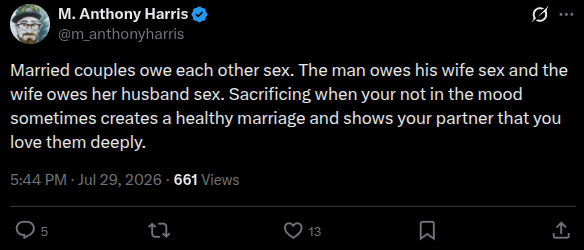
You are NEVER entitled to your spouse's body.
Mutual consent is a must.
English
Nick retweetledi


Oh, hi there, Nutrition Twitter! It's been a while! How've you been? Still wracked with crippling health anxiety and coping about it with sciencey-sounding words and grossly misplaced confidence?
Dr. Rhonda Patrick@foundmyfitness
I don't add bananas to my smoothies. Why? Not because bananas are bad (I love bananas). They contain polyphenol oxidase, an enzyme that can break down polyphenols. And studies suggest that when you add banana to a blueberry smoothie, you may absorb fewer of the beneficial polyphenols from the berries! So instead, I use avocado. It gives the smoothie the same creamy texture with the bonus of monounsaturated fat in avocado, which can increase absorption of carotenoids like lutein and zeaxanthin from kale - nutrients important for eye and brain health. I talked about this recently on my appearance on The Mel Robbins Podcast.
English

When we're viewing fiction, some suspension of disbelief is typically required in order to accept the narrative. But the demanded scope of that suspended disbelief has to compellingly fit what's being offered to us. With this particular historical fiction, the scope demanded of the audience, for many, was too wide given expectations the material itself that had been established over milenna.
In this case, the audience was implicitly expected to accept that there was some massive rewrite of the geopolitical and cultural history between Africa and Europe, such that Helen of Troy could be black. The scope was too wide for many, and those audiences weren't buying it. The deviation from historical accuracy was just too orthogonal, and literally just came across as political. And once you've lost the audience on that front, don't expect them to accept the trans casting choice as anything other than political either.
Just to help pump your intuitions here, would you similarly defend an historical fiction where Martin Luther King Jr was made a Japanese woman because the film producers "prioritized talent rather than race/gender"?
bob's burgers urbanist 🐿️@yhdistyminen
It seems like the film's advertising did basically everything right. There was no "muh diversity" or "decolonizing the Odyssey" or whatever, just regular casting that prioritized talent rather than race/gender ID/etc. Didn't matter, the chuds still pissed themselves with anger
English
@yhdistyminen Sure, but the claim was never that most people react that way, only that some people did and their reasoning (as I understand it) is coherent.
English

@upRootNutrition Sure, in principle. Empirically, "an ancient Greek woman was black" does not cross that threshold for most people. There is a rich historic tradition in the Anglo-American world of black actors playing traditionally white roles
English
@yhdistyminen Both can be weird to wildly different degrees while still both passing the threshold of what is too weird to take seriously.
English
@upRootNutrition Idk about "best" but "MLK is talking about how hard it is to be a black man, despite the fact that he is obviously a Japanese woman" would be much weirder than than "one of the women in Greece 3,000 years ago was black "
English
@KrampusSnail It's not clear what point you're trying to make. Were there no canonical depictions or descriptions of these individuals?
English
@upRootNutrition Historically, what color were Zeus' daughters? When I look back in history to try to find daughters of Zeus I'm having trouble finding any.
English

The issue was not that Helen was Black. Nobody minded Black Calypso in the 1990s Odyssey. Nobody would have minded a young Halle Berry being Helen.
The issue was Lupita. A lovely woman, but not a conventional beauty (it’s ok! I’m not a conventional beauty either!)
Nick@upRootNutrition
When we're viewing fiction, some suspension of disbelief is typically required in order to accept the narrative. But the demanded scope of that suspended disbelief has to compellingly fit what's being offered to us. With this particular historical fiction, the scope demanded of the audience, for many, was too wide given expectations the material itself that had been established over milenna. In this case, the audience was implicitly expected to accept that there was some massive rewrite of the geopolitical and cultural history between Africa and Europe, such that Helen of Troy could be black. The scope was too wide for many, and those audiences weren't buying it. The deviation from historical accuracy was just too orthogonal, and literally just came across as political. And once you've lost the audience on that front, don't expect them to accept the trans casting choice as anything other than political either. Just to help pump your intuitions here, would you similarly defend an historical fiction where Martin Luther King Jr was made a Japanese woman because the film producers "prioritized talent rather than race/gender"?
English
@MN_Vikings_Pete I don't have strong views about it one way or the other; I think both sides make strong cases and I'm not invested enough to care to solidify a view either way. It doesn't look like my sort of movie and I probably won't make any special effort to watch it. 🤷♂️
English

@upRootNutrition Hiding behind other people:
"In this case, the audience..."
What did YOU think about the casting? Don't tell me what you imagine other people think. Were YOU taken out of the movie because you saw a black person in a typically white role?
English
@MN_Vikings_Pete This is the position in question.
x.com/upRootNutritio…
Nick@upRootNutrition
When we're viewing fiction, some suspension of disbelief is typically required in order to accept the narrative. But the demanded scope of that suspended disbelief has to compellingly fit what's being offered to us. With this particular historical fiction, the scope demanded of the audience, for many, was too wide given expectations the material itself that had been established over milenna. In this case, the audience was implicitly expected to accept that there was some massive rewrite of the geopolitical and cultural history between Africa and Europe, such that Helen of Troy could be black. The scope was too wide for many, and those audiences weren't buying it. The deviation from historical accuracy was just too orthogonal, and literally just came across as political. And once you've lost the audience on that front, don't expect them to accept the trans casting choice as anything other than political either. Just to help pump your intuitions here, would you similarly defend an historical fiction where Martin Luther King Jr was made a Japanese woman because the film producers "prioritized talent rather than race/gender"?
English
@upRootNutrition "I'm aware of the position"
Feel free to give it at any time, rather than hiding behind all these other people and their opinions.
English
Well, yeah? Duh. It's not my position. I'm aware of the position, but I'm not aware of all of the typical defenses its proponents may deploy. Nor do I have to be. I'm not a mind-reader. You're just upset because your misdirected dunks aren't landing. You wanna be mad at me but you're mad at the fact you don't have a good reason to be mad, haha. It's cute.
English
@upRootNutrition "recreating someone else's position"
Because then you get to deflect any criticisms or questions or push back as "Well, those aren't MY thoughts, I don't have any, but I do know how to accurately read other people's minds."
Like you are doing now.
Tell me what YOU think.
English
@yhdistyminen 1. I don't see why either of us should care about this.
2. That's fine and doesn't undermine anything I wrote.
3. So in some cases it's best to prioritize race and gender over talent?
English
@upRootNutrition 1. There was no "backlash" except among right wing weirdos. Most people just don't care
2. Very little about the Odyssey is "historical" anyway
3. MLK's race is central to his story in a way Helen's is not (though a race-swapped MLK movie would be funny)
English
@upRootNutrition I think I’ll find another date
But has along as I’m open to it which I am I’m sure I’ll find the right guy eventually
English
I think the date didn’t go well but I am still serious of getting to know someone and preferably I like a coffee date. A simple coffee date will do.
English
@MN_Vikings_Pete What's wrong with recreating someone else's position when it looks like it's being attacked unfairly? Would you prefer the discussion remain at the level of vague gesturing rather than clear, honest engagement? Lmfao. This isn't the dunk you're hallucinating in your head.
English
@upRootNutrition The laziest, weakest, stupidest argument is "Oh, well that's not what I think! And no, I can't tell you my actual thoughts. But let me tell you what I am certain that other people think, while again not saying any of my own original thoughts or opinions on the matter,"
English
@MN_Vikings_Pete Why are you assuming what I accept? I'm simply explaining why I think the backlash occurred. I never said I relate to it.
English
@upRootNutrition You accepted Matt Damon, who was born in The New World across the great world-river Oceanus. If you tried to explain that to Ancient Greeks and said "Yeah, he's just like you!", their brains would explode
On the other hand, handsome King Memnon and his Ethiopians fought at Troy
English
@edamwashere Damn. I was expecting a dating app so I was gonna suggest meeting people in person. There goes that idea, haha.
English
@upRootNutrition I just didn’t click with him, felt odd at times, didn’t even ask me about my profession or what am looking for in a man
English