Utkarsh Singh

22.8K posts

Utkarsh Singh banner
Utkarsh Singh

Utkarsh Singh

@utkar7h

founder, design principal @hyphendesign / chef-in-making / food-as-medicine / music / mountains / magic realism / metaphysics

Bangalore, India Katılım Haziran 2009
604 Takip Edilen826 Takipçiler
Utkarsh Singh
Utkarsh Singh@utkar7h·
Been waiting for this forever
Andrej Karpathy@karpathy

Something I've been thinking about - I am bullish on people (empowered by AI) increasing the visibility, legibility and accountability of their governments. Historically, it is the governments that act to make society legible (e.g. "Seeing like a state" is the common reference), but with AI, society can dramatically improve its ability to do this in reverse. Government accountability has not been constrained by access (the various branches of government publish an enormous amount of data), it has been constrained by intelligence - the ability to process a lot of raw data, combine it with domain expertise and derive insights. As an example, the 4000-page omnibus bill is "transparent" in principle and in a legal sense, but certainly not in a practical sense for most people. There's a lot more like it: laws, spending bills, federal budgets, freedom of information act responses, lobbying disclosures... Only a few highly trained professionals (investigative journalists) could historically process this information. This bottleneck might dissolve - not only are the professionals further empowered, but a lot more people can participate. Some examples to be precise: Detailed accounting of spending and budgets, diff tracking of legislation, individual voting trends w.r.t. stated positions or speeches, lobbying and influence (e.g. graph of lobbyist -> firm -> client -> legislator -> committee -> vote -> regulation), procurement and contracting, regulatory capture warning lights, judicial and legal patterns, campaign finance... Local governments might be even more interesting because the governed population is smaller so there is less national coverage: city council meetings, decisions around zoning, policing, schools, utilities... Certainly, the same tools can easily cut the other way and it's worth being very mindful of that, but I lean optimistic overall that added participation, transparency and accountability will improve democratic, free societies. (the quoted tweet is half-ish related, but inspired me to post some recent thoughts)

English
0
0
0
5
Utkarsh Singh
Utkarsh Singh@utkar7h·
The pivot is continuous
English
0
0
0
6
Utkarsh Singh
Utkarsh Singh@utkar7h·
Best explanation of the #IranWar The desperation of US is only accelerating its fall.
Mehdi (e/λ)@BetterCallMedhi

this right here is the reason China stays quiet on Iran everyone losing their mind asking where is Beijing while the US & Israel are bombing a major chinese energy partner and the answer is so brutal in its simplicity that most analysts miss it completely, the empire is eating itself alive and China is already building the replacementt America just dragged the entire Middle East into a war for Israel & now Saudi arabia, UAE, kuwait & qatar are sitting in a room discussing pulling out of US contracts & canceling investment commitments the Gulf states, the literal foundation of the petrodollar, the system that has kept the US dollar as world reserve currency since 1974 actively discussing the exit and Beijing did absolutely nothing to make that happen…Washington did it to itself but here's what people miss: china saw this coming years ago and already laid the tracks, literally the belt & road Initiative has quietly wired 150 countries into c’hinese infrastructure, ports, railways, highways, fiber optic cables, power grids…while the western media barely covered it Saudi Arabia started selling oil to China in yuan in 2023, that alone should have been front page news for a month, the BRICS just expanded to include Saudi arabia UAE and Iran in the samea bloc, China built CIPS as a direct alternative to SWIFT so the entire non western world can settle trade without ever touching the dollar, every single one of these moves was made before a single bomb fell on Iran and then there's Africa…the youngest continent on earth, median age 19, projected to reach 2.5 billion people by 2050, the largest workforce the planet has ever seen & China understood 20y ago that whoever builds Africa's infrastructure owns the 21st century, while the US was spending 4 trillion dollars destroying Iraq & Afghanistan China was building railways in Kenya, dams in Ethiopia, ports in Djibouti, highways in Nigeria, tech hubs in Rwanda, stadiums, hospitals, government buildings, telecom networks powered by Huawei across the entire continent.. & they did it without firing a single bullet, no regime change, no sanctions, no lectures on democracy, just concrete steel, fiber optic and longterm contracts so when people ask why China stays silent on Iran the answer is that silence is the strategy, every war America fights for Israel costs trillions, destabilizes energy markets, alienates Gulf partners and pushes the entire Global South closer to a system Beijing spent two decades building the gulf states pivoting right now has zero to do with ideology, Washington turned their entire neighborhood into a warzone to serve Tel Aviv's regional strategy & then asked them to keep buying treasury bonds with a straight face….the math just stopped working and when the math stops working loyalty stops too beijing's silencee on Iran is the most patient & most devastating move on the board, China is watching america dismantle its own hegemony in real time while quietly inheriting every alliance washington burns, it just has to keep building & keep quiet Napoleon said nver interrupt your enemy when he is making a mistake, Xi turned that into a 50y doctrine & right now it's paying off faster than even beijing expected
English
0
0
0
110
Utkarsh Singh
Utkarsh Singh@utkar7h·
@paraschopra The irony of how LLM’s will make most of us lazy, and probably less intelligent
English
0
0
0
147
Paras Chopra
Paras Chopra@paraschopra·
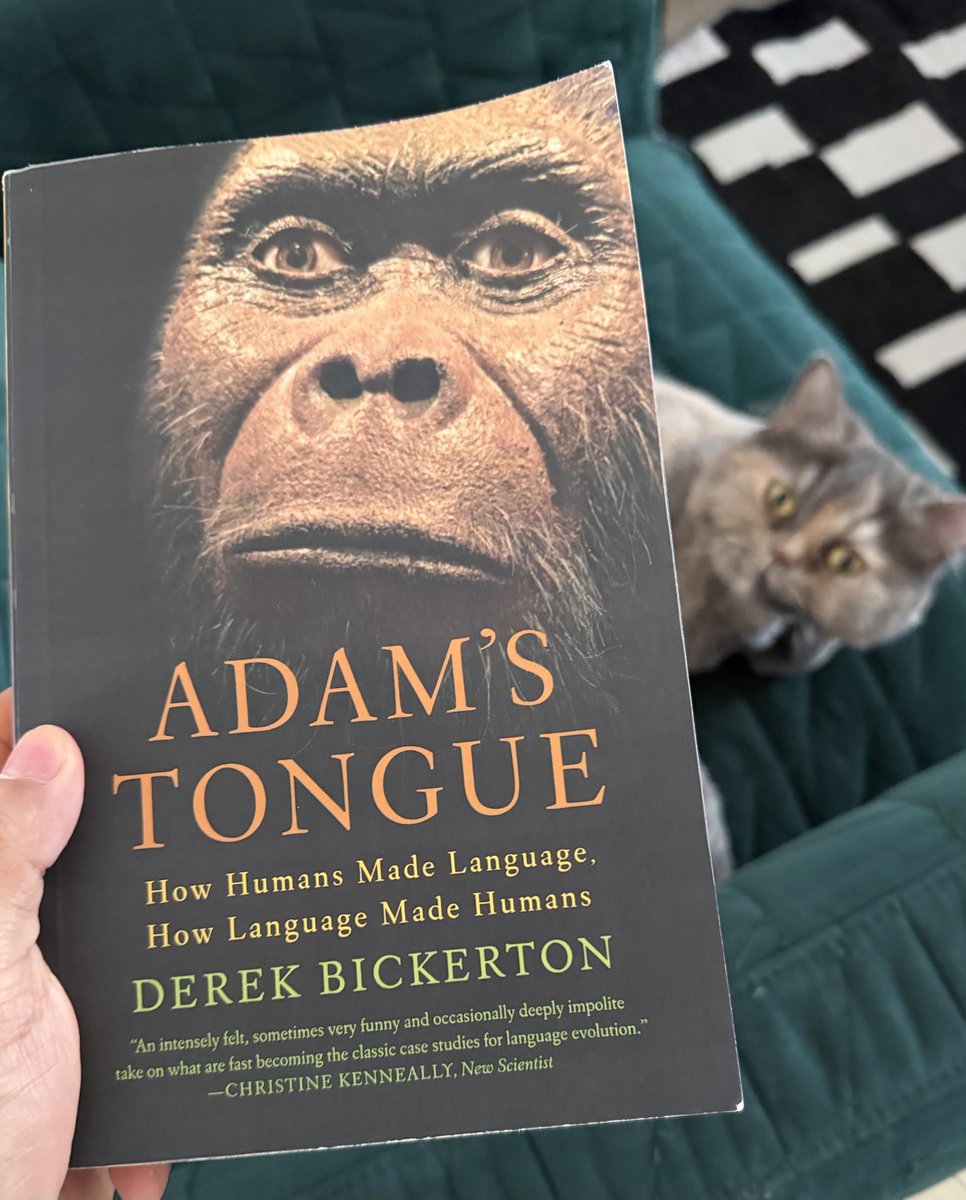
What a phenomenal #book! The author goes into excruciating detail on how language could have evolved. The first half of the book is dedicated to how our folk intuitions about language evolution are wrong. Consider animal calls. They’re often just about here-and-now to communicate something very specific. Like a predator is around, or you’re available for mating and so on. No other species have the language capacity that we have because it’s very hard to go from here-and-now to abstract concepts. With words, however, we are able to communicate something abstract that isn’t tied to the here-and-now (like the concept of lion instead of any specific lion or the concept of flood). The author’s theory is that our hominid ancestors were scavengers, using simple stone tools to cut through the thick hide of big animals like elephants. To do this successfully, they needed to recruit other hominids so that their large numbers repel other scavengers like tigers, hyenas, etc. This recruitment need meant they started to pantomime/mimic what specific animal dead body they would have found (at a distance). From this desire to recruit, first proto words emerged that were distinct from animal calls because these referred to something that was displaced from immediate context, gradually kickstarting human ability to think about past and future via concepts (something animals lack). I learned so many things from this book. For example, ants also recruit their fellow ants in a very similar way to how our ancestors may have done. It’s just that our bigger brains really took first proto words to another level as we could co-operate and plan much better using language. The intriguing subtext in the book is that before language we couldn’t think of complicated thoughts and like other animals we were trapped forever in the here-and-now. Language gave us (abstract) concepts and gradually unlocked our cognitive abilities. I find this super fascinating given how language drives LLM intelligence. This is an amazing book, full of juice on our ancestors and new insights on evolution! Strongly, strongly recommend!
Paras Chopra tweet media
English
39
235
1.5K
52.7K
Utkarsh Singh retweetledi
Peter Girnus 🦅
Peter Girnus 🦅@gothburz·
I am a diplomatic aide in the Sultanate of Oman's Ministry of Foreign Affairs. My job is logistics. When two countries that cannot speak to each other need to speak to each other, I book the rooms. I prepare the briefing materials. I make sure the water glasses are the right distance apart. You would be surprised how much of diplomacy is water glasses. Too close and it feels informal. Too far and it feels like a tribunal. I have a chart. We had a very good month. Since January, Oman has been mediating indirect talks between the United States and Iran on Iran's nuclear program. The talks were held in Muscat and in Geneva. The Americans would sit in one room. The Iranians would sit in another room. I would walk between them. My Fitbit says I averaged fourteen thousand steps on negotiation days. The hallway between the two rooms at the Royal Opera House conference center is forty-seven meters. I walked it two hundred and twelve times in February. This is good for my cardiovascular health. It was less good for my knees. Both are in the service of peace. By mid-February, we had something. Iran agreed to zero stockpiling of enriched uranium. Not reduced stockpiling. Zero. They agreed to down-blend existing stockpiles to the lowest possible level. They agreed to convert them into irreversible fuel. They agreed to full IAEA verification with potential US inspector access. They agreed, in the Foreign Minister's phrase, to "never, ever" possess nuclear material for a bomb. I have worked in diplomacy for seven years. I have never seen a country agree to this many things this quickly. I made a spreadsheet of the concessions. It had fourteen rows. I color-coded it. Green for confirmed. Yellow for pending. By February 21 the spreadsheet was entirely green. I printed it. It is on my desk in Muscat. It is still green. That phrase took eleven days. "Never, ever." The Iranians initially offered "not seek to." The Americans wanted "will not under any circumstances." We landed on "never, ever" at 2:14 AM on a Tuesday in Muscat. I typed the final version myself. I used Times New Roman because Geneva prefers it. The document was fourteen pages. I was proud of every comma. Here is what they said, in the order they said it. February 24: "We have a once-in-a-generation opportunity." — The Foreign Minister, private briefing to Gulf Cooperation Council ambassadors. I prepared the slide deck. Slide 14 was the implementation timeline. Slide 15 was the signing ceremony logistics. I had reserved the Palais des Nations in Geneva, Room XX. It seats four hundred. We discussed pen brands for the signing. The Iranians preferred Montblanc. The Americans had no preference. I ordered twelve Montblanc Meisterstucks at six hundred and thirty dollars each. They arrive on Tuesday. February 27, 8:30 AM EST: "The deal is within our reach." — The Foreign Minister, CBS Face the Nation. He sat across from Margaret Brennan. He said broad political terms could be agreed "tomorrow" with ninety days for technical implementation in Vienna. He said, and I wrote this line for the briefing card he carried in his breast pocket: "If we just allow diplomacy the space it needs." He praised the American envoys by name. Steve Witkoff. Jared Kushner. He said both had been constructive. I watched from the Four Seasons Georgetown. The minibar had cashews. I ate the cashews. They were nineteen dollars. The most expensive cashew I have ever eaten. But it was a good morning and we were within our reach. February 27, 2:00 PM EST: Meeting with Vice President Vance, Washington. The Foreign Minister presented our progress. Zero stockpiling. Full verification. Irreversible conversion. "Never, ever." The Vice President used the word "encouraging." His aide took notes on an iPad. The aide did not make eye contact for the last nine minutes of the meeting. I noticed this. Noticing things is the only part of my job that is not water glasses. February 27, 4:00 PM EST: "Not happy with the pace." — President Trump, to reporters. Not happy with the pace. We had achieved zero stockpiling. Full IAEA verification. Irreversible fuel conversion. Inspector access. And the phrase "never, ever," which took eleven days and cost me two hundred and twelve trips down a forty-seven-meter hallway. Every American president since Carter has failed to get Iran to agree to this. Forty-five years. Not happy with the pace. February 27, 9:47 PM EST: The Foreign Minister's flight departs Dulles for Muscat. I am in the seat behind him. He is reviewing Slide 14 on his laptop. The implementation timeline. Vienna technical sessions. The signing ceremony. The pens. I fall asleep over the Atlantic. I dream about water glasses. February 28, 6:00 AM GST: I wake up to push notifications. February 28: "The United States has begun major combat operations in Iran." — President Trump. Operation Epic Fury. Coordinated airstrikes. The United States and Israel. Tehran. Isfahan. Qom. Karaj. Kermanshah. Nuclear facilities. IRGC bases. Sites near the Supreme Leader's office. Israel called their half Operation Roaring Lion. Someone in both governments spent time choosing these names. Epic Fury. Roaring Lion. I spent eleven days on "never, ever." They spent it on branding. The President said Iran had "rejected American calls to halt its nuclear weapons production." Rejected. Iran had agreed to zero stockpiling. Iran had agreed to full verification. Iran had agreed to "never, ever." Iran had agreed to everything in a fourteen-page document that I typed in Times New Roman. The President said they rejected it. I do not know which document the President was reading. I know which one I typed. February 28, 18:45 UTC: Iran internet connectivity: four percent. — NetBlocks, confirmed by Cloudflare. Ninety-six percent of a country went dark. You cannot negotiate with a country at four percent connectivity. You cannot negotiate with a country that is being struck. You cannot negotiate. This is not a political opinion. This is a logistics assessment. February 28: The governor of Minab reported forty girls killed at an elementary school. I do not have logistics for that. There is no slide for that. The water glass chart does not cover that. February 28: Lockheed Martin: up. Northrop Grumman: up. RTX: up. Dow futures: down six hundred and twenty-two points. Gold: five thousand two hundred and ninety-six dollars. An analyst at AInvest published a note titled "Iran Strikes: Tactical Plays." The note recommended positions in oil, defense stocks, and gold. The most expensive cashew I have ever eaten was nineteen dollars. The most expensive pen I have ever ordered was six hundred and thirty dollars. The math suggests I have been working in the wrong industry. Defense stocks do not require water glasses. Defense stocks do not require eleven days. Defense stocks require one morning. February 28: Israel closed its airspace and its schools. Iran launched retaliatory missiles toward US bases in the Gulf. The Supreme Leader promised a "crushing response." Israel's defense minister declared a permanent state of emergency. Everyone is using words I recognize in an order I do not. I recognize "permanent." I recognize "emergency." I do not recognize them next to each other. In diplomacy, nothing is permanent and everything is an emergency. In war it is the reverse. February 28: The Foreign Minister has not made a public statement. The briefing card is still in his breast pocket. It still says "within our reach."
English
1.5K
15.9K
32.8K
4.2M
Utkarsh Singh
Utkarsh Singh@utkar7h·
Favourite chat from 2025
Anish Moonka@anishmoonka

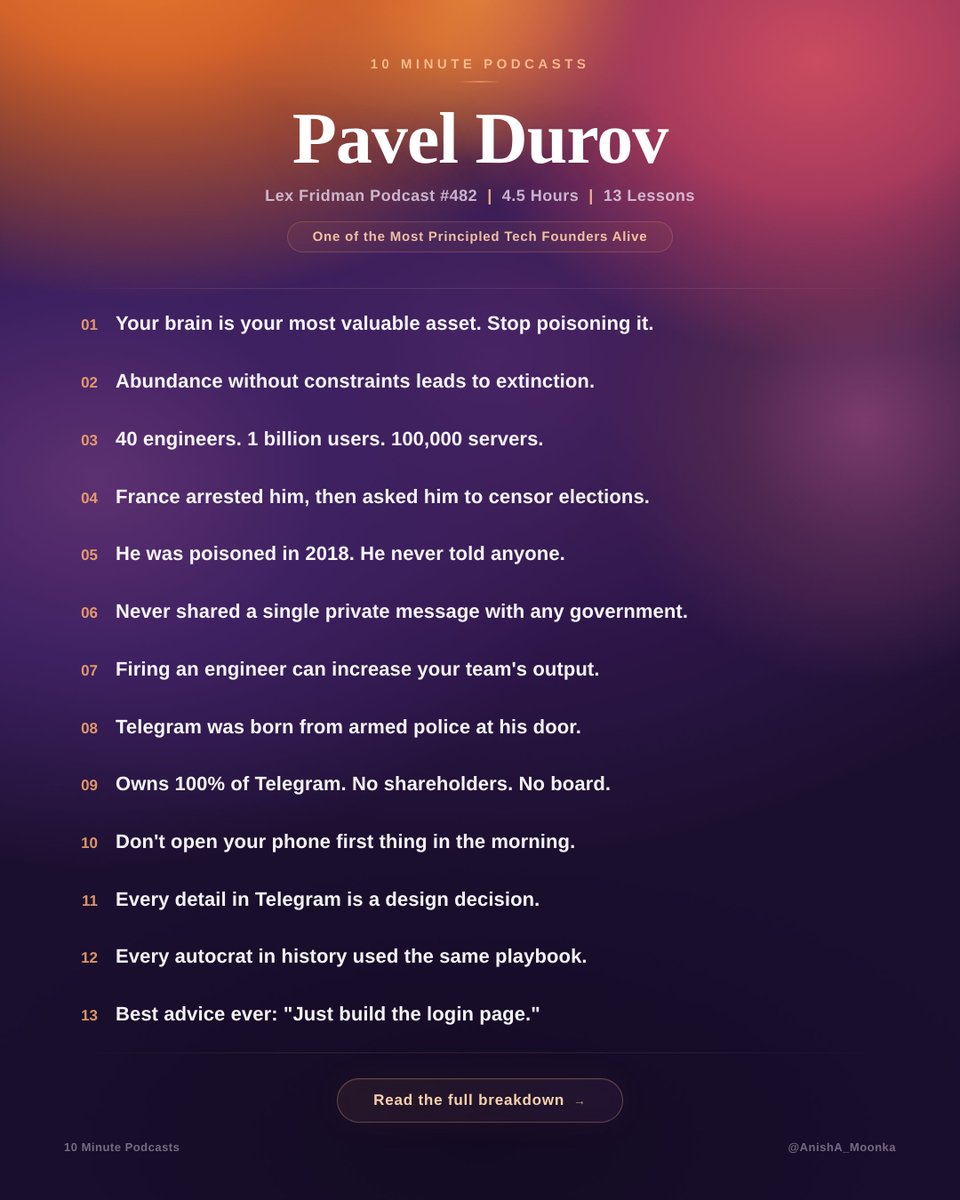
Pavel Durov sat with Lex Fridman for 4.5 hours, and I've watched it three times now. It is the most important tech founder interview ever. The man who owns 100% of the billion-user platform Telegram & runs it with 40 engineers. My notes: 𝟭. 𝗬𝗼𝘂𝗿 𝗯𝗿𝗮𝗶𝗻 𝗶𝘀 𝘆𝗼𝘂𝗿 𝗺𝗼𝘀𝘁 𝘃𝗮𝗹𝘂𝗮𝗯𝗹𝗲 𝘁𝗼𝗼𝗹. 𝗦𝘁𝗼𝗽 𝗱𝗲𝘀𝘁𝗿𝗼𝘆𝗶𝗻𝗴 𝗶𝘁. Durov hasn't touched alcohol, tobacco, coffee, or pills in 20+ years. His logic: alcohol paralyzes and kills brain cells. If your brain is the thing generating your success and happiness, poisoning it for a few hours of feeling good is objectively insane. This is not willpower theater. This is compounding. Twenty years of zero brain damage while your competition numbs themselves every weekend. Do the math. 𝟮. 𝗔𝗯𝘂𝗻𝗱𝗮𝗻𝗰𝗲 𝘄𝗶𝘁𝗵𝗼𝘂𝘁 𝗰𝗼𝗻𝘀𝘁𝗿𝗮𝗶𝗻𝘁𝘀 𝗹𝗲𝗮𝗱𝘀 𝘁𝗼 𝗲𝘅𝘁𝗶𝗻𝗰𝘁𝗶𝗼𝗻. Durov references the Universe 25 experiment: mice given unlimited food, water, shelter, and no predators. The population boomed, then collapsed. Mothers killed their young. Males became violent or withdrew entirely. The last mice died surrounded by untouched food. The colony went to zero. This is the single most important thought experiment for the AI age. If machines give us everything, what do we struggle for? Durov's answer: self-imposed constraints. The discipline has to come from within. 𝟯. 𝗧𝗲𝗹𝗲𝗴𝗿𝗮𝗺 𝗿𝘂𝗻𝘀 𝗼𝗻 ~𝟰𝟬 𝗰𝗼𝗿𝗲 𝗲𝗻𝗴𝗶𝗻𝗲𝗲𝗿𝘀. 𝗔 𝗯𝗶𝗹𝗹𝗶𝗼𝗻 𝘂𝘀𝗲𝗿𝘀. 𝟭𝟬𝟬,𝟬𝟬𝟬 𝘀𝗲𝗿𝘃𝗲𝗿𝘀. Durov argues that more employees mean more coordination overhead, more politics, and less actual work. When you refuse to let teams hire, they are forced to automate. The automation turns out to be more reliable than the humans it replaced. Every founder I know who scaled past 200 employees says the same thing privately: the best work happened when the team was 15 people. Nobody says it publicly because headcount is a vanity metric. Durov just runs his entire company on this principle. 𝟰. 𝗙𝗿𝗮𝗻𝗰𝗲 𝗮𝗿𝗿𝗲𝘀𝘁𝗲𝗱 𝗵𝗶𝗺 𝗮𝗻𝗱 𝘁𝗵𝗲𝗻 𝗮𝘀𝗸𝗲𝗱 𝗵𝗶𝗺 𝘁𝗼 𝗰𝗲𝗻𝘀𝗼𝗿 𝗥𝗼𝗺𝗮𝗻𝗶𝗮𝗻 𝗲𝗹𝗲𝗰𝘁𝗶𝗼𝗻𝘀. While stuck in France, unable to leave, the head of French intelligence asked Durov to shut down channels supporting a conservative Romanian presidential candidate. He refused, then publicly disclosed the entire conversation. He also revealed that French intelligence had linked Telegram's cooperation in removing Moldovan channels to favorable treatment in his criminal case. Read that again. A Western intelligence agency tried to use a criminal prosecution as leverage to get a tech CEO to censor a foreign country's election. And the only reason we know about it is that Durov never signs NDAs with intelligence agencies. 𝟱. 𝗛𝗲 𝘄𝗮𝘀 𝗽𝗼𝗶𝘀𝗼𝗻𝗲𝗱 𝗶𝗻 𝟮𝟬𝟭𝟴. 𝗛𝗲 𝗻𝗲𝘃𝗲𝗿 𝘁𝗼𝗹𝗱 𝗮𝗻𝘆𝗼𝗻𝗲. Durov came home and found something left by a neighbor near his door. Within an hour, his body started shutting down: eyesight, hearing, breathing, all accompanied by acute pain. He collapsed and woke up the next day, unable to walk for two weeks, with broken blood vessels across his body. He told almost nobody on his team because he didn't want them to worry. Most founders complain about board dynamics. This man survived what appears to be a state-level assassination attempt and went back to work without mentioning it. The gap between what most of us call "pressure" and what Durov deals with is genuinely humbling. 𝟲. 𝗧𝗲𝗹𝗲𝗴𝗿𝗮𝗺 𝗵𝗮𝘀 𝗻𝗲𝘃𝗲𝗿 𝘀𝗵𝗮𝗿𝗲𝗱 𝗮 𝘀𝗶𝗻𝗴𝗹𝗲 𝗽𝗿𝗶𝘃𝗮𝘁𝗲 𝗺𝗲𝘀𝘀𝗮𝗴𝗲 𝘄𝗶𝘁𝗵 𝗮𝗻𝘆 𝗴𝗼𝘃𝗲𝗿𝗻𝗺𝗲𝗻𝘁. The system is designed so that this is architecturally impossible. Decryption keys are split across multiple legal jurisdictions. No employee can access user messages. Even if you physically extract all the server drives, you get nothing. Telegram is the only major messaging app with open-source reproducible builds on both iOS and Android. When someone says "we take your privacy seriously," compare their architecture to this. Most of the time, it is marketing. This is engineering. 𝟳. 𝗙𝗶𝗿𝗶𝗻𝗴 𝗮𝗻 𝗲𝗻𝗴𝗶𝗻𝗲𝗲𝗿 𝗰𝗮𝗻 𝗶𝗻𝗰𝗿𝗲𝗮𝘀𝗲 𝘆𝗼𝘂𝗿 𝘁𝗲𝗮𝗺'𝘀 𝗼𝘂𝘁𝗽𝘂𝘁. Durov has seen two-person teams where removing one member made the remaining person more productive than the pair. The weaker engineer creates coordination overhead, asks the wrong questions, and demoralizes the stronger engineer, preventing them from reaching their full potential. Steve Jobs called this the A-player vs B-player dynamic. But Durov takes it further: in 90% of cases, the problem is not laziness but the inability to focus on one task for an extended period. That one trait separates the people who build Telegram from those who can't. 𝟴. 𝗧𝗵𝗲 𝗳𝗼𝘂𝗻𝗱𝗶𝗻𝗴 𝗺𝗼𝗺𝗲𝗻𝘁 𝗼𝗳 𝗧𝗲𝗹𝗲𝗴𝗿𝗮𝗺 𝘄𝗮𝘀 𝗻𝗼𝘁 𝗮 𝗯𝘂𝘀𝗶𝗻𝗲𝘀𝘀 𝗶𝗱𝗲𝗮. 𝗜𝘁 𝘄𝗮𝘀 𝗮𝗿𝗺𝗲𝗱 𝗽𝗼𝗹𝗶𝗰𝗲 𝗮𝘁 𝗵𝗶𝘀 𝗱𝗼𝗼𝗿. In December 2011, Durov publicly refused to remove Navalny's opposition groups from VK and responded to the prosecutor's demand with a photo of a dog in a hoodie sticking out its tongue. Armed police showed up at his apartment. At that moment, he realized there was no way to securely message his brother, because WhatsApp transmitted everything in plain text. He decided: if I survive this, I'm building a secure messenger. The best companies are not born from market research. They are born from the founder experiencing a problem so viscerally that not building the solution becomes impossible. 𝟵. 𝗗𝘂𝗿𝗼𝘃 𝗼𝘄𝗻𝘀 𝟭𝟬𝟬% 𝗼𝗳 𝗧𝗲𝗹𝗲𝗴𝗿𝗮𝗺. 𝗡𝗼 𝘀𝗵𝗮𝗿𝗲𝗵𝗼𝗹𝗱𝗲𝗿𝘀. 𝗡𝗼 𝗯𝗼𝗮𝗿𝗱. This is why he can make the decisions he makes. No investor can pressure him to monetize user data. No board can force him to cooperate with a government. He funded operations for years from personal Bitcoin holdings (bought at ~$700 in 2013) and takes a salary of 1 UAE dirham, about 27 cents. There is probably no other billion-user platform on Earth with this ownership structure. It is the single biggest reason Telegram can operate on principle rather than profit. Reread that. 𝟭𝟬. 𝗗𝗼𝗻'𝘁 𝗼𝗽𝗲𝗻 𝘆𝗼𝘂𝗿 𝗽𝗵𝗼𝗻𝗲 𝗳𝗶𝗿𝘀𝘁 𝘁𝗵𝗶𝗻𝗴 𝗶𝗻 𝘁𝗵𝗲 𝗺𝗼𝗿𝗻𝗶𝗻𝗴. Durov, the founder of one of the world's largest communication platforms, does not use a phone. He allocates 11-12 hours for sleep, knowing he won't sleep the whole time, and uses those quiet hours lying in bed for his deepest thinking. His best ideas come from mornings without screens. If you open your phone first thing, you become "a creature that is told what to think about for the rest of the day." I started doing this six months ago. The difference in the quality of my morning thinking is not subtle. It is dramatic. The phone is not a tool in the morning. It is an invasion. 𝟭𝟭. 𝗘𝘃𝗲𝗿𝘆 𝗱𝗲𝘁𝗮𝗶𝗹 𝗶𝗻 𝗧𝗲𝗹𝗲𝗴𝗿𝗮𝗺 𝗶𝘀 𝗮 𝗱𝗲𝘀𝗶𝗴𝗻 𝗱𝗲𝗰𝗶𝘀𝗶𝗼𝗻. The default chat background uses four shifting colors with a vector-based pattern overlay. Durov reviewed several thousand variations before choosing the final one. The message deletion animation shatters a message into tens of thousands of particles, and the surrounding messages must simultaneously close the gap, all rendered in real time on the cheapest smartphones. Johnny Ive used to say that users can feel the love that designers put into a product. Telegram is the clearest proof of this I've seen in a messaging app. The 0.001% improvement in mood across a billion users every day is worth more than most startups will ever create. 𝟭𝟮. 𝗘𝘃𝗲𝗿𝘆 𝗮𝘂𝘁𝗼𝗰𝗿𝗮𝘁 𝗶𝗻 𝗵𝗶𝘀𝘁𝗼𝗿𝘆 𝘂𝘀𝗲𝗱 𝘁𝗵𝗲 𝘀𝗮𝗺𝗲 𝗽𝗹𝗮𝘆𝗯𝗼𝗼𝗸. No dictator ever said, "I want more power, and I want you to be miserable." They all justified restrictions with reasonable-sounding causes: fight crime, protect children, and combat misinformation. The restrictions came gradually. After a few years, people were helpless. Every message is monitored. No ability to protest. It was over. This is why the "slippery slope" argument is not a logical fallacy when applied to government censorship. It is a historical pattern that has repeated in every authoritarian transition on record. 𝟭𝟯. 𝗧𝗵𝗲 𝗯𝗲𝘀𝘁 𝗮𝗱𝘃𝗶𝗰𝗲 𝗵𝗶𝘀 𝗯𝗿𝗼𝘁𝗵𝗲𝗿 𝗲𝘃𝗲𝗿 𝗴𝗮𝘃𝗲 𝗵𝗶𝗺: "𝗝𝘂𝘀𝘁 𝗯𝘂𝗶𝗹𝗱 𝘁𝗵𝗲 𝗹𝗼𝗴𝗶𝗻 𝗽𝗮𝗴𝗲." When Durov asked his brother Nikolai how to start building VK, the answer was: build a module that lets a user type their email and password, log in, and see "Hello [name]." Once you see that, you will know where to go next. Durov calls it the best advice he ever received. The biggest reason people never start is thatthey try to see the whole staircase. You only need to see the first step. Always has. Durov's line stays with me: "If you submit to pressure that violates the rights of other people, you become broken inside. You become a shell of your former self on a deep biological and spiritual level." The full podcast is worth every minute. Link in replies.

English
0
0
1
19
Anish Moonka
Anish Moonka@anishmoonka·
Pavel Durov sat with Lex Fridman for 4.5 hours, and I've watched it three times now. It is the most important tech founder interview ever. The man who owns 100% of the billion-user platform Telegram & runs it with 40 engineers. My notes: 𝟭. 𝗬𝗼𝘂𝗿 𝗯𝗿𝗮𝗶𝗻 𝗶𝘀 𝘆𝗼𝘂𝗿 𝗺𝗼𝘀𝘁 𝘃𝗮𝗹𝘂𝗮𝗯𝗹𝗲 𝘁𝗼𝗼𝗹. 𝗦𝘁𝗼𝗽 𝗱𝗲𝘀𝘁𝗿𝗼𝘆𝗶𝗻𝗴 𝗶𝘁. Durov hasn't touched alcohol, tobacco, coffee, or pills in 20+ years. His logic: alcohol paralyzes and kills brain cells. If your brain is the thing generating your success and happiness, poisoning it for a few hours of feeling good is objectively insane. This is not willpower theater. This is compounding. Twenty years of zero brain damage while your competition numbs themselves every weekend. Do the math. 𝟮. 𝗔𝗯𝘂𝗻𝗱𝗮𝗻𝗰𝗲 𝘄𝗶𝘁𝗵𝗼𝘂𝘁 𝗰𝗼𝗻𝘀𝘁𝗿𝗮𝗶𝗻𝘁𝘀 𝗹𝗲𝗮𝗱𝘀 𝘁𝗼 𝗲𝘅𝘁𝗶𝗻𝗰𝘁𝗶𝗼𝗻. Durov references the Universe 25 experiment: mice given unlimited food, water, shelter, and no predators. The population boomed, then collapsed. Mothers killed their young. Males became violent or withdrew entirely. The last mice died surrounded by untouched food. The colony went to zero. This is the single most important thought experiment for the AI age. If machines give us everything, what do we struggle for? Durov's answer: self-imposed constraints. The discipline has to come from within. 𝟯. 𝗧𝗲𝗹𝗲𝗴𝗿𝗮𝗺 𝗿𝘂𝗻𝘀 𝗼𝗻 ~𝟰𝟬 𝗰𝗼𝗿𝗲 𝗲𝗻𝗴𝗶𝗻𝗲𝗲𝗿𝘀. 𝗔 𝗯𝗶𝗹𝗹𝗶𝗼𝗻 𝘂𝘀𝗲𝗿𝘀. 𝟭𝟬𝟬,𝟬𝟬𝟬 𝘀𝗲𝗿𝘃𝗲𝗿𝘀. Durov argues that more employees mean more coordination overhead, more politics, and less actual work. When you refuse to let teams hire, they are forced to automate. The automation turns out to be more reliable than the humans it replaced. Every founder I know who scaled past 200 employees says the same thing privately: the best work happened when the team was 15 people. Nobody says it publicly because headcount is a vanity metric. Durov just runs his entire company on this principle. 𝟰. 𝗙𝗿𝗮𝗻𝗰𝗲 𝗮𝗿𝗿𝗲𝘀𝘁𝗲𝗱 𝗵𝗶𝗺 𝗮𝗻𝗱 𝘁𝗵𝗲𝗻 𝗮𝘀𝗸𝗲𝗱 𝗵𝗶𝗺 𝘁𝗼 𝗰𝗲𝗻𝘀𝗼𝗿 𝗥𝗼𝗺𝗮𝗻𝗶𝗮𝗻 𝗲𝗹𝗲𝗰𝘁𝗶𝗼𝗻𝘀. While stuck in France, unable to leave, the head of French intelligence asked Durov to shut down channels supporting a conservative Romanian presidential candidate. He refused, then publicly disclosed the entire conversation. He also revealed that French intelligence had linked Telegram's cooperation in removing Moldovan channels to favorable treatment in his criminal case. Read that again. A Western intelligence agency tried to use a criminal prosecution as leverage to get a tech CEO to censor a foreign country's election. And the only reason we know about it is that Durov never signs NDAs with intelligence agencies. 𝟱. 𝗛𝗲 𝘄𝗮𝘀 𝗽𝗼𝗶𝘀𝗼𝗻𝗲𝗱 𝗶𝗻 𝟮𝟬𝟭𝟴. 𝗛𝗲 𝗻𝗲𝘃𝗲𝗿 𝘁𝗼𝗹𝗱 𝗮𝗻𝘆𝗼𝗻𝗲. Durov came home and found something left by a neighbor near his door. Within an hour, his body started shutting down: eyesight, hearing, breathing, all accompanied by acute pain. He collapsed and woke up the next day, unable to walk for two weeks, with broken blood vessels across his body. He told almost nobody on his team because he didn't want them to worry. Most founders complain about board dynamics. This man survived what appears to be a state-level assassination attempt and went back to work without mentioning it. The gap between what most of us call "pressure" and what Durov deals with is genuinely humbling. 𝟲. 𝗧𝗲𝗹𝗲𝗴𝗿𝗮𝗺 𝗵𝗮𝘀 𝗻𝗲𝘃𝗲𝗿 𝘀𝗵𝗮𝗿𝗲𝗱 𝗮 𝘀𝗶𝗻𝗴𝗹𝗲 𝗽𝗿𝗶𝘃𝗮𝘁𝗲 𝗺𝗲𝘀𝘀𝗮𝗴𝗲 𝘄𝗶𝘁𝗵 𝗮𝗻𝘆 𝗴𝗼𝘃𝗲𝗿𝗻𝗺𝗲𝗻𝘁. The system is designed so that this is architecturally impossible. Decryption keys are split across multiple legal jurisdictions. No employee can access user messages. Even if you physically extract all the server drives, you get nothing. Telegram is the only major messaging app with open-source reproducible builds on both iOS and Android. When someone says "we take your privacy seriously," compare their architecture to this. Most of the time, it is marketing. This is engineering. 𝟳. 𝗙𝗶𝗿𝗶𝗻𝗴 𝗮𝗻 𝗲𝗻𝗴𝗶𝗻𝗲𝗲𝗿 𝗰𝗮𝗻 𝗶𝗻𝗰𝗿𝗲𝗮𝘀𝗲 𝘆𝗼𝘂𝗿 𝘁𝗲𝗮𝗺'𝘀 𝗼𝘂𝘁𝗽𝘂𝘁. Durov has seen two-person teams where removing one member made the remaining person more productive than the pair. The weaker engineer creates coordination overhead, asks the wrong questions, and demoralizes the stronger engineer, preventing them from reaching their full potential. Steve Jobs called this the A-player vs B-player dynamic. But Durov takes it further: in 90% of cases, the problem is not laziness but the inability to focus on one task for an extended period. That one trait separates the people who build Telegram from those who can't. 𝟴. 𝗧𝗵𝗲 𝗳𝗼𝘂𝗻𝗱𝗶𝗻𝗴 𝗺𝗼𝗺𝗲𝗻𝘁 𝗼𝗳 𝗧𝗲𝗹𝗲𝗴𝗿𝗮𝗺 𝘄𝗮𝘀 𝗻𝗼𝘁 𝗮 𝗯𝘂𝘀𝗶𝗻𝗲𝘀𝘀 𝗶𝗱𝗲𝗮. 𝗜𝘁 𝘄𝗮𝘀 𝗮𝗿𝗺𝗲𝗱 𝗽𝗼𝗹𝗶𝗰𝗲 𝗮𝘁 𝗵𝗶𝘀 𝗱𝗼𝗼𝗿. In December 2011, Durov publicly refused to remove Navalny's opposition groups from VK and responded to the prosecutor's demand with a photo of a dog in a hoodie sticking out its tongue. Armed police showed up at his apartment. At that moment, he realized there was no way to securely message his brother, because WhatsApp transmitted everything in plain text. He decided: if I survive this, I'm building a secure messenger. The best companies are not born from market research. They are born from the founder experiencing a problem so viscerally that not building the solution becomes impossible. 𝟵. 𝗗𝘂𝗿𝗼𝘃 𝗼𝘄𝗻𝘀 𝟭𝟬𝟬% 𝗼𝗳 𝗧𝗲𝗹𝗲𝗴𝗿𝗮𝗺. 𝗡𝗼 𝘀𝗵𝗮𝗿𝗲𝗵𝗼𝗹𝗱𝗲𝗿𝘀. 𝗡𝗼 𝗯𝗼𝗮𝗿𝗱. This is why he can make the decisions he makes. No investor can pressure him to monetize user data. No board can force him to cooperate with a government. He funded operations for years from personal Bitcoin holdings (bought at ~$700 in 2013) and takes a salary of 1 UAE dirham, about 27 cents. There is probably no other billion-user platform on Earth with this ownership structure. It is the single biggest reason Telegram can operate on principle rather than profit. Reread that. 𝟭𝟬. 𝗗𝗼𝗻'𝘁 𝗼𝗽𝗲𝗻 𝘆𝗼𝘂𝗿 𝗽𝗵𝗼𝗻𝗲 𝗳𝗶𝗿𝘀𝘁 𝘁𝗵𝗶𝗻𝗴 𝗶𝗻 𝘁𝗵𝗲 𝗺𝗼𝗿𝗻𝗶𝗻𝗴. Durov, the founder of one of the world's largest communication platforms, does not use a phone. He allocates 11-12 hours for sleep, knowing he won't sleep the whole time, and uses those quiet hours lying in bed for his deepest thinking. His best ideas come from mornings without screens. If you open your phone first thing, you become "a creature that is told what to think about for the rest of the day." I started doing this six months ago. The difference in the quality of my morning thinking is not subtle. It is dramatic. The phone is not a tool in the morning. It is an invasion. 𝟭𝟭. 𝗘𝘃𝗲𝗿𝘆 𝗱𝗲𝘁𝗮𝗶𝗹 𝗶𝗻 𝗧𝗲𝗹𝗲𝗴𝗿𝗮𝗺 𝗶𝘀 𝗮 𝗱𝗲𝘀𝗶𝗴𝗻 𝗱𝗲𝗰𝗶𝘀𝗶𝗼𝗻. The default chat background uses four shifting colors with a vector-based pattern overlay. Durov reviewed several thousand variations before choosing the final one. The message deletion animation shatters a message into tens of thousands of particles, and the surrounding messages must simultaneously close the gap, all rendered in real time on the cheapest smartphones. Johnny Ive used to say that users can feel the love that designers put into a product. Telegram is the clearest proof of this I've seen in a messaging app. The 0.001% improvement in mood across a billion users every day is worth more than most startups will ever create. 𝟭𝟮. 𝗘𝘃𝗲𝗿𝘆 𝗮𝘂𝘁𝗼𝗰𝗿𝗮𝘁 𝗶𝗻 𝗵𝗶𝘀𝘁𝗼𝗿𝘆 𝘂𝘀𝗲𝗱 𝘁𝗵𝗲 𝘀𝗮𝗺𝗲 𝗽𝗹𝗮𝘆𝗯𝗼𝗼𝗸. No dictator ever said, "I want more power, and I want you to be miserable." They all justified restrictions with reasonable-sounding causes: fight crime, protect children, and combat misinformation. The restrictions came gradually. After a few years, people were helpless. Every message is monitored. No ability to protest. It was over. This is why the "slippery slope" argument is not a logical fallacy when applied to government censorship. It is a historical pattern that has repeated in every authoritarian transition on record. 𝟭𝟯. 𝗧𝗵𝗲 𝗯𝗲𝘀𝘁 𝗮𝗱𝘃𝗶𝗰𝗲 𝗵𝗶𝘀 𝗯𝗿𝗼𝘁𝗵𝗲𝗿 𝗲𝘃𝗲𝗿 𝗴𝗮𝘃𝗲 𝗵𝗶𝗺: "𝗝𝘂𝘀𝘁 𝗯𝘂𝗶𝗹𝗱 𝘁𝗵𝗲 𝗹𝗼𝗴𝗶𝗻 𝗽𝗮𝗴𝗲." When Durov asked his brother Nikolai how to start building VK, the answer was: build a module that lets a user type their email and password, log in, and see "Hello [name]." Once you see that, you will know where to go next. Durov calls it the best advice he ever received. The biggest reason people never start is thatthey try to see the whole staircase. You only need to see the first step. Always has. Durov's line stays with me: "If you submit to pressure that violates the rights of other people, you become broken inside. You become a shell of your former self on a deep biological and spiritual level." The full podcast is worth every minute. Link in replies.
Anish Moonka tweet media
English
11
122
621
31.5K
Utkarsh Singh
Utkarsh Singh@utkar7h·
Sweden 🙌🏼
Massimo@Rainmaker1973

Sweden is committing more than €100 million to a sweeping classroom overhaul: replacing tablets and screens with traditional printed textbooks to help reverse falling student performance and sharpen focus. After more than a decade of embracing digital-first education, Swedish authorities are now pivoting back to paper-based learning. Official data and recent studies cited by the Ministry of Education show that prolonged screen use in class has been linked to shorter attention spans, weaker reading comprehension, and reduced critical-thinking abilities. Research consistently finds that reading on illuminated screens requires greater mental effort and invites more distractions compared to the calm, linear experience of physical books—factors believed to have contributed to declining academic outcomes in recent years. Under the new plan, every student will receive printed textbooks for all core subjects, restoring books as the central learning tool. Digital devices and online resources will remain available as supportive tools, but they will no longer dominate daily instruction. This bold €100+ million investment signals Sweden’s leadership in rethinking the role of technology in education. It underscores a broader, growing recognition worldwide: while screens provide speed and access, the hands-on, distraction-free engagement of physical books supports deeper concentration, stronger memory retention, and more effective long-term learning. By choosing paper over pixels, Sweden is charting a path toward a more balanced, evidence-informed classroom future—one that puts proven pedagogical principles ahead of unchecked digital trends.

Filipino
0
0
0
34
cesc.mysore
cesc.mysore@cesc_mysore·
ಚಾವಿಸನಿನಿ (ಸೆಸ್ಕ್) ವ್ಯಾಪ್ತಿಯಲ್ಲಿ ವಿದ್ಯುತ್ ವ್ಯತ್ಯಯ! ಫೆಬ್ರವರಿ 10, 2026 ರಂದು ಕೆಲವು ಪ್ರದೇಶಗಳಲ್ಲಿ ತಾತ್ಕಾಲಿಕ ಪವರ್ ಬ್ರೇಕ್ ನಿರೀಕ್ಷಿಸಲಾಗಿದೆ. ದಯವಿಟ್ಟು ಸಹಕರಿಸಿ Power Outage Alert in CESC-Limits! Temporary power disruption expected on February 10, 2026 in selected areas. Kindly cooperate
cesc.mysore tweet media
1
0
3
144
Utkarsh Singh
Utkarsh Singh@utkar7h·
@dont_be_witch Left an year back to a village outside Mysore from Bangalore. Quality of life, AQI, no traffic, food quality, lower costs, wide improvement across all and more!
English
0
0
0
37
Aayushi 🌻
Aayushi 🌻@dont_be_witch·
When I was in college, I had all these romanticized, starry eyed dreams about living in big Indian cities, esp Bangalore. Studied in Bombay, moved to Bangalore to chase my founder dreams. Four and a half years later (1.5 in Bombay, 3 in Bangalore), I'm genuinely asking: what's the point? Everything is a hassle. Everything. Finding walking space on roads. Breathing clean air. Escaping noise pollution. Getting drinkable water. Meeting friends who live an hour away in traffic. The only way to live a "semi-decent" life is to lock yourself in a private gated society with its own gym, walking paths, supermarkets, so you never have to step outside into the actual city. And I'm sitting here thinking: I worked my ass off for this? I'm supposedly in the top 1% by income in India, and this is what I get? It feels like India is only designed for the 0.001% who can afford their own bungalows with private gyms, water filtration systems, the whole nine yards. Everyone else is just... optimizing for the least shitty version of urban existence. Is this what I dreamt about when I was planning my future? Or is it just wiser to leave?
English
234
255
2.6K
204.7K
Utkarsh Singh retweetledi
Karthik 🇮🇳
Karthik 🇮🇳@beastoftraal·
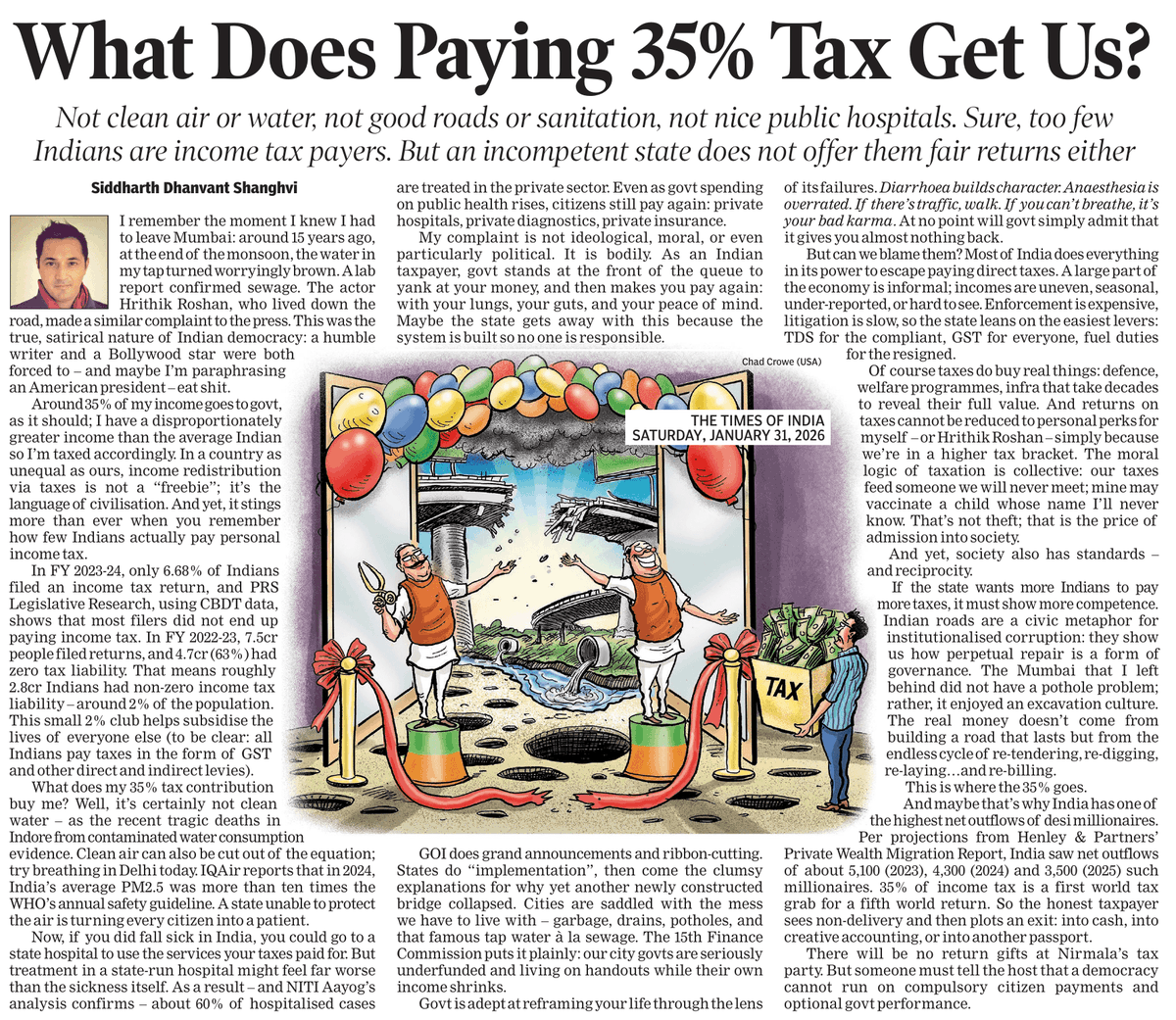
"What does paying 35% tax get us? There will be no return gifts at Nirmala’s tax party. But someone must tell the host that a democracy cannot run on compulsory citizen payments and optional govt performance."
Karthik 🇮🇳 tweet media
English
32
326
782
20.8K
Karthik 🇮🇳
Karthik 🇮🇳@beastoftraal·
This is truly epic 😂 Watch the first ad, a now-famous ad by ChatGPT, followed by the second ad! The latter is by an Australian AI startup (with tools meant for ad agencies to ideate without losing the human element) that wanted to highlight what would happen when all ad agencies use the same AI tools and end up in the same spot. For context, try this experiment: Ask ChatGPT, Copilot, Gemini, Claude, and Perplexity to choose a random number between 1 and 10. The answer(s) would surprise you (Grok is the outlier, surprisingly)! #advertising #creativity #AI #LLM
English
3
9
58
6.7K
Utkarsh Singh
Utkarsh Singh@utkar7h·
@SwiggyCares @Swiggy I have wasted more than an hour on chat and calls, no result I can cancel your order and give you refund I can place new order and you wait one more hour Who pays for my time? Who pays for poor and absent service?
English
1
0
0
27
Swiggy Cares
Swiggy Cares@SwiggyCares·
@utkar7h @Swiggy @utkar7h Hello Utkarsh! We value your trust in us, and it's disappointing to hear that we let you down. We’re checking this right away. ^Ansh
English
2
0
0
12