Valentin Teruggi

1.3K posts

Valentin Teruggi banner
Valentin Teruggi

Valentin Teruggi

@valentin_macro

Economist | MBA | Experto en Business Cycles Podcast Spotify https://t.co/UkbdHUf2gc Newsletter Economics Latam https://t.co/vAOJNa2TFR

Canada Katılım Nisan 2011
174 Takip Edilen1.2K Takipçiler
Sabitlenmiş Tweet
Valentin Teruggi
Valentin Teruggi@valentin_macro·
Oil shocks are exogenous, private credit is endogenous. The first can be resolved or ended “rapidly” in the same way it began but the second cannot.
English
1
3
32
26.9K
Valentin Teruggi retweetledi
Steve Saretsky
Steve Saretsky@SteveSaretsky·
Greater Vancouver home sales for the month of May hit a 25 year low outside of the May 2020 pandemic year. Year to date sales are also tracking lower than last year.
English
23
25
263
18.7K
Valentin Teruggi
Valentin Teruggi@valentin_macro·
In my latest valuation update, I explain why the Shiller CAPE remains my preferred metric and why today's market is approaching the valuation extremes of the 2000 dot-com bubble. Full article below 👇 open.substack.com/pub/valentinte…
English
0
1
5
273
Valentin Teruggi
Valentin Teruggi@valentin_macro·
Petrobras (PBR) combina dos de los activos más cíclicos del mercado global: petróleo y mercados emergentes. Esa combinación puede generar retornos extraordinarios cuando el contexto acompaña, pero también vuelve a la acción especialmente vulnerable cuando el dólar se fortalece o el petróleo pierde impulso. En nuestro nuevo análisis explicamos por qué somos cautelosos en el corto plazo, qué señales estamos observando en Brasil, el petróleo y el dólar, y bajo qué escenario Petrobras podría convertirse en una de las grandes oportunidades del próximo ciclo. Leelo acá: open.substack.com/pub/economicsl…
Español
0
0
6
369
Valentin Teruggi
Valentin Teruggi@valentin_macro·
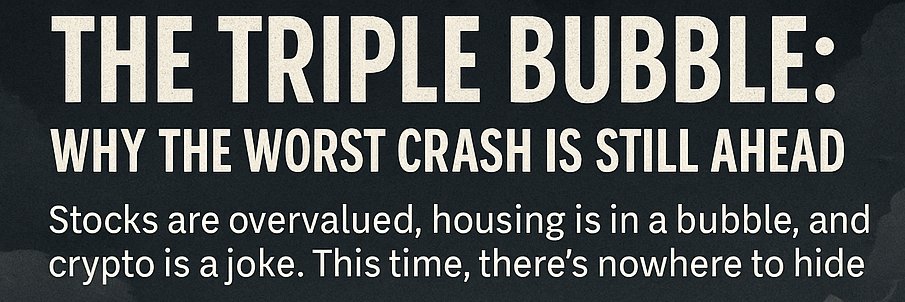
En 1929, el mercado celebraba una revolución tecnológica, valuaciones extremas y la idea de que “esta vez era diferente”. Hoy vemos inteligencia artificial, concentración histórica en pocas acciones, deuda récord, crédito privado opaco, consumidores presionados y una Fed que advierte sobre valuaciones elevadas mientras sigue flexibilizando. La comparación no es perfecta. Pero los datos muestran algo incómodo: 2026 podría tener elementos de 1929, 1907 y 2008 al mismo tiempo. Leelo completo en Substack: open.substack.com/pub/economicsl…
Español
1
1
7
399
Valentin Teruggi
Valentin Teruggi@valentin_macro·
@NGarciaLagrenee Empresas petroleras y mineras. Estoy escribiendo un post de PBR que seguro sale mañana. Saludos!
Español
0
0
2
38
Valentin Teruggi
Valentin Teruggi@valentin_macro·
¡Artículo Gratis! Durante años hemos escuchado la misma frase: “Latinoamérica está barata.” Pero LATAM lleva barata desde hace casi dos décadas. El problema nunca fue solamente la valuación. El problema fue el dólar. La región tuvo una década ganada en los 2000, pero después de 2008 cambió el régimen. El dólar entró en un ciclo estructuralmente más fuerte y Latinoamérica quedó atrapada en una larga década perdida. Ahora la pregunta es otra: ¿Y si estamos cerca del final del dólar fuerte? Leelo completo en Substack: open.substack.com/pub/economicsl…
Español
0
0
2
322
I CHAD I
I CHAD I@xrpger·
@valentin_macro And the economic paradox becomes- who makes money at $30 $CL….. the answer is nobody.
English
1
0
0
12
Valentin Teruggi
Valentin Teruggi@valentin_macro·
If we get an economic downturn, prices won't go sub-$70. They will go sub $30. I just can't believe these static analyses that focus only on supply when the most important thing is DEMAND. During a downturn, no one wants oil, regardless of what happens with the supply. Everyone ignores demand. Ridiculous.
The Lincoln Project@ProjectLincoln

"If you want $3 gas, you're going to have to wait 6 years. We will not get back down to that sub-$70 oil level until 2032"

English
8
1
19
3K
Valentin Teruggi
Valentin Teruggi@valentin_macro·
Someone who knows their stuff!👇 Inflation from supply shocks does not change the structural inflation driven by demand. These shocks force people to spend more on energy and to cut back on other goods and services. That shrinks the rest of the economy, except the energy-related industry. Unless these shocks are accompanied by wage growth so people can absorb higher energy prices (such as in 2022), they are massively deflationary due to demand destruction. This is economics 101; no one needs a Phd to understand this.
Lee Bollard@The_Jolly_Co

@valentin_macro Inflation is clearly energy driven. Now energy is coming down. Problem largely solved.

English
2
1
11
742