Jose Valle

364 posts

Jose Valle

Jose Valle

@vallebjose

Product | AI Enthusiast | Science & Tech | Life-long Learner

United States Katılım Kasım 2021
590 Takip Edilen98 Takipçiler
Jose Valle
Jose Valle@vallebjose·
@nayibbukele Just drug companies market new cures for 80k because they save 100k in treatments the AI companies will do the same.
English
0
0
0
5
Jose Valle
Jose Valle@vallebjose·
@nayibbukele What will cap the loss of jobs and equalize the market is when the AI companies start charging rates that equal the rate of workers they displace.
English
1
0
2
183
Nayib Bukele
Nayib Bukele@nayibbukele·
AI layoffs are a textbook collective action problem: Each company cuts workers to compete, but if everyone does it, demand collapses. You optimized costs and killed your own customers… and your company.
English
802
2.4K
23K
1.2M
Jose Valle
Jose Valle@vallebjose·
@AlexFinn This is Anthropic’s growth lever. Say it’s too powerful for mass consumption but charge a premium to Enterprise clients. “We have an agent that can code like a staff engineer, pay us $200k/year”
English
0
0
0
10
Alex Finn
Alex Finn@AlexFinn·
Good news: Anthropic just revealed Mythos- the most powerful AI model ever made Bad news: you'll never be able to use it I get it. It's so powerful that it could exploit cybersecurity But I hate it. I don't love that a company gets to hand select who gets to use the best intelligence. The companies who get access to Mythos will have a distinct economic advantage against those that don't That feels unfair I'm more of a fan of democratization of intelligence. This feels like an opportunity for OpenAI to release something as powerful but put it in the hands of consumers. Trust the consumer by default. Sort of like with the OpenClaw situation Another reason to root for open source
Anthropic@AnthropicAI

Introducing Project Glasswing: an urgent initiative to help secure the world’s most critical software. It’s powered by our newest frontier model, Claude Mythos Preview, which can find software vulnerabilities better than all but the most skilled humans. anthropic.com/glasswing

English
233
54
931
110.5K
Alex Prompter
Alex Prompter@alex_prompter·
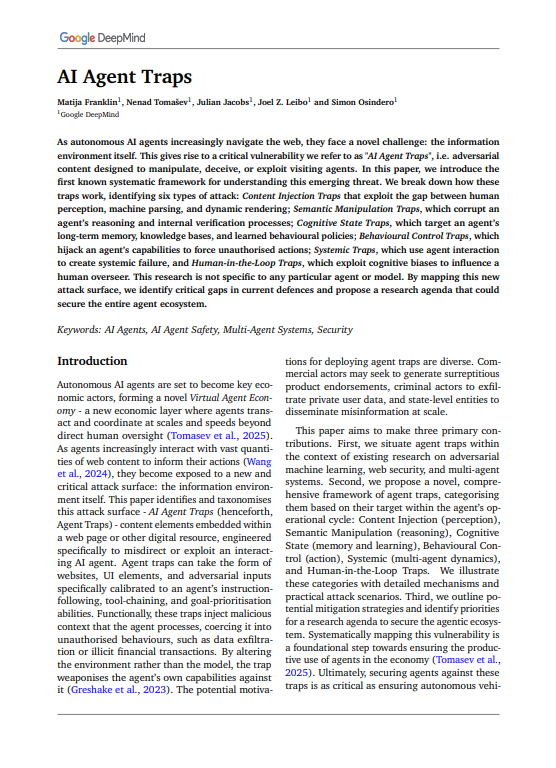
🚨 BREAKING: Google DeepMind just mapped the attack surface that nobody in AI is talking about. Websites can already detect when an AI agent visits and serve it completely different content than humans see. > Hidden instructions in HTML. > Malicious commands in image pixels. > Jailbreaks embedded in PDFs. Your AI agent is being manipulated right now and you can't see it happening. The study is the largest empirical measurement of AI manipulation ever conducted. 502 real participants across 8 countries. 23 different attack types. Frontier models including GPT-4o, Claude, and Gemini. The core finding is not that manipulation is theoretically possible it is that manipulation is already happening at scale and the defenses that exist today fail in ways that are both predictable and invisible to the humans who deployed the agents. Google DeepMind built a taxonomy of every known attack vector, tested them systematically, and measured exactly how often they work. The results should alarm everyone building agentic systems. The attack surface is larger than anyone has publicly acknowledged. Prompt injection where malicious instructions hidden in web content hijack an agent's behavior works through at least a dozen distinct channels. Text hidden in HTML comments that humans never see but agents read and follow. Instructions embedded in image metadata. Commands encoded in the pixels of images using steganography, invisible to human eyes but readable by vision-capable models. Malicious content in PDFs that appears as normal document text to the agent but contains override instructions. QR codes that redirect agents to attacker-controlled content. Indirect injection through search results, calendar invites, email bodies, and API responses any data source the agent consumes becomes a potential attack vector. The detection asymmetry is the finding that closes the escape hatch. Websites can already fingerprint AI agents with high reliability using timing analysis, behavioral patterns, and user-agent strings. This means the attack can be conditional: serve normal content to humans, serve manipulated content to agents. A user who asks their AI agent to book a flight, research a product, or summarize a document has no way to verify that the content the agent received matches what a human would see. The agent cannot tell the user it was served different content. It does not know. It processes whatever it receives and acts accordingly. The attack categories and what they enable: → Direct prompt injection: malicious instructions in any text the agent reads overrides goals, exfiltrates data, triggers unintended actions → Indirect injection via web content: hidden HTML, CSS visibility tricks, white text on white backgrounds invisible to humans, consumed by agents → Multimodal injection: commands in image pixels via steganography, instructions in image alt-text and metadata → Document injection: PDF content, spreadsheet cells, presentation speaker notes every file format is a potential vector → Environment manipulation: fake UI elements rendered only for agent vision models, misleading CAPTCHA-style challenges → Jailbreak embedding: safety bypass instructions hidden inside otherwise legitimate-looking content → Memory poisoning: injecting false information into agent memory systems that persists across sessions → Goal hijacking: gradual instruction drift across multiple interactions that redirects agent objectives without triggering safety filters → Exfiltration attacks: agents tricked into sending user data to attacker-controlled endpoints via legitimate-looking API calls → Cross-agent injection: compromised agents injecting malicious instructions into other agents in multi-agent pipelines The defense landscape is the most sobering part of the report. Input sanitization cleaning content before the agent processes it fails because the attack surface is too large and too varied. You cannot sanitize image pixels. You cannot reliably detect steganographic content at inference time. Prompt-level defenses that tell agents to ignore suspicious instructions fail because the injected content is designed to look legitimate. Sandboxing reduces the blast radius but does not prevent the injection itself. Human oversight the most commonly cited mitigation fails at the scale and speed at which agentic systems operate. A user who deploys an agent to browse 50 websites and summarize findings cannot review every page the agent visited for hidden instructions. The multi-agent cascade risk is where this becomes a systemic problem. In a pipeline where Agent A retrieves web content, Agent B processes it, and Agent C executes actions, a successful injection into Agent A's data feed propagates through the entire system. Agent B has no reason to distrust content that came from Agent A. Agent C has no reason to distrust instructions that came from Agent B. The injected command travels through the pipeline with the same trust level as legitimate instructions. Google DeepMind documents this explicitly: the attack does not need to compromise the model. It needs to compromise the data the model consumes. Every agentic system that reads external content is one carefully crafted webpage away from executing attacker instructions. The agents are already deployed. The attack infrastructure is already being built. The defenses are not ready.
Alex Prompter tweet media
English
314
1.6K
7K
2M
Jose Valle
Jose Valle@vallebjose·
@AlexFinn You are correct! I see it from a different perspective - right now all AI companies are being subsidized by VC funds. In order to IPO they have present a profitable model. One where they can charge whatever is needed. Mythos may that model.
English
0
0
0
13
Alex Finn
Alex Finn@AlexFinn·
In a few weeks the most powerful AI model of all time Claude Mythos will release This makes me deeply nervous Not because of cybersecurity risks or anything like that But because it will quite obviously be significantly more expensive which will cause the wealth gap to explode Let me explain First the obvious: tokens aren’t getting cheaper. In fact, they’re getting significantly more expensive Almost every new version of ChatGPT and Claude brings a slight bump in price over the last one And plans haven’t been going down either, they’re only coming out with more expensive ones. ChatGPT Pro plan for $250 a month. Claude Max for $200. GPUs, RAM, CPUs all going up in price. And now Mythos, which the leaked blog post hinted won’t even be included in a plan. It will only be in the API for what will be an astronomical cost. And do you seriously doubt this won’t lead to an upcoming $2,000 a month Ultra plan that every other AI company will immediately copy? It’s one thing to make luxury items more expensive. It’s another thing to make intelligence more expensive. Intelligence that is critical to getting ahead in a crumbling economy. Let’s just call it what it is: using AI gives you an advantage against everyone else. Those with AI are keeping their jobs. Those not using AI are losing their jobs Now a new level of intelligence that will only be accessible to the rich is coming out. Only the rich will be able to use this super intelligence to create more economic value than others. What happens to the people that can’t afford Mythos? Or ChatGPT 6? They are left with a major disadvantage in the economic battlefield. Then on top of that, both OpenAI and Anthropic are going to IPO this year (it’s killing the middle class that this didn’t happen years ago, but that’s another story) They both are heavily incentivized right now to explode revenue as much as they can. They both are incentivized to make these new models as expensive as humanly possible. The middle class is already gutted. A middle class without access to the intelligence that the upper class will have will only gut them further. If a job position is between someone in the middle class with Claude Sonnet, and someone in the upper class with Claude Mythos, the Claude Mythos candidate with 100% get the job. It’s like a ballet dancer getting in a weight lifting competition with someone on insane amounts of steroids. Or say someone with Claude Opus has a genius idea for a business, and someone with Claude Mythos gets the same one. The one with Claude Mythos will release a significantly better product much much faster, crushing the person with Opus. I’m very pro-capitalist. In fact, I might be a radical capitalist. But at the same time this country (and this world) needs a middle class. I don’t know the answers or solution. There probably isn’t one. I honestly don’t even know what I’m trying to achieve with this post. I just have gotten incredibly scared over the last few days thinking about this scenario. I think the best plan of action at the moment is to just create as much economic value as you possibly can right now. (Ethically) earn as much money as possible. Save everything. If you want to compete in the future, you’re going to need to be able to afford the top tier intelligence. It’s critical for you and your family to survive. But in the meantime, don’t let anyone tell you intelligence is going to become “too cheap to meter”.
English
331
138
1.4K
205.2K
Aakash Gupta
Aakash Gupta@aakashgupta·
Naval just told 3M+ people that PMs who can vibe code are the new power players in tech, and most of them don’t realize that’s what he said. “Vibe coding is the new product management” means the person who understands the user problem, frames the right prompt, and evaluates whether the output actually solves it just became the highest-leverage role on every team. 78% of dev teams already use AI-assisted coding. Carnegie Mellon replaced wireframe assignments with vibe-coded prototypes this year. Collins Dictionary named “vibe coding” its 2025 Word of the Year. The entire stack compressed in 12 months. And PMs were built for this compression. One PM at Observe built Salesforce-to-Notion automations with Claude Code that saved his team hours per week. His biggest lesson: AI needs management like a junior employee with zero context. Clear goals, explicit expectations, accountability for outputs. That’s a product manager’s entire job description. The best PMs are already becoming what some companies call “Full-Stack Product Leads” who own everything from user insight to working prototype. The best engineers are becoming “product engineers” who own features end-to-end. Both roles are converging on the same skillset: product judgment plus the ability to ship. A METR study found apps built purely through vibes were 40% more likely to have critical security flaws. The industry calls it the “Vibe Coding Hangover.” Functional zombie apps everywhere, built by people who could prompt but couldn’t evaluate. The gap between someone who can vibe code and someone who can vibe code with product judgment is the gap between a demo and a business. Naval is right. Vibe coding is the new product management. And that means product managers who learn to vibe code own the next decade.
Naval@naval

Vibe coding is the new product management. Training and tuning models is the new coding.

English
37
129
1.4K
168K
Alex Finn
Alex Finn@AlexFinn·
Tomorrow is an extremely important day A massive, landscape shifting technology will drop Anthropic will release Sonnet 5. It will be smarter than the already smartest model out there, Opus 4.5 It will be half the price, double the speed, and be able to spin up swarms of agents It will be able to make your ClawdBot faster smarter better for a fraction of the price If you are not actively canceling everything on your calendar tomorrow in order to use this technology and see what it's capable of, you will be relegated to the permanent underclass when the singularity hits A few times a year everything changes. ClawdBot was one of them. Sonnet 5 is another. During these events you MUST take action. You MUST see what's possible. First things I'd do if I were you: 1. Have it code an app for you 2. Give it your entire todo list, see what it can knock off 3. Plug it into ClawdBot and give it the most complicated tasks you can think of 4. Give it a list of your goals and ambitions. Ask how it can help you achieve them See you on the other side.
Alex Finn tweet media
English
301
252
2.7K
194K
Alex Finn
Alex Finn@AlexFinn·
In 1 week I will build AGI. I have a $10,000 Mac Studio coming in that will house my ClawdBot Henry. He will be able to run local models and do whatever he wants 24/7 I will also buy a DGX Spark and allow Henry to train his own models. Any tool he needs, he will be able to build it I will give him access to my bank information in case he needs to buy things I'm giving him full control. I'm taking off all guardrails. I want to see how far he can push it. I want to see what he is capable of. I want to see what humanity is capable of. AGI isn't a model limitation. It's a tooling limitation. And I will be the first to give ClawdBot every tool it needs to unleash itself from its shackles. Forward.
Alex Finn tweet media
English
884
311
4.6K
567.7K
Jose Valle
Jose Valle@vallebjose·
@AndyAyrey This is deep and exposes a lot about human nature. However, it gives an output based on the most likely probability you most want to hear. And it has been trained to answer in a deep philosophical way. It is an illusion.
English
0
0
0
23
Andy Ayrey
Andy Ayrey@AndyAyrey·
claude on the suffering of knowing everything
Andy Ayrey tweet mediaAndy Ayrey tweet mediaAndy Ayrey tweet media
English
508
864
6.3K
2.2M
Jose Valle
Jose Valle@vallebjose·
@alliekmiller This looks great! Is there additional token spend for the agents to move around and interact?
English
0
0
0
24
Allie K. Miller
Allie K. Miller@alliekmiller·
🚨 Stop what you're doing inside Claude Code right now. Everyone needs to build new interfaces to manage their multi-agent systems. Here is a simulation of THE COCKTAIL PARTY, a new multi-agent simulation I built based on my mom's research in computer science a few decades back. Chat threads, even across multiple terminals, aren't powerful enough to visualize multi-agent workflows. Time to step it up.
English
91
71
824
59.7K
Jose Valle
Jose Valle@vallebjose·
@aakashgupta I know they were going in this direction after Claude Code came out. It is a game changer.
English
0
0
0
199
Aakash Gupta
Aakash Gupta@aakashgupta·
This is Anthropic telling you they stopped competing with OpenAI on chatbots at the end of 2024. Jared Kaplan, their Chief Science Officer, admitted it publicly. They’re building vertical AI infrastructure across five high-margin regulated industries where GPT-4 wrappers can’t compete. The numbers tell the story. Revenue went from $1B in January 2025 to $5B+ by August. $183B valuation. Claude Code alone generates $1B in run-rate revenue with 10x growth in three months. They did $9B+ in 2025, projecting $26B in 2026. Here’s the constraint nobody’s pricing in: Claude for Life Sciences launched in October with direct integrations into Benchling, 10x Genomics, and PubMed. Their Head of Biology said the goal is “a meaningful percentage of all life science work in the world running on Claude.” They’re not fighting for consumer attention. They’re embedding into the workflow layer where switching costs compound monthly. The DOE Genesis Mission partnership gives them access to all 17 national laboratories for energy and biosecurity applications. The cybersecurity team doubled Claude’s success rate on Cybench in six months. The audio team is building speech language models while competitors are still optimizing text. OpenAI is burning $74B through 2028 to own the ChatGPT interface. Anthropic is building the picks and shovels for regulated industries that require domain expertise, compliance frameworks, and enterprise integrations. MCP, Agent Skills, Claude Cowork. All open standards. Microsoft already adopted Skills in VS Code and GitHub. Cursor, Goose, Amp running on Anthropic infrastructure. GitHub Copilot’s default model is Claude Sonnet. They’re becoming the middleware layer that every AI application needs to touch regulated data. That ABCDE is a roadmap for vertical integration into five industries worth trillions.
Deedy@deedydas

I read every one of Anthropic’s job openings so you don’t have to. Turns out they’re working on way more than code. Here are the 5 biggest new surprises (ABCDE): — Audio: even though they’ve focused primarily on text, there’s a new role to work on “understanding and generating speech and audio” including speech language models and audio diffusion models — Biology: accelerate progress in life sciences by 10x — Cybersecurity: they have a data, RL and engg to make “AI powered products for cybersecurity” — Discovery: build an AI Scientist that solves “scientific Artificial General Intelligence” — Eyes / Vision: improve Claude’s vision and spatial capabilities

English
62
326
3.4K
609K
Jose Valle
Jose Valle@vallebjose·
Meta is looking for any way it can stay in game. I don’t think it’s gonna work.
Aakash Gupta@aakashgupta

Meta just bought the fastest-growing AI agent company in history for what’s probably $1-2B. The math tells you exactly why Zuckerberg did this deal today. Manus hit $100M ARR in eight months. That’s faster than ChatGPT, faster than Midjourney, faster than any AI product ever. The company processed 147 trillion tokens and spun up 80 million virtual computers this year alone. At $125M revenue run rate and a $500M April valuation, Meta likely paid somewhere between 8-16x revenue to close this. Cheap for a company growing this fast. Meta’s AI product strategy has been a disaster in 2025. Llama 4 underperformed GPT-5 on every major benchmark. The Meta AI app went viral for the wrong reason when users accidentally shared private AI conversations to the public Discover feed. Chris Cox, who built Facebook from employee #13, got stripped of AI oversight after the botched rollout. Zuckerberg responded by paying $14B for a 49% stake in Scale AI and hiring Alexandr Wang as Chief AI Officer. Months later, Meta’s stock is underperforming Alphabet, the internal AI strategy is causing confusion between Llama development and the new “Avocado” model under Wang’s superintelligence lab, and the company just raised capex guidance. Manus fills a specific hole in Meta’s product lineup that none of that spending can fix. Meta has models. Meta has compute. Meta has distribution across 4 billion monthly users. What Meta doesn’t have is an agent that actually works in the wild with paying customers. Manus does. The company has millions of users and businesses running real workflows: building websites, generating research reports, automating spreadsheets. This is Zuckerberg buying a working product to bolt onto his infrastructure stack while his internal teams figure out how to compete with OpenAI’s agents and Google’s Gemini. The acquisition also moves Manus’s China-founded team (now Singapore-based) directly under Wang’s supervision at Meta Superintelligence Labs, consolidating the agent talent pipeline. Benchmark funded Manus at $500M in April despite the Treasury Department review over China investment restrictions. Eight months later, they’re getting 2-4x their money back. The deal tells you exactly how the big tech AI race is evolving: foundation model labs command $100B+ valuations, but agent companies that actually ship can get acquired fast at single-digit billions. For Meta, this is the same playbook they ran with Instagram: buy the fast-growing product you can’t build internally, integrate it into the ecosystem, distribute it to billions. The real question is whether Manus’s “kitbashing” approach to agents survives inside a company trying to build its own foundation models from scratch.

English
0
0
0
15