vaughn

422 posts

vaughn

vaughn

@vaughnhew

Cares about soil and a Cosmonaut. Free money, free society. healthy soil, healthy society.

Myanmar Katılım Eylül 2010
440 Takip Edilen234 Takipçiler
vaughn retweetledi
Regens Unite 🌱✨
Regens Unite 🌱✨@regensunite·
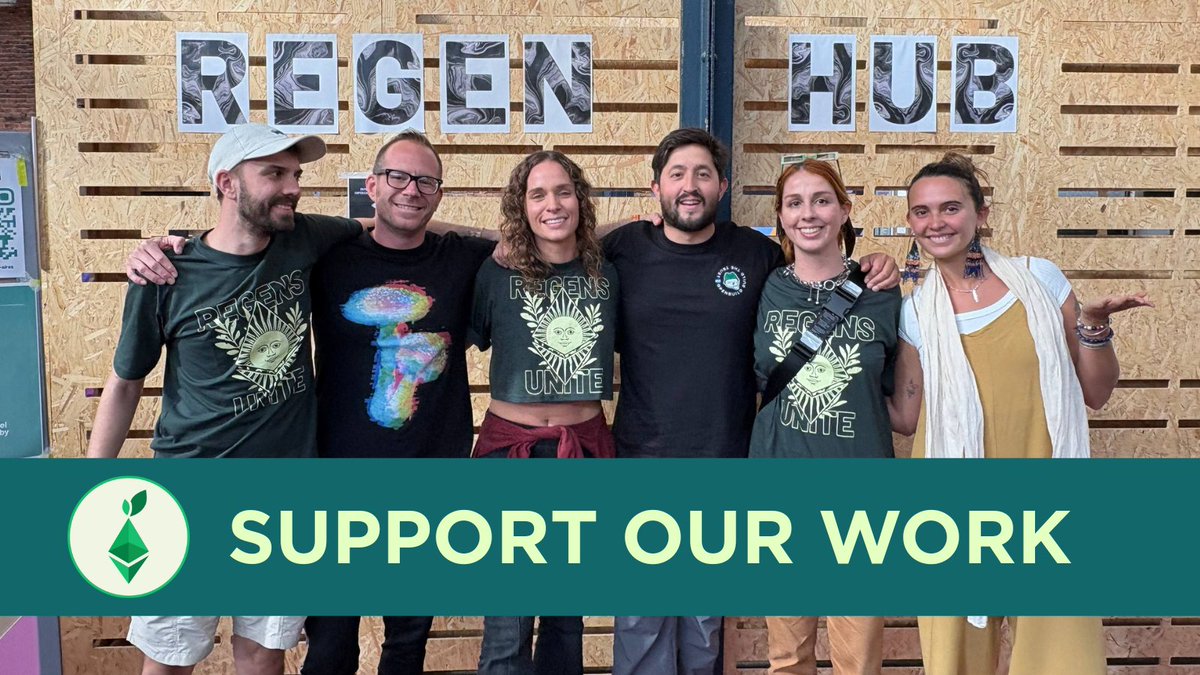
Thank you so much to everyone who made the Regen Hub come to life during @EFDevcon! We've gotten so much heartwarming feedback. 6 days, 50 sessions, hundreds of participants. Apparently we were one of the best organized community hubs, and a true "home" throughout the week for many who attended Devconnect. 🥹 Guys this means so much to us. It's been a labor of love. Most people seem to assume that our work is compensated by Devconnect, but that is not the case. We are a very small, independent team and we've spent months of volunteered time, with 3x-a-week meetings, and our own treasury spend to make this happen. Why? Because this space needs it. We create safe containers for local Argentinian projects to connect with the global Ethereum community, sharing their on-the-ground expertise and learnings, exploring the possibilities of these evolving technologies, and fostering new connections for future opportunities. For us, regen is not a trending meme that is "working" or not. It's a community of people who deeply care about building regenerative systems. It's an entire world outside of this space that is doing hard work on the ground. And we need to keep connecting the dots. If this experience brought you value, if you believe in our work, we invite you to support through a contribution of any size. 👇 regensunite.eth - or find the link to our project on @Giveth in the comments. Stay tuned for more detailed recaps, footage and updates soon! 💚
Regens Unite 🌱✨ tweet media
English
7
13
51
2.7K
vaughn retweetledi
dom williams.icp ∞
dom williams.icp ∞@dominic_w·
When Cloudflare went down, apps onchain on the Internet Computer continued running, however... some users experieced issues where apps used Cloudflare for DNS (domain names). So, decision made, we're going to bring that onchain too (DNSSEC + NNS + chain key).
English
170
450
1.7K
121.1K
vaughn retweetledi
Lam
Lam@LamWeb3·
What was an impromptu decision to come to Argentina turned out to be a pleasant surprise! I didn't expect that my team would be able to deliver the full solution, nonetheless winning one of the finalists prize. After 3 days and 2 nights of little sleep and hours of coding/building/discussing, my team eventually was invited to the stage to pitch in front of 750+ hackers and audience. Quite a surreal experience that I was able to crown @ETHGlobal finalist a 2nd time, even though this hackathon had the most number of ETHGlobal finalist, meaning it was very competitive. I think this moment, taken by a professional photographer, captured the spirit of hacking and what it meant to take ownership. The photo was taken at around ~6:30AM in the morning, just a couple of hours before the final submission was due. At that point, I was still struggling to give the right pitch, and the audio from my mic didn't function properly, but after the 6th recording, I came to an acceptable demo and submitted our project! Thanks to my team (@vaughnhew @ballew @netun0 @Ghost_xD2) that pulled all nighters with me to build this project. Also thanks to all the organizers and sponsors for making this hackathon experience smooth and fun! Until next time in this little Web3 world! Hasta la vista!
Lam tweet media
English
1
3
12
585
vaughn retweetledi
Lam
Lam@LamWeb3·
My teammates (@ballew, @vaughnhew and @netun0 ) and I built a protocol extension for x402 using @CoinbaseDev at @ETHGlobal hackathon in Buenos Aires. Our extension integrates zk proofs for verified variable payments and verifiable contents. Verifiable leaks. Anonymous monetization. AI-native access.
English
2
2
5
356
vaughn retweetledi
Bob Loukas 🗽
Bob Loukas 🗽@BobLoukas·
Are Your Ready? youtu.be/DU0nwsY-8WY?fe… Latest Bitcoin 4 Year Cycle Video. Appreciate a retweet and share on other platforms. All the best.
YouTube video
YouTube
English
140
472
2.6K
330.2K
vaughn
vaughn@vaughnhew·
@BobLoukas how does bitcoin dominance react to a double cycle blowoff?
English
6
0
1
136
Bob Loukas 🗽
Bob Loukas 🗽@BobLoukas·
The Perfect Storm Bitcoin 4-Year Cycle Journey video. Appreciate you sharing it on other media, and a retweet. Cheers. youtu.be/lFyXznUq30A?fe…
YouTube video
YouTube
English
96
329
1.8K
328K
vaughn
vaughn@vaughnhew·
@thrivenex @dominic_w PWA apps run from your mobile browser and can be installed to start like any other app. if your user base is in the global south, this feature is critical as many do not (cannot) install via the app store. so caffeine not building native mobile apps is a pro not a con.
English
0
0
1
35
dom williams.icp ∞
dom williams.icp ∞@dominic_w·
Bitcoin ₿ and the Internet Computer ∞ are both holdout networks powered by *sovereign* specialist hardware that's dedicated to purpose = real infra Are there other similar sovereign networks I've missed in the Top 50?
English
77
185
955
32.2K
vaughn
vaughn@vaughnhew·
an important read for any builder and investor who believes in decentralization. For an investor ICP has team, has multiple narratives, has amazing revenue and lacks hype.
dom williams.icp ∞@dominic_w

Caffeine demo @ Crypto Valley Conference had the audience entranced & clapping as it unfolded :) 💪 But, there was something else that I experienced, and I’ll talk about this subject for the last time, since I feel our project is moving on. The laptop I was going to use to demo had a problem with its internet, so while it was sorted out, I engaged in a back and forth with the audience. To level-set in preparation for the demo, and make sure the audience understood what they were about to see, I asked the audience about their understanding of the phase "onchain" and what it meant for an app or service to built "on" a blockchain. I asked the audience to put their hands up for one of two choices (one of which would be true, the other false): Choice 1: "if an app/service is said to be 'built on Blockchain XYZ’, and is said to be running ‘onchain,’ this means that XYZ is functioning as a decentralized cloud, and that's where the app/service is actually hosted and runs”. Choice 2: "the phrase means the app/service is built on one of Big Tech’s cloud services or similar, where the user experience and backend data and computation lives under the full control of the developers and the cloud service, without blockchain resilience and security, and is termed 'onchain' because it has an associated token on blockchain XYZ.” More than 90% of the audience raised their hands for Choice 1 (but, of course, Choice 2 is what the prevailing Web3 vernacular means). I shouldn't have been surprised by this, since past research performed by DFINITY found an even higher proportion of retail crypto investors, institutional crypto investors, crypto journalists, mainstream journalists, etc, believe that when someone says that an app or service is built on Blockchain XYZ, and is onchain, that it is running from XYZ, which is playing the role of decentralized cloud. But I thought the truth would have percolated more by now. This was something I was fighting 3-4 years ago. But the massive misunderstanding obviously remains fully intact. Back in the day, I tried to help people understand on social media by posting the theoretical cost of storing a single phone photo on different blockchains, and comparing the cost to storing a photo on the Internet Computer. Everyone knows what a phone photo is, so this was meant to provide a way to grok the difference. The costs on other blockchains ranged from the millions to tens of thousands of dollars owing to limitations in traditional blockchain design, to fractions of a cent on the Internet Computer (which is why NFT media typically lives offchain, and why blockchain NFTs just store a link to it) Of course, my purpose was partly to help people understand what had been achieved with the Internet Computer, the level R&D that went into creating it, and deep innovation it embodies (and why DFINITY, a not-for-profit with a defined mission, had spent hundreds of millions on R&D, rather than directing that money into marketing). But my purpose wasn’t just to draw attention to the Internet Computer: I also personally prefer a world grounded in reality, and for the facts to be out there. This, after all, is pretty fundamental to what Web3 is. My phone photo reveals didn’t go down well at all. I was widely attacked and derided as lying about the Internet Computer, and accused of spreading disinformation about other blockchains, and as being an industry downer. Eventually I gave up and took the view that people would eventually get to the truth without me making enemies – after all, the difference between perception and reality was so vast, I felt it surely couldn’t persist But the problem has never gone away, in reality. For example, less than a year ago, I had a difficult interview with the Managing Editor of Crypto at a huge mainstream publication, which experience I shall share with you. I spent the first 15 minutes explaining the Internet Computer vision, how much we had invested into reinventing blockchain so that it could function as a revolutionary new form of decentralized cloud and end-to-end stack that hosts online apps and services that are tamperproof (no need for traditional cybersecurity) and unstoppable (resilience guaranteed), while continuing to support blockchain specialities such as tokenization and autonomous logic, adding additional functionalities such as trustless multi-chain etc etc The Internet Computer addresses seminal challenges in tech, and in society generally. The project has employed world-famous computer scientists. Who could fail to be interested in that, but — Soon, the crypto editor was looking irritated, and in fact, plain angry. I paused. He shrugged his shoulders, and said (verbatim): "so what's new!?.. isn't that what Solana and Ethereum are… decentralized clouds.” I wasn’t going to be able to disabuse him of his strongly-held beliefs, and persuade him that these these networks are designed to store and process tokens, and DeFi, and cannot provide cloud functionality where online apps and services can be hosted. The interview was over in 20 minutes. The editor thought what I was saying was completely preposterous, and obvious lies, and that *I* was a charlatan taking him for a fool. This is the bizarre alternate reality that DFINITY has been living for four years since launching of the Internet Computer in 2021 – after 5/6 years of hard R&D at scale, with another 4 following since. At launch, the credibility of the network suffered from extraordinary attacks by shady people in our industry to deflect from its capabilities and protect the status quo, in ways anyone can read about on CryptoLeaks, but what’s really bizarre, is that despite the scale and power of those 2021 attacks, in the end the unique capabilities of the Internet Computer have become masked within the industry not by those reputational attacks and historical market manipulation, but by the widespread baseless misunderstanding that other blockchains provide exactly the same (or better) decentralized cloud functionalities, an idea completely detached from reality. While the Internet Computer can host a social network, these other blockchains can't even store one phone photo in practice. They are token-processing networks. The situation derives not only from disinformation and misleading vernacular, but from the lack of direct experience people have with networks. The average man can't tell where an app or service is running. If someone claims an app or service is running on their favorite blockchain, then who's to say it isn't!?!? The industry has fostered this profitable mass delusion to such a point that the social proof appears overwhelming to people, and it is accepted fact. This, of course, is what happens in cults. And, just like in cults, when someone demurs, and dares to challenge cherished delusions, they are attacked and vilified. Back in the day, when I helped pioneer this industry, as one of its technical leaders, I was driven by an overwhelming passion to use my technical skills to unlock utility for humanity by developing the most advanced decentralized technology possible. I’m a very technical person, and as a pioneering theoretician in the field, I was in love with the technology and what could be achieved (and absolutely still am). At DFINITY, we aim to do big things, and our work addresses seminal challenges in tech, and to no small extent, in society more broadly. The technology was and is revolutionary. In practice, successful engagement in serious science and engineering pursuits is easier if you are someone who is almost religiously interested in truth, logic and facts – even if you are overly optimistic about timelines, you are pursue inspiring things you have worked out can be achieved technically. You constantly try to move past imperfect understandings of things. For that reason, it is very difficult for me to personally accept that our industry, accidentally or not, promulgates egregious untruths like these. In my opinion, when the leaders of major projects participate in promoting these untruths, even if just by subtly encouraging the misunderstanding, at the least they are guilty of a serious lie of omission. There’s nothing wrong with blockchains that are primarily designed to host and process tokens and DeFi. Nothing at all. They, and the communities that create, support and sustain decentralized value, are valuable things in their own right. We can celebrate and value that without deceiving people. The challenge is that when markets and industries are routinely given completely false information, it totally distorts incentives, and ultimately, prevents them from doing their work. Technological innovation within our industry has suffered greatly. People look at price as a kind of social proof of value, without understanding that it’s often manufactured by armies of market makers and treasury traders. They lap up narratives that they are completely unequipped to verify for themselves, but which appear to be validated by clamor on social media (which is also manufactured, or paid for) and supportive crypto media owned by people with vested interests. Cool as some people think this machine that extracts value from the cryptosphere is, it's horrible for our industry, and it causes great harm. This is not what the Internet Computer is about, nor is it something I want to be involved with personally. Perhaps I would feel more comfortable if people weren’t being deceived en masse. In Web3 today, the space for the pursuit of real technology, vision and utility, and the value of real adoption and network usage figures, has been shrinking. Only major science and engineering-led projects like the Internet Computer can resist the pull of the narrative game. Thomas Gresham was a sixteenth century English economist. Gresham’s law is “bad money drives out the good.” Web3 has rewarded deliberately misleading fast-money narratives, and lies and misrepresentation is not punished. A large section of the industry participates. Since developing and promoting narratives is far less costly and time consuming than developing truly game-changing technology through multi-year R&D programs, more and more projects have become snakeoil spinners to stay in the game. It's a sad fact that many alt-tech networks are now complete vaporware, and their native tokens are really memecoins in disguise. Although retail doesn't have an inside view and understand what's happening exactly, they have a growing instinct that they can't trust any narrative any more, and increasingly turn to memecoins as investment vehicles, because at least they are not masquerading as something they aren't, even if they often lose their money on them. It's a great shame so much of our industry is now primarily directed towards extracting value from well-meaning but unwitting people through pump and dump cycles and narrartives, rather than sustainably building real value by developing game-changing decentralized technological infrastructure. Yhe industy has come to value stuff that's not valuable. Projects like the Internet Computer are the last bastion, holding out with a determination to succeed by powering decentralized networks with more and more advanced technology until it unlocks game-changing utility, taking crypto where we all want to go. With the "self-writing internet," I believe we are now getting to a place where we can pull something off that will help reset our industry, and take us somewhere completely new. My experience sharing Caffeine demos over the last couple of days has shown me why and how: Caffeine will put one of the most powerful crypto technologies ever developed into the hands of the anyone who wants to give it a try, where they can experience it *directly* such that they can easily appreciate the value themselves, because it's valuable to them, removing the need to evaluate a complex technical story or narrative they cannot easily verify the veracity of. Caffeine and the self-writing internet technologies are shockingly good and powerful, and hugely enjoyable to use – my guess is most of the industry will eventually feel compelled to try it for themselves. Simply by having a conversation with AI in natural language, with no separate technical steps, users can create and update sophisticated sovereign online apps, that are also tamperproof and unstoppable, and run entirely from an advanced blockchain network. What's striking, is that the sophistication of these apps (really dapps) far exceeds what can currently be created using “mostly hands-free” Web2 vibe coding platforms, which in practice still require craft coding (human) input, and thus technical skills. Moreover, it's crypto technology that provides guarantees that data is not lost during upgrades, if the AI makes a mistake, such that the paradigm works in production. It won't be difficult for Web3 participants to confirm these apps run on the Internet Computer, and this begin to have people asking what "onchain" really means. Not a moment too soon :) There's no way to fake self-writing internet technology, at least not without risking jail.. This will be a blockchain experience unlike any before. Mostly Web3 "ownership" has meant speculating with tokens, memecoins and NFTs. This is something else altogether. This is our chance to make Web3 about the tech again. I want the self-writing internet, and Caffeine, to nudge Web3 in a slightly different direction, and I hope you'll join me in that effort. Lastly, there are 5 billion people with internet-connected smartphones who will be able to use Caffeine. There are also a gazillion entrepreneurs and startups, small and medium sized businesses, corporations, governments and NGOs... Caffeine has almost unlimited use cases. The overwhelming majority of these self-writing internet users will come from outside Web3 and this is about breakthrough mass market technology with impact that reaches far further. For that reason, the ICP community will see that we begin to stop describing ourselves as a Web3 or blockchain technology project. That's simply because outside our industry, anything Web3 is now often viewed with distrust. I think we will best help restore the reputation of Web3, and better light the way forwards, by succeeding outside. We want outside people to experience the power of the self-writing internet without Web3 baggage. But, this won’t change the fact that Bitcoin DeFi is quietly taking off on the Internet Computer, or any ot the other really interesting things happening that belong to Web3. Internet Computer 2.0 and the self-writing internet will be its own sector. Here's to a better future!


English
0
0
0
60
vaughn retweetledi
dom williams.icp ∞
dom williams.icp ∞@dominic_w·
I think people will be shocked by what they see today. My personal blood sweat and tears is in this tech, and my thanks goes out to everyone involved in what has been a colossal effort. No exaggeration to say this is INTERNET COMPUTER 2.0
dom williams.icp ∞@dominic_w

World Computer Day on 3rd of June, at DFINITY HQ, Zürich, might as well have been called "Caffeine ☕ AI 🧠 & Self-Writing Internet ✏️ " Day. Tick tock, can't get no sleep.. #ICP

English
180
411
1.5K
90K
vaughn
vaughn@vaughnhew·
@dominic_w I was already sold to build on #ICP at chain fusion. Next evolution of AI needs data sovereignty, only on ICP, but Caffeine is already dreaming and DELIVERING beyond that. it's gonna take a while for me to grasp the significance of the self writing internet.
English
0
0
0
19
vaughn retweetledi
dom williams.icp ∞
dom williams.icp ∞@dominic_w·
The AI x internet revolution coming on #ICP: *Self-writing* sovereign web applications and internet services that owners can update in real-time by talking 💥 The Internet Computer has been designed for this and work has been ongoing for YEARS. Today I want to explore this topic in a bit of depth for the first time. Please note — this area of work is not to be confused with the AI capabilities of ICP networks (for newcomers: the Internet Computer is unequivocally the ONLY public network in the world that can host and run AI in the mode of smart contracts, which makes it network-resident and decentralized, and secure and unstoppable, and for example, I recently demonstrated onchain neural networks performing facial recognition, and pending enhancements to the ICP protocol will allow LLMs to run as smart contracts too). Today I'm talking about a very different challenge that ICP shall help the world meet, where *running* web applications and internet services are created and updated simply by talking. Users will create these for any purpose – to create something like a secure personal notes manager, or a personal website, or something for others, like social media, games, web3, or enterprise infrastructure, which involve online communities large and small – simply by issuing instructions in natural language. Please also note, this is a far bigger and different challenge to using AI to write and review software, which is already happening at scale. This is something well beyond, for reasons I will explain... To begin, let's step back and look at some general trends, to understand where the internet is going with AI: Many of you reading this, will already be using ChatGPT to explore ideas, get information, and analyze, refine and create content, and soon to search the internet. ChatGPT is an example of a large LLM (i.e. chat bot) with a huge number of parameters that has been trained on a colossal amount of data. If you're a software engineer, you'll already have been using LLMs to help write and review code, although maybe you prefer Claude. These models triggered the recent wave of hype around AI. But in fact, they are manifestations of a deeper trend that AI has been driving for some time now. The deeper trend is this: we interact with AI, knowingly or not, and it gives us something we want. Some of the first mass market manifestations were services like TikTok and Instagram Reels. These services are not traditional social media services at all. Under the skin, they are driven by powerful AI engines, without which they wouldn't work. When you use them, you are really interacting with AI. The AI inside these services classifies the social media content they can serve, so that it knows what's inside videos and other kinds of posts. Then, as it feeds you content to consume, telemetry is collected, enabling the AI to track how you interact with the content – for example, most simply, it can track how much of a video you watch, to determine what kinds of content you like. As the AI gets better at understanding what you find compelling (which can extend to the sequences of videos it shows you, not just individual videos), you receive a better and better experience, which is why these services are so incredibly addictive. This new media model is just part of inexorable journey we are being taken on by AI technology, where it gives us what we want – which will be far reaching. Seemingly impossible things are now happening. For example, researchers recently trained AI on millions of hours of footage of people playing Doom and Minecraft. This has enabled the AI to simulate those games in realtime for users. You can play the games, but there's no game server or game client, just an AI streaming video to you in response to traditional inputs such as left, right, run, jump and shoot (to be clear, there's no game server, or game client, or any other infrastructure involved from the original games). This hints at what's coming: in the future, AI will create virtual reality experiences for us, and watch how we interact with them, tailoring them in real time to make them more enoyable and compelling. Sci-fi as this might sound, really will just a continuation of the trend exemplifed by TikTok and Instagram. But enough of this. What else will AI give us on demand where ICP specifically plays a role? We in the ICP community are heavily focused on reinventing the platform on which we build, specifically providing a better way to create web applications and internet services (including those with web3 and AI functionality inside), which also happen to be sovereign. In the future, we will just talk to AI, to create and update the *running* web applications and internet services we want too. It's obvious why. For example, what if a businessperson wishes to build a custom personal website, to promote their brand, with blogging functionality, a section where they can embed media pulled from places like YouTube, a library page hosting documents they have created, and a page linking to their social media profiles – and have all that functionality look a certain way. In the future, will they still be expected to hire designers and developers to build such a thing, or otherwise be stuck fiddling with Wix, or just sticking with their vanilla LinkedIn profile page? Of course not, they'll just talk to AI. What about an avid gamer, who wishes to create their own custom online game to share with friends? Will it still be difficult to express creativity without special technical skills and a lot of time? Nope. And how about a business, NGO or government that just needs some custom CRM functionality? Will they still have to sign-up to big-ticket SaaS services like Salesforce, and hire consultant to customize them? Today, creating things on the internet is complex, time-consuming and costly – and this stops us building what we want. The world is waiting to break free from this. In the future, we will just talk to AI to create and update, which will result in an almost limitless number of new custom web applications and services being created for every purpose imaginable. Here's how it will work: 1) You'll describe to AI the custom app or service you want 2) It will return a URL to your web browser, and there it will be, ready to use! 3) You and others will use the app, causing it to accumulate content and data. 4) You'll describe improvements, extensions and fixes. 5) Then you'll just refresh the web page to see them. 6) Loop to 3, and continue iterating to realize value. Over time, this new paradigm will massively change the way tech works. Imagine what this might mean for budding entrepreneurs around the world, who lack the technical skills or the funding to hire them, but who have ideas for ventures in social media, games, the sharing economy, AI-based services, web3 services, communication suites, and _ (fill in what you want). This will democratize access to the tech economy, and help enable vast additional worldwide talent to participate and become industrious and successful. This is an aim that has been part of the ICP project since inception. Furthermore, this functionality will be for all humanity, not just entrepreneurs. Imagine a simple group of high school students that want to organize the information they collect from a biology field trip. It works for them too! Imagine some business department that needs custom online functionality, but can't convince the CIO and CFO to allow them to sign up for something like Salesforce and hire some consultants to customize it. (Which will anyway take a very long time, and cost a huge amount, even if they agree). Solved. Now think about the current situation in the developing world. They having growing needs for custom online functionaltiy, but can't afford Big Tech SaaS services, and meanwhile don't have the skills to build it out themselves – and if they did, then they would also need the cybersecurity expertise to make what they built safe, which they lack. For those economies, this will be trasformative. The new paradigm will solve for all these needs, and in fact go one better. People who create custom applications and internet services will OWN the software that makes them, even though they don't write it themselves, and OWN the data inside them – which contrasts to popular SaaS services businesses use, which holds customer data hostage, and even consumer services like Google Photos, which make it impossible to get media out. These custom applications and services will be truly sovereign, and the owners won't be captive customers – which has long been an aim of the Internet Computer network. Counterintuitively, this new paradigm will also be great for software engineers – it will result in millions of new custom applications and services being created, and inevitably, there will be places where human assistance is useful to solve specific issues, and help making prompts go further. The orders of magnitude increase in online infrastructure will create huge numbers of software engineering jobs, all around the world. If you have stayed with me this far, hopefully by now you can see that this new paradigm is both inevitable, and represents one of the biggest revolutions ever in tech. So... the next question is, how exactly will ICP finally uncork the paradigm for the world. To understand this next part, we first have to look at the limitations of traditional IT when applied to this paradigm. Creating and updating *running* online applications is much more complicated that getting an LLM to write some software code. For example, using a typical traditional IT framework to build, this is what might be required: 1. Get an AWS account, and add a credit card 2. Get some "compute instances" (effectively servers) 3. Install some cybersecurity to make it safe 4. Install a database server, a web server, a... 5. Orchestrate it all with e.g. Kubernetes 6. Patch all your software for security 7. Design failover, backup and restore 8. Create tables in the database 9... 10. Install the code involved This is quite a list of tasks, some of which are very involved, so the AI will have to do much more than just write code. Let's assume the AI is given hooks, and has the knowledge, to perform all these steps itself. Will this solve the paradigm? Unfortunately there will still be issues... At a basic level, the paradigm should provide users with a real-time creation experience, and even installing a database server or patch can take some time. Of course, this kind of thing can be mitigated by using preinstalled images, but problems run deeper... The various steps and requirements involved in traditional IT can go wrong in multitudinous ways. The AI's build sequence will break, like it does for humans, and it will have to make judgements about how to address them within an *unconstrained problem space,* which will subtly impact things like security – which is a serious problem, because traditional IT is insecure by default, and even small mistakes can result in disaster. Traditional IT is a crazy complex Rube Goldberg machine, and providing AI with sole responsiblity in that kind of unconstrained problem space is potentially very dangerous, because it hallucinates, and can pickup bad memes from its training data. Everything the AI does would have to be manually reviewed and, if the application or service is important, audited, by technically competent people – and of course – the whole point of this paradigm is that it doesn't require creators to have technical skills, and to make creation a real-time iterative act. And there are other showstoppers using traditional IT. In the new paradigm, the users/creators will want to update their running web applications and internet services in real-time, simply by telling the AI about the improvements, extensions and fixes they want. The systems created will need to undergo substantial upgrades every few minutes!! Traditional IT has not been designed to make this possible. Anyone involved will know that upgrades are a big deal, and with production systems, typically occur on long time intervals. That's because changes often have to be made across multiple components in a synchronized way (e.g. updating database tables, changing web server configurations...) and it's a fiddle. Moreover, when you change the design of web applications and services running on traditional IT, the upgrade process often involves refactoring/migrating data, which process is slow, computationally expensive and error prone – again, preventing traditional IT realizing the crucial real-time nature of the paradigm, which will involve running web applications and internet services being updated almost at the speed of chat. I could go on, but it should become clear traditional IT is not really suitable for the paradigm. Because of the difficulties, we will see services like Vercel, and probably eventually services like Google, providing AI that can create apps within custom infrastructure platforms they craft, which ameliorate some of these problems. But their platforms will remain less than ideal, and moreover, the software created by the AI will also be locked to their special platforms, and they will probably also hold the data involved hostage somehow, creating customer lock-in, and the applications and services involved won't be sovereign. (Nonetheless, we predict that certain web3 projects that tend to imitate ICP, in desperation will use something like Vercel to create dumbed-down versions of this paradigm, then mis-sell their services to the token-buying public as being "onchain," but beyond successfully selling more tokens for them, their schemes will ultimately fail to be competitive with mainstream users/creators worldwide.) So what is really needed? The good news is that DFINITY has been working on a solution to this paradigm for years already. Let me explain... From the beginning, going back years, and now more than a 1000 person-years of R&D effort, our work has been ruthlessly focused on reinventing compute broadly using a decentralized network leveraging advanced cryptography, protocol math and computer science. Our work is completely unique in the web3 field. A key feature of ICP is that you can build a web application entirely from secure and unstoppable netwok-resident software, which a vastly more powerful evolution of smart contracts. When you build on the network, you don't need Big Tech and traditional IT. AI can write this code, and upload it to the an ICP network like the Internet Computer to create an web application or other internet service. To be clear, in the radical compute environment ICP creates, AI can create and update, just by uploading code... There is no need to configure a cloud account, a database, a web server, cybersecurity. Moreover, the code is automatically secure and immune to cyber attack. So there's no need to worry that a hallucination will leave a door open for hackers. Moreover, there's no need for the AI to design and configure complex failover systems, because the code is unstoppable and always runs. So those roadblocks are out of the way. But the real power derives from a seminal computer science advance that ICP provides called "orthogonal persistence" (keep reading, I won't go too technical on you!) On ICP, units of software run inside persistent pages of memory, which is basically to say, that data "sticks" to the software logic that programmers create when they write in a software language, which saves them from the complexity and inefficiency of copying data in and out of databases and files, also removing the need for those things. Everything is just network-resident highly-abstracted software. This makes it possible for engineers, and soon AI, to describe functionality in a much more simpler form, without dependencies, which is ideal for this paradigm. I described a vision for "orthogonal persistence" back in 2018, but only now, 6 years later, will it be fully realized through Motoko, a domain specific language that directly hooks in to the workings of the ICP platform. Get ready for what we are calling EOP, or "ehnanced orthogonal persistence," which will finally realize what we have been working towards. (This is gated by pending upgrades like the 64-bit change also need to run LLMs on the network, which are about to happen.) Above I talked about the importance of instant and safe upgrades to the new AI paradigm. Well.. EOP makes it possible to "morph" software between upgrades. Developers (human and AI) will write new versions of software, which realize the changes required. Then separately they will describe code that transforms that data from the old version. (For example, if a Google Photos-style application has been created, then an upgrade might add location data and comments to photos, causing the strucutre of the "photo" data type to change.) During upgrades, in the new paradigm, EOP does the following: 1) It adds type safety to the upgrade, ensuring that if the AI has made a mistake that might cause data loss, by hallucination or otherwise, the upgrade will fail, which greatly reduces the risks that would be ever-present in traditional IT architectures. 2) As software is morphed through upgrades, it allows data transformation to occur in a highly efficient manner, such that the paradigm can deliver real-time upgrades at the speed of talk. Which is what is needed. Other benefits from the years focused on reinventing compute are important too. For example, because code and state exist as one within this the environment, ICP can easily almost instantly snapshot applications and services, enabling users to rollback to precisely where they were before, if they don't like how their data was transformed (using EOP, this can often also be done just by "upgrading" to earlier versions of the software). I could go on, but I'll summarize. This new paradigm, which will ultimately profoundly change tech, will be unlocked by combining ever-improving AI, with ICP technology. What's incredible for the ICP community, is that the paradigm provides utility to massive worldwide market, and we will not be constrained by web3 noise. People will use it because it gives them what they want. I can tell you that behind the scenes we are expending great effort on AI itself, and also on the framework that will let it build on ICP, and on making sure that the Internet Computer can scale to handle this – which work you might already be aware of. If you think the incredible recent growth of compute on the Internet Computer is impressive, buckle up, because this paradigm may mean we haven't seen anything yet. As always, we choose to believe in this over narratives: Pure. Utility. From. Advanced. Alien. Tech. Will. Win. In. The. End. Today we are closed than ever. O, btw did I mentioned that this next generation of web applications and internet services that people create using AI will be internet native, and sovereign. They will run on a network hosted by real decentralized hardware (the Internet Computer is one of the few web3 networks that does not really run on Big Tech), leverage trustless multi-chain functionality, and embed real onchain AI. This is going to really, really cool...
English
313
806
2.2K
420.3K
vaughn
vaughn@vaughnhew·
@eesee_io @AethirCloud those looking for an eesee referral code, appreciate it if you use this: jg6upo8xj68w
English
0
0
0
12
eesee.io
eesee.io@eesee_io·
We're thrilled to announce our new strategic partnership with @AethirCloud!🎉🎉 Within this partnership we're glad to provide exclusive benefits to Aethir community, including 25% eesee Mainnet points multiplier!
Aethir@AethirCloud

We have an exciting partner on board @eesee_io a gamified liquidity solution and marketplace for digital assets, tokens, and RWAs on @Blast_L2, backed by @animocabrands Eesee’s phase 1 snapshot will be on April 9. They have a large number of challenges that users get points for completing, for which they will get airdrop very 🔜 🎁 To incentivise our community, they are offering you all the following perks 👇🏻 🔹 +25% to airdrop points for our community 🔹 Simultaneously farm $ESE and Blast points on the same platform 🔹 2-tier referral system (Get 16% of earned points from your referrals and another 8% from each referral they invite) Steps to take: 1. Visit eesee.io/?r=001 2. Connect wallet 3. Deposit funds to the platform, buy tickets and complete challenges 🎁 ONLY FOR NODE HOLDERS 👇🏻👇🏻 Our node holders are eligible for guaranteed whitelist spots for Eesee’s public sale/IDO. 1️⃣ For that, you must complete KYC (with node holding wallet address): eesee.io/explore/launch… 2️⃣ After completing KYC, please fill out the form: forms.gle/XDHUkDMAJnWVUo… Key info for whitelist 👇🏻 🔹 To get whitelisted, have your KYC Done 🔹 Kindly mention the same node holding wallet address for KYC and also within the form 🔹 First Come First Serve 🔹 The minimum number of tickets per wallet is 1 🔹 The max amount is 10 tickets 🔹 Each ticket is 10$

English
217
1.1K
1.4K
151.9K
Aethir
Aethir@AethirCloud·
We have an exciting partner on board @eesee_io a gamified liquidity solution and marketplace for digital assets, tokens, and RWAs on @Blast_L2, backed by @animocabrands Eesee’s phase 1 snapshot will be on April 9. They have a large number of challenges that users get points for completing, for which they will get airdrop very 🔜 🎁 To incentivise our community, they are offering you all the following perks 👇🏻 🔹 +25% to airdrop points for our community 🔹 Simultaneously farm $ESE and Blast points on the same platform 🔹 2-tier referral system (Get 16% of earned points from your referrals and another 8% from each referral they invite) Steps to take: 1. Visit eesee.io/?r=001 2. Connect wallet 3. Deposit funds to the platform, buy tickets and complete challenges 🎁 ONLY FOR NODE HOLDERS 👇🏻👇🏻 Our node holders are eligible for guaranteed whitelist spots for Eesee’s public sale/IDO. 1️⃣ For that, you must complete KYC (with node holding wallet address): eesee.io/explore/launch… 2️⃣ After completing KYC, please fill out the form: forms.gle/XDHUkDMAJnWVUo… Key info for whitelist 👇🏻 🔹 To get whitelisted, have your KYC Done 🔹 Kindly mention the same node holding wallet address for KYC and also within the form 🔹 First Come First Serve 🔹 The minimum number of tickets per wallet is 1 🔹 The max amount is 10 tickets 🔹 Each ticket is 10$
Aethir tweet media
English
85
74
372
115.5K
vaughn
vaughn@vaughnhew·
just saw @dominic_w @dfinity demo modern AI running on Internet Computer Protocol. That's AI running 100% on the blockchain. AI agents will be crypto native citizens, and the ones trained on transparent data sets i can trust. just saw the future folks.
English
0
0
1
171
vaughn retweetledi