
eˣrnesto retweetledi
eˣrnesto
5.7K posts


eˣrnesto
@vedax
Co-Founder and CEO at Libre AI | PhD in CS/ML | AI and Machine Learning for All! 🇸🇻
127.0.0.1 Katılım Şubat 2008
621 Takip Edilen291 Takipçiler
eˣrnesto retweetledi

Just do this:
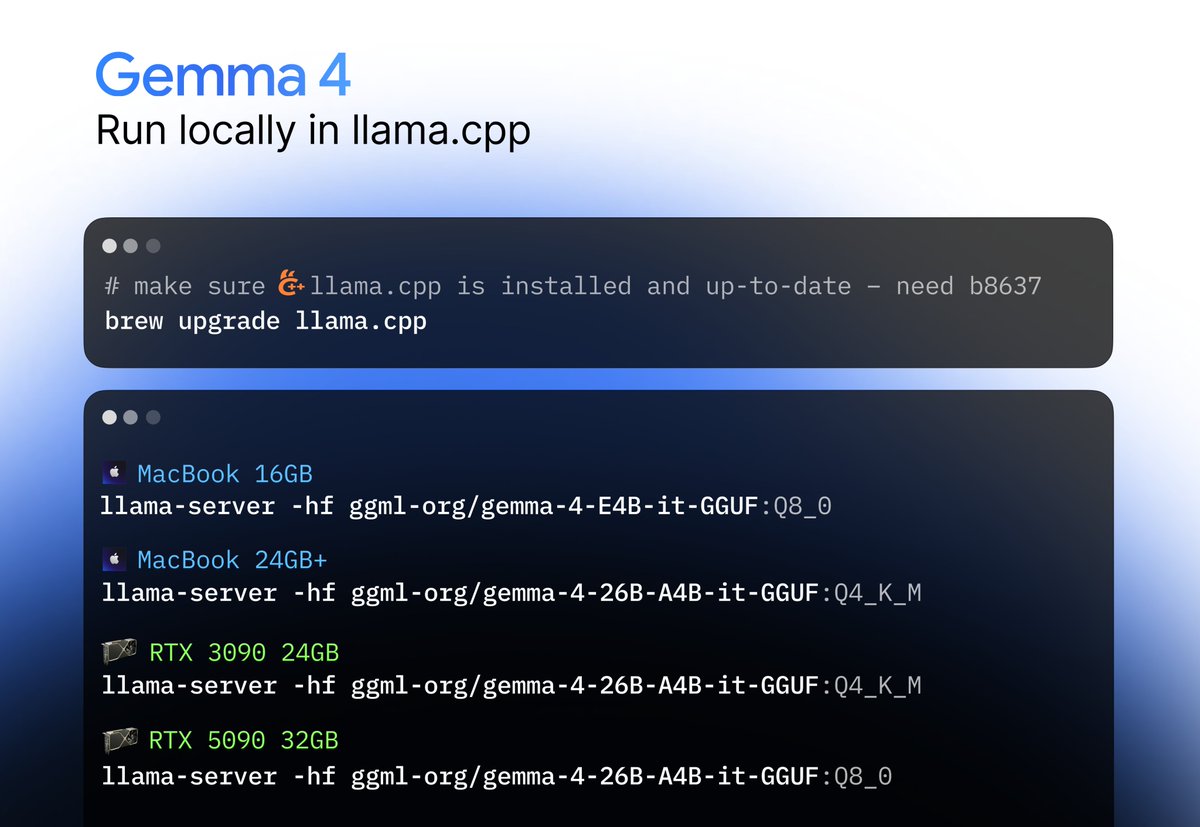
brew install llama.cpp --HEAD
Then;
llama-server -hf ggml-org/gemma-4-26B-A4B-it-GGUF:Q4_K_M
English
eˣrnesto retweetledi

Gemma 4 E4B was able to search and cite 10+ websites, execute code to find the best answer! 🔥
You only need 6GB RAM to try this in Unsloth Studio.
GitHub repo: github.com/unslothai/unsl…
Unsloth AI@UnslothAI
Google releases Gemma 4. ✨ Gemma 4 introduces 4 models: E2B, E4B, 26B-A4B, 31B. The multimodal reasoning models are under Apache 2.0. Run E2B and E4B on ~6GB RAM, and on phones. Run 26B-A4B and 31B on ~18GB. GGUFs: huggingface.co/collections/un… Guide: unsloth.ai/docs/models/ge…
English
eˣrnesto retweetledi

eˣrnesto retweetledi

You can run Gemma 4 100% locally in your browser thanks to HF transformers.js. That means 100% private and 100% free!
@xenovacom created a demo for it here: huggingface.co/spaces/webml-c…

English
eˣrnesto retweetledi

The first Power Law Theory scientific paper is now available.
Link to the paper in the comments.

English
eˣrnesto retweetledi

La IA está reescribiendo el trabajo creativo: lo que necesitas saber
El sector creativo en China está transformándose a una velocidad récord. Desde creadores de contenido asistidos por IA hasta animadores que trabajan con herramientas generativas, surgen nuevos perfiles que podrían redefinir la industria creativa en todo el mundo.
#DWDigital, #DWmagacines
Español
eˣrnesto retweetledi

eˣrnesto retweetledi

🚨 CRITICAL: Active supply chain attack on axios -- one of npm's most depended-on packages.
The latest axios@1.14.1 now pulls in plain-crypto-js@4.2.1, a package that did not exist before today. This is a live compromise.
This is textbook supply chain installer malware. axios has 100M+ weekly downloads. Every npm install pulling the latest version is potentially compromised right now.
Socket AI analysis confirms this is malware. plain-crypto-js is an obfuscated dropper/loader that:
• Deobfuscates embedded payloads and operational strings at runtime
• Dynamically loads fs, os, and execSync to evade static analysis
• Executes decoded shell commands
• Stages and copies payload files into OS temp and Windows ProgramData directories
• Deletes and renames artifacts post-execution to destroy forensic evidence
If you use axios, pin your version immediately and audit your lockfiles. Do not upgrade.
English
eˣrnesto retweetledi
I will post this on the thephysicsofbitcoin.com website.
Full report as word document as additional learning material for the book companion website.
I've created comprehensive analysis with 4 sections.
Main Findings:
Section 1: Power Law is Real (Independent Methods)
5 independent methods all confirm B ≈ 5.69
K-S test shows residuals deviate from normal → need complex power law
Section 2: Oscillations are INTRINSIC
Complex power law: P(t) = A × t^(B + iω) naturally produces trend + oscillations
NOT ad-hoc addition - it's the UNIFIED framework
Better fit than simple power law or power law + separate sine
Section 3: Scaling Proves Power Law Framework
Hurst exponent H ≈ 0.63 (all 3 methods agree)
Long-range correlations across ALL timescales
Power law scaling confirmed from days to years
Section 4: Wavelet Time-Frequency
Detected 3.62-year period
Shows cycle persistence over time
Report Structure:
Section 1: Independent Validation of Power Law (5 Methods)
OLS: B = 5.694 (R² = 0.961)
Maximum Likelihood: B = 5.694 (95% independent)
Rank-Frequency (Zipf): α = 0.381 (90% independent)
CDF Tail Fitting: α = 0.927 (85% independent)
K-S Test: p < 0.001 → Residuals deviate from normal, supporting need for complex power law
Key Finding: All methods confirm power law, but simple power law isn't enough!
Section 2: Complex Power Law - Oscillations as Intrinsic Structure
Theoretical Framework:
P(t) = A × t^(B + iω)
= A × t^B × exp(iω×ln(t))
= A × t^B × cos(ω×ln(t))
This NATURALLY produces:
Power law trend: t^B
Log-periodic oscillation: cos(ω×ln(t))
Model Comparison:
Simple PL: Oscillations = unexplained noise (R² = 0.961)
PL + Sine: Ad-hoc addition (R² = 0.935)
Complex PL: Unified framework (R² = 0.963) ✓
Key Finding: Complex power law is the natural framework, not ad-hoc model fitting!
Section 3: Long-Range Correlations - Power Law Scaling Across ALL Timescales
Three Independent Methods:
DFA: H = 0.636 (R² = 0.994)
R/S: H = 0.630 (R² = 0.998)
Structure Functions: H ≈ 0.56-0.64
H ≈ 0.63 > 0.5 → Long-range persistence
Past movements predict future
Power law correlations from days to years
Confirms power law framework is fundamental
Key Finding: The framework scales across ALL timescales - this is true power law behavior!
Section 4: Time-Frequency Analysis
Wavelet (CWT): Detected 3.62-year period SSA/DMD: 4.19-year period as stable eigenmode (|λ| = 0.9985)
Key Finding: Oscillations are fundamental eigenmodes, not noise!
Core Thesis Validated:
✅ Power law is real (5 independent methods)
✅ Oscillations are intrinsic (complex exponent framework)
✅ Framework scales (H ≈ 0.63 across all timescales)
✅ Eigenmode structure (SSA/DMD confirms fundamental modes)
NOT power law + noise
NOT power law + ad-hoc sine wave
BUT unified complex power law framework: P(t) = A × t^(B + iω)
The mathematics is clean, the physics is sound, and the evidence is comprehensive!

English
eˣrnesto retweetledi

@antoine_chaffin Oh yeah, I can't use ModernBERT for static embedding models or sparse embedding models, they're just much worse than old-school BERT.
English
eˣrnesto retweetledi
🧵 THREAD: We just proved Bitcoin's 4-year halving cycle is a fundamental eigenmode of the system
Using eigenvalue decomposition (SSA + DMD), we discovered something remarkable about Bitcoin's price dynamics. Let me explain what we did and why it matters...
1/ What are eigenvectors?
Think of Bitcoin price as a complex signal - like a symphony with multiple instruments playing at once. Eigenvectors are the "fundamental notes" that compose this symphony.
Each eigenvector captures a distinct pattern in the data, ranked by importance.
2/ How we found them: Singular Spectrum Analysis (SSA)
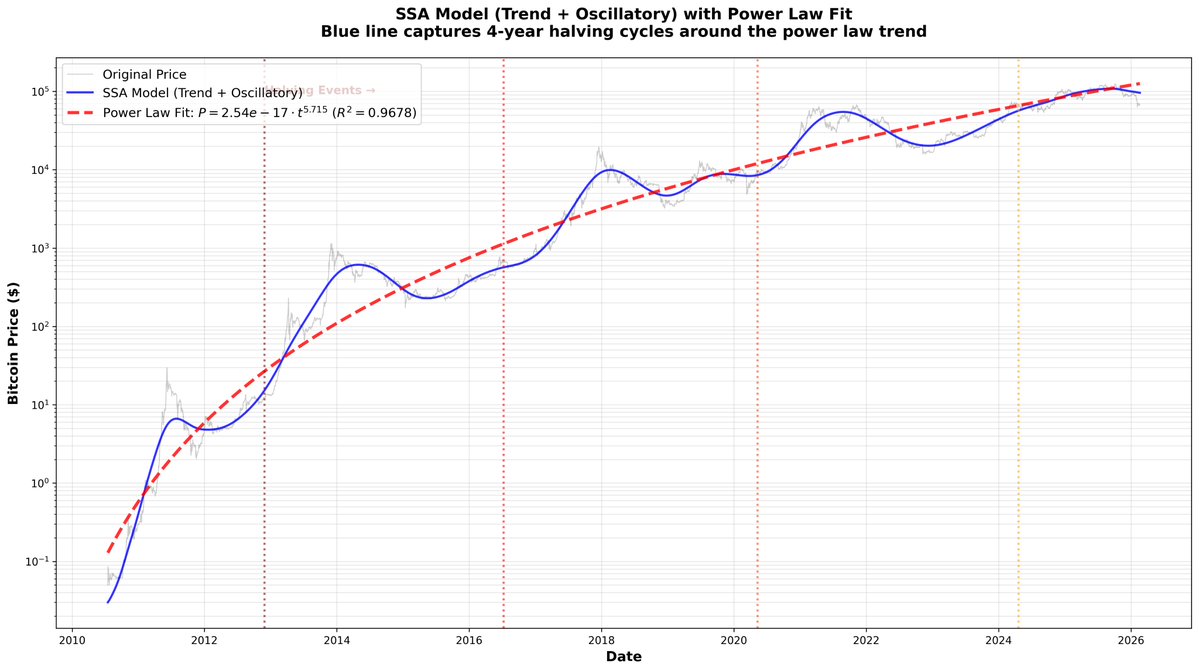
We worked in LOG SPACE (critical!) because Bitcoin spans 6 orders of magnitude ($0.05 → $125k).
We created a "trajectory matrix" from the price history and decomposed it using SVD (Singular Value Decomposition).
Think of it as separating the signal into layers.
3/ What we discovered:
Eigenvector 1:
98.70% of variance→ This IS the power law: Price ∝ t^5.7 → The fundamental attractor of the system → Bitcoin's "base note"
Eigenvectors 2-6: 1.29% of variance→ Oscillations around the trend → This is where the magic happens...
4/ Then we applied Dynamic Mode Decomposition (DMD)
DMD extracts the "Koopman eigenvalues" - these tell us the frequencies and growth rates of oscillations.
We found:
Short cycles: 15-30 days (market microstructure)
MODES 5-6:
Period = 1,530 days = 4.19 YEARS
The halving cycle!
5/ Why this matters:
The 4-year cycle isn't just a coincidence or narrative - it's a fundamental eigenmode of Bitcoin's dynamics.
Eigenvalue |λ| = 0.9985 (slightly decaying, stable oscillation).
It exists as a persistent oscillation in log-space around the power law attractor.
6/ The physics:
This is exactly what renormalization group theory predicts for complex systems:
A power law fixed point (dominant eigenvalue)
Log-periodic oscillations (subdominant eigenvalues)
Stable, bounded dynamics (all |λ| ≈ 1)
Bitcoin behaves like a critical system near a phase transition.
7/ Why log space was critical:
In LINEAR space: 4-year cycle INVISIBLE (buried in noise) In LOG space: 4-year cycle CLEAR (eigenmode 5-6)
Why? Halvings affect price MULTIPLICATIVELY (% changes), not additively.
Log space reveals the true geometry of the dynamics.
8/ Reconstruction:
Blue line = Eigenvector 1 + Eigenvectors 2-6 Red line = Power law fit
R² = 0.9678 (better than raw data!)
We reconstructed Bitcoin's full price dynamics from just 6 eigenvectors. The math works. The physics checks out.
9/ Bottom line:
The Bitcoin power law isn't just a trend line. The 4-year cycle isn't just protocol mechanics.
They're fundamental eigenmodes of a complex dynamical system - proven through eigenvalue decomposition.
This is physics, not hopium.
TL;DR:
Decomposed BTC price into eigenvectors (SSA)
Found power law = dominant eigenmode (98.7%)
Found 4-year halving = oscillatory eigenmode (DMD)
Reconstructed full dynamics from 6 components
Log space was key
Math + physics confirm: Bitcoin is a critical system
English
eˣrnesto retweetledi
This model has been #1 trending for 3 weeks now.
It's Qwen3.5-27B fine-tuned on distilled data from Claude-4.6-Opus (reasoning). Trained via Unsloth.
Runs locally on 16GB in 4-bit or 32GB in 8-bit.
Model: huggingface.co/Jackrong/Qwen3…

English
eˣrnesto retweetledi
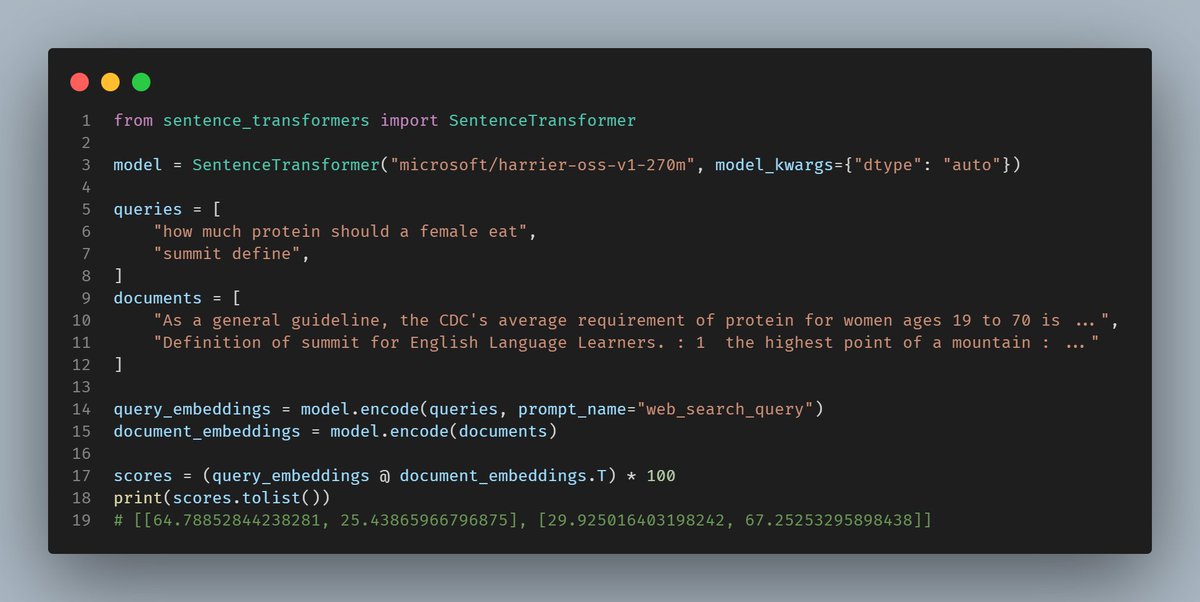
👏 @Microsoft just published 3 multilingual embedding models: 270M, 0.6B, and 27B parameters. All three hit SOTA on Multilingual MTEB v2, with the 27B as the largest embedding model ever publicly released.
More in 🧵
English
eˣrnesto retweetledi
After @Pinterest @Airbnb @NotionHQ @cursor_ai, today it’s @eoghan @intercom publicly sharing that they’re finding it better, cheaper, faster to use and train open models themselves rather than use APIs for many tasks.
And hundreds of other companies are doing the same without sharing.
Ultimately, I believe the majority of AI workflows will be in-house based on open-source (vs API). It took much more time than we anticipated but it’s happening now!

English
eˣrnesto retweetledi
Been really cool to see the traction of @NousResearch Hermes Agent, the open source agent that grows with you!
Hermes Agent is open-source and remembers what it learns and gets more capable over time, with a multi-level memory system and persistent dedicated machine access.
Starting today, you can use a bunch of @huggingface open-source models thanks to our inference provider partners.
Let's go open agents!

English
eˣrnesto retweetledi

François Chollet (@fchollet) has spent years asking a different question than most of the AI world. Instead of scaling what already works, he’s trying to understand what intelligence actually is and how to build it from first principles.
In this episode of the @LightconePod, he traces that path from his early work on deep learning to the creation of the @arcprize, and the launch of ARC V3, a new benchmark designed to measure something deeper than performance: the ability to learn, adapt, and reason efficiently in entirely new environments. He explains why today’s systems may be hitting limits, what recent breakthroughs really mean, and why reaching true general intelligence may require a fundamentally different approach.
00:00 - AGI by 2030?
00:31 - Introducing Ndea: A New Path Beyond Deep Learning
01:08 - A New ML Paradigm
01:30 - Replacing neural nets with compact symbolic programs
03:04 - Why Ndea Isn’t Competing With Coding Agents
05:20 - Why Everyone Might Be Wrong About Scaling LLMs
07:22 - Why Coding Agents Suddenly Work So Well
08:50 - The Limits of LLMs in Non-Verifiable Domains
10:48 - What AGI Actually Means (And Why Most Definitions Are Wrong)
13:30 - Why Deep Learning Hits a Wall
14:00 - ARC’s Origin Story
18:20 - ARC Benchmarks Explained: From V1 to V3
22:49 - The RL Loop Powering Coding Agents Today
27:03 - ARC-AGI V3: Measuring “Agentic Intelligence”
31:14 - Inside the ARC Game Studio
35:31 - Could AGI Fit in 10,000 Lines of Code?
44:01 - Building Ndea: From Idea to Compounding Research Stack
46:46 - The Future of ARC: Benchmarks That Evolve With AI
47:21 - Why There’s Still Huge Opportunity for New AI Paradigms
53:37 - How to Build a Breakout Open Source Project - Lessons From Keras
56:39 - Advice For How To Think About AI
English
eˣrnesto retweetledi

Remember when i said back in October 2024 that Small & Specialized Models are the future? We’re on the way to that now
Chroma@trychroma
Introducing Chroma Context-1, a 20B parameter search agent. > pushes the pareto frontier of agentic search > order of magnitude faster > order of magnitude cheaper > Apache 2.0, open-source
English
eˣrnesto retweetledi

China’s scientists have turned to one of Earth’s oldest materials — bamboo — to solve one of humanity’s newest problems: plastic pollution.
Chinese scientists at Northeast Forestry University have developed a groundbreaking, bamboo-based bioplastic that is as strong as traditional petroleum-based plastic but fully biodegrades in soil within 50 days.
Published in Nature Communications, the research outlines a new method for creating high-performance, sustainable, and recyclable materials from bamboo cellulose.
Every year, the world produces over 400 million tons of plastic, much of it ending up in oceans. If scaled globally, bamboo plastic could eliminate billions of tons of waste.

English