Sabitlenmiş Tweet

Veilnet
129 posts

@Veilnet_
FHE-powered encrypted state transitions settled on-chain through commitments, nullifiers, Merkle tree, and ZK proof 0xd13ba0d625c04b8364de5e15e58bf2ebdda8dba3







Veil DEX testing is now underway on Base. This is a live test of our private DEX flow using real transactions on Base Mainnet. Public Release of Veil DEX will be soon. Route tested: USDC → ETH Input: 0.02 USDC This is not a normal public DEX swap. A normal swap exposes the entire execution path: wallet address token pair amount in expected output route timing router interaction execution behaviour follow-on wallet activity Veil DEX is designed to change the swap lifecycle by moving sensitive intent and state handling into Veilnet’s encrypted execution model before settlement becomes public. The tested flow: 1. User approves Veil DEX The user approves the Veil DEX contract to spend 0.02 USDC. approve(Veil DEX, 20000) Tx: basescan.org/tx/0xef32b92c1… 2. User deposits USDC into Veil DEX The user deposits 0.02 USDC into the Veil DEX contract. deposit(USDC, 20000) Tx: basescan.org/tx/0xb89a3521f… This creates the input-side private state for the swap. Instead of the user directly broadcasting a standard wallet → router → DEX path, the value first enters Veil DEX’s encrypted execution flow. 3. Off-chain FHE state preparation After the deposit, the sensitive swap parameters are prepared off-chain. The private state can be represented as encrypted values rather than public plaintext values. Conceptually, the system is dealing with encrypted arithmetic over swap state: encrypted input amount encrypted balance update encrypted asset transition encrypted output accounting encrypted state delta The chain does not need to inspect the full plaintext swap context. It only needs the resulting commitment, nullifier data, proof material, and settlement instructions. 4. Merkle root #1 is committed Root #1 represents the committed input state: user USDC amountIn Root: 0xdc3d4c5862abe5bc247baf0b1ac92d4a27043a63ec815d8f471a5afbbb32c659 updateMerkleRoot(root1) Tx: basescan.org/tx/0x0daaa48e5… Instead of publishing the full private state transition, Veilnet compresses the state into a Merkle root. The root becomes the public reference. The underlying private path does not. 5. Shielded swap execution The swap is then executed through the Veil DEX flow. Quote: 0.02 USDC → 0.000009473027280205 ETH Slippage: 500 bps Minimum output: 0.000008999375916194 ETH SwapAuth nullifier: 0x3558d765ce5db37209d2259384de196e433a8e8ff93aa1cb6325c5cbd3bcbe0d adminExecuteSwap Tx: basescan.org/tx/0xfdf4123fd… This is the core test transaction. Behind the scenes, the FHE-side flow is used to handle the sensitive swap logic before settlement. The encrypted computation layer can process private state transitions using ciphertext-side arithmetic, where the system updates balances, transition values, and state deltas without turning the full intent path into public transaction data. The output ETH is credited into Veil DEX reserves first. That matters because the execution is not simply presented as a direct public user swap path. The swap is mediated through: encrypted state preparation FHE-based private computation Merkle commitment tracking nullifier protection contract verification onchain settlement 6. Merkle root #2 is committed After the swap, a second root is committed. Root #2 represents the updated output-side private state: user ETH amountOut Root: 0x4217510bbf0b825e71629a6862d14a5c1cb146893262f492ad6b378afdf25633 updateMerkleRoot(root2) Tx: basescan.org/tx/0x392c9cb9d… This records the post-swap state transition. The chain can verify that state changed. But it does not need the full plaintext computation path behind the swap. 7. ETH payout is withdrawn to the user The final step withdraws the ETH output to the user. Withdraw leaf: token = ETH Balance: 9473027280205 wei Nullifier: 0xf17677cf48d750e47972cab371b3e921d2507911dea5f08f8a0130eb7b4231b6 adminWithdraw(leaf 1) Tx: basescan.org/tx/0x5de298343… This completes the tested swap lifecycle: USDC deposited input state encrypted and prepared FHE-side arithmetic handles private state logic Merkle root commits input state swap executes output state is committed nullifier prevents reuse ETH is withdrawn settlement completes onchain The public chain can still see contract calls, root updates, and settlement. But the full swap lifecycle is no longer expressed as a simple public wallet → router → pair route. That is the point of Veil DEX. A normal DEX makes the trade path public by default. Veil DEX is being built to move sensitive swap intent into encrypted execution, use FHE-style computation for private state handling, compress state transitions into Merkle commitments, and settle through verifiable contracts onchain. The chain remains verifiable. The user path becomes more private. This is the first live testing phase toward the first FHE-powered DEX experience. Shielded transfers proved the privacy rail. Veil DEX brings that rail into active DeFi execution, powered through $VEILNET



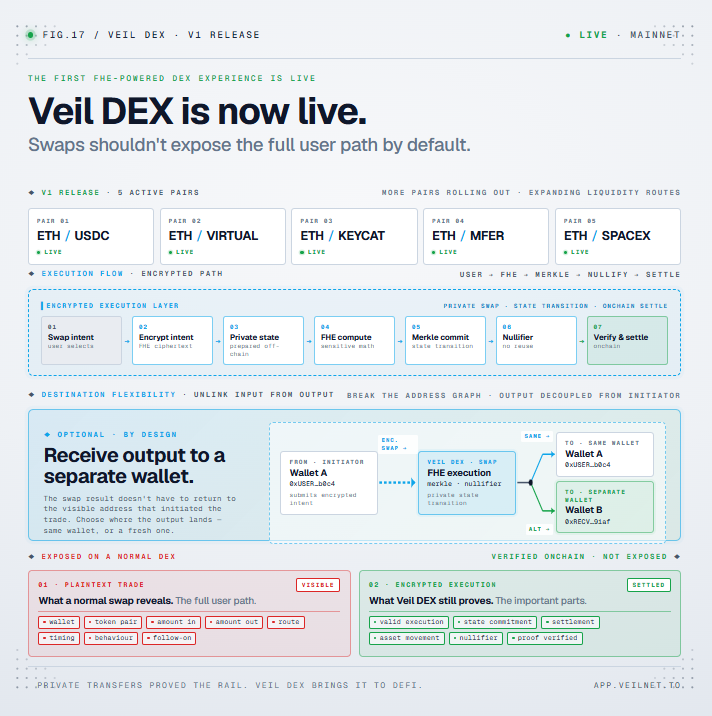
Veil DEX is now live. app.veilnet.to/veil-dex The first release is live with 5 active pairs: ETH / USDC ETH / VIRTUAL ETH / KEYCAT ETH / MFER ETH / SPACEX More pairs will be added over the next few days as we continue expanding liquidity routes and testing live execution across the Veilnet ecosystem. Veil DEX is built around one core idea: swaps should not expose the full user path by default. A normal DEX trade can reveal: wallet address token pair input amount output amount route timing trading behaviour follow-on wallet activity Veil DEX introduces a different execution flow. User selects swap → swap intent is encrypted → private swap state is prepared → off-chain FHE computation handles sensitive arithmetic → Merkle commitments record private state transitions → nullifiers prevent reuse → contracts verify and settle onchain The public chain still gets the important parts: valid execution state commitment settlement asset movement But the user does not have to expose the full plaintext swap path in the same way as a normal public trade. To increase privacy even further, users can choose where they receive the output tokens: back into their own wallet or into a separate destination wallet That means the swap result does not always need to return to the same visible address that initiated the interaction. Private transfers proved the rail. Veil DEX brings that rail into live DeFi execution. The first FHE-powered DEX experience is live. All under the $VEILNET umbrella.