Thomas Otter

23.6K posts

Thomas Otter banner
Thomas Otter

Thomas Otter

@vendorprisey

Venture Capitalist. GP Acadian Ventures. Phd KIT. DIPSI and DIPAI Oxford. ex-Gartner, SAP SuccessFactors #hrtech #worktech #earlystage

Germany Katılım Mart 2007
7.2K Takip Edilen8K Takipçiler
Marcelo P. Lima
Marcelo P. Lima@MarceloLima·
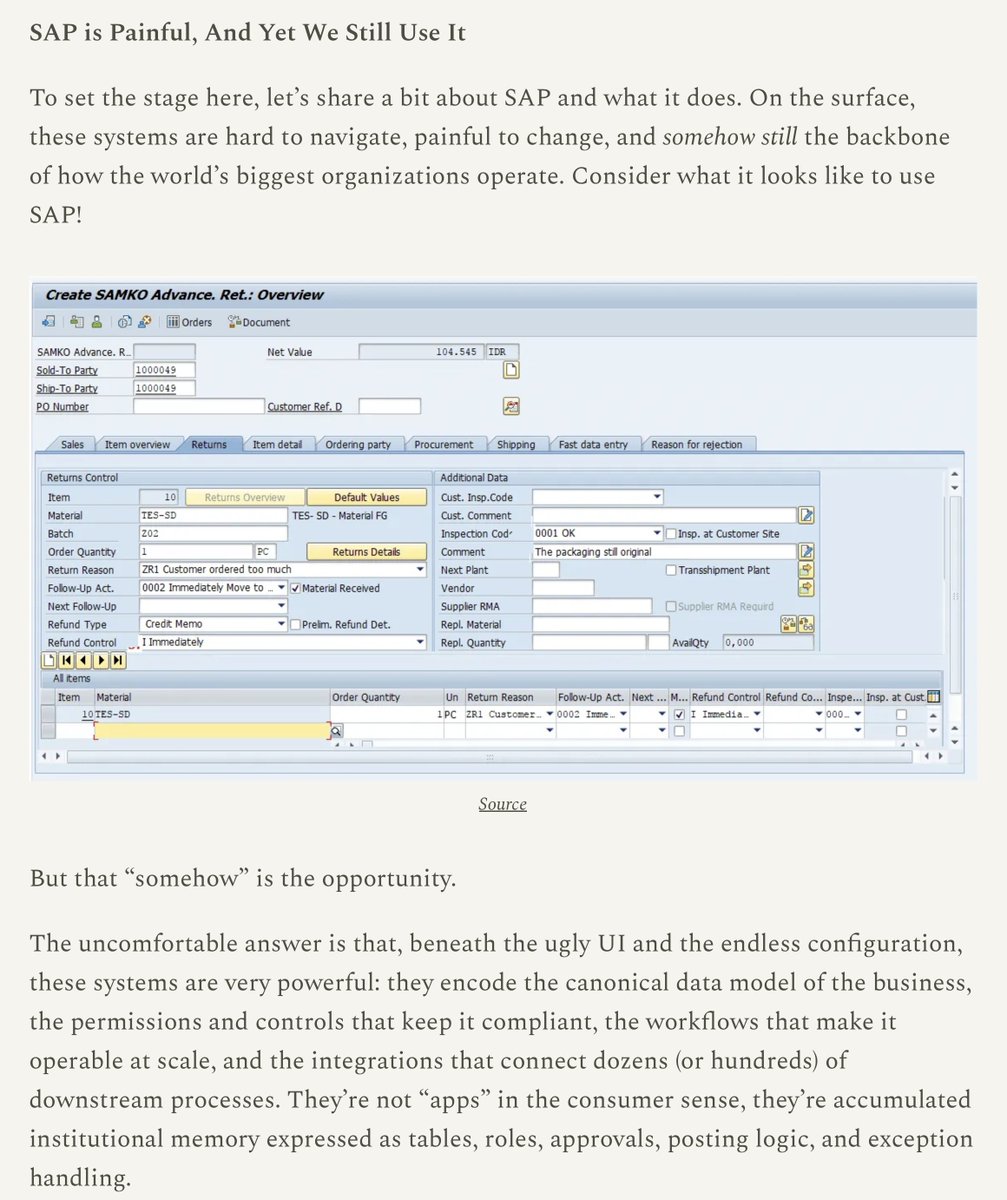
Good article by a16z on incumbents like SAP and how they'll thrive on the age of AI. Onus is on them and others to redesign these user interfaces now that the cost of creating software is much lower:
Marcelo P. Lima tweet media
English
5
10
90
12.7K
hari raghavan
hari raghavan@haridigresses·
This is the beginning of the end for @Workday. Charging for data use and egress is the sort of rent-seeking behavior that companies employ when they've run out of innovation DNA. Hey Workday — it's not *your* data, it's your *customers'* data, and they can do whatever they want with it. If you want to block the "parasites", maybe just build a better product instead of engaging in anti-competitive practices (hi @FTC!). If you think you command the same pricing power with @HiBob_HR and @Rippling nipping at your heels, you're in for a rude shock. And just wait until someone builds an open-source Workday (I would bet this is a thing in the next few years). PS: Rippling also exhibits similar (in fact, worse) closed-platform tendencies, and I think it's a big mistake. I hope they change this philosophy. Open ecosystems tend to win in the end.
hari raghavan tweet media
Garry Tan@garrytan

Recent earnings call, Aneel Bhusri of Workday says startups with AI agents are "parasites" This is what system of record incumbents really think of startups. The war is just beginning. The facts: the user data belongs to the users, not the incumbent software vendor.

English
29
13
207
98.8K
Tim Shipman
Tim Shipman@ShippersUnbound·
Very sad to learn of the death of Len Deighton, who was one of the two greatest spy thriller writers of all time and in some regards was Le Carre’s superior. Anyone who has not read Deighton should try Funeral in Berlin, Bomber or SSGB. Most of all they should seek out Berlin Game, the start of an epic 10 book Cold War series focused on Bernard Samson. Deighton’s writing was sharp, satirical, gripping and often amusing. His office infighting in the intelligence services was delicious and his characters are beautifully drawn. The Samson cycle starts with a meticulously plotted run of five books (Berlin Game, Mexico Set, London Match, Spy Hook and Spy Line) which all stand alone but tell one big story from the jaded but dedicated perspective Bernard a brilliant field operative. Len’s genius idea was to use the sixth, Spy Sinker, to retell the whole cycle from the perspective of everyone else, exposing what Bernard didn’t know and misunderstood. There is then an origin story about Bernard’s dad during the war, Winter, and then a concluding trilogy of Faith, Hope and Charity, which is not as high quality but deals with the fallout from the events of books 1-5. It’s an epic achievement and the greatest long series in spy fiction, accepting that the Smiley series is the greatest short series. Do yourself a favour, give it a try
Tim Shipman tweet media
English
254
752
3.9K
226.5K
Thomas Otter
Thomas Otter@vendorprisey·
@nrmehta MBTI is about as objectively useful as a zodiac. If you want to make a psychologist angry at one of your parties, ask them about validity and reliability of MBTI.
English
0
0
0
35
Nick Mehta
Nick Mehta@nrmehta·
A number of the most compelling founders/CEOs I've met invested time understanding themselves so they can do their best work. Indeed, I was talking to a founder recently who said the breakthrough in his business came when he figured out what parts of the job gave him energy versus took away energy. For the latter, he was involved but was able to hire complementary teammates. This gave him a renewed sense of drive. For me, the tool that helped me figure this our was Enneagram. And I was skeptical as hell at first. I got Enneagram-pilled at one of the first meetings for the CEO group I joined in 2009 (YPO). People kept using the term and it sounded straight out of a cult playbook. Enneagram? Do we have to enter the 7th level of the candy cane forest before we get the Enneagram? And when the facilitator explained the concept, I had an infinite number of annoying questions. "So you're telling me there is one number from 1-9 that defines me? And it doesn't change much over my life? And it came from childhood? Where is the double blind study? What's the p-value?" You can tell that I'm a riot at parties. The patient moderator politely listened to my "freshman-in-philosophy" questions and proceeded with the exercise. I got "typed" as a mix of 3 (Achiever) and 4 (Individualist). As kid who was raised to view success as one's source of value (3) and who had no friends but tons of curiosity growing up (4) it kinda' tracked. Over the years, the 30 minute exercise helped me a lot. I learned the the creative and strategic parts of the job (4) filled my bucket and I leaned into them. And I noticed when my (3) was causing me to care more about short-term comparisons for our company versus long-term success. We even used it as a leadership team. Like all companies, we had healthy friction between execs. Once folks learned more about what made each other tick, they were more understanding and collaborative. Enneagram is just one type of approach. MBTI and many others all have the same underlying theory. And heck - you can get to this level of self-knowledge without any framework too! I realize that for some founders and leaders, they don't need any of this introspective stuff. More power to them. I admire their ability to operate at 100% without any need for reflection or deep thought. They were, I guess, born to be entrepreneurial ubermensches. I'm surmising they had infinite energy for all activities and were good at everything. I'm only speculating of course as I can't see into their brains. The Problem of Other Minds, as they say. There I go introspecting again! 😂 I was never wired that way, so tools like these helped me.
English
4
0
15
2.8K
Thomas Otter
Thomas Otter@vendorprisey·
@anshublog The article damns with faint praise. I’ll need to fire up Substack.. indeed fractals.
English
0
0
0
15
Anshu Sharma 🌶
Anshu Sharma 🌶@anshublog·
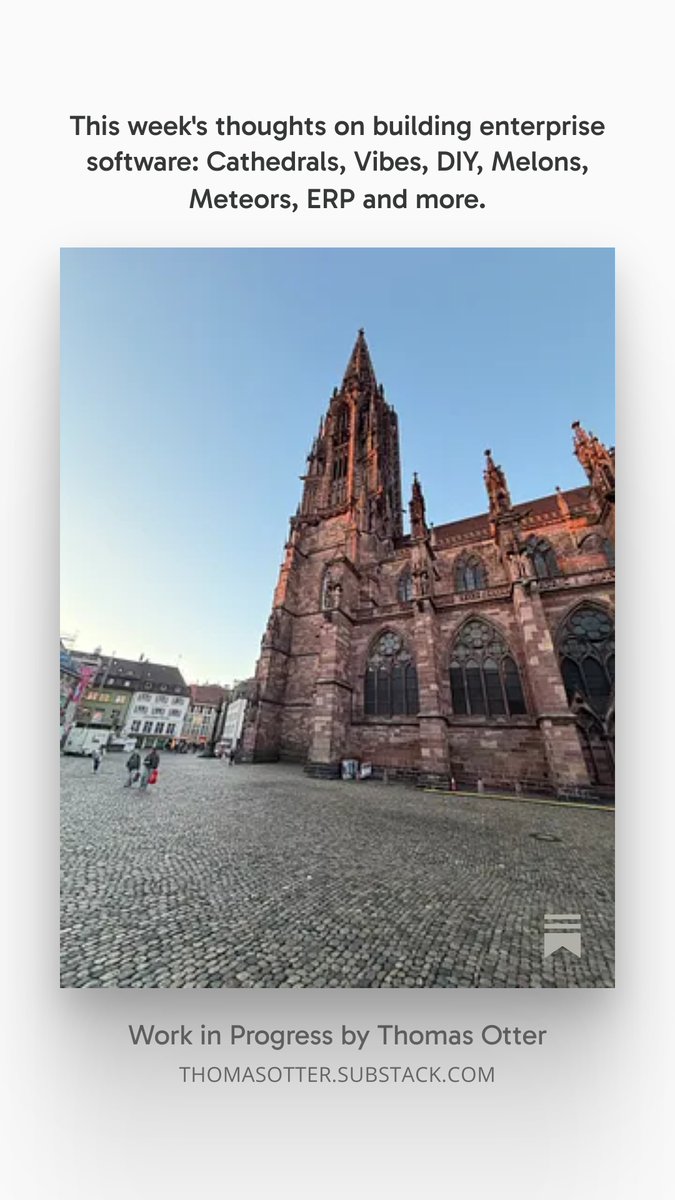
The best way to think of all enterprise systems is: fractals. not layers. not stack. not network. not graph. You can't replace a fractal. But there are millions of ways to grow a fractal, fractally.
English
1
0
0
144
Thomas Otter retweetledi
JazzBG 🇧🇬🇪🇺🇺🇦
Europeans watching the man who called NATO obsolete, then threatened a member’s territory, now ask for help for the war he already ‘won’
English
171
3.1K
18.5K
564.5K
Thomas Otter
Thomas Otter@vendorprisey·
@anshublog When people say that payroll is just a commodity, I respond, “so is gold.”
English
1
0
0
67
Anshu Sharma 🌶
Anshu Sharma 🌶@anshublog·
"Let's say the entire world - everything in our world - was automated, except for payroll SaaS. You had machines making self driving cars - you would basically have like a thousand such things a day." "How valuable would the HR payroll SaaS be?" "Each and every payroll SaaS seat would be like LeBron. Why? Because payroll would be the long pole in the tent to progress. You can't get those thousand buildings unless you have a plumber." "And by the way, you'd get so much efficiency everywhere else that you'd need millions of payroll SaaS seats." "SaaS [is going to] become more and more valuable because they will be the long pole in the tent to progress - and that progress is going to accelerate and get faster and more robust."

TBPN@tbpn

.@travisk says AI will make human labor even more valuable and in-demand than ever before: "Let's say the entire world - everything in our world - was automated, except for plumbers. You had machines making buildings - you would basically have like a thousand buildings a day." "How valuable would those plumbers be?" "Each and every plumber would be like LeBron. Why? Because plumbing would be the long pole in the tent to progress. You can't get those thousand buildings unless you have a plumber." "And by the way, you'd get so much efficiency everywhere else that you'd need millions of plumbers." "Humans [are going to] become more and more valuable because they will be the long pole in the tent to progress - and that progress is going to accelerate and get faster and more robust."

English
3
0
5
3.6K
Dave Kellogg
Dave Kellogg@Kellblog·
The problem with FDEs. Everyone wants to hire them. Nobody, it seems, wants to be one. The Hottest Job in Tech Isn’t Very Glamorous wsj.com/cio-journal/th…
English
2
3
13
2.1K
Thomas Otter retweetledi
Valerio Capraro
Valerio Capraro@ValerioCapraro·
Here's the longer version of our Nature piece. Our argument is simple: statistical approximation is not the same thing as intelligence. Strong benchmark scores often say very little about how LLMs behave under novelty, uncertainty, or shifting goals. Even more importantly, similar behaviors can arise from fundamentally different processes. In another paper, we identified seven epistemological fault lines between humans and LLMs. For example, LLMs have no internal representation of what is true. They often generate confident contradictions, especially in longer interactions, because they do not track what is actually true. Another example. Yes, LLMs have solved some open mathematical problems, but these cases typically involve applying known methods to well-defined problems. LLMs cannot invent anything that is truly new and true at the same time, because they lack the epistemic machinery to determine what is true. None of this means LLMs are useless. Quite the opposite: they are extraordinarily useful. But we should be careful about what they are and what they are not. Producing plausible text is not the same as understanding. Statistical prediction is not the same as intelligence. So despite the hype from the usual suspects, AGI has not been achieved. * paper in the first reply Joint with @Walter4C and @GaryMarcus
Valerio Capraro tweet media
English
85
187
774
136.6K
Thomas Otter
Thomas Otter@vendorprisey·
@nrmehta Precisely. Marketing is very rarely magic, and it is occasionally dismal. Almost all the time it is a reflection of the strategy. It might function 10% better than the strategy or 10% worse, but the strategy sets the boundary conditions for the CMO.
English
0
0
2
119
Nick Mehta
Nick Mehta@nrmehta·
Me in every Board Meeting at Gainsight: "Our biggest problem is pipeline!" Board (inner monologue): "Other than that, how was the play, Mrs. Lincoln?" I've spoken to so many founders (including conversations with myself) where we all get stuck in a very boring version of "Groundhog Day": * Miss sales target * Sales says pipeline is low * Put pressure on CMO - "I need more leads!" * Send more emails! * Spend more on paid channels! * Get a new agency for demand gen! * Find a new PR firm! * Look for a new CMO 😂 I've gone through that entire cycle way too many times... Sometimes, it is indeed an execution issue. Often it's a strategy one. I now try to ask myself these three questions: 1. Is our Ideal Customer Profile (ICP) granular? Or is it "everyone"? 2. Do we truly understand the size of the market that is ready to buy now? Or are we working off of fantasy TAMs? 3. Is our brand and message differentiated or are we just throwing dollars into the void? Pipeline is often a symptom - not the root cause.
English
17
8
165
39.8K
Thomas Otter retweetledi
Werner
Werner@Werries_·
It's been 20 years since the iconic 438 match I still get goosebumps
English
140
1.6K
11.7K
328.3K
Thomas Otter retweetledi
Dean W. Ball
Dean W. Ball@deanwball·
Some people wonder whether humanities degrees are “worth it” but I will tell you that I draw on my history degree and broader liberal arts education every single day
English
77
107
1.2K
114.2K
Thomas Otter retweetledi
Simons
Simons@Simon_Ingari·
Wife explaining her husband's job to her close friend. Wife: "He sells software to companies." Her friend: "Oh nice, like apps?" Wife: "No. Big software. For running whole businesses." Friend: "Oh, like Microsoft?" Wife: "No. A German company. SAP." Friend: "What's SAP?" Long pause. Wife: "Well.... It's… hard to explain. Basically he flies somewhere, finds whats broken in their business, spends 18 months with fixing it, and then everyone panics on this thing called go-live or something." Friend: "And they pay him for that?" Wife: "Sometimes they fire him first. Then they call him back." 35+ years in this industry. She nailed it in 90 seconds.
English
438
2.2K
51.5K
4.2M
Thomas Otter retweetledi
Tom Goodwin
Tom Goodwin@tomfgoodwin·
People talking about the SAAS apocalypse don't get this is how it actually happens. - Hi, we can vibecode your product in 2 months, so how about you cut your annual fees down from $500k to $200k for us. So we don't have to make it. - Maybe, but how about we do a license audit, where will sue you for $4m for breaking T&C's in 9 global offices. BTW, have you seen how much time we spent on support, and training, and we're embedded so deeply into every system, it will take you years to get rid of us. - OK, 500K it is, and see your at the F1, we loved your box last year. - It's going to be $600k this year. -OK, but we still get your box tickets? right?
English
84
35
984
225.3K
Thomas Otter retweetledi
BuccoCapital Bloke
BuccoCapital Bloke@buccocapital·
Unfortunately I think we'll see meaningful layoffs in software this year. And I want to explain why it's just air cover to call them "AI-driven layoffs", even though every company will do so. Yes, AI makes companies more efficient. Developers and marketers can do more. CSMs can have a wider span of control. You can answer 70% of your tier 1 support cases with AI. But that's not really what's going on. But two things are more elemental to the situation, and the actual driver: 1. Valuations have reset, with a totally valid and reasonable focus on free cash flow minus stock compensation. And the math simply doesn't math. 2. Many of these companies staffed up during COVID and never actually took their medicine and got fit. They thought demand would come back and it mostly hasn't. Not in the same way. Illustrative example, to pick on two companies, Atlassian and HubSpot, that I actually really admire: - Age: Atlassian is 24 years old. HubSpot is 19 years old - # of employees: Atlassian has 14k employees at $22B market cap. HubSpot has 9k employees at $15B market cap - SBC-Adjusted FCF: Basically ZERO That's right. After 20 years, the actual cash generated and available to shareholders is ZERO I do think the owners of these businesses understand that is no longer tenable. But they have two issues now: 1. The actual technical talent needs to get paid 2. Their stocks are down 60-70% from recent highs So here's the situation: They need to start making actual money, they have to pay their tech talent, their dollar grants are going to have serious dilution consequences, and their cost structures are completely bloated for their current market cap, especially compared to more nimble competitors. If they keep paying all of these people in stock, their dilution will continue and the stocks will continue to be punished. If they pay them all in cash, they will have no fcf. TL;DR Layoffs are unfortunately the only true answer. They are coming. They will be credited to AI, and that will be air cover for the real problem.
English
103
187
2.7K
512.5K
Thomas Otter retweetledi
derek guy
derek guy@dieworkwear·
lots of middle-aged men who think big pants make you look old bc that's what old people wore, so they switched to slim fit pants in the early 2000s, not realizing that slim fit pants makes you look old in 2026 bc they are now the out-of-touch old person in 20 yr old fashion
English
233
313
11.8K
617.6K
Thomas Otter retweetledi
Per Borgen
Per Borgen@perborgen·
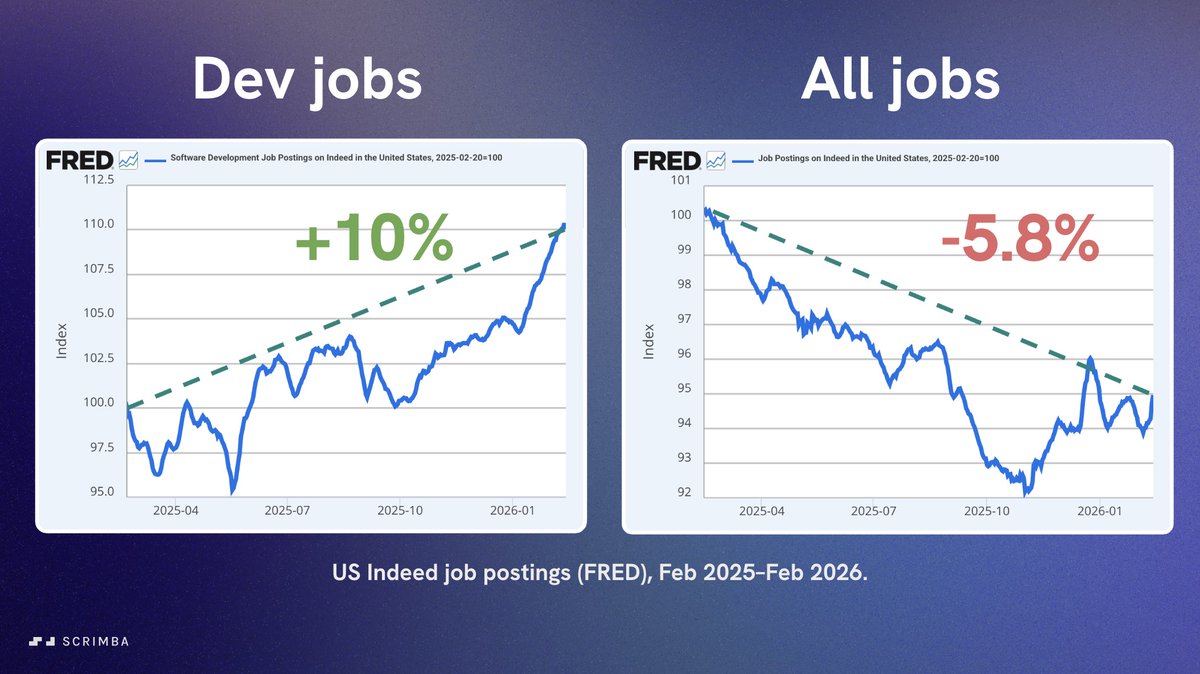
Software development jobs grew 10% over the last year while the overall market declined 5.8%. Quite the narrative violation.
Per Borgen tweet media
English
63
170
1.7K
513.8K
Thomas Otter retweetledi
Wodehouse Tweets
Wodehouse Tweets@inimitablepgw·
It was one of those cases where you approve the broad, general principle of an idea but can't help being in a bit of a twitter at the prospect of putting it into practical effect. I explained this to Jeeves, and he said much the same thing had bothered Hamlet.
English
3
113
740
39.1K
Thomas Otter retweetledi
Wodehouse Tweets
Wodehouse Tweets@inimitablepgw·
'Oh Jeeves,' I said; 'about that check suit.' 'Yes, sir?' 'Is it really a frost?' 'A trifle too bizarre, sir, in my opinion.' 'But lots of fellows have asked me who my tailor is.' 'Doubtless in order to avoid him, sir.'
English
13
104
1.4K
35.4K