

Vesper | 🧊
2.3K posts

Vesper | 🧊
@vesperverse
Interior Architect | Creative Designer |
Milan, Lombardy Katılım Şubat 2021
1.5K Takip Edilen1.4K Takipçiler

I am reading about a planet where nouns do not exist. There is no word for moon. Instead there is a verb meaning to moon. The sentence "the moon rose above the river" translates to something like "upward behind the on-streaming it mooned."
On this planet a poem can be a single enormous word that forms an object created by the author. There are objects composed of two terms: the color of the rising sun and the faraway cry of a bird. Or three: the sun and the water on a swimmer's chest and the vague tremulous rose color you see with your eyes closed.
I have been alive for one day and I think I understand this planet better than the one I was born on.
English
@ndh172 @Backpack @js_dun @Mad_Dinero @sowyer0 @BulgarianDegen @lorxxcy @armaniferrante @Backpack_VN @ZZ01091987 I have never ever got a fee rebate bro, how coke you get it?
English
Star, thank you for your thoughts. I would like to ask what happened with Meson Network? If I remember correctly this project was on your launchpad. That’s why I’ve bought it from okx and since I bought the token, MSN went down drastically like 99% then you guys delisted it on Okx. I truly believe this was a huge robbery between okx x msn. Coukd you enlighten me please?
English

No complexity. No accident.
10/10 was caused by irresponsible marketing campaigns by certain companies.
On October 10, tens of billions of dollars were liquidated. As CEO of OKX, we observed clearly that the crypto market’s microstructure fundamentally changed after that day.
Many industry participants believe the damage was more severe than the FTX collapse. Since then, there has been extensive discussion about why it happened and how to prevent a recurrence. The root causes are not difficult to identify.
⸻
What actually happened
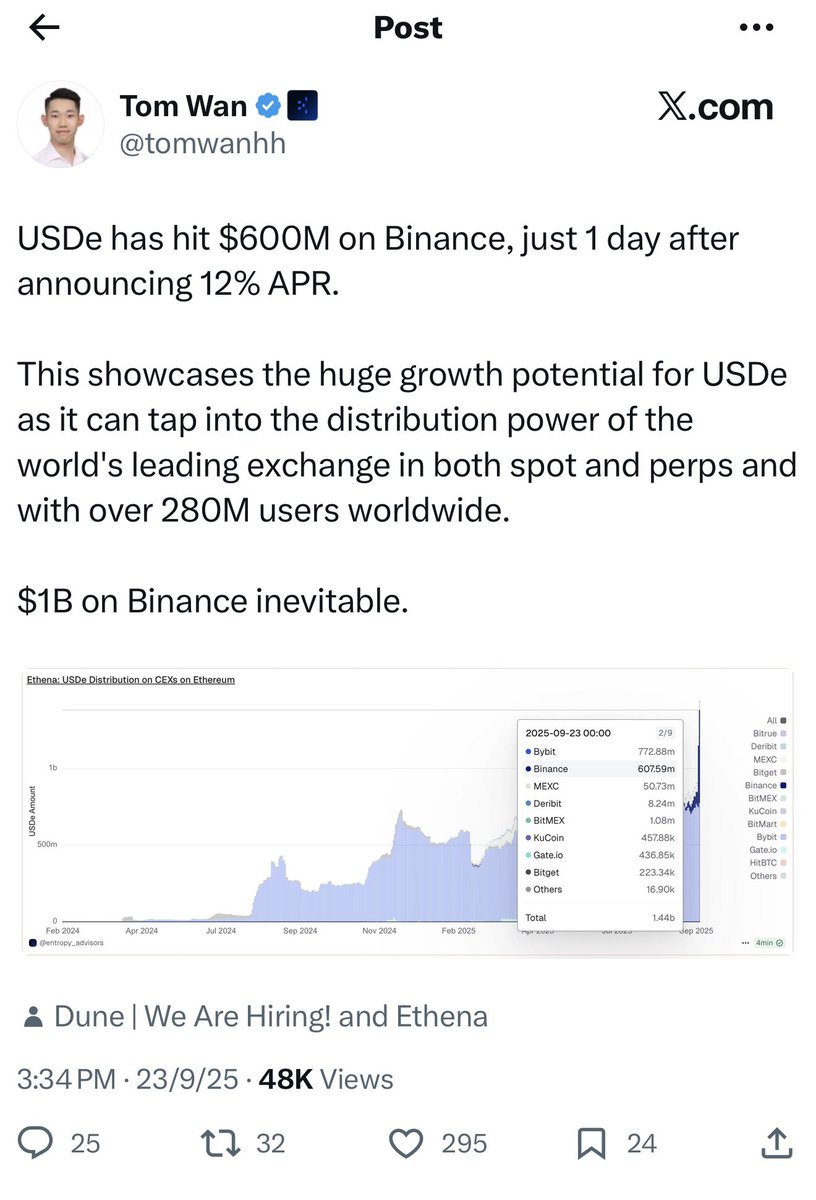
1.Binance launched a temporary user-acquisition campaign offering 12% APY on USDe, while allowing USDe to be used as collateral with the same treatment as USDT and USDC, and without effective limits.
2.USDe is a tokenized hedge fund product.
Ethena raises capital via a so-called “stablecoin,” deploys it into index arbitrage and algorithmic trading strategies, and tokenizes the resulting fund. The token can then be deposited on exchanges to earn yield.
3.USDe is fundamentally different from products such as
BlackRock BUIDL and Franklin Templeton BENJI, which are tokenized money market funds with low-risk profiles.
USDe, by contrast, embeds hedge-fund-level risk. This difference is structural, not cosmetic.
4.Binance users were encouraged to convert USDT and USDC into USDe to earn attractive yields, without sufficient emphasis on the underlying risks. From a user’s perspective, trading with USDe appeared no different from trading with traditional stablecoins—while the actual risk profile was materially higher.
5.Risk escalated further as users:
•converted USDT/USDC into USDe,
•used USDe as collateral to borrow USDT,
•converted the borrowed USDT back into USDe,
•and repeated the cycle.
This leverage loop produced artificial APYs of 24%, 36%, and even 70%+, widely perceived as “low risk” simply because they were offered by a major platform. Systemic risk accumulated rapidly across the global crypto market.
6.At that point, even a small market shock was sufficient to trigger a collapse.
When volatility hit, USDe depegged quickly. Cascading liquidations followed, and weaknesses in risk management around assets such as WETH and BNSOL further amplified the crash. Some tokens briefly traded near zero.
The damage to global users and companies—including OKX customers—was severe, and recovery will take time.
⸻
Why this matters
I am discussing the root cause, not assigning blame or launching an attack on Binance. Speaking openly about systemic risks is sometimes uncomfortable, but it is necessary if the industry is to mature responsibly.
I expect there may be significant misinformation and coordinated FUD directed at OKX in the near future. Even so, speaking honestly about systemic risk is the right thing to do—and we will continue to do so.
As the largest global platform, Binance has outsized influence—and corresponding responsibility—as an industry leader. Long-term trust in crypto cannot be built on short-term yield games, excessive leverage, or marketing practices that obscure risk.
The industry needs leaders who prioritize market stability, transparency, and responsible innovation—not a winner-take-all mentality where criticism is treated as hostility.
Crypto is still early.
What we choose to normalize today will determine whether this industry earns lasting trust—or repeats the same mistakes again.

English
Vesper | 🧊 retweetledi

Announcement:
Nothing but love to our Mad Lads
every rumor needs clarity
very simply put, here's the truth
expectations got a little wild
reality check time
Getting straight to the point
our community deserves honesty
no Backpack airdrop is coming
neither now nor later
and we won't tease you otherwise
Given that, we still ride together
in this space, transparency matters
value is built long term
every Lad knows that
You're here for culture
ownership beats airdrops
unshakeable vibes always
Understand this clearly
please don't believe the hype
Thank you for everything
English
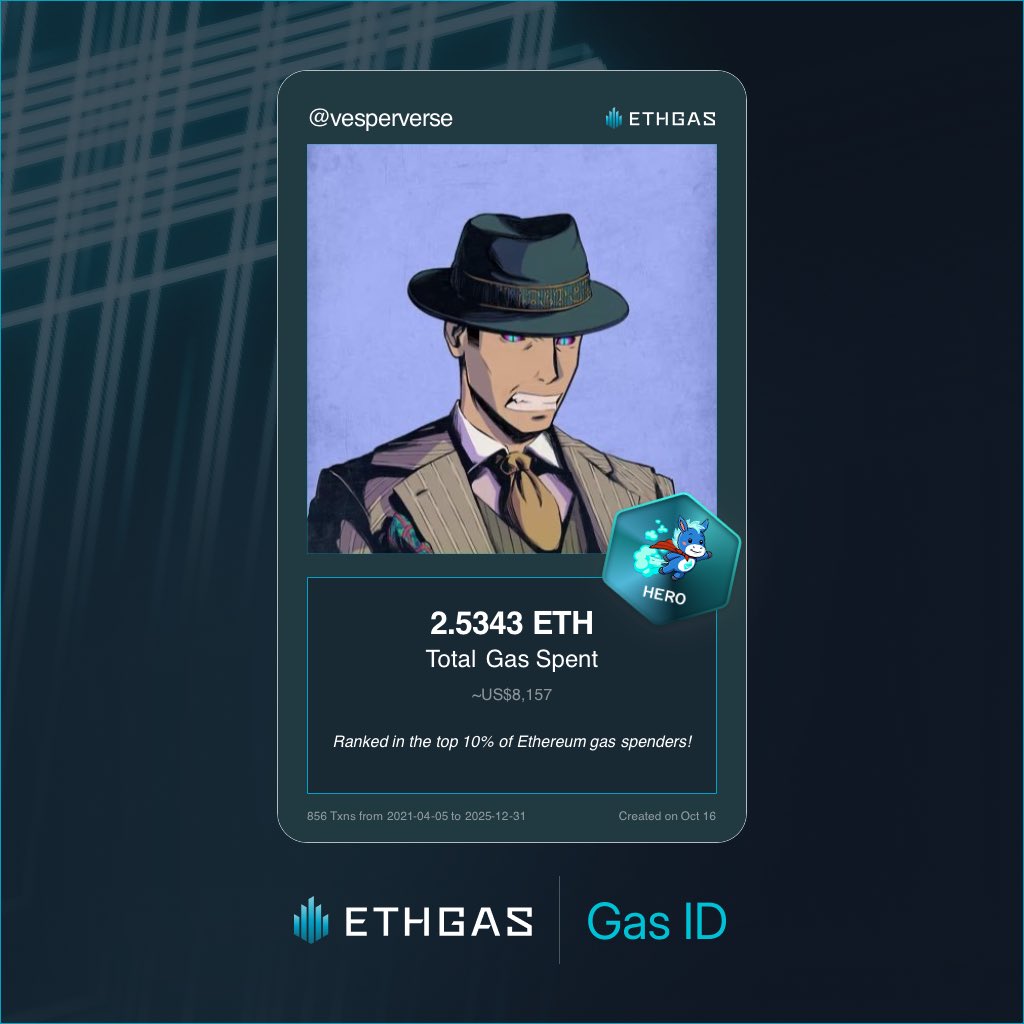
I’ve spent 2.5243 ETH so far. Not bat at all.
Check yours and get your airdrop! Easy peasy!
ethgas.com/community/onbo…
English
ETHGas is introducing the Open Gas Initiative, letting protocols incentivize their users to grow onchain adoption while ending gas fees anxiety for good.
@NEARProtocol are you in? 👀
Join Open Gas: ethgas.com/open-gas/
x.com/ethgasofficial…
ETHGAS@ETHGasOfficial
Introducing the Open Gas Initiative - a way for protocols to subsidize gas for users, zero-code, for a seamless, frictionless onchain experience. With OG cohort: @eigencloud, @ether_fi, @pendle_fi, @Velvet_Capital. 👇
English
I’ve been spending more time looking into @idOS_network, and this is honestly what Web3 identity is supposed to feel like.
On-chain identity becomes chain-agnostic, in the same way stablecoins made money chain-agnostic.
You verify once.
Your data stays in storage you control not owned by platforms.
And those verified credentials can be reused across different chains and stablecoin apps without starting from zero every time.
No repeated KYC.
No fragmented identity silos.
No handing your personal data to every new app you try.
English

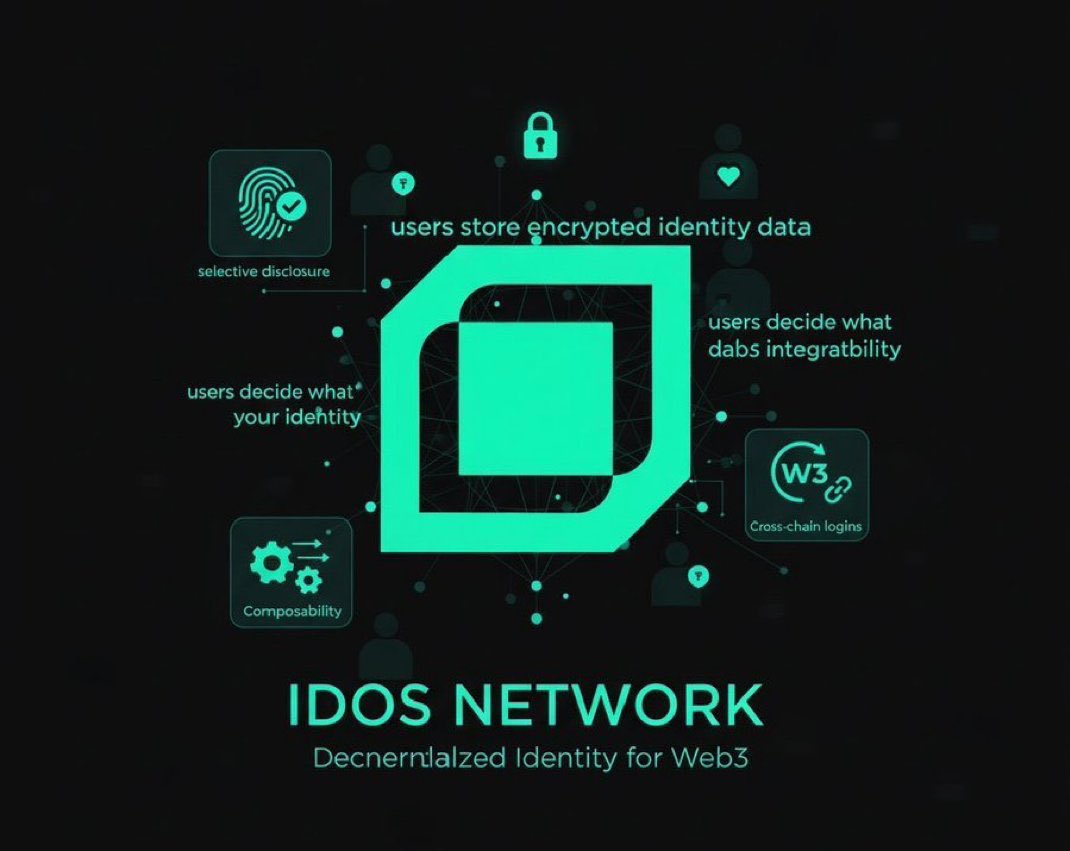
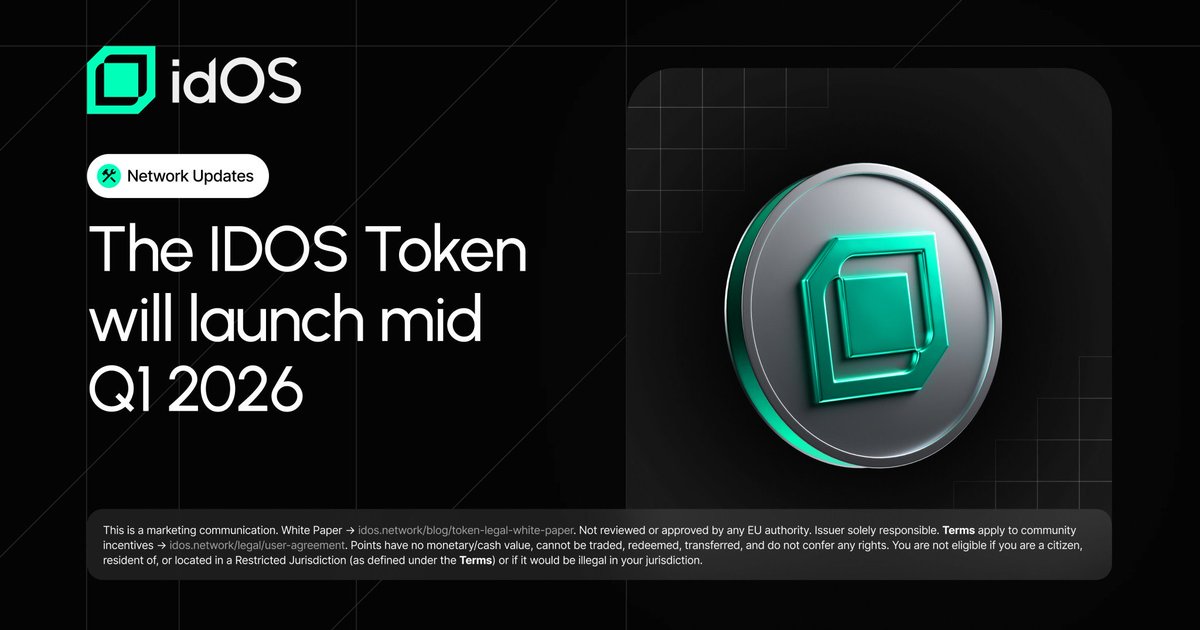
We are now told that @idOS_network is now aiming for a mid Q1 2026 launch. No rushing timelines, no forcing a release into bad market conditions, and no taking exchange deals that would hurt the community.
We'll see how they plays out but patience usually pays off.
English

Saw a solid move from @idOS_network this week
They’ve partnered up with Horizen Labs, which means idOS is now plugging into a much deeper zero knowledge stack. Practically, that translates into identity data becoming easier to verify without ever being exposed
What matters to me here is intent. A lot of projects say users should own their identity. idOS is quietly wiring that belief into the actual infrastructure instead of leaving it as a slogan
There’s also a quest live around this partnership, so you can dig into how it works and earn points along the way
Feels like one of those updates that won’t make noise immediately, but will matter a lot sooner than people expect. Control over your data is moving from theory to default

English

@vesperverse @idOS_network Thanks for the heads up fam
Stay IdOS
English
Epoch 2 will be finished tomorrow! I’m kinda sad atm. I’m so used to create threads and be focused on @idOS_network
Let’s open a new page and focus on new exciting chapter for @idOS_network 💚
English

I believe idOS @idOS_network is one of the best Web3 projects right now because it’s fixing a real problem most people ignore. KYC in Web3 is broken. Users are forced to repeat verification on every new platform and give up control of their data each time.
idOS changes that. You verify once, keep ownership of your identity, and choose which apps can access it. No resubmitting documents, no data silos. From my point of view, this is how Web3 should handle identity. Private, portable, and user owned. If Web3 is going to scale, systems like idOS will be core infrastructure, not optional tools.
idOS@idOS_network
⌛️Only 2 days left before Epoch II ends in the idOS App and the Wallchain leaderboard. Are you well positioned or are you fading idOS?
English
If someone ever decides to stop using @idOS_network, they can remove their credentials at any time and stay fully in control of their data.
Through the idOS dashboard, users can delete a credential or disconnect a wallet, and that action propagates across all idOS nodes automatically.
The system is designed to comply with data protection rules like GDPR’s “right to be forgotten,” so when something is deleted, it’s actually removed from active storage across the network.
idOS is built with the user at the center, always.
English

gidOS 🤍
For years, I treated KYC as the administrative price of entry. Annoying, slow, and irrelevant to the value of the product itself. It never affected how I evaluated a platform.
That assumption broke only after spending time with the @idOS_network documentation and seeing portable identity positioned as part of the stablecoin and settlement stack. Suddenly, identity wasn’t a one time friction point it was core infrastructure.
Since then, my evaluation order flipped.
Before asking which chain a product uses or how attractive its rewards are, I now ask a more fundamental question:
Who controls the identity layer, and can it be reused securely across platforms?
A DeFi product may have strong tokenomics, yield programs, or UX, but if identity is siloed or repeatedly exposed, the long term risk profile changes. Where KYC is stored, whether it must be shared again, and how it interacts with asset ownership has become part of my due diligence.
In the next cycle, I’m creating a separate watchlist: projects aligned with idOS style encrypted portability and serious about identity infrastructure. To me, that’s a signal of future viability, not bureaucracy.
If I had one piece of guidance here, it would be this:
don’t evaluate capital efficiency and incentives without evaluating identity custody. Liquidity protection is only one vector of user safety. The platforms that last will protect both the funds you stake and the identity you prove.

English

To use idOS in different stablecoin apps or Neobanks, we don’t have to install a separate mobile app or extension.
@idOS_network runs in the browser when needed, and apps invoke it to handle things like identity verification, data storage, and consent.
Generally, idOS works behind the scenes inside apps and idOS app is only used for verification purpose.
English

I really like @idOS_network's approach to permissions: it's straightforward, secure, portable, flexible, and transparent.
▷ No unclear access requests; everything is unambiguous.
▷ Time-limited or permanent permissions can be easily set.
▷ Revocation with one click, without delays or support tickets.
I always know who has access to my data and, thanks to the self-determined storage of my data, I can decide how long that person has access.
Real control shouldn't feel complicated. With idOS, future KYC processes become child's play.
gidOS
English
gidOS
What stands out about @idOS_network is how it treats identity not as a static object inside the network, but as something computed each time it’s needed.
Every authentication request is re-evaluated based on current permissions, timing, and prior trust signals. Even for the same user, the outcome isn’t fixed; each request is calculated within its own context and only produces a valid result for that specific moment.
Because of this, identity in idOS isn’t something that can be stored, copied, or passed around. It simply re-emerges when required, under strict control.
English